Daily editionTuesday 3 November 2026thursdaytimes.com
Economy

Pakistan out-exports Vietnam on rice in September, 420,000 tonnes to 337,000, despite Gulf war shipping disruption

First-quarter rice export volumes are up 51 per cent and earnings 37 per cent, an industry expert says, as Pakistan pushes for third place in the world rice trade.

A rice field in Chunian, Punjab. File photo. — KAMRAN SARDAR/WIKIMEDIA COMMONS (CC BY 3.0)
TT Business Desk

LAHORE (The Thursday Times) — Pakistan shipped more rice than Vietnam in September, 420,000 tonnes against 337,000 tonnes, according to figures from Vietnam’s foreign trade agency, as exporters held up through the shipping disruption caused by the war in the Gulf.

Pakistan also earned more per tonne, an average of $621 compared with Vietnam’s $563, helped by its mix of premium Basmati and other varieties. Vietnam is traditionally the world’s third-largest rice exporter, a position Pakistan has been pushing to take.

Hamid Malik, a rice industry expert, said the shift began in December 2025, when Pakistan passed Vietnam’s monthly export volume for the first time this millennium. Pakistan’s total rice export volumes rose 51 per cent in the first quarter of the financial year, from July to September, and earnings rose 37 per cent, he said.

He credited large carry-over stocks and an 18 to 20 per cent increase in the area planted with rice, along with readily available urea and easier farm credit.

The gains came despite higher freight rates, marine insurance premiums and delayed payments since the war began. Exports of ordinary non-aromatic rice from Thailand, Vietnam and Pakistan fell by 20 to 30 per cent in the early part of the crisis, but world trade in Basmati, the premium grain of Pakistan and India, held at 6.9 million tonnes, level with 2025.

Pakistani exporters receive no minimum support price for paddy and no state-funded marine insurance or freight subsidies, and private millers buy at market rates.

International

Karl Bushby walks home to Hull after 28 years and 50,000km around the world: ‘Is that it, is it done?’

He left Chile in 1998 with a tent and a few hundred dollars, crossed the frozen Bering Strait and swam the Caspian and the English Channel

Karl Bushby at his homecoming in Hull on November 2, 2026. — HULLIAN111/WIKIMEDIA COMMONS (CC BY-SA 4.0)
TT Foreign Desk

HULL (The Thursday Times) — British adventurer Karl Bushby walked up to his mother’s front door in Hull on Monday, 28 years after he set off from the southern tip of Chile to walk home the long way round.

The 57-year-old covered about 50,000km without using motorised transport to advance his route, and was embraced by his mother, Angela, outside her terraced house under a banner reading “Welcome Home Son”. Hundreds of supporters had cheered him through the city centre.

“Sorry to keep you waiting,” he told the crowd. “Is that it, is it done?”

Bushby left Punta Arenas in November 1998 with a tent, a few hundred dollars and a cheap plastic camera, expecting what he called the Goliath Expedition to take 12 years.

It took more than twice that. He crossed the Darien Gap jungle between Colombia and Panama, walked over the frozen Bering Strait from Alaska to Russia, was detained after entering Russia, and went on through Mongolia and China. He swam the Caspian Sea, and last month swam the English Channel to clear the last major obstacle. Visa problems and the loss of major sponsors in the 2008 financial crisis added years.

“They say it takes a village, but literally it took a world to get me here,” he said. “The kindness of strangers, so many, from individuals to nation-states, to get me back here today. I didn’t do this alone. There was a big team. The biggest team. Earth.”

A feature-length documentary on the journey is in production, and Bushby plans a speaking tour of England in the coming weeks.

International

Russian bombs kill at least 26 people at Ukrainian school used for aid, as fighting resumes after the war’s longest truce

Smoke and dust over damaged buildings in Komyshuvakha, in a frame from video released after the attack. — UKRAINE’S STATE EMERGENCY SERVICE/HANDOUT
TT Foreign Desk

KYIV (The Thursday Times) — At least 26 people were killed after Russian aerial bombs hit a school used to hand out humanitarian aid in the Ukrainian village of Komyshuvakha on Monday, Ukrainian officials said, as fighting resumed elsewhere after the longest truce of the war.

President Volodymyr Zelensky gave the toll of 26 in a video address late on Monday, up from an earlier 18 and then 24. Ukraine’s emergency service said rescuers and police officers were among the dead, and a day of mourning has been declared across the Zaporizhzhia region for Tuesday. Five people were injured and people were still under the rubble, said Mykhailo Semikin, the regional head in Zaporizhzhia. He said at least nine 3,000kg bombs hit the village, and that rescuers had to stop several times because of Russian drones.

Zelensky called the attack “utterly horrific”. He said that after the first strike on the school, a second wave of nine bombs targeted the shelter where people had taken cover. “The Russians could not have been unaware that every week, local residents who had remained in Komyshuvakha received humanitarian aid at that very location,” he wrote.

“After the humanitarian operation in Oleshky, there was a moment when the next steps could have shown that progress toward peace was possible. With these killings, Russia is sending an entirely opposite signal: Russia is counting on more killings,” he said, calling for a “strong and tough response” from the world.

The truce that ended on Monday

The bombing came as a six-day ceasefire in the Kherson region ended. The truce around the Russian-occupied town of Oleshky, which both sides credited to mediation by US First Lady Melania Trump, was the longest since Russia’s full-scale invasion began in 2022 and let hundreds of trapped civilians leave.

Local authorities in Kherson said on Monday morning that strikes had resumed, with Russia hitting a medical facility in the city centre and a drone injuring two people in a car. Ukraine’s General Staff accused Russian forces of using the pause to rotate units and bring in ammunition. Kremlin spokesman Dmitry Peskov said it was “reasonable to assume” that Ukraine had also used it to regroup.

Both countries’ human rights ombudsmen, who oversaw the truce together, called for it to be repeated elsewhere. Peskov ruled that out on Monday. “There are no similar plans or initiatives,” he said.

The attack followed a fake radiation alert that hit Kyiv when Ukraine’s air raid app was hacked.

Economy

Sindh’s foreign debt jumps 49% in two years to $5.6 billion, the fastest of any province, finance ministry document shows

The Clifton skyline in Karachi, Sindh’s capital. File photo. — KTOWNBOY103/WIKIMEDIA COMMONS (CC0)
TT Business Desk

ISLAMABAD (The Thursday Times) — Sindh’s foreign debt rose by $1.84 billion, or nearly 49 per cent, in the two years to June 2026, the fastest increase of any province, according to a Ministry of Finance document.

The province’s outstanding foreign loans climbed from $3.78 billion in June 2024 to $5.62 billion. That accounted for about 65 per cent of the $2.82 billion added across all provincial and regional governments, whose combined foreign debt reached $15.63 billion.

Punjab still owes the most, but its debt grew far more slowly, rising about 6 per cent to $6.40 billion. The gap between the two provinces has narrowed to less than $800 million, and Sindh now holds about 36 per cent of all provincial foreign debt, up from about 30 per cent two years ago.

Khyber Pakhtunkhwa’s foreign debt rose 25 per cent to $2.97 billion. Balochistan’s went up by $33 million to $390 million, and Gilgit-Baltistan’s by $7 million to $69 million. Azad Jammu and Kashmir was the only region to cut its foreign debt, which fell by $29 million to $180 million.

Science

NASA images show a grinning ‘skull’ in the ice on Antarctica’s Vega Island, and melting could change its face

TT News Desk

WASHINGTON (The Thursday Times) — NASA has released satellite images of an Antarctic island whose ice and rock form what looks like a grinning skull in profile, and a glaciologist says an unusually warm winter has left it exposed to melting.

The “skull” is on Vega Island, in the Weddell Sea off the eastern Antarctic Peninsula, gazing towards the nearby Devil Island. A nunatak, a rocky peak jutting out of the ice, forms the eye socket. A lateral moraine, a ridge of debris left along a glacier, forms the mouth, and Bahía del Diablo, or Devil’s Bay, Glacier makes the jawbone.

NASA’s Landsat 9 satellite photographed the island on March 22, 2025, and again on October 10, 2026. In the first image a layer of snow coats the ice, typical of the region’s wettest month. In the second, snow is absent from large areas and darker ice shows through.

Above-average temperatures in winter 2026, particularly in June, were partly responsible, said glaciologist Mauri Pelto of Nichols College. The exposed ice points to limited new snow over the winter, further reduced by sublimation and wind, he said. “The winter season was no treat for these glaciers.”

Bare ice is darker than snow and absorbs more of the sun’s energy, so melting is poised to speed up as the days grow longer and warmer. “Even a thin cover of new snow from a spring storm would be helpful in the short run,” Pelto said. “When entombed in snow and ice, the skull is preserved. But when exposed to melt, it weathers away, which will lead to a changing jawline and expanding eye socket.”

Scientists have tracked the island’s ice for decades. A 1982 study using early Landsat images catalogued 29 glaciers on Vega, and researchers have measured an overall decline in the mass of Devil’s Bay Glacier since the summer of 1998-1999. Recent satellite images show ice loss from other glaciers on the island too.

The island also has a place in the history of Antarctic exploration. In spring 1903, two stranded groups from the Swedish Antarctic Expedition, whose ship had been lost to the pack ice, were reunited at a spot off the skull’s “forehead” that became known as Cape Well-met. An Argentine expedition rescued the survivors soon afterwards.

Culture

Witches’ hats, superheroes and flashcards: Islamabad children learn English at a Halloween party

Mahwish Fakhar

ISLAMABAD (The Thursday Times) — Witches’ hats, masks and English flashcards took over a language school in Islamabad for Halloween, as children arrived at the Berlitz Language Institute dressed as their favourite cartoon characters and superheroes.

The little guests spent the event on games and stories, and went trick-or-treating around the institute, which had been hung with bat, ghost and pumpkin decorations and orange and black balloons. “I am the Batman,” one small boy declared, and a girl said she had come as Hermione, with her little brother as Harry Potter. Adults joined in too, in witch’s hats and masks of their own.

There was a lesson tucked inside the fun. Between the games and the costumes, the children picked up new English words and phrases and got a glimpse of other cultures and traditions, including through word cards laid out on the tables.

International

US midterms: Judge throws out Justice Department bid to block Alaska’s Senate result, in the race with two Dan Sullivans on the ballot

TT Foreign Desk

ANCHORAGE (The Thursday Times) — A federal judge has thrown out a Justice Department lawsuit that sought to stop Alaska certifying its Senate result if Republican Senator Dan Sullivan loses on Tuesday, in a race with a second Dan Sullivan on the ballot.

Judge Sharon Gleason ruled on Sunday that what the government asked for was “infeasible”, because many voters had already cast their ballots and those ballots had been mixed together. She wrote that the United States offered “no workable plan” for setting aside votes for the other Sullivan and investigating them while keeping the ballot secret. More than 86,700 Alaskans had voted early, the state’s Division of Elections said.

The Justice Department filed a notice of appeal shortly afterwards, which takes the case to the 9th Circuit Court of Appeals. “Alaskan voters deserve a fair election, not to be misled in an attempt to rig outcomes,” a spokesperson said. The department described the dismissal as procedural.

The contest is one of a handful expected to decide which party controls the Senate.

Who the two Dan Sullivans are

Dan S. Sullivan, a Trump ally first elected in 2014, is seeking a third term against Mary Peltola, the Democrat and former congresswoman who was the first Alaska Native elected to the US House. Daniel J. Sullivan Jr. is a retired elementary school teacher and former Forest Service employee from Petersburg, in southeastern Alaska.

Election officials first removed the retired teacher from the ballot, but the Alaska Supreme Court ruled in June that he could run. The ballot lists the senator as a registered Republican and the incumbent, and the other man as Daniel J. Sullivan Jr. with no party shown, even though he has registered as a Republican. He has denied trying to confuse voters.

In the August primary Peltola took 49.54 percent and the senator 41.40 percent. Daniel J. Sullivan Jr. took about 2.5 percent, enough to reach the top four and qualify for Tuesday’s vote.

That small share is why the case matters. Alaska uses ranked-choice voting: if nobody wins a majority of first-place votes, the last-placed candidate drops out and those votes pass to each voter’s next choice. The lawsuit, filed on October 22, wanted certification blocked if the senator lost by fewer votes than his namesake received.

A criminal probe and a governor’s warning

The ruling does not end the fight. Reports last week said aides to Peltola had been involved in recruiting the second Sullivan, and the Justice Department then accused her campaign and Senate Democrats of misleading the court. Michael Heyman, the US attorney in Alaska, said on October 30 that a criminal investigation was under way.

Peltola has denied any involvement. “I am not interested in tricking voters,” she said at a recent campaign event, and her campaign called the case a “sham investigation” and a “baseless lawsuit”. Daniel J. Sullivan Jr. has called the lawsuit a “gross misuse of the Justice Department” and said he had no contact with her campaign about running. He has not answered messages in recent days.

Alaska’s Republican governor, Mike Dunleavy, has ordered his own investigation and suggested the result may not be certified. “If we find out there’s wrongdoing, and if that means that the certification then is stopped or changed, then that’s what happens,” he said on October 30.

President Donald Trump, who says he ordered the suit, posted on Sunday that the “Fake” Sullivan had “DISAPPEARED”. Senator Sullivan said the same day that he would accept the result, win or lose, while accusing Peltola of lying about what she knew.

Not every Republican backed the case. The state’s own lawyers asked the judge to dismiss it as “meritless”, and Senator Lisa Murkowski said the department “should never have filed this lawsuit”.

Economy

Pakistan considers tokenising its Eurobond debt and will seek cabinet approval, Aurangzeb says

TT Business Desk

ISLAMABAD (The Thursday Times) — Pakistan is considering tokenising its existing Eurobond debt and will seek cabinet approval before issuing a request for proposals, Finance Minister Muhammad Aurangzeb said on Monday.

Aurangzeb disclosed the plan at a dialogue on digital assets and the future of banking, organised by the Pakistan Banks’ Association with the Lahore University of Management Sciences. He said talks on the idea were under way.

Tokenisation generally means recording ownership of an asset on a digital ledger. The aim is to explore its use in managing sovereign debt, which could open new avenues for digital transactions and investment.

The minister urged banks to develop practical proposals of their own and to build the expertise to assess these technologies, working with regulators within their mandates. Pakistan now has a legal framework for the sector under the Virtual Assets Act 2026, with the Pakistan Virtual Assets Regulatory Authority licensing service providers. The State Bank has given banks a conditional route to serve licensed businesses, but they still cannot invest in, trade or hold virtual assets using their own funds or customer deposits.

Aurangzeb said innovation had to come with safeguards, oversight and cybersecurity. “We are under attack 24/7 by state and non-state actors,” he said, adding that there was no room for complacency.

The Thursday Times
Tuesday 3 November 2026 · 2
National

Pakistan’s National Incubation Centers win Commonwealth digital policy award in London

Ignite’s startup programme takes the top prize in its category, and Pakistan also wins silver and bronze honours at the Commonwealth Telecommunications Organisation awards.

A contract signing ceremony at the National Incubation Center Islamabad. File photo. — IGNITE/HANDOUT
TT Islamabad Bureau

ISLAMABAD (The Thursday Times) — Pakistan’s National Incubation Centers programme won the Digital Policy and Regulatory Excellence award at the Commonwealth Telecommunications Organisation’s Digital Excellence Awards 2026 in London last month.

The programme is run by Ignite, the National Technology Fund, and gives startups incubation, mentoring, business support and access to investors through a nationwide network of centres. The awards were presented during the organisation’s 125th anniversary celebrations.

Pakistan received two other honours. A project on transforming government relief delivery through digital systems took the silver medal in the e-government category, and an integrated spectrum governance reform was a bronze-medal finalist in the same category as the incubation centres.

The Ministry of Information Technology and Telecommunication, led by Shaza Fatima Khawaja, oversees Ignite.

National

Gilgit-Baltistan marks 79th Independence Day with flag hoisting and 21-gun salute, honouring the 1947 uprising against Dogra rule

Gilgit Scouts personnel at a flag-raising after the uprising against Dogra rule in Gilgit in 1947. Public domain/Wikimedia Commons
TT Islamabad Bureau

GILGIT (The Thursday Times) — Gilgit-Baltistan marked its 79th Independence Day across all 10 of its districts on Sunday with flag hoisting, a 21-gun salute and tributes to the local fighters who ended Dogra rule in the region on November 1, 1947.

The main ceremony was held at Chinar Bagh in Gilgit, where Governor Syed Mehdi Shah and Chief Minister Haji Amjad Hussain raised the national flag. Contingents of police and security forces presented a salute, and the two leaders and the Force Commander Northern Areas laid wreaths at the Martyrs’ Memorial. The day began with special prayers in mosques.

Governor Shah said the courage and sacrifices of the region’s forefathers had allowed its people to live in freedom. The day called on them to pledge loyalty to the homeland and play an active part in its development, he said, adding that freedom was a blessing all had a duty to safeguard. He also praised the armed forces, saying they had shot down more than seven Indian aircraft in the recent confrontation with India.

Chief Minister Hussain said the people of Gilgit-Baltistan had overthrown the Dogra regime despite limited resources and then taken the historic decision to accede to Pakistan.

Similar ceremonies, silent walks and sports events were held in Skardu, Diamer, Ghizer, Hunza, Nagar, Ghanche, Astore and Shigar. Tributes also came from elsewhere in Pakistan, including from the PTI and from PPP leader Syed Nasir Hussain Shah, who praised the heroes’ sacrifices and the region’s culture and beauty, while the occasion also brought renewed calls for the region’s greater constitutional integration.

What happened in 1947

After partition, the region was part of the princely state of Jammu and Kashmir. On November 1, 1947, the Gilgit Scouts and local forces, with Subedar Major Babar Khan among their leaders, moved against the Maharaja’s governor, Brigadier Ghansara Singh, who surrendered. The Scouts’ British commander, Major William Brown, also played a leading part.

A provisional government declared an independent Islamic Republic of Gilgit that day. Its leaders then opted for Pakistan, and on November 16 the Pakistani government’s representative, Sardar Mohammad Alam Khan, arrived in Gilgit and took charge as political agent.

Military

Field Marshal Munir and China’s Liu Haixing vow to strengthen ‘all-weather’ partnership at GHQ talks on regional security

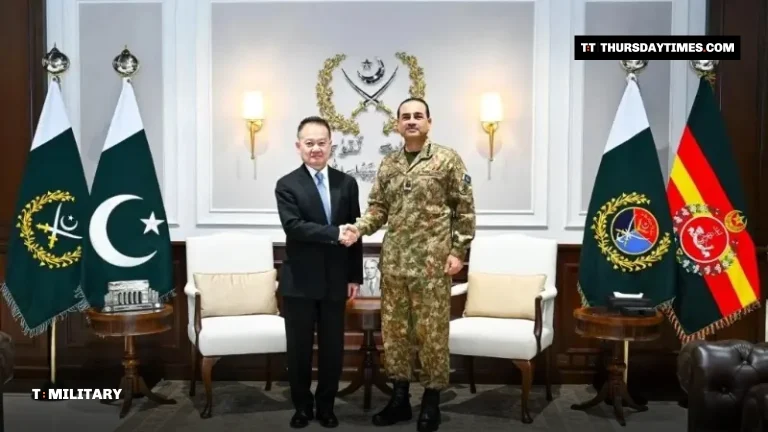
Liu Haixing, minister of the International Department of the Communist Party of China’s Central Committee, and Field Marshal Asim Munir at General Headquarters in Rawalpindi on Monday. ISPR/Handout
TT Defence Desk

RAWALPINDI (The Thursday Times) — Chief of Defence Forces Field Marshal Asim Munir and senior Chinese Communist Party official Liu Haixing on Monday expressed a shared resolve to further strengthen the “all-weather strategic cooperative partnership” between Pakistan and China, the military’s media wing said.

Liu, who heads the International Department of the party’s Central Committee, called on Munir at General Headquarters, where the two discussed “evolving regional and international security dynamics and bilateral relations”, Inter-Services Public Relations said.

Munir highlighted the “historic and time-tested bond” between the two countries and stressed the importance of sustained high-level engagement, stronger institutional links and wider cooperation, the statement said. Liu appreciated Pakistan’s contributions to regional peace and stability and expressed confidence in advancing the partnership.

Liu also met Deputy Prime Minister and Foreign Minister Ishaq Dar in Islamabad, conveying greetings from Foreign Minister Wang Yi. Dar sent warm greetings to President Xi Jinping on behalf of Pakistan’s leadership and reaffirmed Islamabad’s commitment to the partnership, the Foreign Office said. The two discussed cultural ties and people-to-people exchanges, and agreed to keep up close coordination.

National

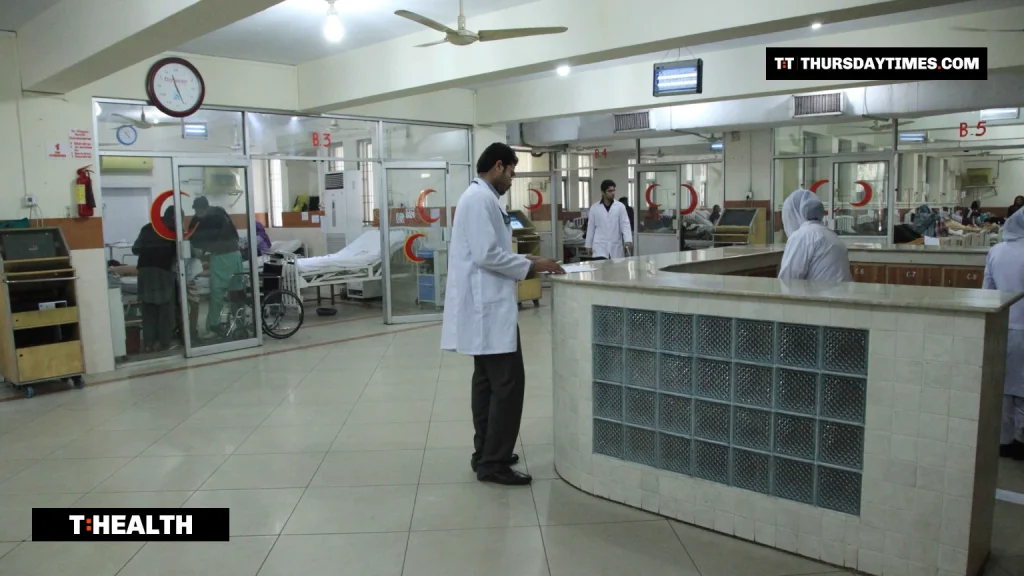
Doctors shut OPDs and private clinics across Pakistan in two-day strike over FBR raids and police cases

The surgery department at Services Hospital in Lahore. File photo. Baitaal/Wikimedia Commons, CC BY-SA 3.0
TT Karachi Bureau

KARACHI (The Thursday Times) — Doctors suspended outpatient services at public and private hospitals and shut private clinics across Pakistan on Monday, the Pakistan Medical Association said, in a two-day strike against tax raids on clinics and criminal cases filed against doctors.

Emergency departments stayed open. The association said the action followed directions from its central leadership and a resolution adopted by doctors on October 29, and urged hospitals and professional bodies to support the shutdown, which medical leaders had called for November 1 and 2.

The dispute centres on the Federal Board of Revenue’s drive to make private clinics install point of sale systems, and on what doctors call a growing number of police cases against them after patients die or suffer complications.

“A doctor’s clinic is a place of healing, not a supermarket checkout counter,” PMA Centre President Dr Izhar Ahmed Chaudhary said at a news conference in Karachi last week, attended by the Young Doctors’ Association, the Private Hospital and Clinics Association of Pakistan and the Society of Obstetricians and Gynaecologists of Pakistan. He said raids on medical facilities treated doctors like tax evaders and created an environment of intimidation.

PMA Centre Secretary General Dr Abdul Ghafoor Shoro said tragic outcomes that often stemmed from a lack of basic medicines, delayed hospital arrivals or severe shortages were being met with police cases under Sections 302 and 322 of the Pakistan Penal Code. “Every death weighs heavily on a doctor’s conscience,” he said. He also argued that every added administrative burden on a clinic pushes up the cost of treatment for patients.

What the doctors want

The medical bodies are demanding an immediate halt to the raids and to direct police cases against doctors. They want no legal action to proceed without prior evaluation by a certified, independent medical board, a Healthcare Professionals Protection Act from parliament, and institutional, legal and physical security at medical facilities.

The association held a one-day strike over the same point of sale policy on September 30. Its leaders said the next steps, which could include a nationwide protest movement, would be decided at a PMA Central Council meeting on November 28.

National

Supreme Court judgments are not binding on us, Federal Constitutional Court says, only ‘persuasive’

The Supreme Court of Pakistan building in Islamabad. File photo. — USMAN GHANI/WIKIMEDIA COMMONS (CC BY-SA 3.0)
TT Court Reporter

ISLAMABAD (The Thursday Times) — Pakistan’s Federal Constitutional Court has said Supreme Court judgments are not binding on it, though they can carry “persuasive value”, again setting out its standing in a court system reshaped by last year’s 27th Amendment.

The eight-page judgment was written by Justice Aamer Farooq, who led a three-member bench hearing a review petition. It said the court may follow Supreme Court case law where it appears consistent with the law and the Constitution. The same applies to the Supreme Court’s rulings on leave to appeal against high court decisions under Article 199, which the bench said do not bind it, although it can draw on them.

That power sat with the Supreme Court under Article 185(3) until the 27th Amendment created the FCC in 2025 and gave it those appeals under Article 175F(1)(c).

The bench also warned lawyers and litigants against treating a review as a second chance to argue a case. Review is limited to errors apparent on the face of the record or mistakes that would lead to a miscarriage of justice, it said, and filing one as a matter of course is deprecated.

It reminded them of the court’s rules: an application must carry a reasoned certificate that a review is justified and a security deposit of Rs50,000, which can be forfeited. A frivolous or vexatious application can bring costs of at least Rs25,000, and lawyers can face disciplinary proceedings. The court may also decide reviews without an oral hearing.

The ruling comes days after FCC Chief Justice Aminuddin Khan criticised a Supreme Court bench led by Justice Munib Akhtar over “judicial discipline” for revisiting a settled case.

In brief

Every story, as it happensIn English and Urdu at thursdaytimes.com
The Thursday Times
Tuesday 3 November 2026 · 3
Economy

Pakistan plans to free LPG prices and end OGRA’s monthly notifications, with subsidies only for poorer households

The proposals, now before the cabinet, would tie prices to import costs after market rates ran up to Rs158 a kilogram above the official ceiling this year.

An LPG tanker at sea. File photo. — W. BULACH/WIKIMEDIA COMMONS (CC BY-SA 4.0)
TT Business Desk

ISLAMABAD (The Thursday Times) — Pakistan is preparing to move LPG to market-based pricing, with import costs setting the price and subsidies kept for low-income households, under proposals sent to the federal cabinet for final approval.

The plan would end monthly price notifications by the Oil and Gas Regulatory Authority for both local and imported LPG, with November 1, 2026 proposed as the start date. State-owned companies including Pakistan State Oil, SSGC LPG and PARCO Pearl Gas would lead bulk imports and set monthly base prices tied to the actual landed cost, covering the Saudi Aramco contract price, import premiums, freight, insurance and taxes.

The Petroleum Division says the current formula no longer reflects what imported LPG costs. Its fixed margin of Rs35,000 per tonne has not changed since 2018, and market prices have run well above the official ceiling as a result. Average prices at filling plants were reportedly Rs60 to Rs79 per kilogram above the notified consumer price between January and July 2026, with the gap reaching Rs158 in March.

A new fund in the Public Account would collect the difference between the import-based price and the lower price paid to local producers. That money would pay for targeted subsidies for households that meet Benazir Income Support Programme or poverty-test criteria. The Petroleum Division would draw up the rules within a month with the Finance Ministry and BISP, and the Auditor General would audit the fund.

Companies would set their own marketing margins and freight costs, with the Competition Commission and OGRA responsible for stopping collusion. The LPG Pricing Committee set up in 2017 would be wound up, and existing taxes and levies would still apply.

Economy

PIA appoints former SalamAir chief Adrian Hamilton-Manns as its new CEO

Adrian Hamilton-Manns, the new chief executive of Pakistan International Airlines. PIA/Handout
TT Business Desk

ISLAMABAD (The Thursday Times) — Pakistan International Airlines has appointed aviation executive Adrian Hamilton-Manns as its chief executive, the airline’s board announced on Monday, calling the move a “pivotal chapter” in its transformation after privatisation.

The board said Hamilton-Manns brought more than 30 years of experience, had run three airlines as chief executive and was considered “a world expert in transformation and reviving airlines”.

The New Zealander led Oman’s low-cost SalamAir from 2024 until this year. He was earlier president and chief executive of FlyArystan, the budget arm of Kazakhstan’s Air Astana Group, from 2020 to 2024, and founding chief executive of Africa-focused flyafrica.com from 2012 to 2016.

He began his career at Air New Zealand in 1997 and has held senior roles at airlines including India’s IndiGo, South African Airways, Virgin Australia’s Pacific Blue and Indonesia’s Mandala Airlines. Most of his top jobs have been at low-cost carriers, while PIA is a full-service airline.

He took charge on Monday from Air Vice Marshal Aamir Hayat, who led PIA for four and a half years and received the airline’s first Boeing 787 Dreamliner in Islamabad on Sunday. “We are immensely grateful for AVM Aamir Hayat’s steadfast commitment to the national flag carrier during a highly complex transitional period,” the PIA board chairman said.

A consortium led by Arif Habib Corporation took over PIA’s management on June 29 after the airline’s sale. It has been overhauling the fleet, routes and services since then, and is starting to rebuild its long-haul network.

Economy

Marvell to buy Lumentum in $115 billion deal, one of the biggest of 2026, in a huge bet on AI data centres

Marvell Technology’s headquarters in Santa Clara, California. File photo. King of Hearts/Wikimedia Commons, CC BY-SA 3.0
TT Business Desk

NEW YORK (The Thursday Times) — US chipmaker Marvell Technology said on Monday it would buy optical components maker Lumentum in an all-stock deal worth $115 billion including debt, one of the biggest of 2026 and among the boldest bets yet on the artificial intelligence build-out.

“AI infrastructure is undergoing a fundamental architectural shift toward optical connectivity, creating an opportunity that comes along once in a generation,” Marvell chief executive Matt Murphy said. He will stay on as chairman and chief executive of the combined company.

Lumentum makes lasers and optical components used to move data at high speed in AI, cloud computing and communications networks. Marvell helps tech giants such as Amazon develop custom AI chips, and the deal strengthens its hand against its larger rival Broadcom.

Marvell will pay $1,132 per share in stock, a 23.9 per cent premium to Lumentum’s closing price on October 28, before talks were first reported. Lumentum shareholders will receive 4.5 Marvell shares for each share they own, giving them about 33 per cent of the combined company.

Investors are nervous

Lumentum shares fell 6.5 per cent before the opening bell and Marvell slipped 2.3 per cent. Both have dropped sharply since talks were reported, as doubts grow over whether AI spending can last, a worry that has already hit chip stocks.

“This is an enormous bet, and investors are right to ask whether Marvell is paying too much and taking on too much at once,” said Axel Rudolph, chief technical analyst at IG Group.

Marvell’s market value has surged to more than $170 billion in three years. Nvidia invested $2 billion each in Marvell and Lumentum earlier this year. In August Marvell signed a deal to supply chips that sit alongside Google’s AI processors, worth up to $120 billion in sales through fiscal 2033. The Lumentum deal has been approved by both boards and is expected to close in the first half of 2028.

Economy

Pakistan cuts petrol by Rs3.40 and diesel by Rs7.76 a litre from Tuesday as oil falls 6%

A fuel pump at Sost in Upper Hunza, northern Pakistan. File photo. — ZINDAGI-ZOQ-E-SAFAR/WIKIMEDIA COMMONS (CC BY-SA 4.0)
TT Business Desk

ISLAMABAD (The Thursday Times) — Pakistan has cut the price of petrol by Rs3.40 a litre to Rs374.51 and high-speed diesel by Rs7.76 a litre to Rs395.20, the Oil and Gas Regulatory Authority said on Monday. The new prices take effect on Tuesday, November 3.

Petrol had been held at Rs377.91 a litre in recent revisions. Diesel went up by Rs2.29 a litre on Friday to Rs402.96 while petrol stayed unchanged.

The regulator said the change reflected global developments, including changes in Platts rates, premiums and incidentals.

Oil fell about 6% on Monday on hopes that talks between Iranian and Qatari officials would ease supply disruption from the war with Iran. Brent crude was down $6.78 at $106.65 a barrel at 1357 GMT, and US crude was down $6.37 at $97.75.

Earlier on Monday, Petroleum Minister Ali Pervaiz Malik said refineries would carry a burden of about Rs15 billion a month to stop a Rs15 a litre rise in petrol, and that some relief would come on Monday. He said the government would meet refiners on Tuesday.

Economy

Refineries to carry Rs15 billion a month to stop a Rs15 petrol price rise, Pakistan’s petroleum minister says

A worker fills a car with fuel at a petrol station in Pakistan, file photo. — FILE/THE THURSDAY TIMES
TT Business Desk

ISLAMABAD (The Thursday Times) — Pakistan’s oil refineries will carry a burden of about Rs15 billion a month to stop a Rs15 a litre rise in petrol prices, Petroleum Minister Ali Pervaiz Malik said on Monday, allowing petrol to be sold Rs15 a litre below its international price.

Speaking at a news conference in Islamabad with Information Minister Attaullah Tarar, Malik said the increase had been due to take effect on Friday. “As a result of this step, a load of approximately Rs15 billion a month would be borne by these refineries,” he said. He said some relief on petrol prices would also come on Monday and that the government would meet refiners on Tuesday, but gave no new price. Petrol has been held at Rs377.91 a litre.

Tarar said the increase was stopped on the prime minister’s strict instructions.

Malik said premiums on Pakistan State Oil tenders had risen while refineries had, over the past three months, earned more than they had in years. The refinery premium, $5 a barrel before the crisis, had been capped at $20, he said. “A very large crude carrier that was once available for a few hundreds of thousands of dollars is now rarely available for even a million dollars,” he added, saying insurance costs had also risen manifold.

No shortage, ministers say

Both ministers ruled out a fuel shortage. Malik said November’s supplies were fully covered, with decisions on December and January to follow, and that the government would step in again if the situation worsened. He said he hoped the Iran issue would move towards reconciliation and negotiations.

Tarar said more than 15 million people had so far benefited from the prime minister’s fuel relief package, with Rs27 billion disbursed to motorcyclists, rickshaw owners and owners of vehicles of up to 800cc. He said the package would continue.

The refineries’ part of the deal is contested. The government changed the petrol pricing mechanism on October 30, and the head of Attock Refinery has warned that it could cost refiners about Rs49 a litre and put $5-6 billion of planned upgrades in doubt.

In brief

Every story, as it happensIn English and Urdu at thursdaytimes.com
The Thursday Times
Tuesday 3 November 2026 · 4
International

US midterms: Trump vows to be ‘Mr Veto’ if Democrats win, as both parties make their last push

He closed at the Lincoln Memorial Reflecting Pool, talking repairs for 20 minutes before turning to the vote. A judge was also hearing a challenge over immigration agents at polling places

The Washington Monument and the Lincoln Memorial Reflecting Pool after the pool’s restoration in June 2026. File photo. — G. EDWARD JOHNSON/WIKIMEDIA COMMONS (CC BY 4.0)
TT Foreign Desk

WASHINGTON (The Thursday Times) — US President Donald Trump said he would become “Mr Veto” if Democrats win control of Congress, as both parties made their last push on Monday before Tuesday’s midterm elections.

“It wouldn’t be the first time [we] have a president and he doesn’t have the Senate. They set stuff up, you veto it. After a month or two of getting things vetoed, they come over, and you make a deal,” he said in a podcast interview.

Trump gave his closing message at the Lincoln Memorial Reflecting Pool, spending about the first 20 minutes on its repairs and showing printed pictures of the pool before the work. “We’ve got some big races tomorrow,” he said when he turned to the election. “America is ready to go. They’re ready to vote.” He claimed his policies had created $25 trillion in wealth, and joked about renaming the site the Trump Reflecting Pool. He has staged more than 25 rallies in mostly conservative areas in the past month, and had called Sunday’s rally in Kansas the “last stop” of his campaign tour.

The venue is an awkward one. His renovation of the landmark ran nearly three months late and cost more than 10 times the first budget, and its blue liner began to peel after he declared the work finished.

Where the candidates are on the last day

Vice President JD Vance began the day at a rally in Rome, New York, for House candidates including Anthony Constantino, who is running for the seat being vacated by Elise Stefanik, in a race polls suggest could be close despite the Republican registration advantage there.

In Michigan, Abdul El-Sayed had stops in Ypsilanti, Flint and Royal Oak before a final rally in Detroit. In Texas, Democrats James Talarico and Gina Hinojosa, running for Senate and governor, were to hold a joint rally in Austin, while Republican Ken Paxton had events in Conroe and Allen. Polls show Talarico narrowly ahead.

Troy Jackson was campaigning across southern Maine, Josh Turek across western Iowa, and Adam Hamilton in Wichita, Topeka and Lawrence in Kansas, all in races that could decide the Senate.

A fight over ICE at polling places

A federal judge in Washington was also due to hear a lawsuit on Monday over whether immigration agents can be present at polling places. Voting and civil rights groups and the city and county of Denver are challenging the administration’s position that armed Immigration and Customs Enforcement agents may enter polling places for enforcement, arguing that it would break a federal limit on armed personnel at the polls and could intimidate voters.

Homeland Security Secretary Markwayne Mullin said in September that agents would not patrol polling sites but could enter to respond to threats or serve warrants. His department says ICE is not planning operations targeting polling locations. Separately, the Justice Department is heading to the Supreme Court over California ballots.

International

Anthropic warns investors it may soon cross its own line for AI that speeds up building AI

Anthropic chief executive Dario Amodei speaks at a technology conference in San Francisco in 2023. File photo. — TECHCRUNCH/WIKIMEDIA COMMONS (CC BY 2.0)
TT Foreign Desk

SAN FRANCISCO (The Thursday Times) — AI company Anthropic has warned investors that it may soon cross its own threshold for AI systems that speed up the building of AI, in a new US filing for its share listing that also says it might not notice such a leap until after it has happened.

The company, which makes the Claude chatbot, said in the updated filing with the Securities and Exchange Commission on Monday that its internal estimates and expectations for future models “indicate that we may imminently meet our Responsible Scaling Policy’s definition of ‘dramatically accelerated progress attributable to AI’”.

“We have not designated any of our current models as exceeding this threshold, and we continue to assess the underlying data,” it said.

The idea at issue is known as recursive self-improvement: AI that becomes good enough at AI research to help create stronger versions of itself, which could rapidly speed up progress. Some see it as a route to huge scientific gains. Others fear systems advancing faster than people can control.

Anthropic said it already uses AI in its own research, and that this “may cause the capabilities of our models to advance more rapidly than our ability to develop, validate, and implement corresponding safety, alignment, and security measures”. It said its evidence relies on lagging indicators. “We have in the past not identified, and may in the future not identify, a significant acceleration in our rate of development until after it has occurred,” it said.

The company said it did not expect to be able to safely let Claude “fully autonomously design and build successive generations of frontier models without meaningful human supervision or understanding, if and when that becomes technically possible”, and that it was considering changes to its safety policy “to keep humans in control”.

Risk sections in share filings are written to warn investors of everything that could go wrong, and sceptics point out that they can also work as marketing for a company’s technology. In June, Anthropic said that being able to slow or pause the development of the most advanced AI would be good for the world. On Monday, OpenAI chief Sam Altman told a conference in Abu Dhabi that AI was now “mostly smarter” than top scientists.

International

Israeli forces withdraw from Hebron after 10-day siege, governor says, as displaced families told they can return

A view of Dura, a town in the Hebron Governorate in the southern West Bank. File photo. — M SH/WIKIMEDIA COMMONS (CC BY-SA 4.0)
TT Foreign Desk

HEBRON, West Bank (The Thursday Times) — Israeli forces have withdrawn from Hebron in the occupied West Bank after a 10-day siege, the city’s governor, Khaled Dudin, said on Monday, adding that displaced families could now return home.

Palestinian security forces had taken full control of the area, Dudin said, and authorities were working to make it safe for residents to go back.

The Israeli military imposed the siege on October 23, after two Palestinians carried out a shooting attack that killed two Israeli soldiers and wounded three others. Israeli forces later killed the two attackers.

During the operation, troops closed off the city and surrounding villages, seized homes in some areas and turned them into military posts, and demolished houses and commercial property. The Hebron Governorate said more than 3,300 Palestinians had been displaced or otherwise affected, particularly in Al-Jalda and Ein Deir Baha, and that 15 homes and other structures had been demolished. It said the operation had also damaged infrastructure and the local economy and disrupted schooling.

International

India moves thousands from the coast as Cyclone Murasu nears Andhra Pradesh, days after deadly Arnab

A NASA satellite image of an earlier storm, Cyclone Mandous, nearing southeast India in December 2022. File image. — NASA
TT Foreign Desk

AMARAVATI (The Thursday Times) — India began evacuating people along its southeastern coast on Monday as Cyclone Murasu, now a severe cyclonic storm, headed for Andhra Pradesh, a region still recovering from a deadly cyclone last week.

The India Meteorological Department said the storm was expected to cross the south Andhra coast around midnight with winds of 100 to 110 kilometres an hour, with landfall continuing until about 4am on Tuesday. It named Nellore, Narsapur and Ongole among the areas likely to be worst hit.

About 2,000 people had been moved and the authorities planned to evacuate some 30,000, Prakhar Jain, managing director of the Andhra Pradesh State Disaster Management Authority, said. Three National Disaster Response Force teams were sent from neighbouring Tamil Nadu.

Heavy rain had already reached northern Tamil Nadu. Madhavaram in Chennai recorded 11 centimetres in 24 hours, the city was under an orange alert, and schools were closed. Some flights were cancelled at Chennai airport. City officials said there was no major flooding, only minor waterlogging in some areas.

Murasu is expected to be weaker than Cyclone Arnab, which killed at least six people and destroyed houses and crops when it struck the same coast last week.

International

Israel election: Election chief rejects Likud bid to delay certifying the results, as Netanyahu now floats a ‘broad national government’

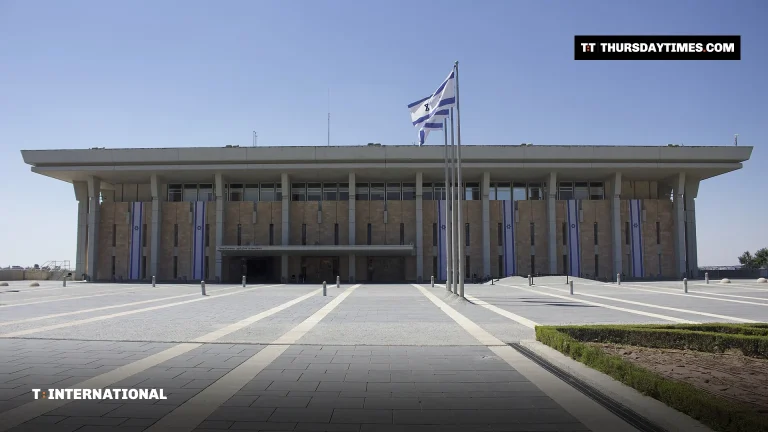
The Knesset, Israel’s parliament, in Jerusalem. File photo. — CLEMA12/WIKIMEDIA COMMONS (CC BY-SA 4.0)
TT Foreign Desk

JERUSALEM (The Thursday Times) — The head of Israel’s election committee on Monday rejected a demand from Prime Minister Benjamin Netanyahu’s Likud to delay certifying last week’s election results, as Netanyahu said he was open to a “broad national government”.

Likud lawyer Ilan Bombach wrote to Justice Noam Sohlberg asking for an urgent meeting before Wednesday’s certification, citing “serious suspicions of foreign interference”. “The seriousness of the suspicions, combined with the lack of clarity regarding their nature and scope, make it impossible for the presidency and the Central Elections Committee to publish the certified results, as if nothing has happened,” he wrote.

Sohlberg refused. “The Central Elections Committee has no authority to withhold the certification of the results, nor does the committee have the authority to intervene in an ongoing investigation,” he replied. By law the results must be certified within eight days of the October 27 vote. He has already said the outcome would stand even if the suspicions were proved.

The allegations, that Qatar or other foreign powers secretly paid to raise turnout among Arab voters, have not been substantiated, and Israeli security agencies are expected to finish their inquiry soon. Likud has said a “dark cloud” hangs over the results and has claimed the vote was “stolen”.

Gadi Eisenkot, whose Yashar party leads the opposition camp, called it “a direct assault on Israeli democracy”. “This current offensive is the last resort of those who understand the magnitude of the defeat they have suffered,” he said. Yair Lapid said: “In a democracy, the winners form the government and the losers head to the opposition.”

Netanyahu, who hours after the vote had vowed a “strong, national, right-wing coalition”, wrote on X on Monday night: “From the very first day, our hand has been extended to form a broad national government.” He insisted he must lead it, and said he would not abandon his far-right and ultra-Orthodox partners. He said the public did not want a government dependent on the Arab parties Ra’am or the Joint List, which he accused of supporting terror.

His bloc won 53 of the Knesset’s 120 seats, eight short of a majority, even though Likud is the largest party with 27. Jewish-led opposition parties took 48 seats and Arab-led parties 19. All four Zionist opposition parties have ruled out serving in a government led by him.

In brief

Every story, as it happensIn English and Urdu at thursdaytimes.com
The Thursday Times
Tuesday 3 November 2026 · 5
Emirates

AI now ‘mostly smarter’ than top scientists, Sam Altman tells ADIPEC as ADNOC signs OpenAI deal

OpenAI chief says there must be “no room for debate” over human control, and names energy as the one challenge he faces today

OpenAI chief executive Sam Altman, ADNOC chief Sultan Al Jaber and Abu Dhabi Crown Prince Sheikh Khaled bin Mohamed bin Zayed Al Nahyan at the signing of the ADNOC, OpenAI and G42 partnership in Abu Dhabi on Monday. ADNOC/Handout
Thursday Emirates

ABU DHABI (The Thursday Times) — Artificial intelligence has gone from trailing the world’s best scientists at the start of this year to mostly outperforming them, OpenAI chief executive Sam Altman told the opening of the ADIPEC energy conference on Monday, while insisting there must be “no room for debate” that people stay in control.

“AI was mostly not as smart as our smartest scientists, and now it’s mostly smarter than them,” Altman said on stage in Abu Dhabi, adding that the technology could now do “a lot of parts” of many white-collar jobs.

He said there “should not be a handoff to AI” and that it “needs to be a tool built for people and needs to serve people, not the other way around”.

“There are a lot of other things we can debate, but on this one, we think there must be no room for debate,” he said. “I can’t believe that this differentiates us from other AI companies, but it does. This is a value that we intend to really go fight for. And I wish it didn’t need to be said.”

Altman said he believed society would “navigate through this all fine”, but that the industry would have to show it could prevent harm as its systems grew more capable. “How do we guarantee, and how do we give the world comfort with that guarantee, that we are going to avoid serious safety and alignment incidents?” he asked. “I think that’ll be increasingly important for our industry to demonstrate.”

One word: energy

Asked in a quick-fire round to name the challenge he faces today, Altman gave a one-word answer to a hall of oil executives and energy ministers: “Energy.”

“We’re going to make more efficient models — we’re going to have robots that can make chip fabs more efficient and assemble racks for us,” he said. “We can bring down the cost of delivering great AI in almost every way, except, you know, atoms are still atoms.”

He called power “the very dominant factor” in how much AI the world can use. The energy needed for each query has fallen sharply, he said, but demand keeps climbing: six years ago OpenAI’s heaviest internal user consumed about 100,000 tokens a month, and the top user now consumes about 500 billion. He said he hoped AI would deliver “a net gain for energy availability in the world”.

The ADNOC deal

Altman’s appearance followed a partnership between ADNOC, OpenAI and Abu Dhabi technology group G42, signed in the presence of Abu Dhabi Crown Prince Sheikh Khaled bin Mohamed bin Zayed Al Nahyan. ADNOC said it would become the first energy company in the world to deploy OpenAI’s frontier technology.

The company said the system would run on OpenAI’s GPT models using infrastructure inside the UAE, and would be used for field planning and for connecting operational, capital and commercial decisions, with its own experts retaining “oversight of consequential decisions”. OpenAI also partnered with Mubadala and Inception42 on investment analysis, and launched a “Machine-Readable Government” initiative with the Department of Government Enablement.

“Sam, from the moment ChatGPT was born, the world has asked what energy can do for AI,” ADNOC chief executive and UAE industry minister Sultan Al Jaber said in his opening address. “And now, together, we will find out what AI can do for energy.”

“AI must be built in, not bolted on,” he said. “In a crisis, the speed of insight and the speed of decision-making is the difference between continuity and disruption.”

Altman, for his part, called the UAE “consistently the most forward-looking country in the world for AI adoption” and said about 80 per cent of its young people were using ChatGPT. OpenAI was reported last month to be in talks with UAE-based funds, including Abu Dhabi’s MGX, to help anchor a $30 billion funding round.

A disputed maths claim

Altman also repeated OpenAI’s claim to have solved one of the Millennium Prize problems, the celebrated set of unsolved mathematics questions, saying the work used 10,000 agents running an upcoming GPT model for about four days. OpenAI first made the claim in September over the Navier-Stokes equations. It has since been caught up in a dispute among mathematicians over credit, and the Clay Mathematics Institute, which awards the prizes, has not recognised any solution.

ADIPEC, which runs until 5 November, is expected to draw more than 40 ministers and 2,260 exhibiting companies, though ExxonMobil and Chevron have pulled senior executives from the event over security concerns, sources said, as tensions between the United States and Iran persist.

Emirates

Hormuz crisis has drained nearly a billion barrels from world oil stocks, ADNOC chief says, as shipping hits 30% of a barrel’s cost

ADNOC chief executive Sultan Al Jaber addresses the opening of ADIPEC in Abu Dhabi on Monday, with a graphic on stage showing barrels drained from global inventories. ADNOC/Handout
Thursday Emirates

ABU DHABI (The Thursday Times) — Nearly one billion barrels have drained from global oil inventories since the disruption of the Strait of Hormuz, ADNOC chief executive Sultan Al Jaber said on Monday, warning at the opening of the ADIPEC energy conference that “the world has eroded its supply buffers”.

Al Jaber, who is also the UAE’s industry minister, said diesel stocks in some markets were at their lowest seasonal level in 35 years, and that others faced a gap of 600 billion cubic feet in liquefied natural gas supply.

Shipping and logistics, he said, made up less than 5 per cent of the cost of a barrel before the disruption. They now account for more than 30 per cent.

“Supply is only half the story. The other half is delivery,” he said. “Energy security is not only measured at the point of production. It is now also measured at the point of delivery.”

The billion-barrel figure is his own. The International Energy Agency, which adds up only the stocks it can observe, has recorded a markedly smaller fall. In October the agency forecast that global oil supply would drop by 5.8 million barrels a day in 2026 and demand by 2.6 million.

Five priorities

Al Jaber set out five steps for the industry. The first was accessible supply, with more strategic storage, larger stockpiles of products and flexible refining capacity closer to consumers. The second was routes to market. “Supply only counts when it arrives,” he said.

The third was operational intelligence, moving to energy systems that anticipate risk. The fourth was capital, with policy to build confidence, finance to accelerate it and insurance to keep trade moving. The fifth, which he called the most important, was people. “Systems don’t carry responsibility, people do,” he said.

‘You can count on the UAE’

He said ADNOC had prepared long before the crisis. “We did not write our playbook during this disruption. We wrote it years before, and at ADNOC, it did not make us immune; it made us prepared.”

The UAE, he said, had held firm under pressure. “Talent stayed. Capital stayed. Investment kept coming and the economy kept moving.” He said the country would keep pressing for dialogue and political solutions that stabilise energy flows, and closed with a message to partners: “When it counts the most, you can count on the UAE.”

ADNOC also announced a final investment decision on the Ruwais Diyab development in Abu Dhabi, its first large-scale unconventional gas project. The company said it would deliver 345 million standard cubic feet of raw gas a day from 2029, with the potential to reach up to one billion.

The four-day conference opened hours after ADNOC signed a partnership with OpenAI and G42, with OpenAI chief executive Sam Altman on stage. It runs until 5 November, though ExxonMobil and Chevron have pulled senior executives from the event over security concerns, sources said.

Saudi

Saudi-led coalition intercepts Houthi ballistic missile after strikes on Yemen’s Ras Isa port, as Houthis threaten Aramco

A Saudi Patriot air defence launcher. File photo. — SAUDI MINISTRY OF DEFENSE/SPA
Thursday Saudi

RIYADH (The Thursday Times) — The Saudi-led coalition said on Monday that its air defences had intercepted and destroyed a Houthi ballistic missile aimed at southern Saudi Arabia, a day after it carried out strikes that Houthi media said hit Yemen’s Ras Isa port.

Coalition spokesman Major General Turki al-Maliki gave no details of the target or of any casualties. He said a drone launched towards the south had also been destroyed on Sunday evening. Saudi Civil Defence issued and then lifted alerts for Abha, Khamis Mushait, Taif and Najran, and warned residents against filming or sharing information about attacks.

Al-Maliki said Sunday’s operation was meant to “neutralise vital resources” the Houthis use to support their war effort, especially ballistic missiles and drones. He did not name the locations. Houthi media said seven people were wounded, four at the Ras Isa port dock in Hodeidah province and three at an oil company site in Bajil district.

The Houthis, citing a military official, repeated threats against Saudi Aramco facilities and warned international airlines against using Saudi airspace, except over Makkah and Madinah.

On the ground, Yemeni government forces are pressing a campaign to retake positions in al-Jawf. An army spokesman said they had killed about 500 Houthi fighters across al-Jawf, Marib and al-Bayda, a figure that could not be independently verified. In Taiz, Yemen’s third-largest city, the governor said 120 health centres had stopped operating since the Houthis cut supply routes in early October.

International

Israel election: ‘Dark cloud’ hangs over the results, Netanyahu’s Likud says, challenging election chief over foreign funding probe

Israeli Prime Minister Benjamin Netanyahu at the White House in September 2025. File photo. The White House
TT Foreign Desk

JERUSALEM (The Thursday Times) — Benjamin Netanyahu’s Likud party said on Monday that “a dark cloud hangs over Israel’s election results” until a probe into alleged foreign funding is finished, challenging the head of the election committee a day after he said the outcome would stand.

“It is highly perplexing that Justice Sohlberg describes the allegations of foreign funding as extremely serious, yet simultaneously, and before the investigation has even concluded, preemptively determines that they have no impact on the election results,” said the statement, posted on Netanyahu’s X account.

The party said just 4,612 votes separated a seat moving from the Arab party Ra’am to the right-wing bloc, a shift it said would have “completely altered” the result. Netanyahu’s bloc won 53 seats, and one more would leave it seven short of the 61 needed for a majority.

The Shin Bet security agency has been investigating claims that Qatar or Turkey paid Arab voters to turn out. Qatar has rejected the claims as “ridiculous and dangerous”.

Justice Noam Sohlberg, chairman of the Central Elections Committee, said on Sunday that the vote was run properly and reflected the will of voters, and that the allegations, even if proved, would not invalidate the overall result. He is due to hand the official results to President Isaac Herzog on Wednesday, when consultations on forming a government begin.

Opposition leader Gadi Eisenkot welcomed Sohlberg’s statement and accused Likud of trying to delegitimise the result. Avigdor Liberman backed Eisenkot for prime minister on Monday.

International

Amit Shah calls 30 million voters struck off India’s rolls ‘Bangladeshi infiltrators’ and dares Rahul Gandhi to a debate in parliament

Indian Home Minister Amit Shah delivers a speech in May 2026. File photo. Government of India (GODL-India)/Wikimedia Commons
TT Foreign Desk

HYDERABAD (The Thursday Times) — Indian Home Minister Amit Shah said on Monday that 30 million of the voters struck off India’s electoral rolls were “Bangladeshi infiltrators”, and dared opposition leader Rahul Gandhi to debate the purge in a special session of parliament.

“Now, I’m coming to what is causing a stomach ache for Rahul Gandhi. Three crore votes were those which never existed. These votes were those of Bangladeshi infiltrators,” Shah told a rally at Mozamjahi Market in Hyderabad. “Should we not remove them from the rolls? But Rahul ji says we shouldn’t remove them.”

He said the Bharatiya Janata Party would remove “every infiltrator from the electoral rolls”, and that the rally the opposition INDIA bloc held in Delhi on Sunday was meant not to save votes but to save infiltrators who form the vote bank of “Congress and company”.

Shah’s breakdown of the 130 million

“Rahul Gandhi says that 13 crore people have lost their vote in the country. He is lying,” Shah said. Of those 130 million, he said, 61.5 million had moved to a different place, 28 million to 30 million had died and 10 million were duplicate voters. The remaining 30 million were the people he called infiltrators.

The figures are his own. The opposition accuses the Election Commission of using the Special Intensive Revision of the rolls to delete 132 million voters, and has staged a mock impeachment of Chief Election Commissioner Gyanesh Kumar over it.

“I challenge you from Hyderabad’s soil. If you have the courage, come for this discussion,” Shah said, offering a special session on the revision, infiltrators and electronic voting machines. He said Gandhi would not come “because he knows that only anarchy keeps Congress in the news”.

He rejected the charge that the BJP was winning because of the revision, saying Prime Minister Narendra Modi had won in 2014, 2019 and 2024 with no such exercise. “Now we are going to win Telangana too,” he said.

In brief

Every story, as it happensIn English and Urdu at thursdaytimes.com
The Thursday Times
Tuesday 3 November 2026 · 6
Opinion

Sehat Dehleez is Balochistan’s healthcare breakthrough

Free consultations, e-prescriptions, referrals and family health records on one public platform: Balochistan has built a model the rest of Pakistan can learn from.

Dr Muhammad Bux Dharejo

Imagine living in Karachi, Lahore, Peshawar or Islamabad. You may be surrounded by some of the country’s largest hospitals, medical institutions and specialist facilities. Yet, when you need medical advice, you may still have to find a doctor, arrange transport, wait for an appointment and navigate a fragmented healthcare system. Now imagine accessing a connected public healthcare service, free of charge, with a single click on your personal or family mobile phone — a doctor consultation, electronic prescription, referral to a hospital and continuity of medical records. And imagine that this 24/7 service comes not from one of the country’s traditionally better-resourced urban centres, but from Balochistan!

This is the proposition of Sehat Dehleez, an initiative of PPHI Balochistan. More than a mobile or web application, it represents a different way of organising public healthcare: bringing the system closer to every citizen, rather than making the citizen struggle to reach the system. Open to citizens of Pakistan from anywhere in the country and across the world, it challenges the conventional boundaries of provincial public service delivery.

The distinction lies in integration. Teleconsultation alone is not a healthcare system. A digital prescription alone does not guarantee continuity of treatment. A referral alone does not ensure that a patient reaches the appropriate facility. Sehat Dehleez seeks to connect these essential elements into one coordinated pathway to ensure continuum of care and universal health coverage. A citizen can obtain a free consultation with a doctor, receive an electronic prescription, and, where further treatment is required, be referred to an appropriate hospital. Hospitals and ambulances are linked to the referral mechanism, with the objective of making the patient’s transition from consultation to further care more organised and traceable.

Its most significant dimension may be the Electronic Medical Record. Each family member has a separate digital health record, allowing consultations, prescriptions, diagnostic information and follow-up to contribute to an evolving medical history. Healthcare should not begin from zero every time a patient meets a new doctor. Nor should a person’s medical history remain scattered across pieces of paper, different facilities and disconnected encounters. A connected record can help make care more informed and continuous.

The scale of the supporting infrastructure is equally important. PPHI Balochistan has connected 185 Basic Health Units to satellite-enabled TeleHealth services. Its TeleHealth Nerve Centre in Quetta operates 24/7 consultation stations with 115 Lady Medical Officers and 15 Consultants. The pilot intervention in Balochistan recorded 437,569 consultations, with women accounting for 85 per cent of consultations. These figures reflect the potential of technology to overcome geographical barriers, particularly for women and communities living far from conventional healthcare facilities.

There is a larger national significance to this development. Sindh, Punjab and Khyber Pakhtunkhwa have their own healthcare initiatives, resources and digital interventions. But the benchmark should not be the number of applications launched or the size of a budget announced. It should be the completeness of the service a citizen can actually access. Sehat Dehleez puts forward an integrated model in which consultation, prescription, referral, hospital connectivity, ambulance linkage and family health records are brought together through a single public platform. This is the distinction that deserves national attention, as it is the first of its kind in Pakistan.

For too long, Balochistan has been viewed primarily through the lens of deprivation, distance and institutional constraints. Its challenges are real; so is its capacity to innovate. The province that has often been expected to follow is now presenting an approach from which the rest of the country can learn. It is a reminder that innovation is not the exclusive privilege of wealthier regions, larger cities or bigger institutions. Vision, institutional commitment and the intelligent use of technology can create possibilities even where resources are constrained.

Sehat Dehleez does not suggest that digital consultations can replace hospitals, emergency care or physical medical examinations. It offers something equally important: a more accessible first point of contact and a gateway into the healthcare system for completing the entire loop of continuum of care — a more connected journey through the healthcare system.

The real measure of this initiative will be the patient who receives timely advice, the woman who avoids an unnecessary journey, the family whose medical history remains accessible and the citizen whose referral does not end at the click of a button.

Balochistan is not merely trying to close the healthcare gap. It is demonstrating how that gap can be reimagined — by taking healthcare to the citizen, wherever the citizen may be.

Editorial · First published 29 October 2026

Four fiefdoms and a flag

Pakistan's four provinces are not an administrative map. They are four estates, kept intact by the men who profit from the distance between citizens and the state.

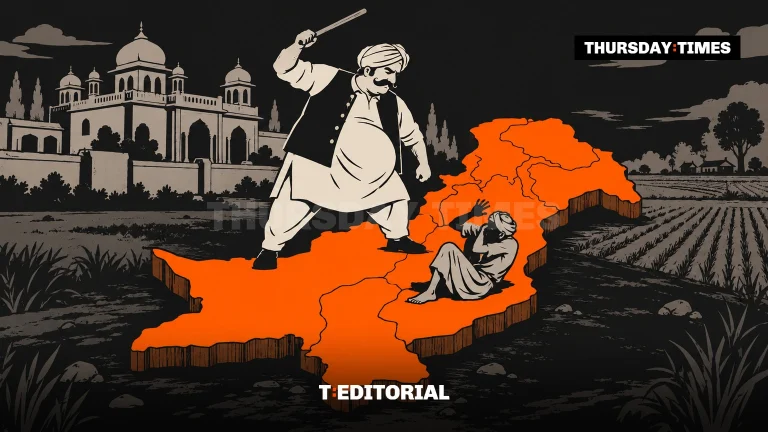
A country of 250 million people cannot be run as four fiefdoms and a flag. — MICHAEL MCCALL FOR THE THURSDAY TIMES
The Editorial Desk

Pakistan does not have four provinces. It has four estates, and the men who own them would rather watch the country fail than redraw a single line.

Start with the arithmetic, because arithmetic does not care who your grandfather was.

Punjab holds nearly 128 million people, roughly as many as Japan, and every one of them is governed from a single secretariat in Lahore. Balochistan covers almost half the country with under 15 million. Pakistan’s population has grown more than sevenfold since 1951, and in all that time the country has lost a wing, swallowed the tribal districts and rewritten its constitution. The provinces have not moved.

No engineer would design this map. No economist would defend it. Only a landlord could love it.

The debate is back, and this time even the government is saying it out loud. The Interior Minister wants an administrative reset. The Planning Minister has floated splitting every province into three. The MQM-P wants a national dialogue, Parliament has been promised a debate this month, and a World Economic Forum paper published in October says Pakistan could run on anywhere from 16 to more than 30 first-tier units. Everyone agrees the system is failing. Almost nobody with power wants to fix it. Ask yourself why.

The man at the door

Every region has a name for him. In central Punjab he is the chaudhri. In the south he is the makhdoom, the pir, the gaddi nashin who inherited the land, the shrine and the assembly seat in a single bequest. In Dera Ghazi Khan and Rajanpur he is the tumandar. In Sindh he is the wadera. In Balochistan, the sardar or the nawab. In Khyber Pakhtunkhwa, the khan or the malik. Different titles. Same racket.

The numbers are not rhetoric. UNDP’s National Human Development Report found Pakistan’s elites, feudal landlords among them, capturing some $17.4 billion a year in privileges, about six per cent of the entire economy. It found a landed class of roughly one per cent of the population holding about 22 per cent of cultivable land. The 2024 Agricultural Census confirms it from the bottom: 97 per cent of farmers own less than 12.5 acres. In Sindh, 0.3 per cent of farms swallow 15 per cent of all farm area, averaging 230 acres apiece.

Land on that scale is not wealth. It is a vote bank with a fence around it. The haari who tills it votes the way the landlord votes, because the landlord owns the road to everything the state is supposed to give him for free: the FIR at the thana, the entry in the patwari’s register, the hospital bed, the teaching post, the water in the canal.

And that racket runs on one thing: distance. When the provincial capital is a day’s journey away and the chief minister will never set foot in your tehsil, the big man in the haveli becomes the only door to the state. He is a toll booth, and the longer the road to the capital, the higher the toll. He does not need you educated. He needs you to need him.

Smaller provinces shorten the road. Put a capital in Multan or Bahawalpur, give the south an assembly where it is the majority instead of a footnote, and post officers who live among the people they govern, and the toll booth starts to look like what it is: a middleman nobody needs. That is the entire reason the middlemen have spent forty years making sure it never happens.

Yes means never

The landed class almost never says no to new provinces. It is far too clever for that. It says yes, at the top of its voice, every five years, and then it buries the idea between elections.

Look at the record in south Punjab. In 2012 the Punjab Assembly and the National Assembly both passed resolutions for a new province. A Senate bill cleared with a two-thirds majority and was left to die in the lower house. In 2018 a bloc of south Punjab electables walked out of the PML-N, christened themselves the Janoobi Punjab Suba Mahaz, and merged into the PTI on a written promise to set the province in motion within 100 days. The PTI took 30 of the region’s 50 National Assembly seats. The province never came. South Punjab got a sub-secretariat in 2020: a branch office of Lahore with a fresh coat of paint.

The suba is a cash crop. It is planted at every election, harvested at the ballot box and ploughed back under the day the results are in. The men it elects then sit in Lahore’s assembly, in Lahore’s cabinet, at Lahore’s budget table. Why would a makhdoom who has made himself indispensable to a faraway capital want one next door, where his constituents could knock?

Then there is the hypocrisy. The PPP has sponsored bill after bill to carve a province out of Punjab, and its chairman campaigned in Multan on the promise of one. Ask the same party about Sindh and the doors slam shut. On 3 September the Sindh Assembly unanimously rejected any division of the province, invoking its veto under Article 239(4), in a line of such resolutions going back to 1948. The Chief Minister said the decision belonged to Sindh’s legislators, “not businessmen from Lahore.” Divide Punjab, never Sindh. That is not a principle. It is a property line.

He is right that it is Sindh’s decision. He is wrong about who Sindh is. The unity defended in that chamber is not the unity of the families of Tharparkar and Thatta, who have been failed by every provincial government they have ever had. It is the unity of an estate: land, votes and office held in the same few hands since before Partition, in the province with the most concentrated landholding of any large one in Pakistan. “Sindh’s integrity” is the wadera’s integrity, wearing an ajrak.

And when people demand a province from below rather than from the drawing room, the state has answered with bullets. In April 2010, when Hazara rose against the renaming of the NWFP and demanded its own province, police opened fire in Abbottabad. At least seven people were killed. Nobody answered the movement. They simply waited for it to tire.

Every excuse, and why it is an excuse

Stop asking their permission

The four-province map was not handed down from heaven. It is the residue of colonial convenience and post-Partition bargains, kept alive because it works beautifully for the few hundred families who sit on top of it. The chaudhri, the wadera, the makhdoom and the sardar do not oppose new provinces because they will divide Pakistan. They oppose them because they will divide their Pakistan: their monopoly on access, their seat at a distant table, their role as the only door to the state.

A country of 250 million people cannot be run as four fiefdoms and a flag. Pakistan needs more provinces, drawn for governance and armoured with real devolution. The men who say “not now” have been saying it for forty years, and they will say it for forty more. The haari has waited long enough for a capital he can reach. Give him one.

Analysis · First published 25 October 2026

Why Afghanistan is called a global hub of terrorism

Terrorist groups sheltering in Afghanistan’s mountains plan attacks that reach far beyond its borders. — MICHAEL MCCALL FOR THE THURSDAY TIMES
TT Monitoring Desk

When Afghanistan’s Taliban authorities told United Nations monitors that there were no terrorist groups on Afghan soil, not a single UN member state agreed.

That finding sits at the heart of the UN’s latest assessment of global terrorism. Its sanctions monitoring team, in a report published in February 2026, describes an Afghanistan where Tehrik-e-Taliban Pakistan (TTP) operates with “greater liberty and support”, where Al-Qaida “continued to enjoy the patronage of the de facto authorities”, and where the leaders of Al-Qaida in the Indian Subcontinent were reported to be living in Kabul.

The warnings do not come from the UN alone. Russia, the first country to formally recognise the Taliban government, told a Shanghai Cooperation Organisation meeting in May that between 18,000 and 23,000 terrorists from more than 20 groups were operating in Afghanistan. US intelligence names the Islamic State’s Afghan branch among the groups most likely to plot attacks abroad. And the Global Terrorism Index ranks Pakistan, Afghanistan’s neighbour, as the country most affected by terrorism in the world.

It is this combination, several transnational groups sheltering in one territory under authorities accused of protecting some of them, that leads security analysts and regional governments to describe Afghanistan as a global hub of terrorism.

A haven for many groups

Afghanistan is not associated with a single terrorist organisation. The UN report lists five groups as active in the country, each with different targets, from Pakistan and China to Central Asia and the wider world.

Russian Security Council Secretary Sergei Shoigu, speaking at the SCO in May, described the threats of terrorism and drug trafficking “emanating from its territory” as particularly important for regional security. He also warned of an influx of Uyghur, Tajik and Uzbek terrorists arriving in Afghanistan from Syria.

Pakistan bears the brunt

No country has felt the consequences more directly than Pakistan. In the Global Terrorism Index 2026, published by the Institute for Economics and Peace, Pakistan topped the index for the first time, with 1,139 deaths and 1,045 incidents in 2025, its highest level since 2013. The index links the surge partly to the Taliban’s return to power in Afghanistan in 2021.

The index identifies the TTP as the deadliest group in Pakistan and the third deadliest in the world. It estimates that 6,000 to 6,500 TTP terrorists operate from inside Afghanistan. Most of the group’s attacks near the border take place 10 to 50 kilometres from it, and 85 per cent of its attacks occur in the former tribal areas, now part of Khyber Pakhtunkhwa.

The figures point to an exported threat. Afghanistan has dropped out of the index’s top 10 for the first time, and its terrorism deaths have fallen 95 per cent since 2007, while attacks across the border in Pakistan have risen.

The UN report’s most striking finding concerns weapons. It says the TTP used advanced assault rifles, night-vision and thermal-imaging devices, sniper systems and drones, and that most of these “were provided by the de facto authorities in conjunction with weapons permits and travel documents”. Several member states said weapons left behind by former coalition forces had made TTP attacks more lethal.

In November 2025, a TTP splinter group claimed an attack on an Islamabad courthouse that killed 12 people, the first attack in the capital for several years. In February 2026, after further attacks inside Pakistan, Pakistani airstrikes on Afghan territory and Taliban retaliation along the border, Pakistan’s defence minister, Khawaja Asif, described the situation as an “open war”.

Some member states also told the UN that the Baloch Liberation Army had collaborated with the TTP and ISIL-K through shared training camps and resources, although others found no ties between the group and Al-Qaida or ISIL. Pakistan has also accused India of supporting armed groups targeting its territory, which India rejects.

Al-Qaida’s old home

Afghanistan’s reputation is rooted in history. The Taliban sheltered Al-Qaida before the September 11 attacks, and in July 2022, Al-Qaida’s leader Ayman al-Zawahiri was killed by a US drone strike at a safe house in Kabul. US officials said senior Haqqani Network figures knew he was there.

The UN says Al-Qaida acts as a “service provider and multiplier” for other groups in Afghanistan, principally the TTP, through training and advice, and that its appetite for “spectacular” external attacks remains undiminished. Leaders of AQIS, Osama Mahmoud and Yahya Ghauri, were reported to be in Kabul, with the group’s media cell based in Herat.

US intelligence assessments add a qualification: Afghanistan remains a safe haven for Al-Qaida, but its leaders probably comply with Taliban restrictions on planning external attacks, according to a March 2026 US Congressional Research Service report.

ISIL-K’s global reach

The clearest evidence of a threat beyond the region comes from ISIL-K. The group carried out the 2021 suicide bombing at Kabul airport that killed 13 US service members, and mass-casualty attacks in Iran and Russia in 2024 were attributed to it. US intelligence says it has also plotted attacks in Europe that were later disrupted. In January 2026 it bombed a Chinese restaurant in Kabul, killing seven people, and UN monitors judged it the likely force behind a February suicide bombing at a Shia mosque in Islamabad that killed 31, which was claimed by a group calling itself ISIL in Pakistan.

The US intelligence community’s 2026 Annual Threat Assessment lists the group among the most likely to conduct external plotting, alongside Al-Qaida in the Arabian Peninsula and the Islamic State in Syria. The UN says it retained “significant operational and combat capability” and the ability to rapidly replenish its ranks, including through online recruitment.

ISIL-K is, however, an enemy of the Taliban. US intelligence says the Taliban have conducted extensive raids against the group and probably thwarted some attacks, while the UN monitors’ August 2026 report found its attacks declining inside Afghanistan but increasing in Pakistan.

China’s concern

The UN report says that under the de facto authorities’ patronage, including the issuance of identity documents, members of the ETIM/TIP were able to move freely within Afghanistan and gradually concentrated in Badakhshan. About 250 members were reported to have joined Taliban police forces in 2025. One member state said the group had urged its members in Syria to move to Afghanistan in preparation for “returning to Xinjiang for jihad”.

New tools

The monitors also warn that terrorist groups are exploiting commercial satellite communications for cheap and relatively secure contact in remote areas, and growing more proficient with artificial intelligence, particularly for propaganda.

The Taliban’s answer

The Taliban deny that Afghan territory is used to attack other countries. Armed violence inside Afghanistan has fallen sharply since their 2021 takeover, according to the European Union Agency for Asylum, and Taliban forces have fought ISIL-K.

The monitors’ August 2026 report also said the Taliban had relocated about 2,000 TTP terrorists and their families away from the Pakistani border to constrain the group, and that Taliban leader Hibatullah Akhundzada had reportedly warned the TTP to halt attacks on Pakistan or risk losing Taliban support. The Taliban accuse Pakistan of striking civilian areas, and the UN mission in Afghanistan has documented civilian casualties from cross-border violence.

A hub, if not the only one

The UN cautions that no single country or region can be called the epicentre of global terrorism, and the Global Terrorism Index gives that title to sub-Saharan Africa. But Afghanistan stands apart for a combination no other theatre matches: its history with Al-Qaida, the number of groups it hosts, its position between South Asia, Central Asia and China, and persistent evidence that authorities in Kabul support some of those groups while fighting others.

That is the case for calling Afghanistan a global hub of terrorism. Its threat is measured not by attacks inside its borders, where terrorism deaths have fallen 95 per cent since 2007, but by groups based there that remain able to recruit, train, arm and strike beyond them, from Pakistan’s border districts to Moscow, Kerman and Islamabad.

Sources

Analysis · First published 22 October 2026

Through the Maldives, Pakistan stakes a claim to a bigger Indian Ocean role

A Pakistani warship sails towards the atolls of the Indian Ocean. — MICHAEL MCCALL FOR THE THURSDAY TIMES
TT Monitoring Desk

When Mohamed Muizzu landed in Islamabad this week, the first Maldivian president to visit Pakistan in 11 years, the headline numbers were modest: a trade target of $200 million and a gift of olive cuttings. The more telling commitments were in the fine print. Of the 20 memorandums signed on Wednesday, one covers defence ties and maritime security, and it gives Pakistan something it has long wanted: a foothold in the middle of the Indian Ocean.

The Maldives sits astride the sea lanes that link the Gulf to East Asia, a chain of atolls about 700 kilometres from Kochi, home of India’s Southern Naval Command, and barely 130 kilometres from India’s Minicoy Island. For decades New Delhi has treated it as part of its own backyard. Pakistan, whose navy has spent most of its history focused on the Arabian Sea and the approaches to Karachi and Gwadar, has rarely had a seat at that table.

One ocean, two coastlines

Prime Minister Shehbaz Sharif made the pitch himself, telling his guest that the same ocean that touches the shores of Karachi and Gwadar also embraces the islands of the Maldives. The line framed Pakistan not as a distant partner but as a fellow Indian Ocean state with a stake in the same waters.

The agreements back that up with practical ties. Alongside defence and maritime security, they cover cybersecurity, narcotics control, policing, fisheries and the training of Maldivian civil servants and police officers at Pakistani academies. The same day, Field Marshal Asim Munir met Muizzu and the two stressed defence cooperation, institutional links and professional exchanges. The Maldivian delegation included its defence minister, Hassan Rasheed.

An opening years in the making

Pakistan has knocked on this door before. In 2018, Qamar Javed Bajwa became the first Pakistani army chief to visit the Maldives, a trip that produced steps on counter-terrorism cooperation. That opening faded when a more India-friendly government took power in Malé later that year.

This time the politics run the other way. Muizzu came to office in 2023 on an ‘India Out’ platform to reduce India’s military footprint in the archipelago, and has since widened his circle of partners. Pakistan, which marks 60 years of diplomatic relations with the Maldives this year, has moved quickly into that space, offering education, health workers, data-centre expertise and 100,000 olive cuttings for the islands’ tree-planting drive.

New Delhi is watching

Indian officials have said they will keep a close watch. The worry in Indian commentary is less about any single agreement than about direction: closer defence ties could, over time, bring Pakistani ships, training teams and port calls into waters India regards as its strategic perimeter, through which most of its trade passes.

For Islamabad, the value lies in exactly that. A navy that wants to be taken seriously beyond the Arabian Sea needs partners further south, and a Maldives that wants more than one friend is a natural place to start. The memorandums are only a framework, and their substance will depend on how quickly the two sides act on them. Signed memorandums of understanding rarely change much on their own. But the signal from this week is clear, and in New Delhi it has been received.

The Thursday Times
Tuesday 3 November 2026 · 7
Health

Need blood in a hurry? Punjab’s government hospitals are getting QR emergency buttons that connect you to help

Scan the code to reach Helpline 15 by call, chat or video and find blood donors through the Safe City Virtual Blood Bank, or call 15 and press 4

The surgery department at Services Hospital in Lahore. File photo. Baitaal/Wikimedia Commons, CC BY-SA 3.0
TT Lahore Bureau

LAHORE (The Thursday Times) — Need blood for a patient, or help in a hurry, at a government hospital in Punjab? The Punjab Safe Cities Authority has started installing QR emergency buttons in hospitals across the province, including in Lahore, that connect you to help from your own phone.

How it works

Scan the code with your phone and you are connected directly to the authority, the agency says. The hospital’s details appear automatically, you register your contact number, and you can then reach help by calling Emergency Helpline 15, by live chat or by video call.

Finding blood

The most useful part for many families may be the link to the Safe City Virtual Blood Bank. After a request, the Safe City team helps connect patients with available donors of the blood group they need, which the authority says makes finding a donor easier and faster.

You do not need to be near a code for that. Calling Helpline 15 and pressing option 4 gets guidance on blood requirements and basic first aid, the authority says.

When it reaches your hospital

The buttons are being installed in phases. They can also be used for emergencies other than blood.

Punjab has already used similar QR panic buttons on public transport, for foreign nationals and at Muharram gatherings. The move comes in the same week that doctors shut outpatient departments across Pakistan in a strike partly over violence and police cases against medical staff, though the authority presents the buttons as a service for patients and their families.

Food

Is your tikka spot allowed to stay open? What Lahore’s smog rules mean for the city’s barbecue

Street food in the walled city of Lahore. File photo. Awon Arshad/Wikimedia Commons, CC0
TT Lahore Bureau

LAHORE (The Thursday Times) — With Lahore’s air index passing 500 this week, one question is hanging over the city’s favourite smoky dinner: is your tikka place allowed to be open? Under Punjab’s smog rules, that now comes down to a suction hood.

The Punjab Environment Protection Agency has made working suction hoods and exhaust systems mandatory for restaurants doing barbecue, grilling and other smoke-producing cooking, calling them a legal requirement rather than an optional extra. Places without them face sealing.

How hard the crackdown has been

In one 24-hour sweep in September, night squads inspected more than 256 restaurants across Punjab and sealed more than 47. In Lahore, 27 of the 30 restaurants inspected were sealed and the other three received notices.

Having a hood is not enough on its own. One Lahore restaurant was sealed that month because its hood was installed but not working effectively, and another outlet had only its barbecue section sealed. Senior Punjab Minister Marriyum Aurangzeb said hoods and ducts must be both installed and operating effectively.

The agency said enforcement would run by day and by night, and that it had a zero-tolerance policy. Its spokesperson said businesses polluting at night would also face legal action.

Why it matters this week

Lahore’s air quality index crossed 530 on Monday, and the Pakistan Air Quality Initiative forecasts fine-particle pollution climbing further by Wednesday. The government says it is acting against all major sources of pollution at once, from brick kilns and factories to plastic waste and restaurant smoke.

For diners, the practical upshot is simple. A working hood and duct above the grill is what inspectors are looking for.

Travel

Going to Murree this winter? Here’s what the new safety plan means for you, from 19 help centres to fixed hotel prices

Murree under snow. File photo. Taha.Imran766/Wikimedia Commons, CC BY-SA 3.0
TT Islamabad Bureau

MURREE (The Thursday Times) — Planning a snow trip to Murree this winter? Officials have activated a safety plan for the hill station after the first snowfall in the Galiyat, with 19 help centres for tourists, thermal drones over the roads and fixed prices at hotels and petrol stations.

The plan, called Mission Safe Winter, was drawn up by the district administration, the National Disaster Management Authority and Rescue 1122. The official winter tourism season runs from December 15 to February 15.

What it means if you go

Help on the road. The 19 tourist facilitation centres are spread across Murree, the Galiyat and the routes in from Rawalpindi, Khyber Pakhtunkhwa and Azad Kashmir, offering assistance and guidance in an emergency. New Rescue 1122 stations have opened.

Cleared roads. More than 20 snow-clearing vehicles, cranes and loaders have been positioned at key points. Roads and entry points are being watched round the clock through 181 Safe City cameras and thermal drones, and a Pakistan Army contingent will also stay deployed.

Prices. The Punjab Enforcement and Regulatory Authority will monitor hotels and petrol stations for overcharging, and uniform fares and standard food prices are to be enforced. Overcharging has long been a complaint among visitors in peak snow season.

Medical care. Hospitals have been told to keep doctors and medicines available 24 hours a day, and an air ambulance strip along the Murree Expressway has been proposed for serious emergencies.

The stakes are well known. In January 2022, more than 20 people died in Murree after thousands of vehicles were trapped on snowbound roads during a severe storm, many of them inside their cars.

Home

Lahore’s air has passed 500 on the index. Here’s how to keep smog out of your home

A HEPA filter and an activated carbon filter from a home air purifier. File photo. Home Air Quality Guides/Wikimedia Commons, CC BY-SA 2.0
TT Lahore Bureau

LAHORE (The Thursday Times) — Lahore’s air quality index passed 530 this week, and the forecast is for more bad days. You cannot fix the air outside, but the World Health Organization and the US Environmental Protection Agency have clear advice on making the air inside your home safer.

Seal the house

Keep external doors and windows closed during high pollution, the WHO says. If your air conditioner has a fresh-air setting, close it and use recirculate mode, the EPA advises in its guidance on wildfire smoke, which is also made up of fine particles.

Stop adding to it

Avoid anything that burns indoors, the WHO says, naming wood stoves, candles and incense, and do not smoke inside. In a Pakistani home in winter, that advice also covers agarbatti and open-flame heaters.

Mop, don’t sweep

Wet mopping and dusting is better than sweeping or vacuuming, according to the WHO, because those can stir up more dust and particles.

Make one clean room

If you cannot clean the whole house, the EPA suggests choosing one room big enough for everyone in the household and running a portable air cleaner there. Check that the cleaner is powerful enough for the room and produces little or no ozone, itself a harmful pollutant. Replace filters when they are dirty, which may be sooner than the manufacturer says.

If a purifier is out of reach, the EPA also describes a do-it-yourself cleaner made from a box fan and one or more high-efficiency filters.

Who needs this most

Children, older people, pregnant women and people with heart or lung disease are at greatest risk, and the WHO says those at risk should stay indoors as much as possible. Everyone should avoid prolonged or heavy exertion outside.

The Pakistan Air Quality Initiative says Lahore’s fine-particle pollution averaged 100 micrograms per cubic metre in October, even in the city’s cleanest October since 2021, and was above Pakistan’s legal limit on all 31 days. It forecasts levels of about 149 by Wednesday.

Style

From Shah Alam Market to all-black menswear: what stood out at LAAM Fashion Week’s second season

A model on the runway at LAAM Fashion Week Season 2 in Lahore in October. LAAM Fashion Week/Handout
TT Lahore Bureau

LAHORE (The Thursday Times) — Pakistan’s runway looked to Shah Alam Market, the handloom and Korean streetwear at the second season of LAAM Fashion Week, which ended in Lahore with 43 shows from more than 50 designers and brands. These are the threads worth following into wedding season.

Bridal stays bold

Truba showed dramatic lehengas, flowing anarkalis and structured shararas, and ALLYS drew its collection Diwani from royal South Asian palaces and old family heirlooms. The finale fell to the show director, HSY, after a designer showcase from Ali Xeeshan, Erum Khan and Mohtaram.

Craft comes forward

Hathghar took an artisan-first route with sarees, kalidar kurtas and ghararas, built around handblock printing and handloom weaving. It was part of a wider mix of traditional technique and street culture across the week.

Lahore’s own bazaars on the ramp

One of the most distinctive collections came from Collected XX, which took its cue from Lahore’s Shah Alam Market, turning the city’s wholesale bazaar into runway material.

Menswear gets darker

Emraan Rajput sent out an all-black collection mixing Korean streetwear with Renaissance elegance, with long structured winter coats, sharp suits and oversized fits, a useful reference as the cold sets in.

You can buy it from your phone

The bigger idea behind the event is commerce. Co-created by LAAM and Design651, it runs on a runway-to-e-tail model that connects shows directly to online shopping, and it was livestreamed on the LAAM app and website and on ARY Plus. LAAM says it has more than 4,000 active brands and designers and delivers to over 1,200 cities worldwide.

In brief

Every story, as it happensIn English and Urdu at thursdaytimes.com
The Thursday Times
Tuesday 3 November 2026 · 8
Cricket

‘A little bit sad’: Glenn Maxwell retires from international cricket after 14 years and three World Cup titles

The man behind the 201 not out against Afghanistan will keep playing for the Melbourne Stars in the Big Bash League

Glenn Maxwell during a warm-up for the Melbourne Stars in January 2026. File photo. — STORM MACHINE/WIKIMEDIA COMMONS (CC0)
TT Sports Desk

MELBOURNE (The Thursday Times) — Glenn Maxwell has retired from international cricket, ending a 14-year Australia career that brought three World Cup titles and one of the greatest innings ever played in the 50-over game.

The 38-year-old, known as “The Big Show”, announced the decision on Monday on a cricket podcast. “A little bit sad and a little bit inevitable as well,” he said. He has also given up first-class and List A cricket, but will keep playing for the Melbourne Stars in the Big Bash League after extending his contract until the 2027-28 season.

Maxwell had already quit one-day internationals in June 2025, and his last appearances for Australia came at the 2026 T20 World Cup, where the team went out in the group stage.

His defining innings came against Afghanistan in Mumbai at the 2023 World Cup. With Australia 91 for seven chasing 292, he batted through severe cramps to make 201 not out off 128 balls and won the match by three wickets, sharing an unbroken stand of 202 with captain Pat Cummins. Australia went on to win the title, as they had in 2015, and he was also part of the side that won the T20 World Cup in 2021.

He finished with 3,990 runs from 149 ODIs at a strike rate of 126.70, and 2,897 runs from 130 T20 internationals, including five centuries, level with India’s Rohit Sharma for the most by a man in the format. He played seven Tests, scoring one century.

Football

Fifa will show council its secret World Cup sell-off plan, but only in person in Zurich, as Uefa deadline passes

Fifa’s headquarters in Zurich. File photo. — ALBINFO/WIKIMEDIA COMMONS (CC BY-SA 4.0)
TT Sports Desk

ZURICH (The Thursday Times) — Fifa has told members of its council they can see documents on president Gianni Infantino’s abandoned plan to sell stakes in the World Cup to private investors, but only in person at its headquarters in Zurich, just as a deadline set by Uefa ran out.

Secretary general Mattias Grafstrom wrote to members hours before the November 2 deadline, saying the conditions were needed to preserve confidentiality obligations. Members have two weeks to say they want to see the paperwork on the plan, known as Fifa Forward Enterprise.

Uefa had demanded details of the proposal and answers to more than 100 questions on how decisions were made. Infantino apologised for the plan at a council meeting last month but did not fully explain how it came about, and asked for questions in writing.

“The withdrawal of FFE, the acknowledgement of mistakes and the announcement of ‘potential governance reforms’ do not answer how the relevant decisions were taken or why the Fifa Council was not involved at the appropriate stage,” Uefa wrote. “These questions require answers now.”

Uefa’s eight pages of questions also cover funding for national associations, the first Fifa Peace Prize given to US President Donald Trump, and the suspended ban for USA striker Folarin Balogun at the World Cup.

Sources said Fifa saw a two-week deadline for so many questions as unworkable, with a youth World Cup in Azerbaijan and an extraordinary congress this month. They also said its answers are limited by legal action Uefa launched in the US in October, seeking disclosure of evidence and documents. Uefa has warned it could file a criminal complaint in Switzerland.

The pressure comes before November 18, the last date for candidates to confirm they will stand against Infantino in next year’s presidential election.

Sports

Quetta’s Abida Batool becomes first Pakistani woman to win a WIBA world boxing title

Abida Batool with the WIBA world atomweight belt in Pattaya, Thailand. Handout
TT Sports Desk

PATTAYA (The Thursday Times) — Quetta boxer Abida Batool has become the first Pakistani woman to win a Women’s International Boxing Association (WIBA) world title, taking the vacant atomweight belt against Thailand’s Wandee Sinongkhrot in Pattaya.

The 26-year-old won on a split technical decision at FCC Stadium on October 31, on the “Brave Hearts” card. The scheduled eight-round fight was stopped in the fifth after an accidental headbutt left Batool with a fractured nose, and the ringside doctor called off the contest, sending the result to the judges’ scorecards.

Two judges scored it 50-45 and 49-48 for Batool, while the third had it 48-47 for Sinongkhrot.

It was Batool’s second title fight in Thailand this year. In January she challenged Wisuta Sririttidet for the WBC Asia atomweight title in Bangkok but lost. She went into this bout ranked as Pakistan’s top female professional boxer and third in the WBC Asia rankings.

Batool began boxing in 2018 and has won Pakistan’s national professional title. She has also competed in mixed martial arts, wushu and kickboxing, and came up through financial hardship and early resistance from her family. She prepared in Islamabad before travelling to Thailand.

After the win she thanked her family, her coach Shariq Khan and the people of Pakistan. “This is just the beginning,” she said. “I’m coming for more titles.”

Sports

Kimi Antonelli becomes Formula One’s youngest world champion at 20 as Verstappen wins dramatic Mexico City Grand Prix

Kimi Antonelli at a press conference during the Dutch Grand Prix in August. File photo. — STEFFEN PRÖSSDORF/WIKIMEDIA COMMONS (CC BY-SA 4.0)
TT Sports Desk

MEXICO CITY (The Thursday Times) — Kimi Antonelli became Formula One’s youngest world champion on Sunday, sealing the title at 20 years and 68 days old by finishing third for Mercedes in a red-flagged Mexico City Grand Prix won by Red Bull’s Max Verstappen.

The Italian beat the record set by Sebastian Vettel, who was 23 years and 134 days old when he won his first title with Red Bull in 2010. He is also the first Italian champion since 1953, and his 119-point lead can no longer be overtaken with the races that remain.

Antonelli wept over the team radio as he took the chequered flag. “I’m speechless,” he told the crowd afterwards, an Italian flag around his shoulders on the podium.

Verstappen took his 74th career win, and his sixth in Mexico, holding off Lewis Hamilton’s Ferrari by 0.799 of a second. Hamilton had started from pole, his first for Ferrari at a full grand prix, but clashed with teammate Charles Leclerc in the opening corners. Leclerc finished fourth, Lando Norris fifth and George Russell, Antonelli’s Mercedes teammate, only sixth in a race he had to win to stay in contention.

The race was stopped for 33 minutes on lap 46 of 71 after a front-left suspension failure sent Valtteri Bottas’s Cadillac into the barriers at turn one at high speed. Bottas walked to an ambulance and was later released from the medical centre. A second safety car followed when Oscar Piastri and Arvid Lindblad collided, and Piastri was later given a 10-second penalty that dropped him from seventh to 15th.

Verstappen now sits second in the standings, with Hamilton third and Russell fourth, 130 points behind Antonelli. Mercedes lead Ferrari 630-504 in the constructors’ standings and could clinch that title in Brazil next weekend.

Football

Chinese state TV keeps Real Madrid off air despite Mbappe’s apology for Mao joke as La Liga blackout continues

The headquarters of Chinese state broadcaster CCTV in Beijing. File photo. — EDITQ/WIKIMEDIA COMMONS (CC BY-SA 4.0)
TT Sports Desk

BEIJING (The Thursday Times) — Chinese state television did not show Real Madrid’s match at Racing Santander on Sunday, extending its La Liga blackout despite apologies from Kylian Mbappe, the club and the league over his remark about Mao Zedong.

Neither of CCTV’s two sports channels aired the game, which Real won 3-0 with Mbappe scoring a penalty. No other match from the weekend’s round had been shown live on public television either. La Liga games were carried on Migu, a streaming service owned by state-run China Mobile, including Barcelona’s 6-1 win over Alaves, but the Real Madrid match did not appear to be among them.

The row began when a video from April went viral, in which Mbappe said the funniest internet meme of himself had his face on “some guy” he thought was “a Chinese dictator”, an apparent reference to Mao. China Media Group, which oversees CCTV, suspended La Liga broadcasts on October 26 and said apologies were an absolute prerequisite for moving on.

Mbappe, Real Madrid and La Liga have all since apologised, and China’s foreign ministry said it took the player’s apology seriously. It remains unclear whether talks to end the dispute have begun. Real coach Jose Mourinho said on Saturday that the club had “done our part”.

In brief

Every story, as it happensIn English and Urdu at thursdaytimes.com