Wednesday 4 November 2026 Archive
WEDNESDAY 4 NOVEMBER 2026Dangerous to those who trade in lies.THE E-PAPER · ENGLISH EDITION · 8 PAGES
234567Westline pull-out8
US MIDTERMS 2026

Democrats win Senate and House in major rebuke to Trump

The US Capitol building lit up at dusk
The US Capitol in Washington at dusk. File photo. — RHODODENDRITES/WIKIMEDIA COMMONS (CC BY-SA 4.0)

They took seven Senate seats including Texas and Maine, and will hold full control of Congress from January for the first time since 2023

TT Foreign Desk · Washington

Democrats won control of both the US Senate and the House of Representatives in Tuesday’s midterm elections, a decisive rebuke to President Donald Trump that returns the party to full control of Congress for the first time since 2023.

Democrats took seven Senate seats from Republicans: North Carolina, South Carolina, Ohio, Texas, Kansas, Iowa and Maine. James Talarico beat Ken Paxton in Texas, Sherrod Brown won back a seat in Ohio, Roy Cooper took North Carolina, Josh Turek won Iowa, Adam Hamilton beat Senator Roger Marshall in Kansas and Annie Andrews beat Darline Graham in South Carolina. In Maine, Troy Jackson defeated Susan Collins, ending her nearly 30 years in the Senate.

Democrats also kept Georgia, where Jon Ossoff won re-election, and New Hampshire, where Chris Pappas beat John Sununu. Abdul El-Sayed won Michigan, becoming the first Muslim elected to the Senate, while Alaska was still being counted. Results across the House are also still coming in.

In the House, Democrats ousted Republican incumbents including Tom Kean in New Jersey, Mariannette Miller-Meeks in Iowa, Derrick Van Orden in Wisconsin and four in Pennsylvania. Hakeem Jeffries, the party’s House leader, is now poised to become the first Black Speaker. “From sea to shining sea, the American people have spoken and made clear they’ve had enough of the extremism, enough of the corruption,” he said. Senate leader Chuck Schumer called it a “generational remake of the Senate map”.

Voters’ frustration over high prices, the war with Iran and corruption drove the result. Trump had urged them to “pretend I’m on the ballot”, and spent weeks at rallies in conservative states. Democrats won in several states he carried by double digits two years ago.

The new Congress takes its seats in January. Democrats will gain the power to investigate the administration and to block Trump’s nominees, including to the courts. “Lawyer up,” wrote Robert Garcia, the congressman expected to lead the House Oversight Committee. Trump keeps his veto, which Democrats lack the numbers to override, so their legislation will still need his signature.

The result also matters well beyond Washington. US officials warned last month that Trump might order a major strike on Iran if Republicans lost, a claim a White House official rejected. Asked about the war on election night, Trump said it would be over “when I say it’s over”.

Follow the results as they come in.

Abdul El-Sayed wins Michigan to become first Muslim US senator

Democrat Abdul El-Sayed has won the US Senate race in Michigan, defeating Republican Mike Rogers to become the first Muslim ever elected to the chamber, after a campaign in which President Donald Trump repeatedly called him a “jihadist”.

“Michigan, we did it,” El-Sayed told supporters. The result keeps a seat Democrats have held since 1979, adding to their win in both chambers of Congress.

El-Sayed, 42, was born in Michigan to Egyptian immigrant parents. A doctor and epidemiologist, he ran the health departments in Detroit and Wayne County, and first ran for office with an unsuccessful bid for governor in 2018. He ran this time on single-payer healthcare, the cost of living and limiting corporate money in politics, drawing in young and infrequent voters.

The closing weeks were among the ugliest of any race this year. Trump called him a jihadist at rallies, invoked the 9/11 attacks in urging voters to reject him, and on polling day said “only fools” would vote for him. Senator Ted Cruz said Americans could die as a result of his election if he was, as Cruz claimed, a supporter of the Muslim Brotherhood. El-Sayed said: “I have never been a member of the Muslim Brotherhood, I never will be a member of the Muslim Brotherhood.” He accused his opponents of Islamophobia.

He also faced trouble in his own party. Representative Haley Stevens, whom he beat by about one point in the August primary, endorsed Rogers two days before the vote, saying he was unfit for the Senate. His opposition to US military support for Israel had alienated some Jewish voters, and he later apologised for his comments after a truck attack on a synagogue preschool near Detroit.

He has been endorsed by some of the biggest names on the American left, and is expected to be a prominent voice as Democrats debate their direction. Michigan is an important early state in the race for the party’s 2028 presidential nomination.

Rogers, 63, a former congressman and FBI agent, also lost a Senate race in Michigan in 2024. Follow the full results here.

“I have total veto power and I’m sure we’ll be able to work things out.”Trump congratulates Democrats, says he’d have won on the ballot Page 2

Why Congress changing hands won’t rewrite US-Pakistan ties

A Republican still walks the White House corridors and America’s shared interests with Pakistan have not moved. Any promise of relief for Imran Khan from a Democratic majority will fail, just as the last one did.

TT MONITORING DESKPAGE 5 ›

‘Americans said no to war,’ Iran’s parliament speaker says

Iran’s parliament speaker has welcomed the Democrats’ win in the US midterms as a vote against the war, and warned Washington not to ignore it.

“Conscience or the cost of living, Americans said NO TO WAR, and we endorse this message,” Mohammad Bagher Ghalibaf wrote on X. “If the US govt betrays their public will to serve international paymasters and blackmailers, it will learn our NO comes with a Nightmare.”

Voters’ anger over high prices and the war with Iran ran through the campaign, and Democrats will now control both chambers of Congress from January. But the war remains in President Donald Trump’s hands. Asked about it on election night, he said it would be over “when I say it’s over, basically. It’ll end when I say it ends.”

Before the vote, US officials warned that Trump might order a major strike if Republicans lost, which a White House official rejected. Three tankers hit mines in the Strait of Hormuz this week, Iran said, as Qatar kept talks going.

A deal under discussion would reopen the strait in exchange for sanctions relief, followed by nuclear talks. Pakistan has been a central go-between in the war.

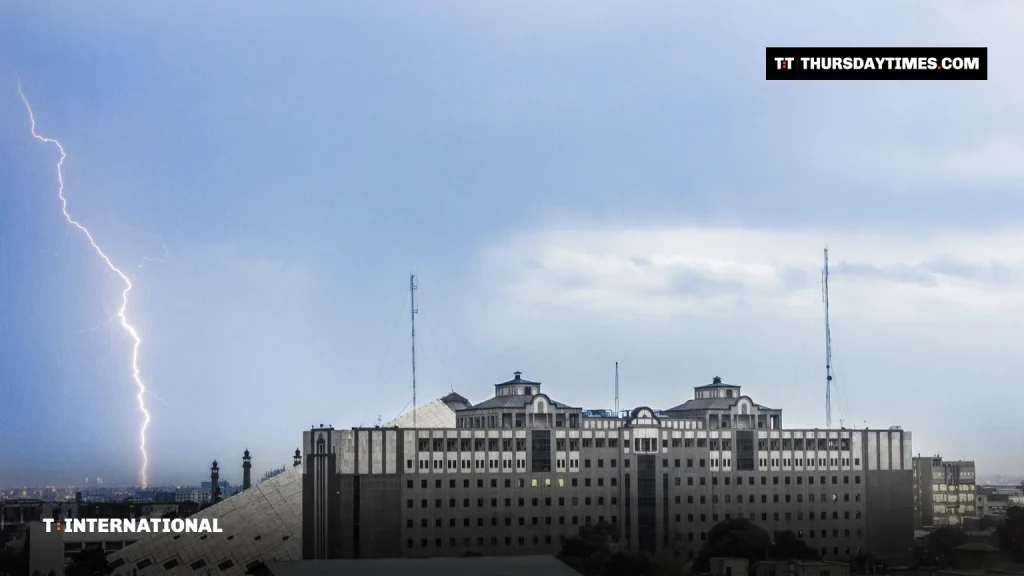
Lightning strikes in the sky near the Iranian parliament building in Tehran
Lightning over the Iranian parliament building in Tehran. File photo. — MAHDIFA33/WIKIMEDIA COMMONS (CC BY-SA 4.0)
Pakistan todayPAGE 2
Online order gone wrong? Go to the consumer court, Lahore High Court rules
Petrol cut by Rs5.45 a litre to Rs369.06, diesel down Rs3.68 to Rs391.52
Pakistan tests its first homegrown air-to-air missile, the Fa’az
THE THURSDAY TIMES · PUBLISHED BY THURSDAY MEDIA INTERNATIONAL · THURSDAYTIMES.COM1
US MIDTERMS · THE WORLD · PAKISTAN · WEDNESDAY 4 NOVEMBER 20262
US MIDTERMS 2026

Trump congratulates Democrats, says he’d have won on the ballot

He blamed Republican candidates and warned he would ‘veto everything’ if the new majority does not work with him

TT Foreign Desk · Washington

US President Donald Trump congratulated Democrats on winning both chambers of Congress, but said Republicans would have won had his own name been on the ballot, and warned he would “veto everything” if the new majority refused to work with him.

“My message is, congratulations to the Democrats, and I look forward to working with you for the good of our country,” Trump said in a telephone interview on election night. “I have total veto power and I’m sure we’ll be able to work things out.” He added: “I think they’re gonna want to work with me. Otherwise I’d just veto everything and they’re not gonna want that.”

He placed the blame on his party’s candidates. “In some cases they didn’t like the candidates, and in some cases those candidates were not my friend and the base knows that better than anybody,” he said. “We would have won easily if I was on the ballot. But I wasn’t.” In a television interview aired early on Wednesday, he said Democrats “did a good job”.

Trump had spent the final weeks telling voters to “pretend I’m on the ballot”. As results came in, he posted: “I wasn’t on the Ballot and if I was, we would have won IN A LANDSLIDE!” He also shared a picture of a red baseball cap with the word “veto” on it, after vowing to be “Mr Veto” before the vote.

Several of the candidates he personally backed lost, including Ken Paxton in Texas, Michael Whatley in North Carolina and Darline Graham in South Carolina.

Asked if he was upset, Trump said he had “tried hard” and “left it on the field”. “It’s a point in time. Happened many times before,” he said.

He was also asked about the war with Iran, in which Pakistan has been a central go-between. It would be over “when I say it’s over, basically”, he said. “It’ll end when I say it ends.”

Three NASA astronauts vote from the space stationAnil Menon says he, Luke Delaney and Jessica Watkins filled out electronic ballots, and his sleeping quarters served as the voting booth
Continued from page 1

‘Americans said no to war,’ Iran’s parliament speaker says

Lightning strikes in the sky near the Iranian parliament building in Tehran
Lightning over the Iranian parliament building in Tehran. File photo. — MAHDIFA33/WIKIMEDIA COMMONS (CC BY-SA 4.0)

Iran’s parliament speaker has welcomed the Democrats’ win in the US midterms as a vote against the war, and warned Washington not to ignore it.

“Conscience or the cost of living, Americans said NO TO WAR, and we endorse this message,” Mohammad Bagher Ghalibaf wrote on X. “If the US govt betrays their public will to serve international paymasters and blackmailers, it will learn our NO comes with a Nightmare.”

Voters’ anger over high prices and the war with Iran ran through the campaign, and Democrats will now control both chambers of Congress from January. But the war remains in President Donald Trump’s hands. Asked about it on election night, he said it would be over “when I say it’s over, basically. It’ll end when I say it ends.”

Before the vote, US officials warned that Trump might order a major strike if Republicans lost, which a White House official rejected. Three tankers hit mines in the Strait of Hormuz this week, Iran said, as Qatar kept talks going.

A deal under discussion would reopen the strait in exchange for sanctions relief, followed by nuclear talks. Pakistan has been a central go-between in the war.

What we knowGhalibaf on X: “Americans said NO TO WAR”.Trump: the war ends “when I say it’s over”.

The world in brief

EVERY STORY IN FULL AT THURSDAYTIMES.COM
Spain’s transport minister resigns six days after train crash killed 69Óscar Puente told Congress he could not stay after two such disasters in a year, and also quit as a candidate in this month’s general election
Canva shakes up 22% of its jobs, with layoffs and moves to SydneyChief executive Melanie Perkins says the design company needs to be ‘refounded’, in changes affecting 1,271 people
NASA seeks ideas to save Hubble before it falls to Earth around 2033The 36-year-old telescope still works well, and administrator Jared Isaacman says it deserves the effort
Europe’s Hera probe gets first sight of the asteroid NASA hit in 2022The spacecraft is closing in to measure what the deliberate crash did, in a test of how to defend Earth from asteroids
Israel election: Five opposition leaders back Eisenkot for prime ministerThey will recommend him to President Herzog, whose talks begin on Wednesday, but remain split over the Arab-led parties they would need for a majority
Binance says a fake job interview opened the door to its $6.3bn hackAn engineer was told to download an ‘assignment’ that was really malware, and the hackers then used a compromised AI tool to reach two more laptops

Pakistan

NATIONAL · ECONOMY · MILITARY

Pakistan weighs arbitration against Etisalat over $800m PTCL balance

TT Business Desk · Islamabad

Pakistan is considering international arbitration against Etisalat to recover $800 million still owed from the 2005 sale of PTCL, along with the cost of waiting for it since 2008 and damages, a Senate meeting heard on Tuesday.

A joint meeting of the Senate committees on privatisation and IT was told that the attorney general’s office has been directed to carry out a federal cabinet decision on the matter at the earliest. The IT secretary called the subject sensitive, and the rest of the session was held behind closed doors.

According to a Privatisation Ministry briefing, Pakistan sold a 26% stake and management control of PTCL to Etisalat for $2.59 billion. It has received $1.76 billion, and about $800 million remains unpaid. Etisalat, now known as e&, tied the balance to the transfer of PTCL properties. The briefing said 99% have been transferred, with 32 of 3,246 still outstanding.

A committee set up in July under the prime minister’s privatisation adviser recommended arbitration after 20 years of dispute, as allowed under the sale agreement. The attorney general is to assess the case first, and would need approval from the prime minister or the federal government before sending Etisalat a notice of intent.

Senators complained they had not been given access to the sale agreement itself. There was no immediate comment from Etisalat.

Seventeen terrorists killed in Balochistan, soldier martyred, ISPR saysForces stopped an attempted roadblock in Kachhi and raided a hideout in Kharan, where Sepoy Hikmat Ullah was martyred
Pakistan tests its first homegrown air-to-air missile, the Fa’azThe ISPR says the missile can hit aerial targets at longer ranges and will strengthen the Pakistan Air Force
Air Punjab has not been scrapped, government says, blaming war for delaysThe airline has its licence and is leasing six aircraft for its first phase, the provincial transport secretary says
Petrol cut by Rs5.45 a litre to Rs369.06, diesel down Rs3.68 to Rs391.52The new rates apply from Wednesday, a day after the last revision, as the minister had hinted
Pakistan and Syria discuss stronger military ties in DamascusThe meeting between Syria’s defence minister and Pakistan’s attaché comes days after Damascus said it was weighing the Makkah defence pact
InsideGulf, 3 · Views, 4 · Analysis, 5 · T:LIFE, 6 · Sports, 7 · Westline, 8
2THE THURSDAY TIMES · THURSDAYTIMES.COM
EMIRATES · SAUDI · QATAR · WEDNESDAY 4 NOVEMBER 20263

Hormuz crisis has drained nearly a billion barrels from world oil stocks, ADNOC chief says, as shipping hits 30% of a barrel’s cost

“The world has eroded its supply buffers,” Sultan Al Jaber tells the ADIPEC energy conference in Abu Dhabi, with diesel stocks at a 35-year seasonal low in some markets

Sultan Al Jaber on a stage screen at ADIPEC beside a graphic reading 1 billion barrels drained from global inventories
ADNOC chief executive Sultan Al Jaber addresses the opening of ADIPEC in Abu Dhabi on Monday, with a graphic on stage showing barrels drained from global inventories. ADNOC/Handout
Thursday Emirates · Abu Dhabi

Nearly one billion barrels have drained from global oil inventories since the disruption of the Strait of Hormuz, ADNOC chief executive Sultan Al Jaber said on Monday, warning at the opening of the ADIPEC energy conference that “the world has eroded its supply buffers”.

Al Jaber, who is also the UAE’s industry minister, said diesel stocks in some markets were at their lowest seasonal level in 35 years, and that others faced a gap of 600 billion cubic feet in liquefied natural gas supply.

Shipping and logistics, he said, made up less than 5 per cent of the cost of a barrel before the disruption. They now account for more than 30 per cent.

“Supply is only half the story. The other half is delivery,” he said. “Energy security is not only measured at the point of production. It is now also measured at the point of delivery.”

The billion-barrel figure is his own. The International Energy Agency, which adds up only the stocks it can observe, has recorded a markedly smaller fall. In October the agency forecast that global oil supply would drop by 5.8 million barrels a day in 2026 and demand by 2.6 million.

Al Jaber set out five steps for the industry. The first was accessible supply, with more strategic storage, larger stockpiles of products and flexible refining capacity closer to consumers. The second was routes to market. “Supply only counts when it arrives,” he said.

The third was operational intelligence, moving to energy systems that anticipate risk. The fourth was capital, with policy to build confidence, finance to accelerate it and insurance to keep trade moving. The fifth, which he called the most important, was people. “Systems don’t carry responsibility, people do,” he said.

He said ADNOC had prepared long before the crisis. “We did not write our playbook during this disruption. We wrote it years before, and at ADNOC, it did not make us immune; it made us prepared.”

The UAE, he said, had held firm under pressure. “Talent stayed. Capital stayed. Investment kept coming and the economy kept moving.” He said the country would keep pressing for dialogue and political solutions that stabilise energy flows, and closed with a message to partners: “When it counts the most, you can count on the UAE.”

ADNOC also announced a final investment decision on the Ruwais Diyab development in Abu Dhabi, its first large-scale unconventional gas project. The company said it would deliver 345 million standard cubic feet of raw gas a day from 2029, with the potential to reach up to one billion.

The four-day conference opened hours after ADNOC signed a partnership with OpenAI and G42, with OpenAI chief executive Sam Altman on stage. It runs until 5 November, though ExxonMobil and Chevron have pulled senior executives from the event over security concerns, sources said.

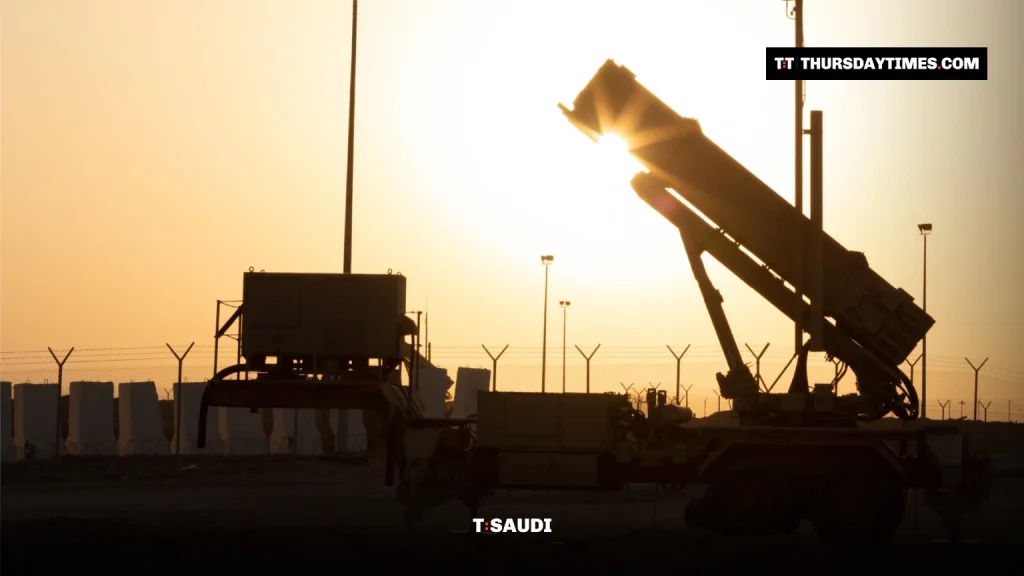
A Patriot missile launcher silhouetted against the setting sun

Saudi-led coalition intercepts Houthi ballistic missile after strikes on Yemen’s Ras Isa port, as Houthis threaten Aramco

Riyadh · thursdaytimes.com
A Nakilat LNG carrier with a maroon hull guided by tugboats

Qatari LNG carrier Al Mayeda hit by ‘unidentified objects’ in the Gulf, crew unhurt

Doha · thursdaytimes.com

AI now ‘mostly smarter’ than top scientists, Sam Altman tells ADIPEC as ADNOC signs OpenAI deal

THE THURSDAY TIMES · THURSDAYTIMES.COM3
EDITORIAL · OPINION · WEDNESDAY 4 NOVEMBER 20264

Four fiefdoms and a flag

Pakistan's four provinces are not an administrative map. They are four estates, kept intact by the men who profit from the distance between citizens and the state.

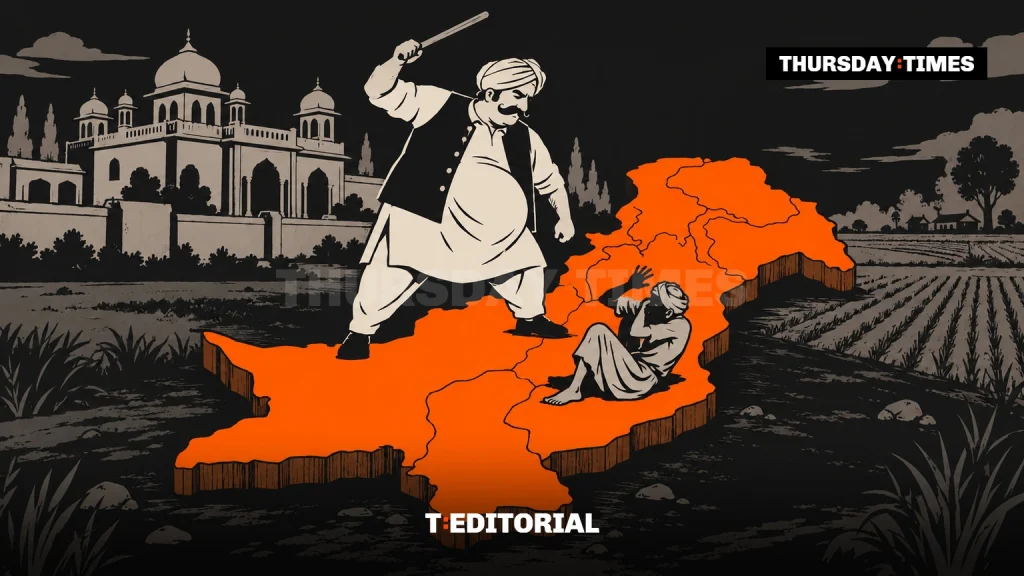
Pakistan does not have four provinces. It has four estates, and the men who own them would rather watch the country fail than redraw a single line.

Start with the arithmetic, because arithmetic does not care who your grandfather was.

Punjab holds nearly 128 million people, roughly as many as Japan, and every one of them is governed from a single secretariat in Lahore. Balochistan covers almost half the country with under 15 million. Pakistan’s population has grown more than sevenfold since 1951, and in all that time the country has lost a wing, swallowed the tribal districts and rewritten its constitution. The provinces have not moved.

No engineer would design this map. No economist would defend it. Only a landlord could love it.

The debate is back, and this time even the government is saying it out loud. The Interior Minister wants an administrative reset. The Planning Minister has floated splitting every province into three. The MQM-P wants a national dialogue, Parliament has been promised a debate this month, and a World Economic Forum paper published in October says Pakistan could run on anywhere from 16 to more than 30 first-tier units. Everyone agrees the system is failing. Almost nobody with power wants to fix it. Ask yourself why.

Every region has a name for him. In central Punjab he is the chaudhri. In the south he is the makhdoom, the pir, the gaddi nashin who inherited the land, the shrine and the assembly seat in a single bequest. In Dera Ghazi Khan and Rajanpur he is the tumandar. In Sindh he is the wadera. In Balochistan, the sardar or the nawab. In Khyber Pakhtunkhwa, the khan or the malik. Different titles. Same racket.

The numbers are not rhetoric. UNDP’s National Human Development Report found Pakistan’s elites, feudal landlords among them, capturing some $17.4 billion a year in privileges, about six per cent of the entire economy. It found a landed class of roughly one per cent of the population holding about 22 per cent of cultivable land. The 2024 Agricultural Census confirms it from the bottom: 97 per cent of farmers own less than 12.5 acres. In Sindh, 0.3 per cent of farms swallow 15 per cent of all farm area, averaging 230 acres apiece.

Land on that scale is not wealth. It is a vote bank with a fence around it. The haari who tills it votes the way the landlord votes, because the landlord owns the road to everything the state is supposed to give him for free: the FIR at the thana, the entry in the patwari’s register, the hospital bed, the teaching post, the water in the canal.

And that racket runs on one thing: distance. When the provincial capital is a day’s journey away and the chief minister will never set foot in your tehsil, the big man in the haveli becomes the only door to the state. He is a toll booth, and the longer the road to the capital, the higher the toll. He does not need you educated. He needs you to need him.

Smaller provinces shorten the road. Put a capital in Multan or Bahawalpur, give the south an assembly where it is the majority instead of a footnote, and post officers who live among the people they govern, and the toll booth starts to look like what it is: a middleman nobody needs. That is the entire reason the middlemen have spent forty years making sure it never happens.

The landed class almost never says no to new provinces. It is far too clever for that. It says yes, at the top of its voice, every five years, and then it buries the idea between elections.

Look at the record in south Punjab. In 2012 the Punjab Assembly and the National Assembly both passed resolutions for a new province. A Senate bill cleared with a two-thirds majority and was left to die in the lower house. In 2018 a bloc of south Punjab electables walked out of the PML-N, christened themselves the Janoobi Punjab Suba Mahaz, and merged into the PTI on a written promise to set the province in motion within 100 days. The PTI took 30 of the region’s 50 National Assembly seats. The province never came. South Punjab got a sub-secretariat in 2020: a branch office of Lahore with a fresh coat of paint.

The suba is a cash crop. It is planted at every election, harvested at the ballot box and ploughed back under the day the results are in. The men it elects then sit in Lahore’s assembly, in Lahore’s cabinet, at Lahore’s budget table. Why would a makhdoom who has made himself indispensable to a faraway capital want one next door, where his constituents could knock?

Then there is the hypocrisy. The PPP has sponsored bill after bill to carve a province out of Punjab, and its chairman campaigned in Multan on the promise of one. Ask the same party about Sindh and the doors slam shut. On 3 September the Sindh Assembly unanimously rejected any division of the province, invoking its veto under Article 239(4), in a line of such resolutions going back to 1948. The Chief Minister said the decision belonged to Sindh’s legislators, “not businessmen from Lahore.” Divide Punjab, never Sindh. That is not a principle. It is a property line.

He is right that it is Sindh’s decision. He is wrong about who Sindh is. The unity defended in that chamber is not the unity of the families of Tharparkar and Thatta, who have been failed by every provincial government they have ever had. It is the unity of an estate: land, votes and office held in the same few hands since before Partition, in the province with the most concentrated landholding of any large one in Pakistan. “Sindh’s integrity” is the wadera’s integrity, wearing an ajrak.

And when people demand a province from below rather than from the drawing room, the state has answered with bullets. In April 2010, when Hazara rose against the renaming of the NWFP and demanded its own province, police opened fire in Abbottabad. At least seven people were killed. Nobody answered the movement. They simply waited for it to tire.

Editorial · The Thursday Times · First published 29 October 2026
Illustration of a feudal landlord standing over a map of Pakistan rendered in orange, a small cowering figure beside him, a grand haveli in the background
“Start with the arithmetic, because arithmetic does not care who your grandfather was.”
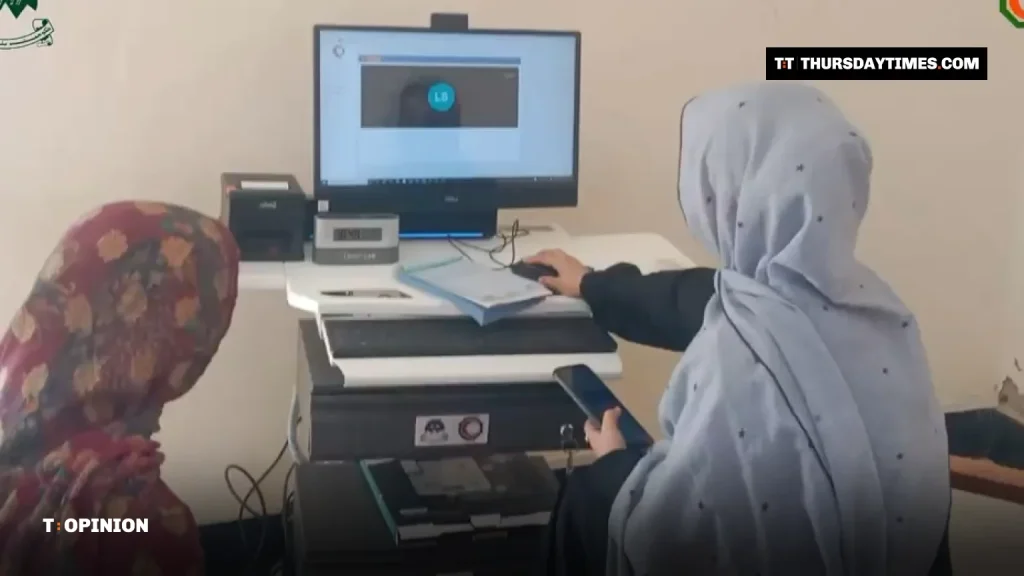
Two women at a telehealth computer station in a Balochistan health unit
Women use a Sehat Dehleez telehealth station at a Basic Health Unit in Balochistan. — SCREENGRAB/PPHI BALOCHISTAN

Sehat Dehleez is Balochistan’s healthcare breakthrough

Free consultations, e-prescriptions, referrals and family health records on one public platform: Balochistan has built a model the rest of Pakistan can learn from.

Words by Dr Muhammad Bux Dharejo · First published 31 October 2026

Imagine living in Karachi, Lahore, Peshawar or Islamabad. You may be surrounded by some of the country’s largest hospitals, medical institutions and specialist facilities. Yet, when you need medical advice, you may still have to find a doctor, arrange transport, wait for an appointment and navigate a fragmented healthcare system. Now imagine accessing a connected public healthcare service, free of charge, with a single click on your personal or family mobile phone — a doctor consultation, electronic prescription, referral to a hospital and continuity of medical records. And imagine that this 24/7 service comes not from one of the country’s traditionally better-resourced urban centres, but from Balochistan!

This is the proposition of Sehat Dehleez, an initiative of PPHI Balochistan. More than a mobile or web application, it represents a different way of organising public healthcare: bringing the system closer to every citizen, rather than making the citizen struggle to reach the system. Open to citizens of Pakistan from anywhere in the country and across the world, it challenges the conventional boundaries of provincial public service delivery.

The distinction lies in integration. Teleconsultation alone is not a healthcare system. A digital prescription alone does not guarantee continuity of treatment. A referral alone does not ensure that a patient reaches the appropriate facility. Sehat Dehleez seeks to connect these essential elements into one coordinated pathway to ensure continuum of care and universal health coverage. A citizen can obtain a free consultation with a doctor, receive an electronic prescription, and, where further treatment is required, be referred to an appropriate hospital. Hospitals and ambulances are linked to the referral mechanism, with the objective of making the patient’s transition from consultation to further care more organised and traceable.

Its most significant dimension may be the Electronic Medical Record. Each family member has a separate digital health record, allowing consultations, prescriptions, diagnostic information and follow-up to contribute to an evolving medical history. Healthcare should not begin from zero every time a patient meets a new doctor. Nor should a person’s medical history remain scattered across pieces of paper, different facilities and disconnected encounters. A connected record can help make care more informed and continuous.

The scale of the supporting infrastructure is equally important. PPHI Balochistan has connected 185 Basic Health Units to satellite-enabled TeleHealth services. Its TeleHealth Nerve Centre in Quetta operates 24/7 consultation stations with 115 Lady Medical Officers and 15 Consultants. The pilot intervention in Balochistan recorded 437,569 consultations, with women accounting for 85 per cent of consultations. These figures reflect the potential of technology to overcome geographical barriers, particularly for women and communities living far from conventional healthcare facilities.

There is a larger national significance to this development. Sindh, Punjab and Khyber Pakhtunkhwa have their own healthcare initiatives, resources and digital interventions. But the benchmark should not be the number of applications launched or the size of a budget announced. It should be the completeness of the service a citizen can actually access. Sehat Dehleez puts forward an integrated model in which consultation, prescription, referral, hospital connectivity, ambulance linkage and family health records are brought together through a single public platform. This is the distinction that deserves national attention, as it is the first of its kind in Pakistan.

For too long, Balochistan has been viewed primarily through the lens of deprivation, distance and institutional constraints. Its challenges are real; so is its capacity to innovate. The province that has often been expected to follow is now presenting an approach from which the rest of the country can learn. It is a reminder that innovation is not the exclusive privilege of wealthier regions, larger cities or bigger institutions. Vision, institutional commitment and the intelligent use of technology can create possibilities even where resources are constrained.

Sehat Dehleez does not suggest that digital consultations can replace hospitals, emergency care or physical medical examinations. It offers something equally important: a more accessible first point of contact and a gateway into the healthcare system for completing the entire loop of continuum of care — a more connected journey through the healthcare system.

The real measure of this initiative will be the patient who receives timely advice, the woman who avoids an unnecessary journey, the family whose medical history remains accessible and the citizen whose referral does not end at the click of a button.

Balochistan is not merely trying to close the healthcare gap. It is demonstrating how that gap can be reimagined — by taking healthcare to the citizen, wherever the citizen may be.

185
Basic Health Units linked by satellite
24/7
control centre in Quetta
437,569
consultations in the pilot
85%
of those consultations involved women
4THE THURSDAY TIMES · THURSDAYTIMES.COM
WEDNESDAY 4 NOVEMBER 20265

Why Congress changing hands won’t rewrite US-Pakistan ties

A Republican still walks the White House corridors and America’s shared interests with Pakistan have not moved. Any promise of relief for Imran Khan from a Democratic majority will fail, just as the last one did.

TT Monitoring Desk · 4 min read
Donald Trump and Shehbaz Sharif seated facing each other in the Oval Office, with Asim Munir, JD Vance and Marco Rubio on the sofas
President Donald Trump meets Prime Minister Shehbaz Sharif and Field Marshal Asim Munir in the Oval Office in September 2025, with Vice President JD Vance and Secretary of State Marco Rubio. File photo. — THE WHITE HOUSE

Within hours of the American vote, a familiar claim began circulating on Pakistani social media: Washington has turned, and relief for Imran Khan is on the way. The record of the past 79 years suggests otherwise. Congress has changed hands. The reasons the two countries deal with each other have not.

Tuesday’s result was a verdict by Americans on American concerns: prices, tariffs, corruption and an unpopular war. It reshapes Washington’s domestic politics, and it will make Donald Trump’s last two years far less comfortable. It does not put a new person in the Oval Office.

The president still directs diplomacy, commands the military and sets the tone with foreign leaders. He also keeps his veto, and overturning it takes a two-thirds majority in both chambers, which Democrats do not have. What they gain from January is the power to hold hearings, summon officials, write spending bills and, in the Senate, slow down nominations. Those are real tools, and Pakistan will feel some of them at the margins. None of them hands Congress the Pakistan file.

Anyone who believes the relationship follows party colours should look at its history. Jimmy Carter, a Democrat, cut off aid in 1979 over the nuclear programme, and Ronald Reagan, a Republican, restored it when Afghanistan made Pakistan indispensable. The Pressler sanctions of 1990 came under a Republican president, using a law written by a Republican senator. A Democratic Congress passed the Kerry-Lugar-Berman act in 2009, promising $7.5 billion in civilian aid. Mr Trump himself froze security assistance in 2018, in his first term, before becoming the warmest American president Islamabad has dealt with in years.

What moved policy each time was the same thing: what Washington needed in the region, and whether Pakistan could help provide it. That is an unsentimental basis for a friendship, and it is also a durable one. It has outlasted every leader on both sides.

Congress has already tried its hand at Pakistani politics. In June 2024, the House voted 368 to 7 for a resolution calling for an investigation into claims of irregularities in Pakistan’s election. It drew excited coverage and was shared endlessly online. American policy towards Pakistan did not change as a result, and that was with a large bipartisan majority behind it.

Expect more of the same from a Democratic House. A committee chair may hold a hearing, and some members will make statements about Mr Khan, encouraged by an organised diaspora lobby. Islamabad should engage those members and not ignore them. But noise on Capitol Hill is a different thing from a change in American interests, and the PTI case does not figure in the calculations that drive this relationship.

Why, then, the excitement? Partly because the PTI’s overseas online campaign has had little else to celebrate. The party’s government in Khyber Pakhtunkhwa has ended in governor’s rule, its street campaigns have not delivered, and the understanding with the establishment it has long sought has not come. For accounts that live on attention, a Democratic victory is fresh material.

We have seen this story before. In the run-up to Mr Trump taking office, the same networks told followers that his return meant relief for Mr Khan and a revival for the party. That narrative was false. When neither arrived, they turned on the man they had been promoting and began attacking him.

The same pattern is now taking shape around the Democrats, and it will end the same way, because the premise has not changed. Mr Khan and the PTI are non-issues in US foreign policy. That policy is built on common geopolitical interests, and those interests currently converge on key issues between Washington and Islamabad. Supporters of the party deserve more honesty about this from those who claim to speak for them.

The agenda between the two capitals is crowded, and it has little to do with any of this. There is the war with Iran on Pakistan’s border, in which Islamabad has been a central go-between. There is Afghanistan and the terrorism launched from its soil. There is energy, including a US-backed consortium that wants to build an LNG terminal at Port Qasim. Secretary of State Marco Rubio put the matter plainly last month, saying the United States “has to have a relationship” with nuclear-armed Pakistan.

It is on these questions that President Trump, Prime Minister Shehbaz Sharif and Field Marshal Asim Munir have built their working understanding. Pakistan’s civil and military leadership has handled a dangerous period with skill, and that has been noticed in Washington and in capitals across the region. A change of committee chairs does not undo it.

None of this is a reason for complacency. Pakistan has relied heavily on the White House, and it now has a new audience on Capitol Hill that will write budgets and ask questions. Diplomats should be meeting incoming committee chairs and their staff early, and making the case on Iran, Afghanistan and trade before others make a different one for them.

But that is routine statecraft, not a crisis. On social media, this week’s vote may look like a turning point for Pakistan. In the offices where the relationship is actually managed, the work carries on much as it did last week.

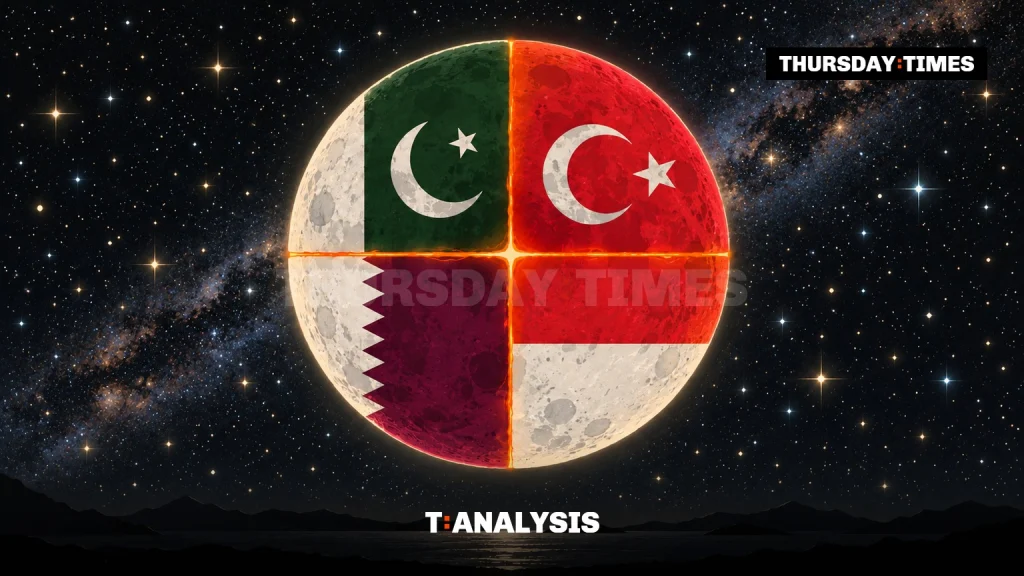
Illustration of a full moon made of four quarters showing the flags of Pakistan, Türkiye, Qatar and Indonesia, welded together by glowing orange seams in a starry night sky
Illustration: The Thursday Times
First published 21 October 2026

With Badr, four Muslim powers bet on building their weapons together

The memorandum that Türkiye, Qatar, Pakistan and Indonesia signed in Doha on Wednesday is easy to mistake for one more line in the long ledger of Muslim-world defence communiqués. It is better read as industrial policy. The Badr Memorandum of Understanding is not a promise to fight together but a plan to build together, and between them its four signatories bring the four things an arms industry needs: factories, money, manpower and a market.

Türkiye’s Ministry of National Defence, which announced the signing, chose the name with care. Badr recalls the Battle of Badr in 624, the first decisive victory of the early Muslim community. The ministry offered a plainer reading too: badr means “full moon”, an image it used for four nations that complete one another.

The stated aims are broad. The memorandum commits the four to cooperate in military production, raise their armed forces’ capabilities and work together on technical military training, research and development. The ministry said it would pool the signatories’ production capacity to meet “the needs of allied and friendly nations”, a phrase that looks beyond the four towards export, and called the accord one of “substantial economic importance”.

Each signatory already has its own thread running to Ankara. What Badr does is weave them onto one loom, and each partner brings something the others lack.

Türkiye is the obvious anchor. Its defence and aerospace exports passed $10 billion for the first time in 2025, according to Haluk Görgün, head of the Presidency of Defence Industries, who attended the signing in Doha. The sector closed the year with a record $17.8 billion in new contracts. SIPRI noted in April that the biggest driver of Turkish military spending is no longer operations in Iraq, Syria and Somalia but investment in the country’s own arms industry.

Qatar brings what factories need most: patient capital and a first customer. Barzan Holdings, chaired by Sheikh Saoud bin Abdulrahman Al Thani, who signed for Doha on Wednesday, has spent the past year turning purchases into partnerships. At the DIMDEX exhibition in January it widened its BARQ joint venture with ASELSAN to add local production, signed a joint production memorandum with the drone maker STM and a letter of intent with KNDS on ammunition. More than 70 agreements, reportedly worth over $5.1 billion, were announced at that show alone. On Monday, Sheikh Saoud told the Global Security Forum that Qatar would soon announce a local defence production hub.

Pakistan, the Muslim world’s only nuclear power, offers scale and experience. It fields the largest standing force of the four and runs working production lines: fighters at the Pakistan Aeronautical Complex in Kamra, warships in Karachi. The sale of up to 40 JF-17s to Azerbaijan, valued at up to $4.6 billion, was its largest export deal, and the four-day conflict with India in May 2025, which SIPRI notes involved combat aircraft, drones and missiles, gave its forces the kind of operational data defence industries prize. The Babur-class corvettes show how Pakistan already works with Türkiye: the 2018 MILGEM deal included design rights and construction know-how, and two of the four ships were built at Karachi Shipyard.

Indonesia, finally, is the market, and an assertive one. A country of more than 280 million people raised military spending by 28 per cent last year, the steepest rise of the four, and insists on building what it buys. The KAAN contract signed in Istanbul in July 2025 includes manufacturing and maintenance facilities in Indonesia, and a separate agreement brought in PT Dirgantara Indonesia and PT Republik Aero Dirgantara.

The deeper logic lies in who these countries have been buying from. In SIPRI’s arms-transfer data for 2021–25, Qatar and Pakistan were the world’s fourth and fifth largest importers, together taking more than a tenth of all the major weapons traded across borders. Pakistan bought 80 per cent of its arms from China; Qatar alone accounted for 7.4 per cent of all American arms exports.

Buying at that scale means waiting in other countries’ queues. An industry source told Middle East Eye in May that US Patriot and THAAD air-defence systems, and their ammunition, faced multi-year delivery backlogs, while Turkish systems could be supplied “within a similar timeframe”, with “a potential option for localisation and joint development if the conditions are right”.

The Iran war drove the point home in Doha. Qatar shut much of its liquefied natural gas complex at Ras Laffan soon after the fighting began, and restrictions on shipping through the Strait of Hormuz disrupted its trade. Qatari sources told Middle East Eye that Badr reflects those lessons, and Doha’s need for air defence it can afford and obtain quickly.

The memorandum’s text has not been published, but people familiar with the arrangement have described a three-tier structure to Middle East Eye.

Türkiye, with the region’s deepest industrial base, is expected to host the joint production facilities, while Qatar has committed funding and technology, the same sources said. Türkiye’s defence industry agency has said the memorandum will help carry forward defence projects already under way among the four, which suggests Badr’s first job is to bind existing bilateral work, from KAAN to MILGEM to BARQ, into a single pipeline rather than to start from scratch.

Badr comes ten weeks after the Makkah Joint Defence Agreement, signed on August 7 by Crown Prince Mohammed bin Salman, President Recep Tayyip Erdoğan and Prime Minister Shehbaz Sharif, under which “any armed attack against any one of the three states shall be regarded as an attack against them all”.

The two are different instruments. Makkah is a guarantee: it settles who comes to whose aid. Badr is a supply chain: it settles who builds what. Pakistan and Türkiye sit in both, which makes them the hinge of an emerging arrangement in which a security pact and an industrial bloc overlap without merging. Both are written with room to grow. Deputy Prime Minister Ishaq Dar has said the Makkah accord is open to others who share its principles, and Badr’s founding statement already speaks of serving “allied and friendly nations”.

This has been tried before, and Qatar was in the room. In April 1975 Egypt, Saudi Arabia, the United Arab Emirates and Qatar founded the Arab Organization for Industrialization in Cairo. The three Gulf states put in $260 million each and Egypt contributed four military factories. The venture foundered within four years, when the Arab states broke with Egypt over its peace with Israel.

Türkiye
Factories: $10bn+ in defence exports in 2025.
Qatar
Capital: 70+ deals worth $5.1bn+ at DIMDEX.
Pakistan
Scale: Kamra, Karachi, and JF-17s for Azerbaijan.
Indonesia
Market: the buyer the others build for.
THE THURSDAY TIMES · THURSDAYTIMES.COM5
HOME · CULTURE · FOOD · WEDNESDAY 4 NOVEMBER 20266

Gas only at meal times from today: your new winter hours

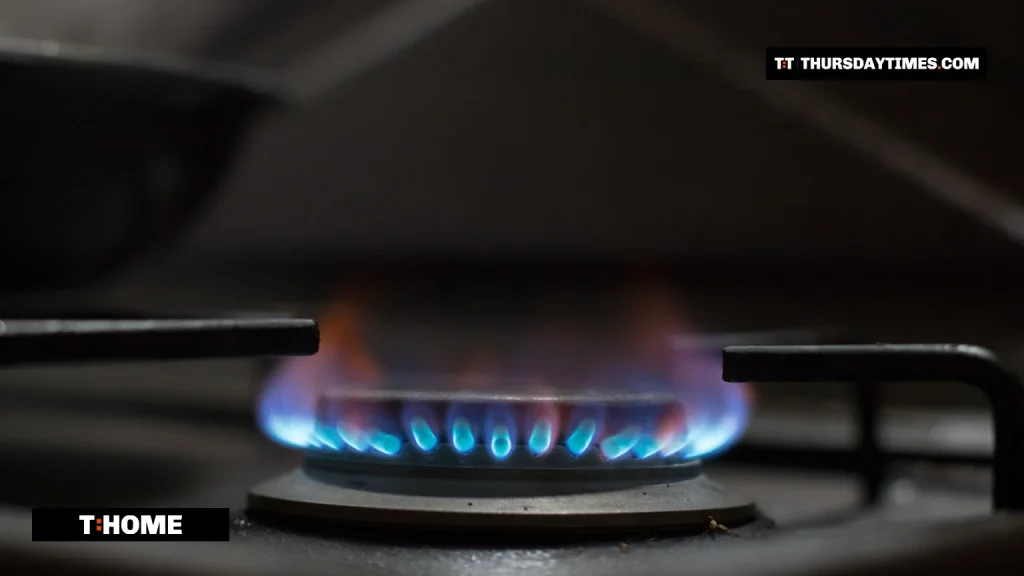
Blue flames on a gas stove burner
A gas stove burner. File photo. — IVAN RADIC/WIKIMEDIA COMMONS (CC BY 2.0)
BREAKFAST
6:30
to 9am
LUNCH
12pm
to 2:30pm
DINNER
6pm
to 9pm

The same three slots now apply across Pakistan, so here is how to plan your cooking and stay safe at home

TT Islamabad Bureau

Piped gas in Pakistani homes now comes on a timetable. From Wednesday, the two gas utilities are supplying domestic consumers in three daily slots built around meals, with the same hours across the country.

Your new gas hours: 6:30am to 9am for breakfast, 12pm to 2:30pm for lunch and 6pm to 9pm for dinner.

Sui Northern Gas has announced the hours for Islamabad, Punjab and Khyber Pakhtunkhwa, and Sui Southern Gas for Sindh and Balochistan, which it says is “prioritising domestic consumers by ensuring supply during meal times”. The change comes as LNG runs short and winter demand rises. In Karachi, where there was a severe shortage on Tuesday, contradictory schedules had been circulating on social media before the company confirmed the official one.

Plan cooking, and any water you heat on the stove, inside the slots, because low pressure or no gas is likely outside them. Keep the kitchen stove knobs and any gas heater valves firmly shut when supply stops, as gas can return without warning when the next slot begins. Check that the flame is lit before you walk away.

Do not use a gas stove to heat a closed room, and keep a window or vent open with any gas heater. Gas fires and carbon monoxide poisoning are a known danger in Pakistani homes every winter.

If you are thinking of switching to LPG

Check the price first. The legal maximum for November is about Rs295 a kilogram, but Petroleum Minister Ali Pervaiz Malik says some sellers are charging Rs700 to Rs800 because of the shortage.

CNG users should also prepare. Sui Northern has cut supply to CNG stations from 50 million to 35 million cubic feet a day and plans to suspend it in the coming days.

Collage: a boy in a mask and waistcoat, a girl dressed as Hermione holding a toddler dressed as Harry Potter, a laughing girl in Halloween make-up, and a boy in bat face paint holding a flashcard

Witches’ hats, superheroes and flashcards: Islamabad children learn English at a Halloween party

Mahwish Fakhar · Islamabad

Witches’ hats, masks and English flashcards took over a language school in Islamabad for Halloween, as children arrived at the Berlitz Language Institute dressed as their favourite cartoon characters and superheroes.

The little guests spent the event on games and stories, and went trick-or-treating around the institute, which had been hung with bat, ghost and pumpkin decorations and orange and black balloons. “I am the Batman,” one small boy declared, and a girl said she had come as Hermione, with her little brother as Harry Potter. Adults joined in too, in witch’s hats and masks of their own.

There was a lesson tucked inside the fun. Between the games and the costumes, the children picked up new English words and phrases and got a glimpse of other cultures and traditions, including through word cards laid out on the tables.

PTV Drama and Film Academy to be revamped and offer Pakistan’s first local colour grading training, Tarar says
GTA VI needs up to 212GB, and you can start downloading it on November 10The game launches on November 19 at $79.99 and is digital only, so even boxed copies will contain just a download code
Sir Patrick Stewart, Star Trek’s Captain Picard and X-Men’s Professor X, dies at 86
6T:LIFE · THE THURSDAY TIMES · THURSDAYTIMES.COM
CRICKET · FOOTBALL · THE WORLD · WEDNESDAY 4 NOVEMBER 20267
Pakistani boxer Abida Batool holds the WIBA world atomweight belt at ringside in Pattaya, Thailand
SPORTS

Quetta’s Abida Batool becomes first Pakistani woman to win a WIBA world boxing title

The 26-year-old took the vacant atomweight belt in Thailand on the judges’ scorecards after a headbutt left her with a fractured nose

TT Sports Desk · Pattaya

Quetta boxer Abida Batool has become the first Pakistani woman to win a Women’s International Boxing Association (WIBA) world title, taking the vacant atomweight belt against Thailand’s Wandee Sinongkhrot in Pattaya.

The 26-year-old won on a split technical decision at FCC Stadium on October 31, on the “Brave Hearts” card. The scheduled eight-round fight was stopped in the fifth after an accidental headbutt left Batool with a fractured nose, and the ringside doctor called off the contest, sending the result to the judges’ scorecards.

Two judges scored it 50-45 and 49-48 for Batool, while the third had it 48-47 for Sinongkhrot.

It was Batool’s second title fight in Thailand this year. In January she challenged Wisuta Sririttidet for the WBC Asia atomweight title in Bangkok but lost. She went into this bout ranked as Pakistan’s top female professional boxer and third in the WBC Asia rankings.

Batool began boxing in 2018 and has won Pakistan’s national professional title. She has also competed in mixed martial arts, wushu and kickboxing, and came up through financial hardship and early resistance from her family. She prepared in Islamabad before travelling to Thailand.

After the win she thanked her family, her coach Shariq Khan and the people of Pakistan. “This is just the beginning,” she said. “I’m coming for more titles.”

‘A little bit sad’: Glenn Maxwell retires from international cricket after 14 years and three World Cup titles

The man behind the 201 not out against Afghanistan will keep playing for the Melbourne Stars in the Big Bash League

Glenn Maxwell has retired from international cricket, ending a 14-year Australia career that brought three World Cup titles and one of the greatest innings ever played in the 50-over game.

The 38-year-old, known as “The Big Show”, announced the decision on Monday on a cricket podcast. “A little bit sad and a little bit inevitable as well,” he said. He has also given up first-class and List A cricket, but will keep playing for the Melbourne Stars in the Big Bash League after extending his contract until the 2027-28 season.

Maxwell had already quit one-day internationals in June 2025, and his last appearances for Australia came at the 2026 T20 World Cup, where the team went out in the group stage.

His defining innings came against Afghanistan in Mumbai at the 2023 World Cup. With Australia 91 for seven chasing 292, he batted through severe cramps to make 201 not out off 128 balls and won the match by three wickets, sharing an unbroken stand of 202 with captain Pat Cummins. Australia went on to win the title, as they had in 2015, and he was also part of the side that won the T20 World Cup in 2021.

He finished with 3,990 runs from 149 ODIs at a strike rate of 126.70, and 2,897 runs from 130 T20 internationals, including five centuries, level with India’s Rohit Sharma for the most by a man in the format. He played seven Tests, scoring one century.

MUMBAI, 2023
201*
off 128 balls, from 91/7 chasing 292
202 stand with Cummins3 World Cups
Jesus de Miguel in a black Castellon shirt on the pitch, hands on his hips
Jesus de Miguel playing for Castellon in May 2024. File photo. — ESTEVOAEI/WIKIMEDIA COMMONS (CC BY-SA 4.0)

De Miguel’s death: Police open inquiry, but prosecutor doubts a case

Spanish police have opened an investigation into possible involuntary manslaughter after the death of Tenerife striker Jesus de Miguel, a routine step after any death not by natural causes, but the region’s chief prosecutor says a criminal case would be “very difficult”.

De Miguel, 30, died on Tuesday, a day after a collision with Andorra goalkeeper Jesus Owono in the sixth minute of stoppage time of a Spanish second-division match.

Jose Luis Sanchez-Jauregui, chief public prosecutor in Santa Cruz de Tenerife, said the impact happened in the course of play, and that Supreme Court doctrine holds that injuries on a sports field are not punishable unless play had stopped. He said he would wait for the referee’s report and a decision by the disciplinary committee. De Miguel’s family could still file a complaint.

The referee’s report said Owono was sent off “for impacting sharply upon an opponent with his leg high and excessive force in dispute of the ball”. Under federation protocols he could face a 12-game ban.

Owono, 25, an Equatorial Guinea international, has faced abuse since the match. Spanish media reported that sections of the crowd chanted “murderer” as he left the field and that he has deactivated his Instagram account. Sources close to Andorra insist he had no intention of hurting De Miguel, and Spanish radio reported that he was seen crying and praying in the dressing room.

Tributes came from across the sport. “There are no words. My condolences and lots of strength to all his family and friends,” Lionel Messi wrote. Kylian Mbappe said: “Much sadness, there are no words.” Gerard Pique, who co-owns Andorra and was at the match, wrote: “I am so deeply sorry, to my soul. Rest in peace, Jesus.”

The Spanish federation postponed Tuesday’s cup matches, and Tenerife have asked to postpone their next two games. Club president Felipe Minambres said players would need “professional assistance”, and Andorra said it was giving psychological support to anyone who needs it.

De Miguel scored 11 goals in 29 appearances for Tenerife after joining in 2025. He leaves a daughter, born last year.

THE THURSDAY TIMES · THURSDAYTIMES.COM7
PULL-OUT · THE THURSDAY TIMES04.11.20268
Westline
BRITAIN, FROM THE OTHER SIDE OF THE LINEWESTLINE × THE THURSDAY TIMES
A STATE THAT STOPPED DECIDING

The backlog Britain built

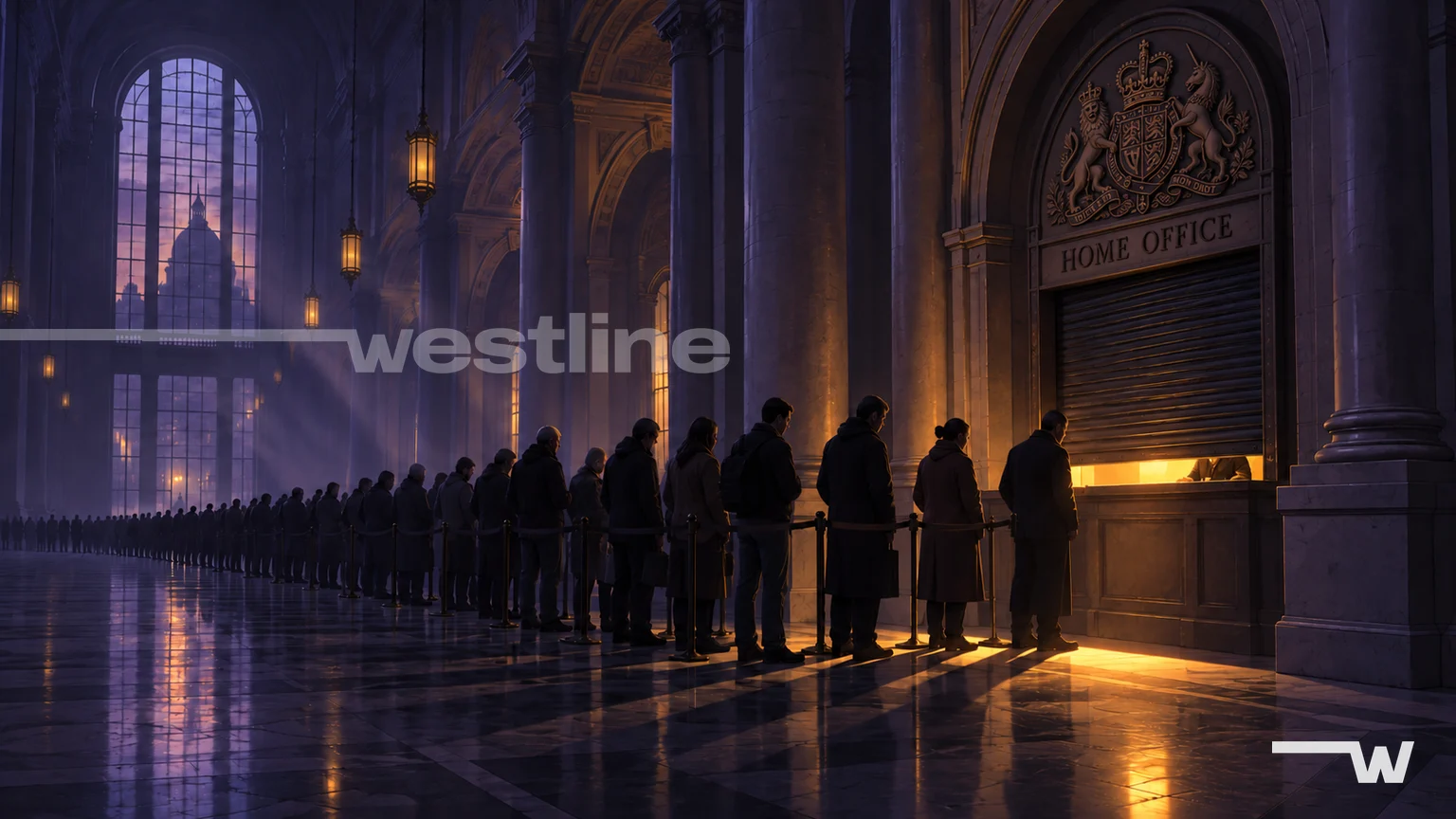
A queue stretches back into the dark while the Home Office counter stays barely open — Illustration: Westline

Ministers of both parties have spent a decade blaming the people in the queue. The numbers point at the people running it.

Abdullah Esquire
Read it in fullthursdaytimes.com/westline

CONSIDER SOMEONE WHO CLAIMED asylum in Britain in January 2023. Where they came from, and how they arrived, matters less than what happened next — which is to say, very little. When the National Audit Office took a sample of 5,000 claims lodged that month and checked on them nearly three years later, more than half were still unresolved. In the meantime our claimant will probably have been housed at public expense, largely barred from working, interviewed by a caseworker who may not have been in post for long, refused, appealed, and then left waiting again: this time for a tribunal that now takes, on average, well over a year to hear a case.

In the political conversation, that person is the problem. The backlog is discussed as though it were a weather system blown in off the Channel — too many boats, too many claims, too many people gaming the system. Arrivals do matter, and nobody serious pretends otherwise. The number of people claiming asylum peaked at around 110,000 in the year to September 2025, the highest figure in nearly two decades.

But a backlog is not a measure of how many people turn up. It is the gap between the cases that come in and the cases a department decides — and decides properly. Judged that way, the story of Britain’s asylum queue is not one of an overwhelmed border. It is the story of an institution that, over ten years, stopped doing its core job, then tried to do it at a sprint, then passed the consequences down the corridor to the courts. The people in the queue designed none of it.

Initial asylum decisions made per year

Home Office annual statistics · output collapsed before small boats became a mass phenomenon, then quadrupled on command

The rot set in long before small boats became a nightly news item. In 2015 the Home Office made 28,623 decisions on asylum applications. By 2017 that had fallen by a quarter, to 21,269, and the department never recovered its old pace. The more striking figure is what happened per head. According to the Institute for Government, in 2011/12 some 380 caseworkers were each producing around 13.7 decisions a month. By December 2022 there were 1,237 of them, managing about four apiece. The workforce had more than tripled; the output of each worker had fallen by over two-thirds.

Then, in January 2019, with ministerial approval, the department dropped its own service standard: the commitment to decide 98 per cent of straightforward claims within six months. The stated reason was to prioritise the most vulnerable cases rather than the simplest. The practical effect was to remove the one clock that had been ticking. The Migration Observatory later found that in 2014 eight in ten applicants received an initial decision within six months; within five years it was one in four.

Why this isn’t a story about the Channel In 2021 the UK had 14.9 cases in its asylum backlog per 10,000 people, more than Germany or France, even though it received far fewer applications per head than either. Countries facing heavier demand were simply getting through their caseloads faster. By December 2022 two-thirds of those waiting — almost 110,000 people — had been in the queue for more than six months. That is not a surge. It is a department that had quietly stopped deciding things.

In December 2022 Rishi Sunak did something the Home Office had not done in years: he set it a deadline. The so-called legacy backlog — roughly 92,000 claims lodged before 28 June 2022 — would be cleared within twelve months. The department doubled its decision-makers to around 2,500 and, for nationalities with very high grant rates such as Afghans, Eritreans and Syrians, swapped lengthy interviews for a questionnaire. The results were instructive. In one four-week stretch in November and December 2023, officials made 20,481 initial decisions, more than in the whole of 2021. Across that year they made 112,138. For anyone who still believed the queue was driven by forces beyond Whitehall’s control, that was the rebuttal.

The sprint had a cost, though, and it was paid in shortcuts. Asylum withdrawals in 2023 were more than four times the 2022 figure, and 79 per cent of them were “implicit” — claims the Home Office itself closed because someone missed an interview, missed a questionnaire deadline or had not updated an address. When the pledge was declared met, 4,537 legacy cases were still awaiting a decision, and the chair of the UK Statistics Authority warned that the episode might affect public trust. A Conservative government that had staked its reputation on control ended up being rebuked by the statistics watchdog for its arithmetic.

Worse, at the same moment that one arm of the department was racing through old cases, another had been told to stop deciding new ones. The Illegal Migration Act meant that claims from those who had arrived irregularly after 7 March 2023 could not be granted. By the end of that year, 55,533 of the 98,599 claims awaiting a decision had been made after the bill was introduced. The backlog stopped falling and, by March 2024, stood at 118,329 people. Those claims were being held for removal to Rwanda, a scheme that by Labour’s later accounting had cost around £700 million — £290 million of it paid to Kigali — to send four volunteers. The Home Affairs Committee later concluded that holding up decisions while the scheme stalled had made the crisis worse. Parliament had, in effect, legislated the state into not processing cases, and then the state paid to house everyone it had declined to process.

Every month a claim sits undecided is a month of bed, board and administration, and this is where the failure becomes a fiscal one. In 2019 the Home Office signed seven regional contracts with Serco, Mears and Clearsprings, expecting them to cost £4.5 billion over ten years. The National Audit Office now puts the figure at £15.3 billion. Between December 2019 and December 2024 the number of asylum seekers in paid-for accommodation rose from about 47,000 to 110,000. Hotels, the emergency option, became the default: at the peak, in September 2023, 56,018 people were in them, spread across roughly 400 sites.

The economics were dreadful. In 2024-25 hotels held around 35 per cent of people in asylum accommodation but swallowed 76 per cent of the contracts’ annual cost.

NAO, asylum accommodation contracts (2025) · hotels held just 35% of people in the system

The three providers made a combined profit of £383 million between 2019 and 2024. The NAO’s verdict was that the department had few levers to control the cost. Across the Home Office and Ministry of Justice, asylum cost £4.9 billion in 2024-25.

For a centre-right reader, this ought to be the scandal. A man waiting for a decision cannot choose to move out of a hotel and is, for the most part, forbidden from earning his own keep. The bill is not run up by his presence so much as by the length of his stay, and the length of his stay is set in Whitehall. Treat the backlog as a migrant problem and you reach for deterrents. Treat it as a productivity problem and you reach for the thing that actually saves money: a decision.

WESTLINE · A THURSDAY TIMES PULL-OUT8
Archive