Thursday 5 November 2026 Archive
THURSDAY 5 NOVEMBER 2026Dangerous to those who trade in lies.THE E-PAPER · ENGLISH EDITION · 8 PAGES
234567Westline pull-out8
US MIDTERMS 2026

‘The reason we lost is the war,’ JD Vance says

JD Vance gesturing with both hands at a White House briefing room podium, between two flags
US Vice President JD Vance speaks at the White House. File photo. — THE WHITE HOUSE

The vice president says many Trump voters switched to Democrats, and that they want the war ended, lower prices and a changed relationship with Israel

TT Foreign Desk · Washington

US Vice President JD Vance has said Republicans lost the midterm elections because of the war with Iran, in an unusually blunt statement after Democrats took both chambers of Congress.

“The reason we lost is the war. The president himself said so last night,” Vance wrote on X on Wednesday. “If you’d like to argue it was worth it, that losing the Senate for the next 6 years was worth it, then do so. Argue it was a worthwhile cost to pay. Agree or disagree, that’s at least honest. But everyone knows why we lost.”

He said the problem was not Republican turnout. “Our voters did show up,” he wrote, citing Florida, where he said the electorate was nine points more Republican than Democratic. “The main problem is that many people who voted for Trump/Vance in 2024 voted for Democrats in 2026.”

Vance said a pollster he described as one of the smartest people he knows in politics had predicted a 13-point loss on the generic ballot, the national measure of congressional support. Asked what would bring them back, Trump voters who had left gave four main answers, he said: end the war, focus on the cost of living and inflation, put America First, and change the relationship with Israel. He did not name the pollster or publish the figures.

He also defended Rachel Campos Duffy, the conservative commentator, who he said had been attacked on Monday for calling for a diplomatic resolution to the conflict. “It turns out her political advice was sound,” he wrote. And he warned against what he said would be efforts to present amnesty for illegal immigrants as the answer. “Anyone pushing amnesty is lying to you,” he said.

Vance’s account is more direct than the president’s. President Donald Trump said in an interview after the results that “a part of it was Iran”, but also: “I don’t think it’s the war. I think it’s a gasoline price.” He said he remained convinced that his decision on Iran was correct, and that the war would end “when I say it ends”.

The statement comes at a delicate moment in that war, in which Pakistan has been a central go-between. Vance said on Monday that there had been “some progress” with Iran, and that Trump “retains kinetic options”. US forces struck Iran’s Qeshm Island hours later. Qatari mediators are still working on a proposal to reopen the Strait of Hormuz, and Iran’s chief negotiator, Mohammad Bagher Ghalibaf, has read the vote as Americans saying “no to war”.

Vance did not call for any specific change in policy on Iran, and he said he remained hopeful about the country. Democrats take control of Congress in January.

Government plans to abolish super tax in phases, FBR chairman says

The government intends to abolish the super tax completely, Federal Board of Revenue (FBR) Chairman Rashid Mahmood Langrial told industrialists on Wednesday, saying work on phasing it out has begun.

Langrial told the Korangi Association of Trade and Industry that the rate had already been cut by two percentage points as a first step. No timetable for the rest was reported, nor how the revenue would be replaced. Pakistan is in an International Monetary Fund programme, and in October Fund staff agreed about $1.2 billion in new financing that still needs the board’s approval.

The levy on high earners, introduced in 2015, has been challenged in court by big companies. The Federal Constitutional Court upheld it on January 27, and on Monday reserved its decision on taxpayers’ petitions seeking a review of that ruling.

The FBR will also open an office at the association to deal with industrialists’ tax problems, extend its help desk from Karachi to Sukkur and consult stakeholders on problems with raw material imports, Langrial said. He asked business to help tackle tax evasion. The association’s president, Sheikh Umer Rehan, said billions of rupees in refunds remained held up with the FBR and called for them to be paid on time.

“But everyone knows why we lost.”‘The reason we lost is the war,’ JD Vance says Page 1

Occupied Kashmir’s ruling party is cracking over a promise it cannot keep

Aga Ruhullah’s exit is about Article 370, but also about how little power an elected government holds in Srinagar. Pakistan should read it carefully, and not overread it

TT MONITORING DESKPAGE 5 ›

PIA to fly direct between Islamabad and Birmingham from December 1

Pakistan International Airlines will fly directly between Islamabad and Birmingham from December 1, with three flights a week, the airline and Birmingham Airport have said. The route brings PIA back to the airport as it rebuilds its UK network.

A PIA spokesperson said the flights would initially run on Tuesdays, Thursdays and Saturdays. Birmingham Airport says tickets are on sale, and the route will be flown with a Boeing 777.

“The resumption of Pakistan International Airlines’ direct flights between Birmingham and Islamabad is an important step in restoring PIA’s UK network and strengthening air links between Pakistan and the United Kingdom,” said PIA chief executive Adrian Hamilton-Manns.

Birmingham Airport cited high demand from travellers in the Midlands. It said more than 320,000 people of Pakistani heritage live in the West Midlands, and that more than 178,000 passengers travelled between Birmingham and Pakistan on indirect flights in 2025. It expects the route to be especially popular with people visiting friends and relatives.

The spokesperson said the UK was an important destination and that PIA aimed to reach 23 weekly flights between Pakistan and Britain. It raised its London service to seven flights a week from October 27, five from Islamabad and two from Lahore. Officials told a National Assembly committee this week that Manchester is also expected, and that Karachi-London flights are scheduled to begin in March 2027.

PIA returned to Britain in October last year, after the UK lifted restrictions on Pakistani carriers in July 2025 that had been in place since 2020. The airline, privatised this year, has also just taken delivery of the first of two leased Dreamliners, a Boeing 787-9 from Norse Atlantic.

A white PIA Boeing 777 with a green tail, landing gear down, under a cloudy sky
A Pakistan International Airlines Boeing 777-300 coming in to land. File photo. — KM30192002/WIKIMEDIA COMMONS (CC BY 2.0)
Pakistan todayPAGE 2
Petrol cut by Rs7.06 a litre to Rs362, diesel down Rs3.71 to Rs387.81
Pakistan’s first robotic telesurgery performed in Islamabad, university says
FIA can’t pursue wilful default until a banking court rules, LHC says
THE THURSDAY TIMES · PUBLISHED BY THURSDAY MEDIA INTERNATIONAL · THURSDAYTIMES.COM1
US MIDTERMS · THE WORLD · PAKISTAN · THURSDAY 5 NOVEMBER 20262

Hackers reset French blood bank freezers to 110C in overnight attack

A technician spotted the rise in time, France says, as a wave of attacks on refrigeration systems spreads across Europe

TT Foreign Desk · Paris

Hackers changed the temperature settings on freezers used by France’s national blood service overnight, from about -30C to 110C, the latest in a wave of attacks on refrigeration systems across Europe.

France’s Health Ministry said the abnormal temperatures were spotted in time and the incident had no operational consequences. An on-call technician reportedly noticed the rise during the night of November 1 to 2, allowing teams to step in.

The attack went through Coolworld, a company that supplies and maintains cold-storage equipment for the French Blood Establishment (EFS), according to reports in France. Facilities in the Bourgogne-Franche-Comté region are said to be among those affected.

The EFS first said the units held donor samples kept for safety monitoring. It later said frozen plasma meant for transfusions was stored in them too. No loss of plasma, disruption to transfusions or harm to patients has been reported.

The 110C figure is the setting entered into the control system, not the temperature reached inside the freezers. Fresh frozen plasma must be kept at -25C or below, and a long rise above that could make it unfit for use. Authorities have not said how many units were affected, how long the settings stayed changed or how warm the contents became.

No one has been publicly identified as responsible, and no technical findings have been released on how the attackers got in. Nor have investigators publicly tied the blood service incident to the attacks on shops.

Those began last month in France, where hackers tampered with supermarket fridges and freezers in the night of October 11 to 12, spoiling large amounts of food. On Monday, shops in eight European countries had to throw away stock after an attack of the same kind. Coop in Sweden said its seven affected shops were running again with their refrigeration systems disconnected from the internet.

France’s national cyber response team warned on October 12 of numerous compromises involving controllers made by Danfoss, Copeland and Dixell, and told operators not to expose them directly to the internet. Danfoss, whose systems were again among those hit, has given the same advice.

The EU’s cybersecurity agency, ENISA, said the scale of the attacks on shops “underscores the importance of European co-operation, rapid information-sharing and co-ordinated responses to cyber incidents”.

US sanctions Indian couple’s ‘criminal network’ over fake ship flags for IranThe Treasury says a Chandigarh-based operation posed as flag authorities for countries from Guyana to Laos, helping Iran’s shadow fleet carry oil
Continued from page 1

PIA to fly direct between Islamabad and Birmingham from December 1

A white PIA Boeing 777 with a green tail, landing gear down, under a cloudy sky
A Pakistan International Airlines Boeing 777-300 coming in to land. File photo. — KM30192002/WIKIMEDIA COMMONS (CC BY 2.0)

Pakistan International Airlines will fly directly between Islamabad and Birmingham from December 1, with three flights a week, the airline and Birmingham Airport have said. The route brings PIA back to the airport as it rebuilds its UK network.

A PIA spokesperson said the flights would initially run on Tuesdays, Thursdays and Saturdays. Birmingham Airport says tickets are on sale, and the route will be flown with a Boeing 777.

“The resumption of Pakistan International Airlines’ direct flights between Birmingham and Islamabad is an important step in restoring PIA’s UK network and strengthening air links between Pakistan and the United Kingdom,” said PIA chief executive Adrian Hamilton-Manns.

Birmingham Airport cited high demand from travellers in the Midlands. It said more than 320,000 people of Pakistani heritage live in the West Midlands, and that more than 178,000 passengers travelled between Birmingham and Pakistan on indirect flights in 2025. It expects the route to be especially popular with people visiting friends and relatives.

The spokesperson said the UK was an important destination and that PIA aimed to reach 23 weekly flights between Pakistan and Britain. It raised its London service to seven flights a week from October 27, five from Islamabad and two from Lahore. Officials told a National Assembly committee this week that Manchester is also expected, and that Karachi-London flights are scheduled to begin in March 2027.

PIA returned to Britain in October last year, after the UK lifted restrictions on Pakistani carriers in July 2025 that had been in place since 2020. The airline, privatised this year, has also just taken delivery of the first of two leased Dreamliners, a Boeing 787-9 from Norse Atlantic.

What we knowFlights run on Tuesdays, Thursdays and Saturdays, on a Boeing 777.PIA aims for 23 weekly flights between Pakistan and Britain.

The world in brief

EVERY STORY IN FULL AT THURSDAYTIMES.COM
NASA’s Swift telescope falls back to Earth over Indonesia after 22 yearsThe observatory re-entered the atmosphere over North Sumatra. NASA expected most of it to burn up, though some parts may have survived
Russian hacktivists claim Europe’s freezer hacks, but experts have doubtsThe groups’ posts have vanished, and researchers say Iranian hackers or even teenagers playing pranks could also be behind the attacks
Ozone hole is seventh largest on record, but still healing, NASA saysAn unusually strong polar vortex enlarged this year’s Antarctic hole, scientists say, but the layer is on track to recover by the 2070s
NASA unveils X-70 Fractal, a new crewed experimental aircraftThe agency expects a first flight within two years, testing manoeuvres and flight controls never before tried in a crewed plane
Musk jokes about ‘space lasers’ after nearly $500m bet failsThe world’s richest man became the biggest individual donor in a US election cycle, and his main Senate candidate lost in Texas

Pakistan

NATIONAL · ECONOMY · MILITARY

Cabinet approves new currency note designs, replaces Rs10 note with coin

TT Business Desk · Islamabad

The federal cabinet has approved designs for a new series of Pakistani currency notes and decided to replace the Rs10 note with a coin, the Prime Minister’s Office said on Wednesday.

The cabinet, chaired by Prime Minister Shehbaz Sharif, took the decision on the Finance Ministry’s recommendation. It has not said when the new notes will appear, when the Rs10 note will stop being legal tender or whether there will be a deadline for exchanging existing notes.

The State Bank of Pakistan said in September, when rumours of a deadline were circulating, that any withdrawal would be formally announced and that the public would be given adequate time to exchange notes. So there is no reason to rush to swap the Rs10 notes in your wallet.

The cabinet was told that the designs reflect the country’s culture, history and development. They were finalised by a special committee after suggestions from artists and designers across the country, and consultations with economists and financial institutions.

Counterfeiting was described in the briefing as a major problem. The new notes will carry advanced security features meant to be hard to copy and easier for the public and banks to check. They will also be made from more durable material, so that they need replacing less often. The statement did not describe the designs in further detail.

The cabinet was told that low-value coins last longer than low-value notes around the world, and that the change would save the cost of constantly replacing them. State Bank Deputy Governor Inayat Hussain told a Senate committee in August that the central bank was considering dropping the note because of its rising production cost, and that it had tried twice before.

The Rs10 note makes up about 35 per cent of the notes printed each year, according to one recent estimate, at a replacement cost of Rs8 billion to Rs10 billion a year. Rs10 coins are already in circulation, but they have never caught on, which leaves the government with a task that may prove harder than designing a note: getting Pakistanis to carry them.

No, the PTA has not banned TikTok: viral notification is fake, regulator saysThe regulator says it issued no such order and urges people to check its official channels
ChatGPT ads have reached Pakistan: what they see and how to limit themFree and Go users may start seeing sponsored boxes below answers. Here is what advertisers get, and how to stop your past chats being used
Blue whale found dead on Gwadar’s East Bay after two days off the coastWWF-Pakistan is investigating, and its adviser says shallow water may have thrown the whale off course
New lizard species with maze-like markings found in Balochistan’s ChagaiResearchers named the racerunner Eremias chagaiensis after the district, and say Balochistan’s deserts remain among South Asia’s least explored places
Missed the tax deadline? Form ATL-U can save you the Rs25,000 chargeThe catch: you cannot buy property for six months after signing the undertaking
InsideGulf, 3 · Views, 4 · Analysis, 5 · T:LIFE, 6 · Sports, 7 · Westline, 8
2THE THURSDAY TIMES · THURSDAYTIMES.COM
EMIRATES · SAUDI · QATAR · THURSDAY 5 NOVEMBER 20263
First published 30 October 2026

Binance freezes assets after $6.3 billion breach in what may be biggest crypto heist ever

The exchange suspended deposits and withdrawals and says it will cover all losses, as an analytics firm blames North Korea’s TraderTraitor unit and bitcoin slides to a six-week low.

Binance co-chief executive Richard Teng, a former head of Abu Dhabi Global Market’s financial regulator, speaks at Binance Blockchain Week in Istanbul. — FILE/THE THURSDAY TIMES
Thursday Emirates · Dubai

Binance, the world’s largest cryptocurrency exchange, said a security breach had caused an estimated $6.3 billion impact, in what analysts said could be the biggest crypto heist in history, and suspended withdrawals while it traced the stolen funds.

The exchange said it had worked with partners to freeze affected assets, with about $3 billion located so far. Co-founder Yi He said Binance would cover “all hacking losses”, and the company said user funds remained safe. Stablecoin issuers Tether and Circle froze about $1.57 billion and more than $800 million respectively linked to the incident, according to reports.

An initial investigation suggested the breach began with a hacked laptop belonging to one of Binance’s engineers, which let an attacker gain access to one of its systems and make unauthorised withdrawals. Blockchain intelligence firm TRM said it believed with “high confidence” that North Korea’s TraderTraitor hacking unit was responsible. Binance said it was working with law enforcement.

TRM said the attackers targeted Binance wallets on 10 blockchains and moved most of the funds in about 20 minutes. Chainalysis also linked the raid to North Korea, and TRM said several features matched earlier heists attributed to Pyongyang, including the 2025 hack of the exchange Bybit, which the FBI blamed on North Korea. North Korea’s mission in Geneva did not immediately respond to requests for comment.

Binance said deposits were unaffected and that it expected to resume withdrawals within 48 hours. World Liberty Financial, a crypto company linked to US President Donald Trump and his family, said it had worked with custodian BitGo to freeze stolen funds, while Ripple said it was freezing affected funds and coordinating with relevant parties.

Bitcoin fell more than 3 per cent in early Asian trading on Friday to a six-week low of $76,368, and ether dropped more than 3 per cent to $2,178. BNB, the token originally launched as Binance Coin, was down 5 per cent over 24 hours, while shares in Coinbase and bitcoin buyer Strategy fell in extended US trading. Coinbase and Binance.US said they were not affected.

“It’s the biggest hack in history,” said Aravind Srinivasan of crypto market maker GSR. Analysts said the breach could prompt investors to reassess the safety of assets held on centralised exchanges. Binance has 335 million registered users and held about $162.8 billion in assets under custody, according to its 2025 annual report.

“It may further dampen risk appetite and prompt investors to reassess the safety of assets held on centralised exchanges,” said Tim Sun, a senior researcher at Hong Kong-based HashKey Group. Bernardo Brites, chief executive of Trace Finance, said users were likely to move away from smaller exchanges, as it was becoming “too risky” to keep money where a large hack could not be covered.

The raid adds to a string of crypto thefts. Attackers stole $2.9 billion across nearly 150 attacks last year, according to TRM, and the exchange Bitget said in September that about $350 million had been stolen from its platform.

Update, October 31: Binance said on Saturday it had covered 90 per cent of the losses from the hack using its own corporate treasury and other funds, and that holdings of bitcoin, ether, Tether and seven other major tokens were fully covered. “Binance will absorb the financial impact of these stolen funds, not our users,” it said, adding that the remaining 10 per cent may take longer to source and that it remained on track to reopen withdrawals on Sunday, November 1. The exchange has frozen about $3 billion of the stolen assets, and co-chief executive Richard Teng said the attack was carried out by more than one person using sophisticated methods to hide their tracks.

Update, November 1: The FBI formally blamed North Korea for the theft, saying on Saturday that its TraderTraitor group, also behind the $1.5 billion Bybit heist in February 2025, had been observed laundering the stolen assets mainly by converting them into Ethereum, and that further laundering was expected in stages. The bureau urged crypto platforms to block transactions linked to addresses it published. Binance said the money used to replace 90 per cent of the losses came from its $1 billion Secure Asset Fund for Users, part of its Futures Insurance Fund and its corporate treasury.

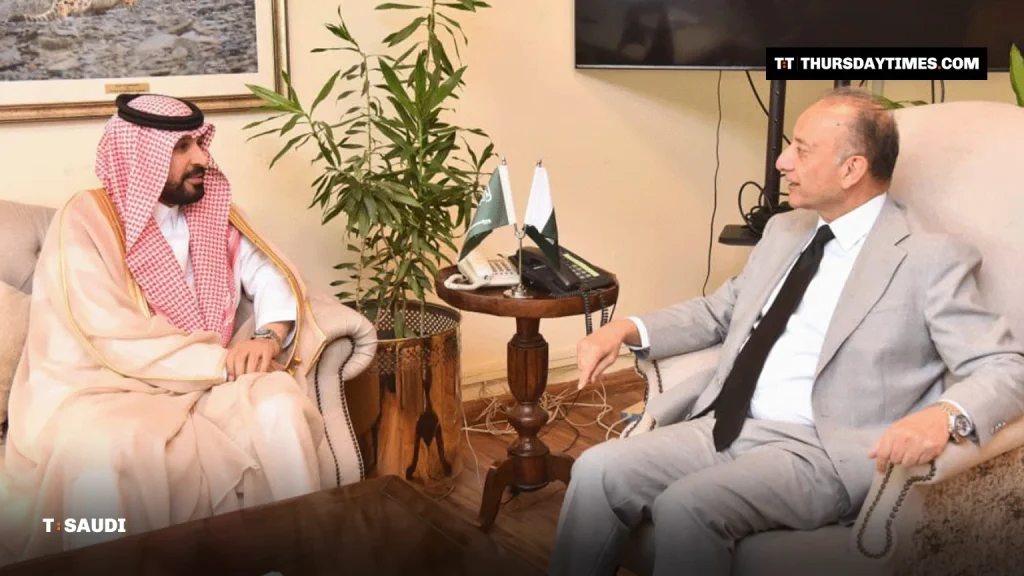
Saudi Ambassador Rajeh bin Tami Al-Baqami in a meeting with a Pakistani minister in Islamabad

Pakistan offers Saudi Arabia tax-free oil storage as a hedge against Hormuz and Red Sea risks

Islamabad · thursdaytimes.com
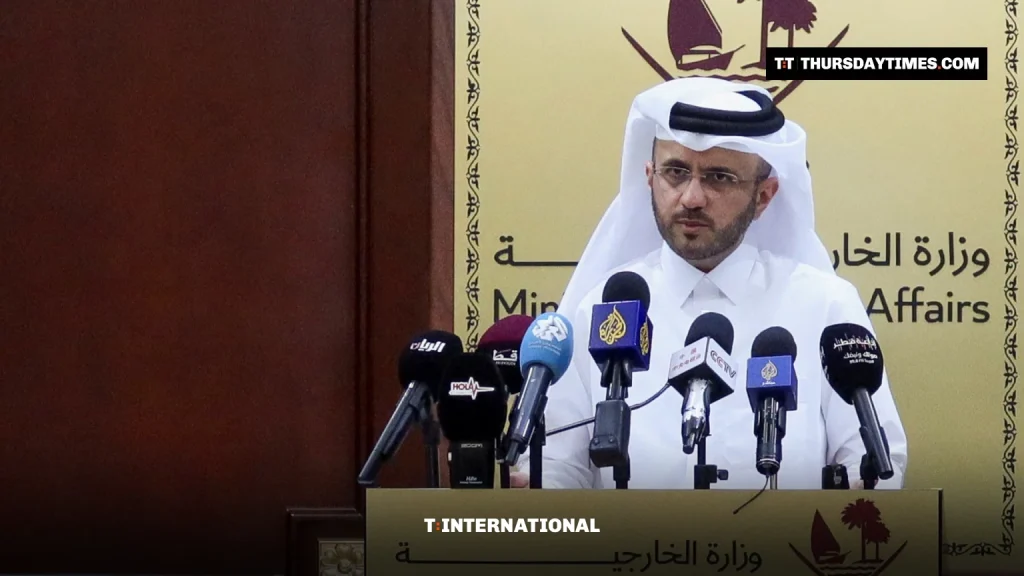
Majed al-Ansari in white thobe and ghutra speaks at a podium with broadcasters’ microphones at Qatar’s Foreign Ministry

Israel-linked influence campaign spent $11m painting Qatar as force behind Muslim migration to Europe, report finds

Doha · thursdaytimes.com

Huge fire at Dammam industrial complex after reported Yemeni strike, Iranian state media says

THE THURSDAY TIMES · THURSDAYTIMES.COM3
EDITORIAL · OPINION · THURSDAY 5 NOVEMBER 20264

Twenty years is long enough to wait for $800m

Pakistan is still owed about $800m for PTCL, over 32 properties worth a fraction of that. Arbitration is the right step, if the state fixes its own file and sets a deadline

Pakistan sold PTCL in 2005 and is still owed about $800 million for it. The cabinet has now asked the attorney general to prepare for arbitration against Etisalat. That is the right step, provided the state uses it to end the dispute and first puts its own side of the file in order.

The story was back in Parliament on Tuesday, when a joint meeting of the Senate committees on privatisation and information technology heard where things stand. The figures have barely moved in years. Pakistan sold 26 per cent of Pakistan Telecommunication Company Limited, along with management control, for $2.59 billion. It has received $1.76 billion. About $800 million remains unpaid, and Etisalat, now known as e&, says that is because the state has not transferred all the properties it promised.

According to the Privatisation Ministry’s briefing, 99 per cent of those properties have now been transferred. Thirty-two of 3,246 have not. A committee formed in July under the prime minister’s privatisation adviser has concluded that, after two decades, Pakistan should consider arbitration as the sale agreement allows, to recover the balance, the cost of waiting for it since 2008, and damages. Etisalat had not commented when the news broke.

Look at the last two of those numbers side by side. The money withheld is roughly nine times what Pakistan’s own valuers have said the missing properties are worth. Whatever the fine print says about the order in which things had to happen, that gap is the heart of the matter, and the strongest argument Pakistan has.

The history explains how a small problem grew so large. Under the revised agreement signed in 2006, Etisalat paid $1.4 billion up front, with the remaining $1.2 billion due in nine half-yearly instalments. Those instalments depended on clean titles for 98 per cent of the properties by January 2007 and all of them by January 2008. Pakistan missed both dates. Etisalat paid three instalments, worth about $400 million, and has paid none since.

That is where this newspaper must be plain. The first failure was ours. The state signed an agreement promising to clear titles to thousands of buildings, exchanges and plots scattered across the country, many of them tied up with provincial departments or in court, on a timetable it could not meet. A secretary of the Privatisation Commission told senators in 2019 that the problem had grown from a lack of proper homework in identifying the properties. That was an honest admission, and a tribunal would hear about it.

But the agreement also anticipated this exact failure. Officials have told Parliament that if a property could not be transferred, each side would value it, and the higher figure would be deducted from what was owed. The remedy for a missing building was a deduction for that building. It was not a licence to hold on to the rest of the money for 18 years. Pakistan’s valuers put the outstanding properties at about $88 million, and said in 2019 that Etisalat had given its own findings to the escrow agent but not to the government. Etisalat, for its part, reopened the list that year, arguing that the shortfall also included another 363 properties.

The money matters. At today’s exchange rate, $800 million is well over Rs200 billion, which is roughly eight times the Rs28 billion paid out so far under the prime minister’s fuel relief package. It would have been worth far more in the years it could have been used. Even at a modest 5 per cent a year, simple interest over the 18 years since 2008 would add about $720 million, on this newspaper’s own rough arithmetic. That is why the committee is right to ask for the cost of waiting as well as the principal, though no one should assume a tribunal would grant it in full.

The principle matters as much. Pakistan is in the middle of an ambitious privatisation programme. PIA has passed to new owners. The Islamabad, Faisalabad and Gujranwala power distributors are due to be sold in the first quarter of 2027, with others to follow. Each buyer will read the PTCL file closely. A state that lets its largest sale sit half-settled for two decades tells the market two unwelcome things: that its titles cannot be relied on, and that it can be outwaited.

And there is the matter of who gets to know. Senators on Tuesday were surprised to find that they had not been given the sale agreement. The session went behind closed doors, and one senator complained afterwards that parliamentarians were apparently not to be trusted with what officials could safely read. There may be genuine commercial reasons for confidentiality. They cannot extend to the elected committees that oversee the sale of a national asset, which can read such a document in private. The people’s representatives should not have to ask how the people’s company was sold.

None of this makes international arbitration a simple remedy. Pakistan’s experience of such tribunals has been sobering. The Reko Diq case produced an award of nearly $6 billion against the country in 2019 before it was resolved by settlement, and it taught an expensive lesson about going into these rooms underprepared.

So the ministry’s briefing is right on the sequence. The attorney general must first assess the strength of the case, its prospects and its legal implications, and only then seek approval from the prime minister or the federal government before any notice of intent goes to Etisalat. The hard questions should be asked now, in private, by Pakistan’s own lawyers, rather than for the first time before a tribunal by the other side’s. What exactly does the 2006 agreement make conditional on what? What happens to a claim that has waited so long? Which of the many versions of the property list binds both parties? Who in the state has the original documents, and can they be found?

That assessment should have a deadline. This file has seen committee after committee since 2015. Officials spoke of arbitration in 2018 and again in 2019. A new caretaker minister spoke hopefully in 2023 of a telecom tribunal. A minister of state later told a National Assembly committee that the government was looking for a middle ground and might not recover the full amount. In January, Mr Dar and Etisalat’s chairman discussed the company’s pending issues in Dubai. The government should give the attorney general 60 days and then make a decision in public. A threat repeated for eight years persuades no one.

Officials have long been wary of what a legal battle might do to one of Pakistan’s most valuable relationships. In 2019 the Privatisation Commission said it wanted an amicable solution in order to avoid bitterness in bilateral ties. That caution is understandable. The United Arab Emirates has stood by Pakistan with deposits, loans and investment commitments during difficult years. Many Pakistani families depend on work in the Emirates. And e& remains an investor in the country, with PTCL recently acquiring Telenor Pakistan and Orion Towers and pressing ahead with fibre and 5G. In April, PTCL rejected reports that its shareholders were having second thoughts as baseless.

All of that is a reason to handle this carefully. It is no reason to leave it unsettled. Arbitration clauses exist so that a commercial disagreement can be decided on its merits without becoming a diplomatic one. Etisalat is a company, its dispute with Pakistan is about a contract, and both governments have an interest in removing an old irritant from a relationship that has larger business to do. A fair settlement, reached at the table with a credible alternative behind it, would serve both countries better than another decade of polite meetings. Abu Dhabi is more likely to respect a partner that knows its own case than one that keeps raising the subject and dropping it.

The best outcome remains a negotiated one. Let both sides put their valuations of the 32 properties on the table, as the agreement envisaged. Let the higher figure be deducted. Let the parties then bargain honestly over the remainder and the cost of the delay. If Etisalat’s valuation is close to Pakistan’s, the gap is small enough to close in a season. If it is not, or if it will not be shared, a tribunal can decide.

Editorial · The Thursday Times
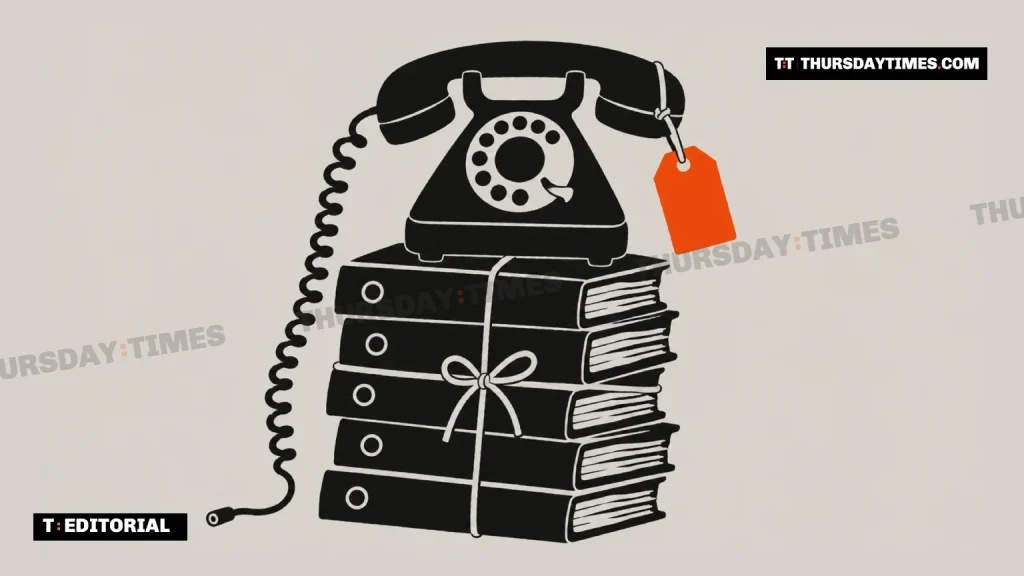
Illustration of an old black telephone on a tied stack of files, with an orange bill tag hanging from the handset
“It was not a licence to hold on to the rest of the money for 18 years.”
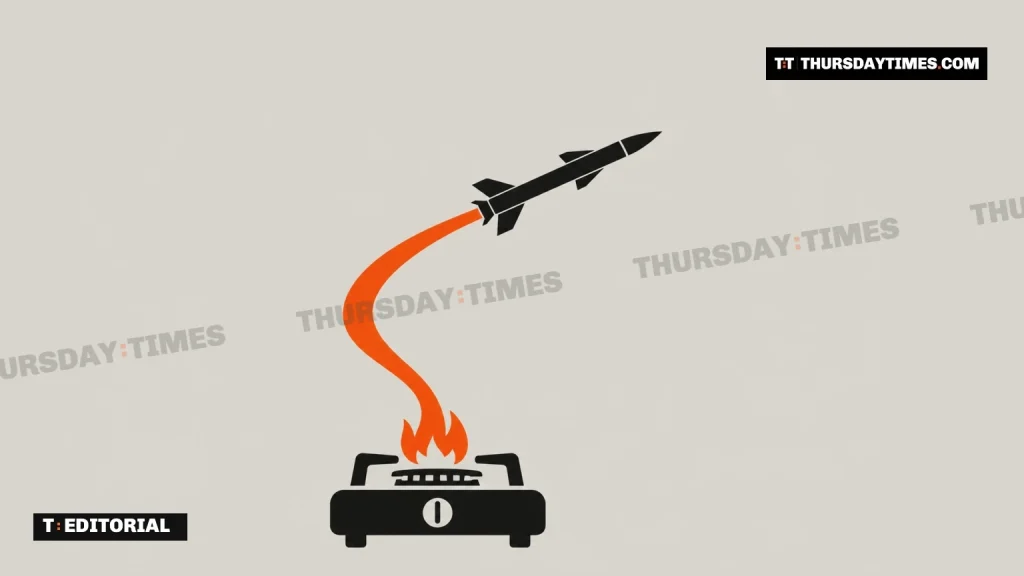
Illustration of a missile rising from an orange trail that begins as the flame of a gas stove
Illustration by Michael McCall for The Thursday Times. — MICHAEL MCCALL FOR THE THURSDAY TIMES

The Fa’az shows what Pakistan can do when it stays the course

The first homegrown air-to-air missile is a real achievement. On the day gas went on a timetable, its lesson of patience belongs in the energy sector too

Words by The Editorial Desk

On Tuesday Pakistan test-fired the Fa’az, the first air-to-air missile it has developed itself. The scientists and engineers behind it have earned the country’s congratulations. They have also shown what Pakistan can do when it picks a hard problem and refuses to let go of it.

On the same day, the gas companies told households across the country that piped gas would now come in three slots a day, built around meals. That is the other half of the story of a country trying to stand on its own feet, and this newspaper would like both halves to be read together.

The facts released are few, as they usually are with weapons. The Inter-Services Public Relations said the Fa’az has a state-of-the-art terminal guidance system and can engage aerial targets at longer ranges. The image released with the news shows it leaving a Pakistan Air Force jet in flight. The range was not given, and neither was the test site. President Asif Ali Zardari, Prime Minister Shehbaz Sharif, Field Marshal Syed Asim Munir and the services chiefs all congratulated the team.

Nobody should expect much more detail, and nobody outside the programme can yet say how it compares with the best in the world. But the word that matters most in the announcement is the plainest one: first. Until now, this was a weapon Pakistan had to obtain from someone else.

Expect the usual noise around it. Some across the border will play it down, as they play down every Pakistani achievement, and some enthusiasts at home will claim more for it than anyone has yet shown. Neither helps. Only a small group of countries design their own air-to-air missiles: India has its Astra and Turkey its Gökdoğan, and both programmes took years of test firings to mature. Pakistan can be proud of joining that company without pretending that one flight has settled anything. The sober reading is also the more impressive one.

Modern air combat is increasingly decided well before pilots can see one another. That was the lesson of the air battle with India in May 2025, when beyond-visual-range engagements, sensors and electronic warfare were at the centre of events. Pakistan said its jets brought down Indian aircraft, including the French-made Rafale. India contested that account. What nobody contests is that air forces around the world have been studying those few hours ever since.

Aircraft get the headlines, but in that kind of fight the missile is what reaches the enemy. A nation that buys its missiles buys them on the seller’s terms: the seller’s price, the seller’s delivery dates, the seller’s politics.

Pakistan knows this better than most. It lived through the American arms cut-off after the 1965 war. In 1990 the Pressler Amendment stopped the delivery of F-16 jets it had already paid for, an episode that shaped a generation of officers and planners. Friendships between states are real, and Pakistan has good ones, including with China, which is its partner in the JF-17. But the lesson of those years is that a country should not need anybody’s permission to defend its own sky. Every step towards that position is worth having.

Pakistan should enjoy this moment, and it should also be clear about what a first flight test is. It is the point at which a design proves itself in the air. What follows is harder and much less exciting: more firings, full integration with the aircraft and radars that must guide it, production in useful numbers at a cost the budget can bear, and years of steady improvement. Other countries’ missiles have not stood still while this one was being built, and they will not stand still now.

Pakistan’s defence establishment knows this, and its record offers reason for confidence. The country’s strategic programmes, and the JF-17 itself, were carried through by people who kept working for decades through sanctions, financial crises and changes of government. What the Fa’az most needs now is more of the same: stable money, and engineers who can see a career in staying.

That last point deserves attention. Each new programme depends on a small pool of highly skilled people who can earn far more abroad. The tributes paid to them this week should be followed by serious investment in the universities and research institutes that train them, and in the civilian firms that could use the same skills in electronics, materials and software.

There is a practical point here for the wider economy as well. Skills do not stay inside a programme. Guidance electronics, precision machining, propellant chemistry and testing all have uses beyond defence, if the state makes it easy for small firms to supply them, learn from them and sell to others. The countries that have gained most from their defence industries did not treat them as sealed compartments. Pakistan, which needs every export it can find, should not either.

There is an economic argument too. Pakistan has been working to make defence a real export line. It took the JF-17 Block III and the Super Mushshak trainer to the World Defence Show in Riyadh this year, and a deal with Libya last December put defence exports in the spotlight. Officials say interest has grown since May 2025. Buyers of fighter jets also want to know what they can carry and who controls the supply, so a homegrown missile could, in time, make the Pakistani offer stronger.

Exports bring foreign exchange, and they can spread manufacturing skills well beyond the factory gate. But they should be counted honestly, on delivered contracts and not on talks, and judged against the wider need of an economy that still imports far too much.

Which brings us back to the kitchen. From Wednesday, a family in Lahore or Karachi gets gas from 6:30am to 9am, 12pm to 2:30pm and 6pm to 9pm. Those without a piped connection have been offered LPG at Rs700 to Rs800 a kilogram, against a legal maximum of about Rs295, because supply from the western border has dried up. The war with Iran did not create these weaknesses. It exposed them.

Petroleum Minister Ali Pervaiz Malik said as much on Tuesday, with a frankness that deserves credit. “We neither worked on storages, nor on refineries, nor on the LPG chain,” he said. The government now says it is rebuilding the country’s energy security from scratch, and has told four state companies to return to importing LPG. These are sensible first steps.

4THE THURSDAY TIMES · THURSDAYTIMES.COM
THURSDAY 5 NOVEMBER 20265

Occupied Kashmir’s ruling party is cracking over a promise it cannot keep

Aga Ruhullah’s exit is about Article 370, but also about how little power an elected government holds in Srinagar. Pakistan should read it carefully, and not overread it

TT Monitoring Desk · 7 min read
Illustration of a wooden armchair split by a jagged orange crack, with one broken leg
“Here we are throwing away a chair, and we are happy,” Aga Ruhullah told Omar Abdullah. — MICHAEL MCCALL FOR THE THURSDAY TIMES

Aga Syed Ruhullah Mehdi signed his resignation from a podium in Budgam on Tuesday, in front of thousands of supporters, and handed the paper to the father of a boy killed in 2010. It was theatre, but it was aimed at a real weakness: the National Conference won Indian-administered Kashmir’s election on a promise it has no power to keep.

The Srinagar MP has ended a 24-year association with the party. He has emailed his resignation to Lok Sabha Speaker Om Birla, and the seat will fall vacant once it is accepted. He chose the anniversary of the death of his father, Aga Syed Mehdi, who was killed in a bomb blast in 2000. The man who received the letter was Muhammad Ashraf Mattoo, whose 17-year-old son Tufail died in 2010 in alleged police firing, when Omar Abdullah was first chief minister.

Few gestures in Kashmiri politics could have been more pointed. “You lied and misled the people, you used me,” he told Mr Abdullah from the stage. “People who lose chairs get unhappy, but here we are throwing away a chair, and we are happy.”

For Pakistan, which has never accepted the changes New Delhi imposed in 2019, the temptation is to treat this as vindication. It is more complicated than that, and more useful to understand properly.

The argument begins with Article 370. New Delhi revoked it in August 2019, and India’s Supreme Court upheld that decision in December 2023. When the region finally voted for an assembly in 2024, the first such election in a decade, the National Conference campaigned on fighting for the restoration of that status, along with the release of prisoners and fairer reservation in jobs and education.

Voters rewarded it. The party took 42 of the 90 seats, and its government has the backing of about 50 legislators. Mr Ruhullah himself had won Srinagar in the general election that year by about 188,000 votes, on a turnout of about 38%, the highest there in decades. He then sat on the committee that wrote the party’s manifesto, which is why he takes its contents personally.

The trouble is what the government could actually do once it won. Jammu and Kashmir is a union territory, in which a lieutenant governor appointed by New Delhi holds real authority, including over police and security. An assembly in Srinagar can pass a resolution on special status, and it did so soon after the election. It cannot restore anything. Only New Delhi can, and the party in power there is the one that took it away.

So the National Conference faced a choice that it has never quite admitted to. It could spend its time in office in open confrontation, with little to show for it, or it could work with the centre to win back statehood and get services delivered. Mr Abdullah has largely chosen the second. His supporters call that realism. Mr Ruhullah calls it surrender. “We demanded the restoration of Article 370, the release of prisoners and the protection of our rights,” his office said last week. “They sought power on those promises, then treated us as fools for expecting them to deliver.”

Both descriptions contain some truth. That is what makes the split dangerous for the party.

It would be a mistake to see this as one man’s quarrel. There are at least three pressures on the party, and they have started to feed each other.

The first is ideological, and Mr Ruhullah has made it his own. He has been openly at odds with the leadership since December 2024, when he joined students outside the chief minister’s home to protest against the reservation policy. He stopped attending party meetings and did not campaign for its candidate in the Budgam by-election last year, a seat the party then lost to the Peoples Democratic Party. He has mocked Mr Abdullah for thanking Prime Minister Narendra Modi at the opening of the tunnel near Sonamarg in January 2025.

The second is organisational, and it has little to do with Article 370. Last week, 17 of the party’s legislators gave the Abdullahs a 15-day ultimatum to end what they called “coterie culture” and “unilateral decisions”, after a cabinet expansion left several senior members out. They ruled out a split “as of now”. Those are complaints about power and access, of the kind every ruling party faces, but they give Mr Ruhullah’s moral case a ready audience inside the party.

The third is his own base. Mr Ruhullah is a prominent Shia leader from Budgam with a following that is not simply on loan from the Abdullahs. He has made a direct appeal to young people, saying he wants to find “honest” newcomers who will fight for their people’s rights and dignity. He has not announced a party. But his words to New Delhi, that Kashmiris “will speak to you on their terms, not on the agenda you set”, sound like someone preparing for more than a protest.

The answer is not obviously Mr Ruhullah, and it is certainly not obviously Kashmiris. The government is in no immediate danger. A party with 42 seats and outside support can survive the loss of an MP, who has no vote in the assembly, and spokesman Imran Nabi Dar has been careful, saying only that the party still hopes he will review his decision and that it will miss “an important voice” on Article 370.

The clearest short-term winner may be the Bharatiya Janata Party, which has long argued that the Abdullahs are a dynasty with nothing to offer. Its national vice-president, Ram Madhav, said on Tuesday that the party was “visibly divided”, and that Mr Ruhullah was holding his rally “with the blessings of our people”, while denying any BJP involvement in the party’s internal affairs. Mr Ruhullah would reject any such suggestion, and he attacked the BJP and the RSS from the same stage. But a fractured Kashmiri vote has helped New Delhi before, and Mr Abdullah’s supporters will make that argument loudly.

There is a real risk here for those who want to keep alive the demand for restoring special status. If the people who hold that position spend the next two years fighting one another, New Delhi loses nothing.

Three old Indian Rs500 banknotes with thick crosses drawn across them
Forged Indian Rs500 notes from the old series, crossed out by bank officials. File photo. — RESERVE BANK OF INDIA/MELUHA66/WIKIMEDIA COMMONS (CC BY-SA 3.0)

Ten years on, Modi’s note ban has little to show for the pain

Ten years ago this Sunday, Narendra Modi went on television at 8pm and told Indians that 86% of the cash in their pockets would be worthless by midnight. He promised that the pain would be temporary and the prize enormous. A decade on, India’s own figures show how little of that prize ever arrived.

The ban on Rs500 and Rs1,000 notes on November 8, 2016, was sold as a “grand sacrifice for cleansing our country”. It would break black money, corruption, fake currency and terrorism in one stroke. Indians took him at his word and stood for hours outside banks and ATMs. Small traders and daily wage workers paid most heavily. Then the promises began to fall away, one by one, and the justification shifted with them.

Mr Modi said in 2016 that high-value notes made up between 80% and 90% of the value of the country’s cash, and that the amount of cash in circulation was directly linked to corruption. By that logic, not much has been achieved. According to the Reserve Bank of India, the Rs500 note alone made up 85.5% of the value of cash in 2025-26. The Rs2,000 note that the government introduced in the middle of the drive has since been withdrawn, a tidy summary of the planning involved.

Reports of large cash transactions dipped briefly after the ban, then climbed past their old levels from 2023, according to India’s Financial Intelligence Unit. Most damning of all remains the central bank’s own finding, published in 2018, that about 99% of the banned money had come back into the banking system. The black money hoards that were supposed to go up in smoke either did not exist as cash or found their way back in.

In his speech Mr Modi boasted that India had climbed to 76th in the global corruption rankings. In 2025 Transparency International placed it 91st, barely better than the 94th it held before he took office. The law against benami property, which he presented as part of the same fight, has produced seven police cases since 2017, and none at all in 2024, according to national crime records.

He also singled out black money in elections. Here the numbers run the wrong way. The Election Commission seized Rs304 crore in cash in the 2014 general election, Rs804 crore in 2019 and Rs1,067 crore in 2024. The commission puts some of that down to better enforcement, and that may be so. But a government that promised to end cash politics now seizes more of it at every national election.

Pakistani readers will remember another part of that speech. “Enemies from across the border run their operations using fake currency notes,” Mr Modi said, as he tied the ban to terrorism. It was a convenient line that placed the blame abroad and turned a monetary gamble into an act of national defence.

India has seen some real gains here, and they should be acknowledged. Detected counterfeit notes fell from 0.00071% of the total in 2014-15 to 0.00013% in 2025-26. But the share was always tiny, a poor reason to shut down an economy’s cash overnight. On terror financing, the Financial Action Task Force rated India’s performance only “moderate” in 2024, noting long delays in prosecutions. Of 1,530 people India was prosecuting between 2018 and 2023, it convicted 89. That is a conviction rate of about 6%, after a decade of being told the money trail had been cut.

The most telling thing about demonetisation is how little accounting has followed it. India’s Supreme Court upheld the decision in 2023 by a majority, with one judge dissenting, but it ruled on the process and not on whether the policy had worked. The government quietly moved its goalposts towards digital payments, which have indeed grown fast, though they did not need a national cash crisis to do so. There has been no public reckoning of what the shock cost the people who could least afford it.

There is a lesson here for Pakistan as well. Calls surface every so often here to scrap the Rs5,000 note as a quick cure for undocumented money. India ran that experiment at enormous scale and at enormous human cost. Undocumented wealth does not sit in a suitcase waiting to be cancelled. It moves into land, gold and foreign currency, and the state only reaches it through the slow work of taxation and enforcement.

Mr Modi asked his country for 50 days. It has given him 10 years. The bold stroke on live television made for excellent politics, and the figures suggest it did very little else.

THE THURSDAY TIMES · THURSDAYTIMES.COM5
HOME · CULTURE · FOOD · THURSDAY 5 NOVEMBER 20266

Iqbal Day long weekend: banks shut for three days, so sort your cash early

The red sandstone tomb of Allama Iqbal in Lahore with the minarets of the Badshahi Mosque behind it
The tomb of Allama Muhammad Iqbal beside the Badshahi Mosque in Lahore. File photo. — MHTOORI/WIKIMEDIA COMMONS (CC BY-SA 4.0)
BANKS SHUT
Sat
to Monday
OFFICES, PSX
Mon
November 9
BANKS OPEN
Tue
November 10

Monday is a public holiday. Here is what closes, what to get done by Friday and when things reopen

TT Islamabad Bureau

Monday, November 9, is a public holiday for Iqbal Day. Because it follows a Saturday and Sunday, many Pakistanis get three days off, and banks will be shut from Saturday until Tuesday morning.

Banks: The State Bank of Pakistan has told commercial banks, microfinance banks and development finance institutions to close their public counters and services on Monday. With the weekend before it, branches will not open between Saturday and Monday. They reopen on Tuesday, November 10.

Offices and schools: The Cabinet Division’s notification closes public and private offices and educational institutions across the country on Monday. Sindh has issued its own notice for schools and colleges.

Stock market: The Pakistan Stock Exchange will also be closed on Monday.

Anything that needs a branch, such as paying in a cheque, getting a demand draft or opening a locker, should be done by Friday. Take out the cash you will need for the weekend early, rather than leaving it to Sunday night, when ATMs can run low. Banking apps usually keep working through holidays, but a transfer or cheque that needs the bank’s own staff may wait until Tuesday.

If a bill falls due over the weekend, pay it before you leave for the break.

The new gas timetable still applies over the holiday, so plan cooking and hot water around 6:30am to 9am, 12pm to 2:30pm and 6pm to 9pm.

The Pakistan Citizen Portal is also down for a system upgrade, and the Prime Minister’s Office has given no date for its return, so complaints through it will have to wait.

Heading north? Check the road first: snow has already closed Babusar Top, although Naran can be reached. And if you are going out in Lahore, including to Iqbal’s tomb beside the Badshahi Mosque, look at the air quality before you take children or older relatives.

Allama Muhammad Iqbal, the national poet, was born in Sialkot on November 9, 1877. The day was on the national holiday calendar for decades until it was dropped in 2015. It was restored in 2022.

The red-brick front of Nishtar Hospital in Multan

Blood cancer patients in Punjab wait for free medicines: what to do

TT Lahore Bureau

About 5,000 blood cancer patients registered with Punjab’s free medicine programme have gone without regular supplies for more than three months, and the province’s health minister says hospitals can now buy the drugs locally while a bigger order is processed.

The programme treats chronic myeloid leukemia, or CML, with four medicines given free through five hospitals: Mayo and Jinnah in Lahore, Nishtar in Multan, Benazir Bhutto in Rawalpindi and Allied in Faisalabad. Patients usually collect them every month.

Supplies stopped because of delays in government procurement and bidding, according to reports. Patients have had to buy the drugs from private pharmacies, where they are also said to be in short supply. They include nilotinib, a targeted therapy that patients often take for years under specialist care. Doctors warn that long gaps in treatment can be dangerous.

Punjab Health Minister Khwaja Salman Rafique acknowledged the shortage. He said leading oncologists had advised expanding the list from four medicines to 27 about a year ago, and that this led to a central procurement process which is still under way. In the meantime, he said, the five hospitals have been authorised to buy medicines locally, and he hoped the shortage would be resolved soon.

If you or a family member is affected

Ask at your CML clinic now whether your medicine has arrived or can be bought under the local purchase arrangement. Do not stop or skip doses without speaking to your doctor, even for a short time, and tell them how many doses you have left. If you have to buy from a pharmacy, use a reputable one, keep the receipt and check the packaging and expiry date.

Lahore Fort’s Akbari Gate restored after being shut since British rule
Preservation work finished at Islamabad’s Shah Allah Ditta Buddhist cavesOfficials hope the ancient site in the Margalla foothills will draw families and foreign visitors
Spotify audiobooks reach Pakistan: what you get and what it costs
6T:LIFE · THE THURSDAY TIMES · THURSDAYTIMES.COM
CRICKET · FOOTBALL · THE WORLD · THURSDAY 5 NOVEMBER 20267
Maliha Ali shouts in celebration with the Pakistani flag held around her shoulders
SPORTS

Hunza’s Maliha Ali stuns Russian champion at MMA World Championships

The 24-year-old won by split decision to reach the quarter-finals in Tbilisi, where her twin sister Manesha is also chasing a world title

TT Sports Desk · Tbilisi

Maliha Ali, a 24-year-old from Hunza, has beaten Russia’s two-time European champion Veronika Drozdova at the IMMAF World Championships, reaching the quarter-finals of the top event in amateur mixed martial arts.

She won by split decision in Tuesday’s featherweight (65.8kg) bout in Georgia, against a 19-year-old from a Russian team of more than 60 athletes. Maliha, who celebrated in prostration with the Pakistani flag over her shoulders, took the first two rounds, working Drozdova against the cage and then landing heavy blows from full mount after a takedown. She tired in the third, which went to the Russian, but had done enough.

“We worked on our opponent’s game plan, how she fights, and executed our strategy,” she said. “And thankfully it worked.”

Maliha, also a wushu champion and national kickboxing gold medallist, came to Tbilisi with a silver medal from the IMMAF World Cup in Angola this year. The Pakistan MMA Federation then ran a six-week camp and brought in an international jiu-jitsu and grappling coach to fix the weaknesses it saw there.

“We come from almost nothing; the only thing we have is our grit and desire to succeed,” said federation president Omar Ahmed, who described Pakistan as among the least-resourced teams at an event where Russia has one of the best-funded programmes.

Maliha’s quarter-final was set for Wednesday against Mexico’s Andrea Gabriela Guzman Salazar. Her twin sister, Manesha, who won gold at the World Cup in Luanda this year, was due to fight Poland’s Martyna Caruk on the same day. Results had not been reported at the time of writing.

The championships run until November 7, with 881 athletes competing for world titles.

Saudi Pro League postpones all this weekend’s matches after Asian Cup move

The league is reviewing its fixtures after the tournament was pushed back by almost a year because of the attacks on the kingdom

The Saudi Pro League has postponed all of this weekend’s matches, hours after the Asian Cup was pushed back by almost a year because of the attacks on the kingdom.

The league said the decision was part of a wider review of the 2026-27 fixture list, with the new Asian Cup dates “creating additional flexibility in the domestic football calendar”. It gave no new dates for the games.

All of Matchday 13 is affected. Al-Qadsiah were due to host Al-Fayha on Thursday and Al-Nassr to visit Al-Hazem, with Al-Ittihad at home to NEOM on Friday. Al-Hilal were to play Al-Ettifaq in Dammam on Saturday, and Al-Ahli to host Al-Taawoun in Jeddah.

The league had already moved several matches in October after attacks on the country, including a missile strike on Riyadh’s airport. It has mostly managed to carry on as usual until now.

The Asian Cup, which was to begin on January 7, will now run from December 23, 2027, to January 21, 2028. The new dates must still be approved by Fifa, and will ease a crowded calendar that coaches have complained about. “It is difficult for the same player to play every three days,” Al-Ittihad coach Jens Wissing said earlier.

Other sport in the Gulf is also under pressure. The Qatar Grand Prix, set for November 27 to 29, and the Abu Dhabi race that follows it are in doubt, after Formula 1 lost its Bahrain and Saudi races in April.

Crowds and a floodlit pitch at King Fahd International Stadium in Riyadh
King Fahd International Stadium in Riyadh in April 2014. File photo. — ALI AL-MAZARQAH/WIKIMEDIA COMMONS (CC BY-SA 3.0)
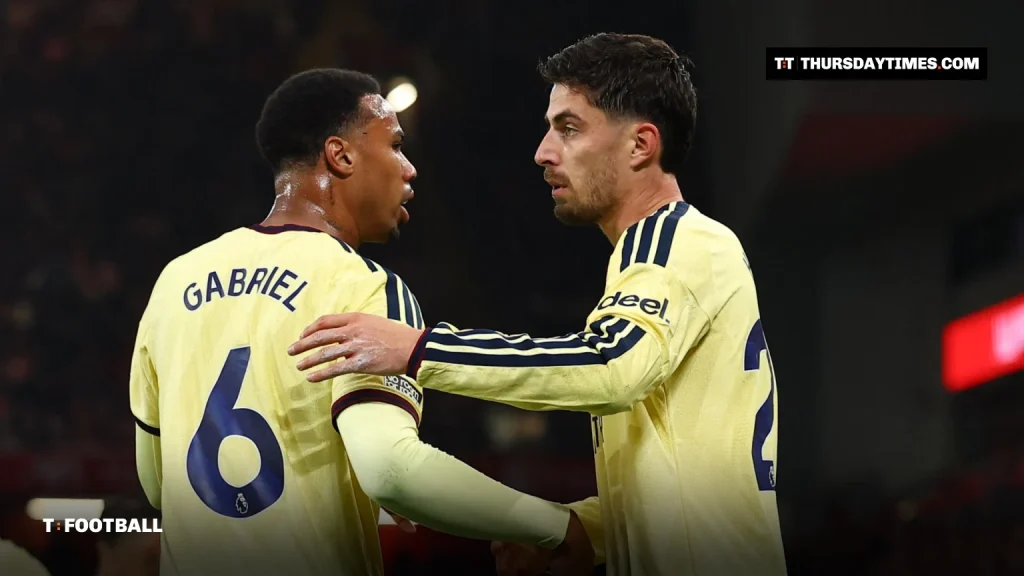
Kai Havertz and Gabriel Magalhaes of Arsenal embrace on the pitch at Anfield
Arsenal’s Kai Havertz and Gabriel Magalhaes during the win over Liverpool at Anfield on Sunday. — REUTERS

Havertz ends Arsenal’s 14-year wait for an Anfield win as champions beat Liverpool 1-0 to go top of the Premier League

Kai Havertz scored the only goal as Arsenal beat Liverpool 1-0 on Sunday to win a Premier League match at Anfield for the first time since 2012 and move to the top of the table.

The goal came in the 16th minute and started with a Liverpool mistake. Arsenal won the ball back as goalkeeper Alisson tried to play out from a goal-kick, Declan Rice ran on to it down the right, and his low cross found Havertz alone at the back post to tap in.

The champions now lead by three points from Manchester City, who lost at Brighton on Saturday, and are nine clear of Liverpool. The goal was Havertz’s 46th in the league, the most by a German player in Premier League history, ahead of Ilkay Gundogan.

Liverpool had 17 attempts but could not find a way past David Raya. Florian Wirtz hit the crossbar with a free-kick in the first half and Alexis Mac Allister headed over unmarked from Milos Kerkez’s cross. They also had strong penalty appeals turned down when Jurrien Timber pulled Alexander Isak’s shirt.

It was the second defeat for Liverpool under Andoni Iraola, who gave 19-year-old Trey Nyoni his first Premier League start among seven changes from the midweek Carabao Cup win over Chelsea. Liverpool have scored only four league goals in five home games this season.

THE THURSDAY TIMES · THURSDAYTIMES.COM7
PULL-OUT · THE THURSDAY TIMES05.11.20268
Westline
BRITAIN, FROM THE OTHER SIDE OF THE LINEWESTLINE × THE THURSDAY TIMES
THE OLD GUARD'S DEMISE · PART 2

The Britain left unheard now roars back

In the gap between television studios and terrace pubs, a different England has been learning to speak for itself. — WESTLINE ORIGINAL

How changing streets, new languages and unanswered letters turned quiet voters into the loudest voice in British politics.

Abdullah Esquire
THE SERIES
010203
Read the seriesthursdaytimes.com/westline

THE PUB IS ALREADY FULL before the football starts. Outside, the street glows under a grey Midlands sky, wet from a passing shower. Inside, there is the low hum of habit - the scrape of chairs, the clink of glasses, a quiz machine that has not paid out in months. The television in the corner is split between a rolling news channel and pre-match chat. For a moment, the sound cuts from pundits to a clip of a march, English flags bobbing like buoys on a restless sea.

No one in the bar needs the caption to tell them who is on screen. They know the face, the way he talks, the way he jabs a finger at the camera, the way he says that ordinary people are not being heard. They have seen him on their phones, shared his clips in WhatsApp groups, watched him standing outside courts and council offices that many of them will never enter. He is not just Tommy Robinson the public figure. For some, he is Tom from streets they recognise, that world of terraces, betting shops and half-closed factories.

Around the tables, conversations drift on. Someone jokes about the referee. Someone else complains about their gas bill. But when the clip of the march comes on, there is a slight pause, barely noticeable, as eyes move to the flags, to the faces, to the police line. Not everyone in the room agrees about him. Some think he goes too far, others that he does not go far enough. What they have in common is that they understand the feeling that produced him.

For years, their towns have been changing. The butcher and the greengrocer shut, a chain mini-market replaces them, then that goes too. High streets that once smelled of chip fat and cigarette smoke now carry other scents - spices, grilled meat, things that once felt exotic and far away. New shops appear with new alphabets on the signs, new churches and mosques open in buildings that used to be bingo halls. School gates fill with languages that their grandparents never heard.

Some people like this mix. They enjoy new food, new music, different ways of living. Others are less sure. They do not object to the people, or at least they do not think of themselves as objecting to them. What unsettles them is the speed, the sensation that a familiar script has been quietly rewritten. The jokes that once filled the factory floor no longer feel safe to tell. The words they grew up using are now judged and measured. They are told to be careful, to be aware, to be sensitive.

When they turn on the television or scroll through social media, they encounter another language altogether. Politicians and commentators talk about inclusion, diversity, global Britain. There are panels on structural injustice, debates about pronouns, statements about values. The vocabulary is elegant and precise, but it sounds like something from elsewhere, a professional dialect that belongs in glass-fronted buildings in big cities. It is not the way people sound in the pub on a Tuesday afternoon.

Tommy Robinson and the English Defence League grew out of that gap. For supporters, the marches and videos were not an abstract ideological project. They were a way of saying: we are still here, we still matter, this belongs to us too. The flags, the chants, even the confrontations were an attempt to carve out visibility in a landscape where they felt reduced to stereotypes, either as villains or as problems to be managed.

The stories that circulate in those circles are often local. A protest down the road. A crime on the estate. A video from outside a school, a mosque, a council office. These are not framed like policy debates. They are told as things that happened to people like them, in streets they know, under grey skies they recognise. When those stories do make it on to national news, they are often handled with caution, softened by careful studio language. The distance between the tone on screen and the tone in the bar is where much of the anger lives.

There is also the question of who gets defended. Many who follow Robinson or similar figures carry a memory of scandals where, in their view, the state moved too slowly or too gently. They remember reports about grooming gangs, or radical preachers, or corruption, and they remember how long it seemed to take for officials to say bluntly what was going on. Against that backdrop, the man outside the courthouse speaking into his phone feels, to them, like someone filling a silence.

The English Defence League made that feeling physical. Marches in town centres, banners across familiar shopfronts, a flood of flags down streets where their parents shopped for school uniforms. It was noisy and sometimes heated, but it was also, for many participants, the first time they had been part of anything political at all. For people who did not attend university, who do not belong to unions or NGOs or party branches, this was politics that looked and sounded like them.

Not everyone stayed on the street. Over time, some drifted away, tired or disillusioned or fearful of trouble. Others took the same set of feelings into a different arena, swapping marches for ballot papers. The face that comes to mind there is not Robinson’s but Nigel Farage’s - pint in hand, tie slightly off, laughing in a way that feels closer to the local boozer than to Westminster.

Farage speaks a language that many recognise. He talks about borders and control, about fishing boats and high streets, about bills and bureaucrats. He links the sense of cultural dislocation with economic grievances - the factory that closed, the job that never came back, the mortgage that is harder to pay. For listeners who have spent years hearing that change is inevitable and globalisation unstoppable, his insistence that things could have been done differently sounds less like fantasy and more like long-awaited respect.

Reform UK, his latest vehicle, gathers up these currents. In Reform meetings, you can meet retired couples from bungalows on the edge of town, warehouse workers from out-of-town estates, self-employed tradesmen squeezed by costs, younger voters who feel laughed at for their views in college or at work. They differ in age and income, but they share a sense that the big parties occupy a single shared world that does not include them.

For them, the term “far right” is something other people use. They hear it on programmes they do not trust, spoken by people whose lives bear no resemblance to theirs. In their own minds they are not extremists. They are patriots, parents, neighbours. They worry about crime because they walk home in the dark. They worry about schools because their children go there. They worry about migration because their local GP surgery is crowded and their housing list is long.

The thing they return to, over and over, is that no one listened earlier. They remember writing to MPs, filling in consultations, answering surveys, and hearing nothing back. They remember being told that their town was “vibrant” while they were watching the last of the old trades vanish. They remember voting for parties that promised control of borders, or levelling up, or taking back power, and then watching as those promises were filtered through committees and court cases and acronyms.

Tommy Robinson’s bluntness, for all its controversies, exists in this context. He speaks in a way that does not ask permission. He uses the words that are used in smoking shelters, on construction sites, in minicabs. When his videos are removed or his accounts limited, supporters do not see a technical enforcement of rules. They see someone like them being told, yet again, that the way they speak and think is unacceptable in polite society.

WESTLINE · A THURSDAY TIMES PULL-OUT8
Archive