Friday 6 November 2026 Archive
FRIDAY 6 NOVEMBER 2026Dangerous to those who trade in lies.THE E-PAPER · ENGLISH EDITION · 8 PAGES
234567Westline pull-out8
US MIDTERMS 2026

Rubio weighs leaving Trump administration after midterm losses, report says

Marco Rubio at the podium of the White House press briefing room with a US flag behind him
Secretary of State Marco Rubio in the White House press briefing room. File photo. — THE WHITE HOUSE

The State Department called the report “fake news” and said the secretary of state has not discussed leaving his role

TT Foreign Desk · Washington

Secretary of State Marco Rubio is weighing whether to leave the Trump administration after the Republicans’ heavy losses in this week’s midterm elections, according to people familiar with the matter, though the State Department has dismissed the report as “fake news”.

Rubio, who is also President Donald Trump’s national security adviser, is going over options for his future with his advisers, the people said. He has not decided whether to quit either post, and there is no timetable for any departure. According to some of the people, he has spoken to White House officials about stepping down and has been asked to stay.

The State Department rejected the account in strong terms. “This is complete and total fake news based on the word of anonymous sources, befitting a tabloid,” said Dylan Johnson, the assistant secretary of state for global public affairs. “The Secretary has not discussed leaving his role and he will continue to proudly serve in President Trump’s administration long after this fake news is revealed as yet another baseless hoax.”

Edgar Vasquez, a deputy assistant secretary for press, said Rubio “is focused on advancing President Trump’s agenda and delivering for the American people”.

The reports have fuelled speculation that Rubio, a former Florida senator who ran for the Republican presidential nomination in 2016, is preparing for a run in 2028. Rubio himself has not commented.

Israel election: Eisenkot wins backing of 67 lawmakers to form next government

Gadi Eisenkot has the backing of 67 of the 120 members of Israel’s next Knesset to form a government, after his own Yashar party recommended him to President Isaac Herzog in consultations on Thursday.

Herzog is expected to task him with forming the next government. Prime Minister Benjamin Netanyahu has the backing of 46. The ultra-Orthodox United Torah Judaism, with seven seats, recommended no one, withholding support from its longtime ally Netanyahu, and said its backing for any government would depend on legislation preserving military service exemptions for yeshiva students.

The Arab parties Ra’am and the Joint List also recommended Eisenkot. The Joint List said its decision came “in response to the public demand to prevent Netanyahu and his government from returning to power”. Recommending him does not mean those parties will join his coalition.

Eisenkot, a former army chief, had already been backed by five opposition leaders, including Naftali Bennett and Avigdor Liberman.

“This is complete and total fake news based on the word of anonymous sources, befitting a tabloid.”Rubio weighs leaving Trump administration after midterm losses, report says Page 1

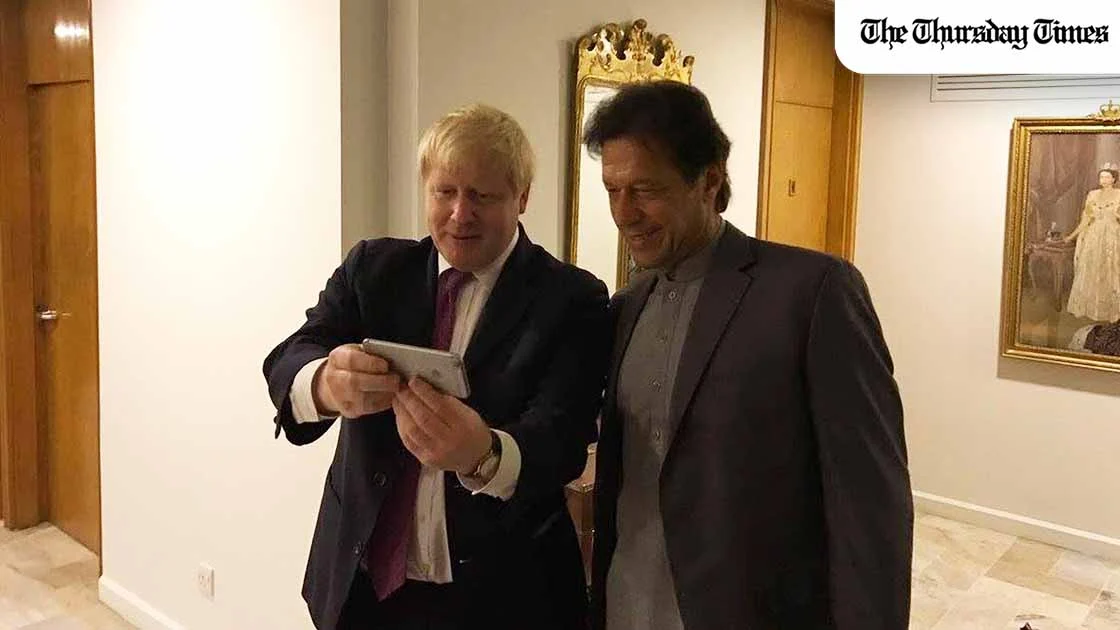
Boris Johnson has lost it on Imran Khan

Pakistan's courts are already ordering what Johnson demands. The man who slashed Britain's aid to Pakistan now wants to use "our leverage" to overrule its courts. Everything else in his Daily Mail column is wrong, half-told or left out.

TT MONITORING DESKPAGE 5 ›

NCCIA arrests 273 in Karachi call centre raid, says 350 scam centres operate

The National Cyber Crime Investigation Agency (NCCIA) has arrested 273 people, including more than 100 women and 42 under-18s, in a raid on a call centre near Shahrah-e-Faisal, Additional Director Shahzad Akbar said on Thursday. He said 300 to 350 scam call centres were operating in the city.

Akbar said the company was among Karachi’s top three scam call centres. More than 300 laptops and 152 mobile phones were seized, and he said the laptops held fake identities and credit card details, and that people based abroad were also involved. Officials say the suspects targeted both foreigners and local residents.

He said it was the first time employees had been named in a case alongside the owner. Previously, he said, only owners were charged, and their relatives would then open new companies with the same staff. He said the parents of underage workers would also be brought into the legal process under Section 109.

Judicial Magistrate East Gulraiz Memon granted two-day physical remand of nine main suspects and ordered the release of women and under-18s on bail against surety bonds of Rs5,000 each. The rest were sent to jail on judicial remand. A defence lawyer told the court those held included more than 70 juveniles and over 80 women. The suspects have not been convicted of any offence.

Illustration of a laptop with an orange hook pulling a bank card from its screen
Illustration by Michael McCall for The Thursday Times. — MICHAEL MCCALL FOR THE THURSDAY TIMES
Pakistan todayPAGE 2
Government to refund up to Rs70,000 for international IT certifications
Petrol cut by Rs9.41 a litre to Rs352.59, diesel down Rs5.56 to Rs382.25
Field Marshal Munir visits SSG headquarters in Tarbela
THE THURSDAY TIMES · PUBLISHED BY THURSDAY MEDIA INTERNATIONAL · THURSDAYTIMES.COM1
US MIDTERMS · THE WORLD · PAKISTAN · FRIDAY 6 NOVEMBER 20262

US warns of ‘ongoing’ cyber threat to freezers after global hacks

CISA and the FBI say hackers are targeting internet-connected cold storage, and urge firms to take systems offline

TT Foreign Desk · Washington

US agencies warned on Thursday of an “ongoing cyber threat” to internet-connected refrigeration and cold-chain monitoring systems, after attacks on supermarket freezers, US military bases and a French blood bank.

In a joint statement, the cybersecurity agency CISA, the FBI and the Departments of Agriculture, Health and Human Services and Transportation said hackers were targeting systems in grocery stores and cold storage facilities. “If successfully exploited, the actors could change the temperature and possibly cause physical impacts such as fire hazards, loss of inventory and changes to the service life of the system,” they said.

The agencies urged companies to take remote control systems off the internet, strengthen passwords, apply updates and retire equipment no longer supported by its maker. “Every organization that depends on refrigeration and monitoring systems should assume it could be a target,” said Chris Butera, CISA’s acting cybersecurity chief.

The warning follows several waves of attacks in Britain and Europe that turned up the temperature on freezers in at least a dozen countries, including the hack on a French blood bank. The US has not blamed any group or government, though security researchers broadly point to Iran and US officials reportedly suspect it. A pro-Russian group earlier claimed some of the European attacks.

Blue Origin unveils third stage for New Glenn as next launch slips to 2027Jeff Bezos’ rocket company also announced Northstar, a lighter and more powerful engine, as it rebuilds a pad damaged in May
Continued from page 1

NCCIA arrests 273 in Karachi call centre raid, says 350 scam centres operate

Illustration of a laptop with an orange hook pulling a bank card from its screen
Illustration by Michael McCall for The Thursday Times. — MICHAEL MCCALL FOR THE THURSDAY TIMES

The National Cyber Crime Investigation Agency (NCCIA) has arrested 273 people, including more than 100 women and 42 under-18s, in a raid on a call centre near Shahrah-e-Faisal, Additional Director Shahzad Akbar said on Thursday. He said 300 to 350 scam call centres were operating in the city.

Akbar said the company was among Karachi’s top three scam call centres. More than 300 laptops and 152 mobile phones were seized, and he said the laptops held fake identities and credit card details, and that people based abroad were also involved. Officials say the suspects targeted both foreigners and local residents.

He said it was the first time employees had been named in a case alongside the owner. Previously, he said, only owners were charged, and their relatives would then open new companies with the same staff. He said the parents of underage workers would also be brought into the legal process under Section 109.

Judicial Magistrate East Gulraiz Memon granted two-day physical remand of nine main suspects and ordered the release of women and under-18s on bail against surety bonds of Rs5,000 each. The rest were sent to jail on judicial remand. A defence lawyer told the court those held included more than 70 juveniles and over 80 women. The suspects have not been convicted of any offence.

The world in brief

EVERY STORY IN FULL AT THURSDAYTIMES.COM
Nasdaq enters correction as AI stocks tumble and SpaceX sinksWall Street fears tougher scrutiny of data centres after Democratic wins, while Pakistan’s KSE-100 closes higher
Turkish parliament passes first article of Makkah defence pact billLawmakers adjourned after the first vote, with the remaining articles due on Thursday afternoon
Turkish parliament approves Makkah defence pact with Pakistan, Saudi ArabiaLawmakers voted 279 to 119, leaving only presidential ratification and the deposit of documents before the pact comes into force

Pakistan

NATIONAL · ECONOMY · MILITARY

NUST leads 90 Pakistani universities in QS Asia rankings, at 76th

TT Islamabad Bureau · Islamabad

The National University of Sciences and Technology (NUST) is Pakistan’s highest-ranked university at 76th in the QS Asia University Rankings 2027, a list that includes 90 Pakistani institutions.

Quaid-i-Azam University is 111th, the Lahore University of Management Sciences 143rd, COMSATS University Islamabad 171st and the University of the Punjab 172nd.

In Southern Asia, NUST ranks second behind IIT Delhi, which is 66th in Asia, and Quaid-i-Azam University is 10th.

This edition covers 1,722 universities across 26 education systems. The University of Hong Kong is first, followed by Peking University and Tsinghua University.

QS uses 11 indicators. Academic reputation carries 30 per cent of the weight and employer reputation 20 per cent, so half the score rests on reputation. If you are choosing a university, look at how your own department performs as well as the overall rank.

Saudi envoy assures Pakistani workers of visas within 24 hoursThe promise came in a meeting with Minister Salik Hussain, and details of how it will work are still to come
Upwork freelancers can now withdraw straight to JazzCash and EasypaisaNayaPay, SadaPay and Finja are also on the list, and the money usually lands within minutes, Upwork says. Here is how to set it up
PTA and Meta block 176,000 WhatsApp accounts on recycled SIM numbersOld accounts stay live after a SIM is cancelled and the number reissued. Here is what the move means and what you should do
InsideGulf, 3 · Views, 4 · Analysis, 5 · T:LIFE, 6 · Sports, 7 · Westline, 8
2THE THURSDAY TIMES · THURSDAYTIMES.COM
EMIRATES · SAUDI · QATAR · FRIDAY 6 NOVEMBER 20263

UAE’s new traffic rules from January: five-car cap, child seats, nine-hour limit

What changes for drivers, delivery riders and e-scooter users under regulations taking effect on January 1

Illustration of a traffic light with an orange lamp above a Dubai skyline with the Burj Khalifa and an e-scooter
Illustration by Michael McCall for The Thursday Times. — MICHAEL MCCALL FOR THE THURSDAY TIMES
Thursday Emirates · Dubai

New regulations under the UAE’s federal traffic law take effect on January 1, 2027, with a five-car limit per person, mandatory child seats and a nine-hour daily driving limit. The changes will touch many of the Pakistani drivers and delivery riders living there.

Drivers will be limited to nine hours at the wheel in any 24 hours, though authorities have not said whether that covers private as well as professional drivers. The theory test for a licence will have a 75 per cent pass mark, and the practical test will assess 15 skills.

Children aged four and under must ride in a suitable safety seat in the back. Children who cannot use one for medical reasons are exempt with an official certificate.

One person will be able to register no more than five vehicles, with an additional fee on the third, fourth and fifth. The regulations do not give the amount, or say what happens to people who already have more than five. Owners of eligible new light vehicles will be able to apply for two-year registration.

Motorcycle delivery riders will not be allowed to carry passengers while delivering, and must use approved equipment instead of backpacks. The minimum age for an e-scooter permit will be 15, with the permit valid for three years, though it is not clear whether Dubai’s existing minimum of 16 will change.

How long a licence lasts will depend on the holder’s age and nationality. Licensing authorities may also accept eye test reports issued outside the UAE at renewal.

Grey smoke rises over the towers of an oil refinery in a desert landscape

Aramco profit jumps 34.5% to $36.25bn despite attacks and lower output

Riyadh · thursdaytimes.com
Sultan Al Jaber on a stage screen at ADIPEC beside a graphic reading 1 billion barrels drained from global inventories

Hormuz crisis has drained nearly a billion barrels from world oil stocks, ADNOC chief says, as shipping hits 30% of a barrel’s cost

Abu Dhabi · thursdaytimes.com

AI now ‘mostly smarter’ than top scientists, Sam Altman tells ADIPEC as ADNOC signs OpenAI deal

THE THURSDAY TIMES · THURSDAYTIMES.COM3
EDITORIAL · OPINION · FRIDAY 6 NOVEMBER 20264

The Thursday Times targeted in major cyberattack by Indian hackers

An extensive security investigation uncovered a sustained Indian intrusion into the publication’s digital infrastructure. With normal operations restored, The Thursday Times says its commitment to independent journalism remains unchanged.

LONDON/ISLAMABAD/FRANKFURT (THE THURSDAY TIMES) — The Thursday Times has been targeted in a major cyberattack attributed to Indian hackers, following the discovery of a coordinated intrusion into the publication’s digital infrastructure that had persisted for several weeks.

The attack involved unauthorised access to critical systems, the installation of concealed malicious components and repeated attempts to maintain control over parts of the publication’s online operations.

Despite the seriousness of the breach, The Thursday Times has confirmed that its website and digital operations have returned to normal. It is business as usual for the publication, which continues to deliver news and independent reporting without interruption.

The incident comes as The Thursday Times continues its extensive coverage of protests across India, where demonstrations over alleged electoral irregularities, restrictions on public assembly and the detention of protest leaders have drawn growing attention.

For a publication whose guiding principle is “We are dangerous to those who trade in lies”, the developments offer a timely reminder of the importance of independent reporting, particularly when the facts are politically inconvenient.

The security breach was discovered during routine technical maintenance, when unusual activity within the website’s infrastructure prompted a wider examination of its systems.

What initially appeared to be a technical irregularity quickly developed into a serious investigation, uncovering evidence of malicious components deliberately concealed within the publication’s digital environment.

The investigation established that the intrusion had begun weeks earlier, with suspicious activity traced back to September. The attackers had installed unauthorised components, disguised them as legitimate system utilities and made changes intended to preserve their access.

Further examination revealed that the perpetrators had returned to the compromised environment repeatedly, with additional activity identified during the early hours of Saturday, October 17.

The pattern suggested a sustained operation rather than an isolated attempt to disrupt the website.

Investigators also identified interference with essential operational processes, raising concerns about the attackers’ ability to compromise the reliability and integrity of the publication’s digital infrastructure.

The precise technical findings are being withheld for security reasons.

The Thursday Times has conclusively attributed the cyberattack to Indian hackers following its internal security investigation.

The findings, according to the publication, establish the origin of the malicious activity and demonstrate that the breach involved deliberate, repeated interference with its systems.

The publication has chosen not to disclose the technical evidence underlying its attribution, citing the need to protect its security arrangements.

There has been no public finding establishing involvement by the Indian government or any state institution, and the precise motivation behind the operation has not been disclosed.

Editorial · The Thursday Times · First published 17 October 2026
The Thursday Times logo, glitched, over a stylised system log of unauthorised file and session activity running from 14 September to 17 October.
“Despite the seriousness of the breach, The Thursday Times has confirmed that its website and digital operations have returned to normal.”
The man who helped bring Imran Khan down now borrows Khan's voice, condemning a system in whose corridors he spent decades bargaining for his share. — MICHAEL MCCALL FOR THE THURSDAY TIMES

Fazl’s quarrel with the establishment: principle, or political exclusion?

He spent a career negotiating at the table of power. Now, locked out of the room, Maulana Fazlur Rehman has begun to sound like the man he helped remove.

Words by Raza Butt · First published 18 October 2026

In Pakistani politics, the establishment tends to look most sinister to those standing outside its door. Proximity breeds accommodation; distance breeds denunciation. Maulana Fazlur Rehman, among the most accomplished practitioners of proximity the country has produced, now finds himself at a distance, and his voice has grown louder in proportion.

For decades, the chief of the Jamiat Ulema-e-Islam-Fazl was less a politician than a fixture of the corridors of power. His party never commanded the numbers to rule, but he rarely needed them. He had something rarer: the patience to negotiate, the instinct for which way a coalition would bend, and a gift for converting a handful of parliamentary seats into a permanent place at the table. Governments came and went; Fazlur Rehman, more often than not, remained.

It is against this history that his new vocation as the establishment's fiercest critic must be read.

In Multan on Thursday, he called the federal government fake and politically defeated. Its leaders, he said, had no authority of their own, and powerful institutions were gathering power to themselves at the expense of civilian democracy. It was not the language of the negotiator. It was the language of the barricade.

Those who have followed Pakistani politics over the past decade will have heard these words before, from a different mouth. The charges of electoral manipulation, the talk of institutional interference, the sweeping dismissal of opponents as illegitimate, the suggestion that elected leaders are puppets of unelected power: this is the grammar of Imran Khan's Pakistan Tehreek-e-Insaf. That Fazlur Rehman now speaks it so fluently is one of the stranger turns of recent politics.

The irony is hard to miss. It was Fazlur Rehman who stood at the head of the Pakistan Democratic Movement, the alliance that unseated Khan through a parliamentary vote of no confidence in April 2022. He was one of Khan's most relentless adversaries. Today he echoes many of the arguments Khan's movement has made against the order that followed, an order Fazlur Rehman himself helped bring into being.

The shift in tone has had consequences. Earlier this year, his remarks that soldiers receive salaries for doing their duty drew a storm of criticism, with many hearing in them a belittling of those who had given their lives in uniform. He rejected that reading, insisting his target was those who wield institutional power, not the soldiers who serve beneath them.

The distinction he draws is real, and it matters. Criticising a military's leadership is not the same as diminishing the sacrifice of its dead. But a politician of his experience, one who has spent a lifetime invoking religious and national duty, ought to know how heavily his words fall. A constitutional argument does not need the graves of fallen soldiers as its rhetorical ground.

Nor can his own past be quietly set aside.

Under General Pervez Musharraf, the religious alliance in which he played a leading part, the Muttahida Majlis-e-Amal, struck the constitutional bargain that lent legitimacy to key elements of a military-led political order. In the years that followed, he moved comfortably through successive governments and shifting alliances, rarely far from influence.

When Khan fell, his party took its seats in the coalition that replaced him. Only after the February 2024 election, when JUI-F found itself outside the new federal government, did his criticism of the prevailing order sharpen into something approaching defiance.

His shifting distance from the establishment

None of this proves his concerns are insincere. Pakistan's long history of institutional interference gives anyone, of any record, reasonable cause for complaint. A true argument does not become false because of who makes it.

But a record invites questions, and his invites an obvious one. Why has the language of resistance become so uncompromising at precisely the moment his party has lost the influence it once enjoyed?

There is a difference between defending constitutional supremacy and wielding constitutional grievance as a weapon in a contest for position. The more aggressive Fazlur Rehman's rhetoric becomes, the harder that difference is to see.

Pakistan's democratic troubles are not the work of unelected institutions alone. They are also sustained by politicians who welcome institutional influence when it favours them and discover its dangers only when fortune turns. Every accommodation made in good times is a brick in the wall they later rail against.

4THE THURSDAY TIMES · THURSDAYTIMES.COM
FRIDAY 6 NOVEMBER 20265
FIRST PUBLISHED 19 SEPTEMBER 2026

Boris Johnson has lost it on Imran Khan

Pakistan's courts are already ordering what Johnson demands. The man who slashed Britain's aid to Pakistan now wants to use "our leverage" to overrule its courts. Everything else in his Daily Mail column is wrong, half-told or left out.

TT Monitoring Desk · 14 min read
He can't tell Sussex from Surrey, a spy chief from an army chief, or a hospital order from house arrest. Pakistan's judges don't need his help. — FILE

Boris Johnson wants Mail readers to know that Imran Khan led Pakistan to its first ever Test victories over India and England. He did not. Pakistan first beat India in a Test at Lucknow in 1952 and first beat England at The Oval in 1954, both under Abdul Hafeez Kardar. The Lucknow Test began on 23 October 1952. Khan was born on 5 October 1952. He was eighteen days old for the first of those wins and not yet two for the second. What he did deliver was Pakistan’s first series win on Indian soil and its first series win in England, in 1987. Johnson also has him playing for “Worcestershire and Surrey”. It was Worcestershire, then Sussex from 1977 to 1988.

Small things. But cricket is the one subject on which this column might have been expected to be sound, and it sets the standard for the rest. The law is wrong, the constitutional story is invented, the statistics are wrong, and Britain’s record is airbrushed. Boris has lost it.

One point deserves conceding without reservation. A prisoner, whoever he is, is owed humane conditions, proper doctors and contact with his family. Amnesty and UN experts have said so. So, more to the point, have Pakistan’s courts. On 18 August a three-judge Supreme Court bench ordered Khan moved to Shifa International Hospital, put his own physician and his sister on the medical board, directed weekly family meetings and calls with his sons, and recorded that a prisoner does not forfeit humane treatment or necessary medical care by being locked up. The government instead took him to the state-run PIMS before dawn and returned him to Adiala once doctors pronounced him fit, and filed for review. That was wrong. It is now the subject of a contempt petition, and on 16 September the bench said its order remains in force. Islamabad should comply, fully and at once.

But notice who is doing all this: Pakistani lawyers, before Pakistani judges, in open court, reported daily by the Pakistani press. That is the first thing Johnson’s column cannot explain, and it never tries.

Johnson describes a windowless six-by-eight cell, crawling with insects, where the lights are cut for days and books and visitors withheld. The picture comes from Khan’s family and from the UN special rapporteur on torture, whose December statement was couched as a response to reports she had received; special rapporteurs are independent experts who do not speak for the United Nations itself. The one inspection on the record was carried out in February by Salman Safdar, Khan’s own barrister, sitting as the Supreme Court’s amicus. He found a bed, chair and table, lighting and ventilation he judged sufficient, a heater in winter and hot water round the clock; an exercise bike, weights and a weekly menu Khan chooses himself; and a patch of lawn for sunlight, with cameras to which Khan raised no objection. He also found real hardship: summer heat, humidity, insects and mosquitoes, no refrigerator, lock-up from 5.30pm until ten the next morning, and roughly two years of what the report treats as solitary confinement.

On 2 September the Islamabad High Court dealt with exactly that. It stopped short of finding solitary confinement in the statutory sense, held that prolonged isolation could not be ignored, and ordered family meetings, WhatsApp calls with his sons, an hour’s daily exercise, books, newspapers and a television, with a compliance report due in fifteen days. The judge’s line: “Security requirements may regulate such interaction; they cannot extinguish it altogether.” This is a contested set of facts under active judicial correction. It is not the uncontested gothic horror Johnson serves up.

He states as fact that Khan has lost 85 per cent of the sight in his right eye. That figure is Khan’s own account, relayed to the Supreme Court by the amicus in February. The diagnosis was a central retinal vein occlusion, treated in a procedure at the Pakistan Institute of Medical Sciences, and Khan says his complaints of blurred vision went unanswered for months beforehand. That allegation is serious and the court is right to pursue it. But within a week PTI’s own secretary-general said two doctors, one chosen in consultation with Khan’s physician, had confirmed his vision had improved. He has since had five injections. In August the jail’s medical report told the court his sight was almost back to normal after 39 check-ups, which PTI disputes and the bench has answered by demanding the complete record. Johnson presents a seven-month-old, self-reported number as settled fact and omits everything since.

He then claims that house arrest would be “in line with” the Supreme Court’s ruling. There is no such ruling. The August order is an interim direction for hospital treatment and family access. It says nothing about release, bail or house arrest.

Johnson says the cases have “mostly collapsed”, bar one. Khan is serving two sentences. Besides 14 years in the Al-Qadir case, a special court on 20 December 2025 gave him and his wife 17 years each over a Bulgari jewellery set from the Saudi crown prince, which prosecutors valued at about Rs80 million and said was retained for Rs2.9 million. He also faces pending anti-terrorism trials over 9 May 2023. He denies everything and both convictions are under appeal. It is true that the cipher and iddat convictions were overturned in 2024. Johnson might ask what that does to his suggestion that no independent court exists to hear Khan.

In Johnson’s telling, Al-Qadir is about “UK government cash” steered to a developer who then gave to a university with “connections” to the Khans. It was not UK government cash. It was £190 million surrendered to Britain’s National Crime Agency by the property tycoon Malik Riaz in a settlement announced on 3 December 2019, covering frozen accounts and 1 Hyde Park Place, which the NCA said would go to the State of Pakistan. It was the largest settlement in the agency’s history and carried no finding of guilt. Johnson was prime minister at the time.

The money never reached Pakistan’s treasury. It was deposited in the Supreme Court account collecting the Rs460 billion Riaz’s company owed in a separate land case: against the tycoon’s own bill. The prosecution case is that Khan’s cabinet approved this the same day without being shown the terms; a former PTI minister testified that the deed arrived in a sealed envelope. The court found that, in exchange, the tycoon’s company gave some 458 kanals of land, Rs285 million and a building to the Al-Qadir trust, of which Khan was settlor. It declared the trust a sham and forfeited its property to the state.

Johnson is right that NAB’s prosecutor told the court his case was not that the couple pocketed money personally but that Khan approved an illegal settlement. That is not a defence. Section 9(a)(vi) of the National Accountability Ordinance criminalises misuse of authority to benefit “any other person”. English law is no different: under section 2 of the Bribery Act 2010 it is immaterial whether the advantage is for the recipient or someone else. The court in any case went further, finding in a 148-page judgment that Khan obtained monetary gain and property through the trust. A former British prime minister might care what became of Britain’s biggest civil recovery.

On speed he has half a point. But look at why the appeal has dragged. In May the High Court recorded that repeated adjournments had stalled the case and that Khan’s counsel wanted time to take instructions. In June the chief justice complained of repeated adjournment requests as defence counsel sought two more weeks to see his client. In July the bench granted what it called a last adjournment and warned it would otherwise decide on the record. Khan’s lawyers say they cannot get proper access to him, a fair grievance the courts have now addressed. It is still not the bench that has been stalling. And “no date for a new trial” misdescribes a convicted prisoner whose application to suspend sentence the High Court refused in May.

In August 2022 the Election Commission found that PTI had taken prohibited funding and concealed 13 bank accounts, and that the form Khan himself signed was badly inaccurate, after the Financial Times exposed money routed through Arif Naqvi’s Wootton Cricket. That October it disqualified him over the sale of state gifts he had failed to declare. Pakistan fell from 117th to 140th on Transparency International’s index during his term. Reporters Without Borders put him on its 2021 list of leaders who prey on press freedom, and his February 2022 ordinance making online defamation non-bailable with five years’ jail was struck down as unconstitutional.

Nor did “lawfare” begin in 2022. Under Khan the accountability bureau jailed a procession of opposition leaders, Shehbaz Sharif and Asif Zardari among them; a former prime minister, Shahid Khaqan Abbasi, was held for 200 days without charge; the Supreme Court said in 2020 that the bureau was widely seen as an instrument for engineering politics, hounding one side and sparing the other; and Rana Sanaullah was arrested with an alleged 15kg of heroin in his car, a case that ended in acquittal when the officers retracted. Johnson makes his argument, incidentally, in a newspaper that had to apologise to Shehbaz Sharif for a false 2019 story, much brandished by Khan, accusing him of stealing British aid.

Khan came to office in an election where EU observers found the parties had not competed on equal terms, while judging the overall result credible, and whose chief observer noted a systematic effort to undermine the outgoing ruling party. He left it having tried to dodge a confidence vote he was about to lose: his deputy speaker threw the motion out as the product of a foreign plot and Khan had the assembly dissolved. A five-judge Supreme Court bench unanimously declared both steps unconstitutional and ordered the vote held. He lost it. He was removed by parliament, not by a coup. Johnson should recognise the genre: in 2019 eleven UK Supreme Court justices unanimously held his own advice to prorogue Parliament unlawful (Miller/Cherry [2019] UKSC 41).

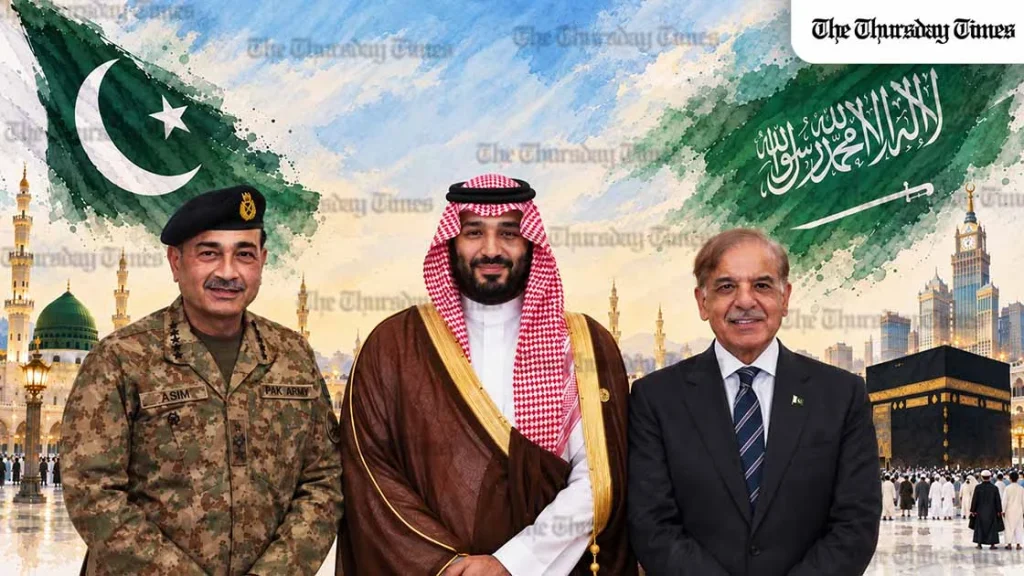
Pakistan has committed to defending Saudi Arabia to any extent. What that obliges has never been written down. — ILLUSTRATION/THE THURSDAY TIMES
First published 19 September 2026

Pakistan’s Saudi commitment: deployed, declared, undefined

One word did the work in the Pakistan military spokesman's interview with Arab News this week, and he made sure nobody missed it. Pakistan stands with Saudi Arabia diplomatically and physically, Lieutenant General Ahmed Sharif Chaudhry said, and then paused to underline the second adverb himself. We will go to any extent. In a region where officials have spent months choosing words designed to commit them to as little as possible, that was a departure.

The moment called for plain speaking. Houthi missiles and drones have been arriving over Saudi cities for weeks, and the targets have grown steadily harder to dismiss. The Saudi-led coalition reported destroying a drone heading towards the restricted airspace around Makkah, a line no one in the Muslim world can treat as ordinary. Drones from Iraq struck three pumping stations on the East-West Pipeline, shutting down a route that carries Saudi crude to the Red Sea when Hormuz is unreliable. On Friday the escalation reached the capital, with explosions reported in Riyadh's Olaya district and the Civil Defence issuing, then lifting, warnings of potential danger across the city. This has stopped being a distant conflict in Yemen.

What gives the spokesman's words weight is that Pakistan is not offering to arrive. It is already there. Reuters reported in May that Islamabad had deployed roughly eight thousand personnel, a squadron of JF-17 fighters, drones and the HQ-9 air defence system to the Kingdom. Air defence is precisely the capability now under strain. The Associated Press reported this week that Riyadh has approached several allies as its interceptor stocks come under pressure, and Pakistan's contribution is not a promise awaiting fulfilment but hardware already in position.

The comparison is instructive. According to the same reporting, Saudi Arabia approached Pakistan, Britain, France and Egypt. Of the four, Pakistan is the one whose forces are already stationed in the Kingdom, the one whose commitment is written into a treaty, and the one that has stated its position publicly and without qualification. That combination is not available to the others, and it is not the product of this month. It rests on a presence built over decades and an alliance that was formalised in Makkah before the current wave of attacks began. In alliance politics such things are noticed, and they are remembered in Riyadh long after a crisis has passed.

The architecture behind the commitment is new enough that its edges are still being drawn. The Makkah Joint Defence Agreement holds that an armed attack on Pakistan, Saudi Arabia or Turkey is an attack on all three, building on the 2025 bilateral agreement that says the same of Pakistan and the Kingdom. The operational annexes of neither document are public. What constitutes an armed attack, what response it obliges, and through what mechanism the three decide, are questions that will have to be settled between the signatories. That work is normal for a young alliance. It is also urgent, because the first crisis is a poor place to begin defining terms.

One element of the guarantee has been described differently at different times. Asked whether Pakistan's nuclear deterrent forms part of what has been extended, Lieutenant General Ahmed Sharif Chaudhry neither confirmed nor denied it. Defence Minister Khawaja Asif said after the 2025 agreement that Pakistan's nuclear capability could be available to the Kingdom if needed, and later told Reuters that nuclear weapons were not within the agreement's scope. Ambiguity has a respectable place in deterrence and can be deliberate. It serves its purpose best, though, when it is a single settled formulation that every official uses, rather than a series of individual answers that have to be reconciled afterwards.

What makes Pakistan's position distinctive is that it is doing something no other party to this can do. It has committed itself to the Kingdom's defence while remaining the only state both Washington and Tehran have been willing to let mediate between them, a role that produced the Islamabad Memorandum of Understanding in June before the talks stalled. Field Marshal Asim Munir spoke by telephone this week to Iran's foreign minister during his visit to Beijing. Pakistan has carried a Saudi message to Tehran asking it to use its influence with the Houthis. Guarantor to one party and channel to the other is an unusual combination, and holding both will take more effort as each becomes more credible.

Ankara has been alive to the same difficulty. Turkish Foreign Minister Hakan Fidan said this week that Iran is not the target of the Makkah arrangement, and that no state which refrains from aggression against the three has anything to fear from it. That is the right message and there is no reason to doubt it is meant. Whether it is accepted in Tehran will be determined by what the alliance does rather than by what its members say about it.

It would be a mistake to read any of this as a country pulled into someone else's war by a treaty signed a fortnight ago. The relationship with Saudi Arabia is eight decades old, carried by governments and by the millions of Pakistanis who work in the Kingdom and send home the remittances that hold up the external account. Pakistani troops have been stationed there before. The Makkah agreement wrote down an arrangement that already existed, and the spokesman this week described it in plainer language than officials usually permit themselves.

THE THURSDAY TIMES · THURSDAYTIMES.COM5
HOME · CULTURE · FOOD · FRIDAY 6 NOVEMBER 20266

Pierpaolo Piccioli leaves Balenciaga after just 16 months

A Balenciaga boutique with clothes on rails behind a glass front
A Balenciaga boutique at Wynn Palace in Macau in 2023. File photo. — BITA RMJOHNSON LIUOSA / WIKIMEDIA COMMONS, CC0

Kering says a new creative direction will be announced shortly, after mixed reviews of his collections

TT Foreign Desk · Paris

Pierpaolo Piccioli is stepping down as creative director of Balenciaga after just 16 months, parent company Kering announced on Thursday. It said the house’s new creative direction would be announced shortly.

Kering chief executive Luca de Meo called him “an exceptional couturier and creative talent”, and Balenciaga chief executive Gianfranco Gianangeli said he had reaffirmed the couture origins of the house.

Piccioli took over from Demna in July 2025 after 25 years at Valentino, and his collections drew mixed reviews. Morgan Stanley estimates Balenciaga’s sales at €1.47 billion in 2025, down from €1.65 billion a year earlier. Kering does not publish sales for the house.

Illustration of a formula milk tin with an orange heart on its label, beside an empty feeding bottle

Formula milk packs in Pakistan must now say ‘Mother’s milk is best’

TT Islamabad Bureau · Islamabad

The Drug Regulatory Authority of Pakistan (DRAP) has told formula milk makers and importers to print “Mother’s milk is best for babies” on their packaging and labels, in both Urdu and English.

Companies must also explain the benefits and importance of breastfeeding on the information panels of their products. The order also covers formula for children aged one to three, whether made in Pakistan or imported.

The step follows directions from the Senate Standing Committee on Health. According to available accounts, it changes labels and does not restrict sales, and companies have been told to comply without delay, though no deadline has been reported.

Dr Khalid Shafi, Secretary-General of the Pakistan Pediatric Association, has said newborns should get mother’s milk within the first hour of birth and only mother’s milk for the first six months. If your child is on formula, speak to your doctor before making any change.

Lahore Fort’s Akbari Gate restored after being shut since British rule
Preservation work finished at Islamabad’s Shah Allah Ditta Buddhist cavesOfficials hope the ancient site in the Margalla foothills will draw families and foreign visitors
Iqbal Day long weekend: banks shut for three days, so sort your cash early
6T:LIFE · THE THURSDAY TIMES · THURSDAYTIMES.COM
CRICKET · FOOTBALL · THE WORLD · FRIDAY 6 NOVEMBER 20267
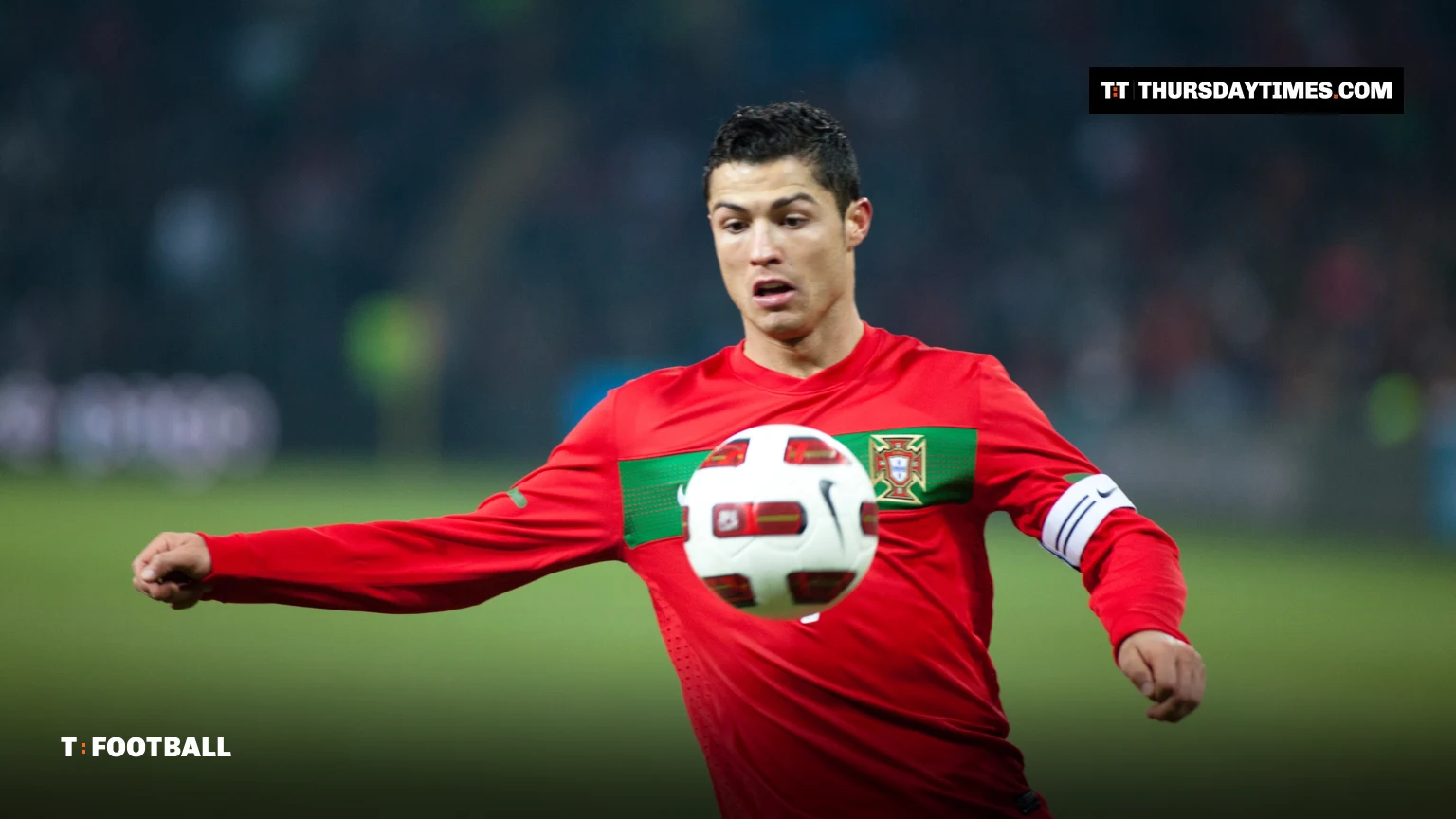
Cristiano Ronaldo in a red Portugal shirt and captain’s armband, chesting a football
FOOTBALL

Cristiano Ronaldo retires from Portugal after 23 years, 234 caps and 146 goals

The 41-year-old hands back the number 7 shirt, weeks after walking out of the national camp

TT Football Desk · Lisbon

Cristiano Ronaldo announced on Thursday that he is retiring from international football, ending a 23-year Portugal career in which he set men’s world records with 146 goals and 234 caps.

“To the Portuguese people, the day has come for me to hand back the number 7 shirt of our national team,” the 41-year-old said in a long video on X. “The goals pass, the cups are in museums, the records end up being beaten.”

He made his debut in 2003, won Euro 2016 and the Nations League in 2019 and 2025, and played at 12 major tournaments: six World Cups and six European Championships. Portugal went out of this year’s World Cup in the round of 16, beaten by eventual champions Spain.

The decision follows a fall-out with new head coach Jorge Jesus. Ronaldo stayed on the bench throughout a 2-1 win over Norway and left the national camp on the eve of the match against Denmark on October 1. His final game was a 1-0 win over Wales.

The Portuguese Football Federation said a fitting tribute would be paid to him in future. “Thank you for everything, CAPTAIN! This will always be your home!” it said. Ronaldo continues at Al Nassr, where he is chasing 1,000 career goals.

Hunza’s Maliha Ali stuns Russian champion at MMA World Championships

The 24-year-old won by split decision to reach the quarter-finals in Tbilisi, where her twin sister Manesha is also chasing a world title

Maliha Ali, a 24-year-old from Hunza, has beaten Russia’s two-time European champion Veronika Drozdova at the IMMAF World Championships, reaching the quarter-finals of the top event in amateur mixed martial arts.

She won by split decision in Tuesday’s featherweight (65.8kg) bout in Georgia, against a 19-year-old from a Russian team of more than 60 athletes. Maliha, who celebrated in prostration with the Pakistani flag over her shoulders, took the first two rounds, working Drozdova against the cage and then landing heavy blows from full mount after a takedown. She tired in the third, which went to the Russian, but had done enough.

“We worked on our opponent’s game plan, how she fights, and executed our strategy,” she said. “And thankfully it worked.”

Maliha, also a wushu champion and national kickboxing gold medallist, came to Tbilisi with a silver medal from the IMMAF World Cup in Angola this year. The Pakistan MMA Federation then ran a six-week camp and brought in an international jiu-jitsu and grappling coach to fix the weaknesses it saw there.

“We come from almost nothing; the only thing we have is our grit and desire to succeed,” said federation president Omar Ahmed, who described Pakistan as among the least-resourced teams at an event where Russia has one of the best-funded programmes.

Maliha’s quarter-final was set for Wednesday against Mexico’s Andrea Gabriela Guzman Salazar. Her twin sister, Manesha, who won gold at the World Cup in Luanda this year, was due to fight Poland’s Martyna Caruk on the same day. Results had not been reported at the time of writing.

The championships run until November 7, with 881 athletes competing for world titles.

Maliha Ali shouts in celebration with the Pakistani flag held around her shoulders
Maliha Ali celebrates her win over Veronika Drozdova at the IMMAF World Championships in Tbilisi on November 3. — PAKISTAN MMA FEDERATION
Crowds and a floodlit pitch at King Fahd International Stadium in Riyadh
King Fahd International Stadium in Riyadh in April 2014. File photo. — ALI AL-MAZARQAH/WIKIMEDIA COMMONS (CC BY-SA 3.0)

Saudi Pro League postpones all this weekend’s matches after Asian Cup move

The Saudi Pro League has postponed all of this weekend’s matches, hours after the Asian Cup was pushed back by almost a year because of the attacks on the kingdom.

The league said the decision was part of a wider review of the 2026-27 fixture list, with the new Asian Cup dates “creating additional flexibility in the domestic football calendar”. It gave no new dates for the games.

All of Matchday 13 is affected. Al-Qadsiah were due to host Al-Fayha on Thursday and Al-Nassr to visit Al-Hazem, with Al-Ittihad at home to NEOM on Friday. Al-Hilal were to play Al-Ettifaq in Dammam on Saturday, and Al-Ahli to host Al-Taawoun in Jeddah.

The league had already moved several matches in October after attacks on the country, including a missile strike on Riyadh’s airport. It has mostly managed to carry on as usual until now.

The Asian Cup, which was to begin on January 7, will now run from December 23, 2027, to January 21, 2028. The new dates must still be approved by Fifa, and will ease a crowded calendar that coaches have complained about. “It is difficult for the same player to play every three days,” Al-Ittihad coach Jens Wissing said earlier.

Other sport in the Gulf is also under pressure. The Qatar Grand Prix, set for November 27 to 29, and the Abu Dhabi race that follows it are in doubt, after Formula 1 lost its Bahrain and Saudi races in April.

THE THURSDAY TIMES · THURSDAYTIMES.COM7
PULL-OUT · THE THURSDAY TIMES06.11.20268
Westline
BRITAIN, FROM THE OTHER SIDE OF THE LINEWESTLINE × THE THURSDAY TIMES
A STATE THAT STOPPED DECIDING

The backlog Britain built

A queue stretches back into the dark while the Home Office counter stays barely open — Illustration: Westline

Ministers of both parties have spent a decade blaming the people in the queue. The numbers point at the people running it.

Abdullah Esquire
Read it in fullthursdaytimes.com/westline

CONSIDER SOMEONE WHO CLAIMED asylum in Britain in January 2023. Where they came from, and how they arrived, matters less than what happened next — which is to say, very little. When the National Audit Office took a sample of 5,000 claims lodged that month and checked on them nearly three years later, more than half were still unresolved. In the meantime our claimant will probably have been housed at public expense, largely barred from working, interviewed by a caseworker who may not have been in post for long, refused, appealed, and then left waiting again: this time for a tribunal that now takes, on average, well over a year to hear a case.

In the political conversation, that person is the problem. The backlog is discussed as though it were a weather system blown in off the Channel — too many boats, too many claims, too many people gaming the system. Arrivals do matter, and nobody serious pretends otherwise. The number of people claiming asylum peaked at around 110,000 in the year to September 2025, the highest figure in nearly two decades.

But a backlog is not a measure of how many people turn up. It is the gap between the cases that come in and the cases a department decides — and decides properly. Judged that way, the story of Britain’s asylum queue is not one of an overwhelmed border. It is the story of an institution that, over ten years, stopped doing its core job, then tried to do it at a sprint, then passed the consequences down the corridor to the courts. The people in the queue designed none of it.

Initial asylum decisions made per year

Home Office annual statistics · output collapsed before small boats became a mass phenomenon, then quadrupled on command

The rot set in long before small boats became a nightly news item. In 2015 the Home Office made 28,623 decisions on asylum applications. By 2017 that had fallen by a quarter, to 21,269, and the department never recovered its old pace. The more striking figure is what happened per head. According to the Institute for Government, in 2011/12 some 380 caseworkers were each producing around 13.7 decisions a month. By December 2022 there were 1,237 of them, managing about four apiece. The workforce had more than tripled; the output of each worker had fallen by over two-thirds.

Then, in January 2019, with ministerial approval, the department dropped its own service standard: the commitment to decide 98 per cent of straightforward claims within six months. The stated reason was to prioritise the most vulnerable cases rather than the simplest. The practical effect was to remove the one clock that had been ticking. The Migration Observatory later found that in 2014 eight in ten applicants received an initial decision within six months; within five years it was one in four.

Why this isn’t a story about the Channel In 2021 the UK had 14.9 cases in its asylum backlog per 10,000 people, more than Germany or France, even though it received far fewer applications per head than either. Countries facing heavier demand were simply getting through their caseloads faster. By December 2022 two-thirds of those waiting — almost 110,000 people — had been in the queue for more than six months. That is not a surge. It is a department that had quietly stopped deciding things.

In December 2022 Rishi Sunak did something the Home Office had not done in years: he set it a deadline. The so-called legacy backlog — roughly 92,000 claims lodged before 28 June 2022 — would be cleared within twelve months. The department doubled its decision-makers to around 2,500 and, for nationalities with very high grant rates such as Afghans, Eritreans and Syrians, swapped lengthy interviews for a questionnaire. The results were instructive. In one four-week stretch in November and December 2023, officials made 20,481 initial decisions, more than in the whole of 2021. Across that year they made 112,138. For anyone who still believed the queue was driven by forces beyond Whitehall’s control, that was the rebuttal.

The sprint had a cost, though, and it was paid in shortcuts. Asylum withdrawals in 2023 were more than four times the 2022 figure, and 79 per cent of them were “implicit” — claims the Home Office itself closed because someone missed an interview, missed a questionnaire deadline or had not updated an address. When the pledge was declared met, 4,537 legacy cases were still awaiting a decision, and the chair of the UK Statistics Authority warned that the episode might affect public trust. A Conservative government that had staked its reputation on control ended up being rebuked by the statistics watchdog for its arithmetic.

Worse, at the same moment that one arm of the department was racing through old cases, another had been told to stop deciding new ones. The Illegal Migration Act meant that claims from those who had arrived irregularly after 7 March 2023 could not be granted. By the end of that year, 55,533 of the 98,599 claims awaiting a decision had been made after the bill was introduced. The backlog stopped falling and, by March 2024, stood at 118,329 people. Those claims were being held for removal to Rwanda, a scheme that by Labour’s later accounting had cost around £700 million — £290 million of it paid to Kigali — to send four volunteers. The Home Affairs Committee later concluded that holding up decisions while the scheme stalled had made the crisis worse. Parliament had, in effect, legislated the state into not processing cases, and then the state paid to house everyone it had declined to process.

Every month a claim sits undecided is a month of bed, board and administration, and this is where the failure becomes a fiscal one. In 2019 the Home Office signed seven regional contracts with Serco, Mears and Clearsprings, expecting them to cost £4.5 billion over ten years. The National Audit Office now puts the figure at £15.3 billion. Between December 2019 and December 2024 the number of asylum seekers in paid-for accommodation rose from about 47,000 to 110,000. Hotels, the emergency option, became the default: at the peak, in September 2023, 56,018 people were in them, spread across roughly 400 sites.

The economics were dreadful. In 2024-25 hotels held around 35 per cent of people in asylum accommodation but swallowed 76 per cent of the contracts’ annual cost.

NAO, asylum accommodation contracts (2025) · hotels held just 35% of people in the system

The three providers made a combined profit of £383 million between 2019 and 2024. The NAO’s verdict was that the department had few levers to control the cost. Across the Home Office and Ministry of Justice, asylum cost £4.9 billion in 2024-25.

For a centre-right reader, this ought to be the scandal. A man waiting for a decision cannot choose to move out of a hotel and is, for the most part, forbidden from earning his own keep. The bill is not run up by his presence so much as by the length of his stay, and the length of his stay is set in Whitehall. Treat the backlog as a migrant problem and you reach for deterrents. Treat it as a productivity problem and you reach for the thing that actually saves money: a decision.

WESTLINE · A THURSDAY TIMES PULL-OUT8
Archive