Wednesday 11 November 2026 Archive
WEDNESDAY 11 NOVEMBER 2026Dangerous to those who trade in lies.THE E-PAPER · ENGLISH EDITION · 8 PAGES
234567Westline pull-out8

Kohat ambush: DSP among 12 policemen injured, toll unclear

An armoured police vehicle on a street in Khyber Pakhtunkhwa
An armoured police vehicle in Khyber Pakhtunkhwa. File photo. — AFP

Police say terrorists and criminals ambushed a police party during a raid on illegal gold mining. Earlier reports of at least 10 martyred have not been confirmed by the latest police statement.

TT News Desk · Kohat

At least 12 policemen, including Deputy Superintendent of Police Haider Zaman and Gumbat station house officer Ayaz Afridi, were injured on Wednesday when terrorists of Fitna al-Khawarij and criminal elements ambushed a police party during an operation against illegal gold mining in Kohat district, police said.

Earlier in the day a police spokesperson and rescue officials said at least 10 personnel had been martyred. The latest police statement listed the injured and did not confirm any deaths, and the final toll remained unclear.

The ambush took place in the Darbukach area of Gumbat police station, where the operation against illegal gold mining along the Indus was under way. Police said the mining had continued because of a nexus between terrorists and criminals. The attackers set a police vehicle on fire.

Fresh contingents of police and security forces reached the area, and an exchange of fire was under way. The Kohat district police officer said the pursuit would continue until the last terrorist was eliminated. An emergency was declared at the District Headquarters Hospital in Kohat.

Police in Khyber Pakhtunkhwa have faced a series of attacks in recent months. Security reports presented to the federal cabinet in October found that 73 per cent of attacks recorded in the province this year had targeted police and security personnel.

This story will be updated as officials confirm the casualties.

Pakistan, Kuwait hail ratified defence pact as Shehbaz meets Kuwaiti PM

Prime Minister Shehbaz Sharif and Kuwait’s Prime Minister, Sheikh Ahmad Al-Abdullah Al-Ahmad Al-Sabah, welcomed the recent ratification of a defence cooperation agreement between their two countries when they met on the sidelines of the COP31 climate summit in Antalya on Wednesday, the Prime Minister’s Office said.

The two leaders hoped the agreement would further promote cooperation between the “two brotherly countries”, the office said.

They discussed the longstanding fraternal relations between Pakistan and Kuwait and reaffirmed their resolve to strengthen cooperation in trade, investment, energy, development cooperation and people-to-people exchanges. They also exchanged views on regional and international developments, particularly the challenges to peace and security in the region, the consequences of climate change and the importance of international cooperation for sustainable development.

The meeting underscored a shared commitment to deepen ties, particularly business ties, “to truly reflect the excellent brotherly ties”, the office said, and both leaders agreed to work together for mutual prosperity, regional stability and sustainable development.

Earlier on Wednesday, Shehbaz met Iranian President Masoud Pezeshkian, Syria’s President Ahmad al-Sharaa and World Bank President Ajay Banga at the summit, where he was received by Turkish President Recep Tayyip Erdogan and UN Secretary-General António Guterres.

“He lived and breathed for his kids.”Chicago father dies hours after ICE deports him to Pakistan Page 2

Sixteen memorandums later, what Pakistan’s minerals forum must show

Last year’s forum produced 16 memorandums. Since then Reko Diq has slowed and its financing is unfinished, while security and a railway have moved up the agenda. PMIF26 will be judged on whether signatures are turning into mines

TT MONITORING DESKPAGE 5 ›

PM Shehbaz, Field Marshal Munir attend Chashma-5 nuclear plant dome ceremony

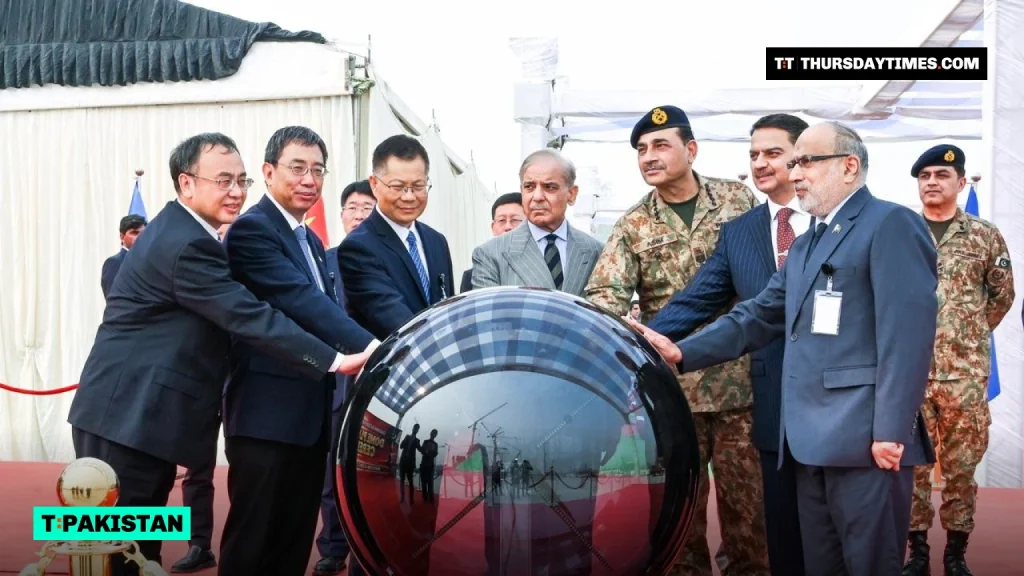
Prime Minister Shehbaz Sharif and Field Marshal Syed Asim Munir on Tuesday attended the dome placement ceremony of the Chashma-5 nuclear power plant, Pakistan’s largest nuclear reactor, which is being built with China in Mianwali.

The Prime Minister’s Office said the prime minister addressed the ceremony at the plant, known as C-5. Field Marshal Munir, the Chief of Army Staff and Chief of Defence Forces, joined him, along with Chinese officials and senior Pakistani officials, who together pressed the ceremonial button marking the milestone.

Placing the steel dome on the reactor building is one of the main stages in building a nuclear plant. It closes the containment structure that houses the reactor, after which work moves on to installing the main equipment inside.

With the dome in place, the plant is about 75 per cent complete. It is due to start supplying electricity to the national grid by September 2030, and is part of the China-Pakistan Economic Corridor.

Chashma-5 is a 1,200-megawatt Hualong One reactor, a Chinese design, and will be the biggest nuclear power unit in the country when it is finished. It is being built by the Pakistan Atomic Energy Commission at the Chashma nuclear power complex, where four smaller reactors built with Chinese help already supply the national grid.

Shehbaz Sharif performed the groundbreaking of the project on July 14, 2023. Concrete was first poured on December 30, 2024, days after the Pakistan Nuclear Regulatory Authority issued its construction licence, formally starting the build.

In September, Pakistan and the International Atomic Energy Agency signed a safeguards agreement covering the plant.

The government sees nuclear power as a steady, low-cost source of electricity at a time when the country is trying to cut its reliance on imported fuel for power generation.

Speaking at the ceremony, the prime minister praised the teamwork between Pakistan and China on the project and said nuclear power gave the country clean electricity while cutting carbon emissions.

Pakistan’s existing nuclear plants, with a combined capacity of 3,530 megawatts, already avoid about 15 million tonnes of carbon dioxide emissions a year, he said, adding that the new 1,200-megawatt unit would strengthen the country’s energy security.

Shehbaz Sharif and Asim Munir with Chinese officials at the Chashma-5 dome ceremony
Prime Minister Shehbaz Sharif, Field Marshal Syed Asim Munir and Chinese officials press the button at the dome placement ceremony of the Chashma-5 nuclear power plant in Mianwali on November 10, 2026. — PMO/HANDOUT
Pakistan todayPAGE 2
Shehbaz meets Pezeshkian, Syria’s al-Sharaa and World Bank chief at COP31
Remittances rise 14% to $3.9bn in October, Saudi Arabia leads
Petrol cut by Rs8 to Rs338 a litre as oil slides to two-month low
THE THURSDAY TIMES · PUBLISHED BY THURSDAY MEDIA INTERNATIONAL · THURSDAYTIMES.COM1
US MIDTERMS · THE WORLD · PAKISTAN · WEDNESDAY 11 NOVEMBER 20262

Bessent moved to US military base after Iranian threats to his life

The Treasury secretary leads the US economic pressure campaign on Tehran, people familiar with the matter say. His department says he “will not be deterred”.

TT Foreign Desk · Washington

US Treasury Secretary Scott Bessent has moved from his home in Washington to an undisclosed military base after threats to his life from Iran, people familiar with the matter said, as he leads the US economic pressure campaign against Tehran.

The severity of the threats was not clear. Concern grew after an aerial photograph of the Georgetown house he bought for $12.5 million shortly after taking office in January 2025 was published in the US press, allowing the property to be located, one of the people said. “The news media has an obligation to act responsibly amid growing threats against public officials,” the person added.

A Treasury spokesperson said “the secretary will not be deterred by the Iranian regime’s threats and remains committed to executing Operation Economic Outcast and maintaining the blockade, which together are collapsing Iran’s economy”.

Bessent has led Operation Economic Outcast since August, a sanctions and pressure campaign meant to force Tehran to stop attacks on shipping and reopen the Strait of Hormuz. It runs alongside a US naval blockade of Iranian ports announced in April, and has included sanctions on Middle Eastern bank branches and other financial firms that handle transactions with Iran.

A senior US intelligence official warned in a memo late last month that Iranian plots against US personnel and citizens had reached an advanced stage, according to people familiar with the matter. Iran has previously denied plotting attacks on officials or people on US soil.

The move comes as Iran insists that the Strait of Hormuz will stay shut until Washington meets its conditions, and as Secretary of State Marco Rubio says the economic campaign is so devastating that major combat operations are not needed.

UK security minister Dan Jarvis visits Pakistan for terror, migration talksJarvis met Ishaq Dar and Mohsin Naqvi on counter-terrorism, organised crime, illegal migration, visa fraud and stability in Afghanistan.
Continued from page 1

PM Shehbaz, Field Marshal Munir attend Chashma-5 nuclear plant dome ceremony

Shehbaz Sharif and Asim Munir with Chinese officials at the Chashma-5 dome ceremony
Prime Minister Shehbaz Sharif, Field Marshal Syed Asim Munir and Chinese officials press the button at the dome placement ceremony of the Chashma-5 nuclear power plant in Mianwali on November 10, 2026. — PMO/HANDOUT

Prime Minister Shehbaz Sharif and Field Marshal Syed Asim Munir on Tuesday attended the dome placement ceremony of the Chashma-5 nuclear power plant, Pakistan’s largest nuclear reactor, which is being built with China in Mianwali.

The Prime Minister’s Office said the prime minister addressed the ceremony at the plant, known as C-5. Field Marshal Munir, the Chief of Army Staff and Chief of Defence Forces, joined him, along with Chinese officials and senior Pakistani officials, who together pressed the ceremonial button marking the milestone.

Placing the steel dome on the reactor building is one of the main stages in building a nuclear plant. It closes the containment structure that houses the reactor, after which work moves on to installing the main equipment inside.

With the dome in place, the plant is about 75 per cent complete. It is due to start supplying electricity to the national grid by September 2030, and is part of the China-Pakistan Economic Corridor.

Chashma-5 is a 1,200-megawatt Hualong One reactor, a Chinese design, and will be the biggest nuclear power unit in the country when it is finished. It is being built by the Pakistan Atomic Energy Commission at the Chashma nuclear power complex, where four smaller reactors built with Chinese help already supply the national grid.

Shehbaz Sharif performed the groundbreaking of the project on July 14, 2023. Concrete was first poured on December 30, 2024, days after the Pakistan Nuclear Regulatory Authority issued its construction licence, formally starting the build.

In September, Pakistan and the International Atomic Energy Agency signed a safeguards agreement covering the plant.

The government sees nuclear power as a steady, low-cost source of electricity at a time when the country is trying to cut its reliance on imported fuel for power generation.

Speaking at the ceremony, the prime minister praised the teamwork between Pakistan and China on the project and said nuclear power gave the country clean electricity while cutting carbon emissions.

Pakistan’s existing nuclear plants, with a combined capacity of 3,530 megawatts, already avoid about 15 million tonnes of carbon dioxide emissions a year, he said, adding that the new 1,200-megawatt unit would strengthen the country’s energy security.

The world in brief

EVERY STORY IN FULL AT THURSDAYTIMES.COM
US charges three over Iran-backed plot at Britain’s RAF FairfordProsecutors say the men sent fuel-laden vans disguised as delivery trucks towards the base used by American bombers, and planned 18 attacks across Europe this spring. Iran denies any role.
Chicago father dies hours after ICE deports him to PakistanAyaz Ahmed, 61, had no criminal record and chronic illnesses. His family says he collapsed after a 38-hour ICE flight; ICE calls claims of neglect “categorically false”.
Iran’s Revolutionary Guards unveil new underground missile cityFootage released on Tuesday shows ballistic and cruise missiles and their launchers in a tunnel complex. Iran has not said where it is, and the claims cannot be independently checked
Saudi Arabia, Türkiye sign 3,000MW wind power deal at COP31The second phase of a February pact brings power plants to be built jointly with Saudi Arabia in Türkiye to 5,000MW, as the COP31 hosts push electrification.
Guterres calls for ‘Climate Justice Compact’ as COP31 summit opensThe UN chief urged a just transition from fossil fuels and $300bn a year in climate finance as about 100 countries met in Antalya, with the US absent and most G7 leaders away.
Iran says Hormuz stays shut until US meets its seven conditionsSecurity chief Mohsen Rezaei called talk of negotiations “a pure lie”. Rubio said the economic campaign is so devastating that major combat operations are not needed.

Pakistan

NATIONAL · ECONOMY · MILITARY

Erdogan and Guterres welcome Shehbaz to COP31 leaders’ summit

TT News Desk · Antalya

Turkish President Recep Tayyip Erdogan and UN Secretary-General António Guterres received Prime Minister Shehbaz Sharif on Wednesday as he arrived for the leaders’ summit of COP31, the UN climate conference in Antalya, his office said.

The prime minister is due to set out Pakistan’s climate priorities to world leaders at the summit. The Foreign Office has said he will call for climate finance for vulnerable countries that is “predictable, adequate and accessible”.

Pakistan produces less than one per cent of the world’s greenhouse gas emissions but is among the countries most exposed to climate disasters. The 2022 floods caused $14.9 billion in direct damage and $15.2 billion in economic losses and pushed up to 9.1 million people into poverty, according to the Asian Development Bank. Last year’s monsoon killed 1,039 people, the government’s Economic Survey says.

On the day the prime minister arrived in Antalya, the bank approved $500 million in contingent disaster financing for Pakistan, to be released as budget support soon after an eligible disaster.

Türkiye is hosting COP31, which runs from November 9 to 20.

OGDCL strikes gas in Khairpur as PPL plans 6,000m well at SuiThe Bitrisim Northwest-1 well tested at 12.8 million cubic feet of gas a day. PPL will drill deep at Sui in 2027-28, targeting about 2 trillion cubic feet.
ADB approves $500m disaster financing for PakistanThe contingent facility is released as budget support soon after an eligible disaster. Pakistan loses about $2 billion a year to floods, earthquakes and other disasters, the bank says.
Pakistan is invested in Eurasia’s new order, America isn’t: Pravin SawhneyAt the Margalla Dialogue, the Indian defence analyst said China and Russia are building the region’s institutions while Washington only trades, and that Pakistan is already inside them.
Imran Khan taken to PIMS overnight for sixth eye injectionThe PTI founder was back in Adiala jail within an hour. His party says a Supreme Court order to move him to Shifa International Hospital has gone unimplemented for nearly three months.
Ex-Afghan army soldier held in Tirah over suicide-bomber plot, police sayPolice say Hikmatullah, alias Hamza, trained a suicide bomber at a madrasa near Jalalabad and tried to attack a security post. A second suspect is still being tracked.
InsideGulf, 3 · Views, 4 · Analysis, 5 · T:LIFE, 6 · Sports, 7 · Westline, 8
2THE THURSDAY TIMES · THURSDAYTIMES.COM
EMIRATES · SAUDI · QATAR · WEDNESDAY 11 NOVEMBER 20263

ADNOC ship damaged in attack inside UAE waters as Gulf tanker strikes mount

The company gave no details of the vessel or crew. Within a day, a tanker near Hormuz was hit by a projectile, Iran’s army said another struck a mine, and a Dubai-bound ship had four crew injured.

People walk past an illuminated ADNOC logo
People walk past the ADNOC logo at the ADIPEC energy conference in Abu Dhabi on November 3, 2025. File photo. — REUTERS/Amr Alfiky
Thursday Emirates · Abu Dhabi

A vessel operated by ADNOC Logistics & Services was damaged in an attack inside the UAE’s territorial waters in the Gulf on Tuesday afternoon, the company said, as at least two more tankers were hit in and around the Strait of Hormuz within a day.

In a statement, the shipping arm of the Abu Dhabi National Oil Company said response efforts were ongoing and that further updates would follow. It did not name the vessel, describe the damage or say whether any crew were hurt, and it urged the public to rely only on official sources and not to spread rumours.

ADNOC’s fleet has been hit repeatedly since the war began on February 28. In August the company said 15 of its vessels had been attacked by missiles and drones while crossing the Strait of Hormuz, killing one person and injuring 20 crew members, and it reported further attacks on August 8, 13 and 14.

Late on Tuesday the UK Maritime Trade Operations centre said a tanker had been struck by an unidentified projectile about 19 nautical miles north-east of Limah in Oman, near the strait. The master reported that the crew were safe and there was no environmental damage. On Wednesday Iran’s army said an oil tanker had caught fire in the eastern part of the strait after hitting a naval mine in a “restricted area”.

A Liberia-flagged oil tanker bound for Dubai was also hit by a projectile in the Gulf on Tuesday, injuring four crew members including an Indian national, India’s shipping minister Sarbananda Sonowal said. The other 18 crew, five of them Indian, were safe.

The attacks follow a strike on the Qatari gas carrier Al Maayeda, which its owner Nakilat said was hit by unidentified objects in the Gulf on October 30, without injuries. Last month the supertanker Gem No. 2 was struck by a projectile off the UAE coast and leaked oil that reached the shores of Umm Al Quwain, Ras Al Khaimah, Ajman and Sharjah. The UAE is now offering to sell up to 1.87 million barrels of Saudi crude recovered from the ship.

The Strait of Hormuz has been largely closed since the United States and Israel attacked Iran on February 28. The UAE can export crude through Fujairah, which lies outside the strait, while Saudi Arabia relies on its East-West pipeline to terminals on the Red Sea.

Grey smoke rises over the towers of an oil refinery in a desert landscape

Saudi air defences down Houthi missiles fired at Riyadh and the south

Riyadh · thursdaytimes.com
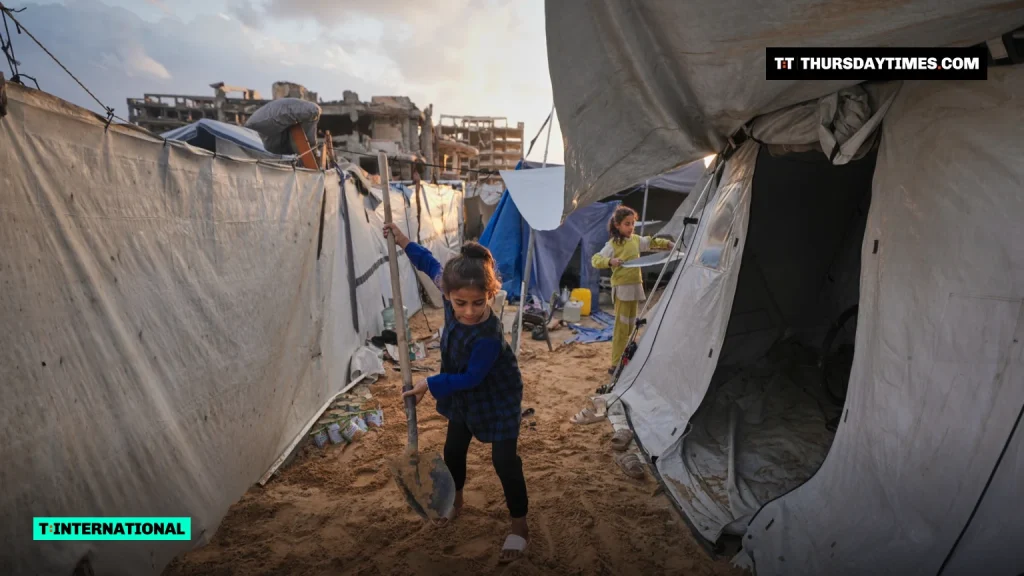
A Palestinian girl digs sand between rain-damaged tents in a Gaza City camp

Dubai ruler orders tents for 50,000 in Gaza as winter rains hit camps

Dubai · thursdaytimes.com

Shrapnel damages Aramco building in Riyadh as Houthi missiles are shot down

THE THURSDAY TIMES · THURSDAYTIMES.COM3
EDITORIAL · OPINION · WEDNESDAY 11 NOVEMBER 20264

Pink buses are a good start. Every bus should be safe for women

The CDA’s 30 women-only electric buses deserve a quick launch. But Peshawar shows that making every bus safe does more for women than a separate fleet, and Islamabad should do both

The Capital Development Authority wants to put 30 pink electric buses on Islamabad’s roads, for women only, within the next few months. It should do so, and quickly. Women and girls in the capital are being squeezed off the city’s popular electric buses at rush hour, and a separate service is the fastest way to give them a seat. But a pink bus is a remedy for a symptom. The disease is that too many women in Pakistan do not feel safe on ordinary public transport, and a city that answers that only with a separate fleet risks telling half its population that the rest of the network is not for them.

The proposal is modest and sensible. A senior CDA official has said the authority decided to introduce the women-only service after seeing how hard it had become for women and girls to find space on the existing electric buses, especially during peak hours. The authority already runs more than 160 electric buses on over 20 routes through a contractor, a service residents have taken to with enthusiasm. The new pink buses would run on those same routes at first, with more added if demand justifies it. A summary is being prepared for the CDA Board, and Heavy Industries Taxila is expected to handle procurement, with the buses imported from China in the same way as the current fleet. The plan follows directions from the federal government and the interior ministry.

Islamabad is not starting from nothing. The Ministry of Federal Education and Professional Training already runs a free Pink Bus Service for working women and girl students. When the ministry last described it, in October 2025, it had 22 buses serving five rural sectors of the capital territory during morning and early-afternoon peaks, carrying more than 4,000 women and girls a day. A third-party review found it had made their journeys safer and easier, and the ministry said it wanted to extend it to more rural and peri-urban areas, with trained female staff and security on board, if money allowed.

Two services for women, run by two different arms of the state, in one small city, is a sign of good intentions. It is also a warning. If the CDA’s pink buses and the ministry’s pink buses are planned separately, with separate routes, timetables, fares and complaint lines, women will pay for the confusion. The first decision the CDA Board should take is to fold both into a single network with one map, one card and one helpline.

For many Pakistani women, the bus is not one option among several. It is the only one. Men are far more likely to own or borrow a car or a motorcycle. Women rarely ride either, and many families consider rickshaws and the crowded paratransit vans unsafe for their daughters. When the bus is crowded, hostile or simply absent, the cost is not a longer journey. It is a lost job, a missed class or a girl kept at home.

The World Bank counts only about 21 per cent of Pakistani women in the workforce, the lowest share in South Asia. Safe transport is far from the only reason, but it is one of the easiest to fix. In one study the bank cites from Lahore, three in four women said they would be willing to work if safe transport were available. In Karachi, it cites a figure of 80 per cent of women having experienced harassment on public transport.

Every one of those numbers is an economic argument as much as a moral one. A country that keeps most of its educated women out of paid work because they cannot get there safely is choosing to be poorer than it needs to be.

The good news is that Pakistan does not need to guess what works. Its own cities have run the experiment.

Peshawar’s BRT is the clearest lesson. A survey in 2016 found that 90 per cent of women in the city felt unsafe on public transport. Peshawar did not respond mainly with separate buses. It reserved about a quarter of the seats on every bus for women, fitted the fleet with CCTV, put guards on board and lit the stations properly. It hired women, who made up about 15 per cent of the system’s 2,000 staff by 2022. Fares were kept low, at about 30 rupees for the longest trip. By 2022 the operator said women accounted for roughly 30 per cent of passengers, up from 2 per cent two years earlier.

Karachi chose the other route first. The Sindh government launched its People’s Pink Bus Service in February 2023 with about 10 buses, starting on a single route from Model Colony to Tower, and has since extended it. Lahore followed in October 2024 with pink buses on 16 routes, though with only one or two buses on each at the start. Mardan had pink buses as far back as 2018, and Gilgit-Baltistan opened a free women-only service in 2022.

The difference between these approaches is instructive. Separate buses help most where they are frequent and dependable. One or two buses on a route, arriving when they arrive, are a gesture rather than a service. A woman who has to be at work at nine cannot plan her day around a bus that comes twice a morning. That is why Peshawar’s approach of making every bus safe has done more for women’s ridership than a handful of pink buses have done anywhere else.

The CDA should launch its pink buses, but as one half of a plan whose other half covers the entire fleet. Karachi’s Yellow Line BRT, now being built with World Bank support, offers a useful template. Its stations were designed after consulting women and transgender people, with good lighting, alarm buttons, CCTV on buses and at stations, visible reporting desks, helpline numbers in local languages and properly placed washrooms. Under its gender action plan, the project aims for at least 30 per cent of its bus drivers to be women. Sindh began training women as bus drivers in a pilot in 2023.

Islamabad can adopt the same standards across its electric fleet without waiting for new buses. A reserved section for women on every bus, clearly marked and actually enforced. Women drivers and conductors, recruited and trained on purpose rather than by accident. Cameras that work and are watched, and a panic button that summons a real response. A single helpline whose number is painted on every bus and stop, with complaints logged, answered and counted. Stops that are lit, shaded and visible from the road.

The journey does not end at the bus door. In Peshawar, commuters and researchers have pointed to the walk between home and the stop as the weak link in an otherwise safer journey. Poor street lighting, empty pavements and the absence of public toilets make that last mile a barrier in its own right. The CDA controls street lighting, footpaths and land use in the capital. It is better placed than any transport authority in the country to fix the whole journey, not just the ride.

Fares matter too. The education ministry’s pink buses are free, and the CDA’s electric buses are cheap. The new service should not price out the low-income women who need it most. Free travel for girl students would be a sound use of public money.

The authority should also publish what it learns. How many women ride, on which routes and at what times. How many complaints of harassment are made, how quickly they are answered and what happens to the offenders. Whether women’s share of passengers on the ordinary electric buses rises or falls after the pink buses arrive. Without that data, nobody will know whether the scheme is working, and the next city to copy it will copy its mistakes along with its successes.

Editorial · The Thursday Times
Two women in burqas, one holding a child, ride a bus in Peshawar
“The authority already runs more than 160 electric buses on over 20 routes through a contractor, a service residents have taken to with enthusiasm.”
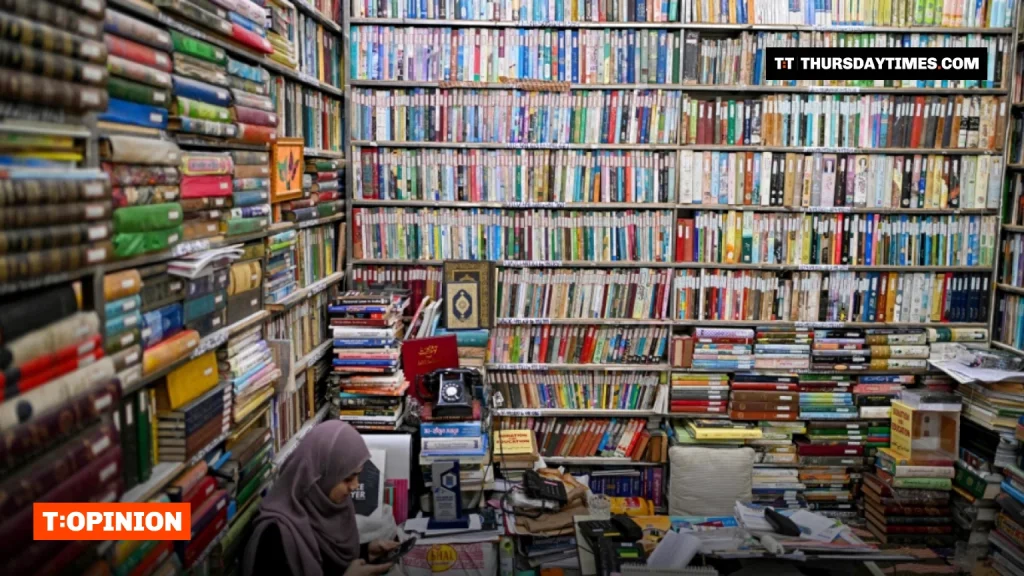
A young woman in a headscarf sits looking at her phone at a desk in a small library, walled floor to ceiling with shelves of Urdu books
A student sits amid stacks of Urdu books at the Hazrat Shah Waliullah public library in Urdu Bazar, Old Delhi, on October 22, 2024. — AFP

Great injustice to Urdu in India

“This great language, which has produced perhaps the best poetry in modern India … and which is a shining gem in the treasury of Indian culture, is today neglected, and by some people even looked at with suspicion,” writes former Supreme Court of India Justice Markandey Katju.

Words by Justice Markandey Katju

Great injustice has been done in India to Urdu.

This great language, which has produced perhaps the best poetry in modern India, the immortal poetry of Mir, Ghalib, Faiz, Firaq and others, and which is a shining gem in the treasury of Indian culture, is today neglected, and by some people even looked at with suspicion. I cannot imagine a greater foolishness.

Urdu was a language created by combining 2 languages, Hindustani or Khadiboli (i.e. simple colloquial Hindi) and Persian. That is why at one time it was called ‘Rekhta’ which means hybrid.

In connection with Persian and Urdu 3 questions arise:

I am giving the answers here.

The Moghuls made Persian their Court language, and not Turkish, their mother tongue, because a Court language must be highly sophisticated, graceful, elegant, and dignified. Persian had been made a highly sophisticated, elegant and polished language by great poets like Firdausi, Hafiz, Rumi, Saadi, Umar Khayyam, etc. Turkish was no match to Persian, and had no writers like the Persians abovementioned. That is why Persian spread in large parts of south east Asia, including India.

Thus, though Babar wrote his autobiography, Tuzuk-e-Babri, in Turkish, his grandson Akbar got it translated into Persian and called it Babarnama. His own biography, Akbarnama, written by Abul Fazl is in Persian, and so is the autobiography of his son Jehangir (called Jahangirnama) and the biography of Shahjehan (called Shahjehannama).

Some people may wonder how Persian landed up in India? After all, it is not a native language of India.

The answer is that the elite in society often want to distinguish themselves from the commoners, and hence speak a foreign language, e.g. the elite in India speak English.

This phenomenon of a foreign language being accepted as the language of the upper class or the court is nothing unique. For instance, French was the language of the Russian and German (and indeed much of European) aristocracy up to the 19th Century. When a Russian aristocrat spoke to another Russian aristocrat, he often spoke in French, though with his servant he spoke in Russian. Similarly, when a German aristocrat spoke to another German aristocrat, he would often speak in French, though with his servant he spoke in German.

Thus in Tolstoy’s ‘War and Peace’, we find that the Russian commanders (who were all Russian aristocrats) often spoke to each other in French, although their enemy, Napoleon, was French.

The Court language of the Delhi Sultanate was Persian, although most Delhi Sultans were Afghans, not Persians. Though their mother tongue was Pashto, they preferred Persian as their Court language, as it was much more sophisticated, elegant and graceful than Pashto.

Akbar’s finance minister Raja Todarmal got all the revenue and judicial records throughout the Mughal Empire written in Persian.

To know the difference between Persian and Urdu, one must first understand that to determine to which language a sentence belongs, one must find out to which language does the verb (called ‘kriya’ in Hindi and ‘feyl’ in Urdu) in that sentence belong.

Suppose I say “Mr Ram, aaiye to my house for dinner with your wife for dinner at 8 pm”. This sentence contains 16 words, of which 15 are from English, nevertheless it is a Hindustani (simple Hindi), not an English, sentence, because the verb ‘aaiye’ in it is of Hindustani.

Similarly, we may take any Urdu sher (couplet) of any Urdu poet, and we will find that the verb therein will be invariably in Hindustani (though the nouns and adjectives are often in Persian or Arabic). If the verb in the sher is Persian, it will become a Persian sher, and if the verb is in Arabic, it becomes an Arabic sher.

4THE THURSDAY TIMES · THURSDAYTIMES.COM
WEDNESDAY 11 NOVEMBER 20265

Sixteen memorandums later, what Pakistan’s minerals forum must show

Last year’s forum produced 16 memorandums. Since then Reko Diq has slowed and its financing is unfinished, while security and a railway have moved up the agenda. PMIF26 will be judged on whether signatures are turning into mines

TT Monitoring Desk · 7 min read
Barrick chief executive Mark Bristow speaks at a press conference table with microphones and flowers
Mark Bristow, president and chief executive of Barrick, speaks to the media in Islamabad. File photo. — REUTERS

When the Pakistan Minerals Investment Forum opens at the Jinnah Convention Centre on Thursday, the delegates will hear again about the size of the prize. They should ask a harder question. Last year’s forum drew more than 5,000 people from over 50 countries and ended with 16 memorandums of understanding. Since then, the country’s flagship project has been slowed, its financing has not closed, and no American company is yet operating in Balochistan. Yet some of the groundwork has moved too, from a security corridor in Chagai to a long-stalled lead and zinc mine. PMIF26 matters less for what gets signed than for whether it shows Pakistan can turn signatures into mines.

The forum, endorsed by the Special Investment Facilitation Council, was due to take place in April and was moved to November 12 and 13 because of regional developments. Its programme is noticeably more practical than last year’s. The first day is given over to financing early-stage exploration, training a mining workforce and bringing discoveries from active licences into production, with a session on antimony. The second day features a dialogue among ministers on building what the organisers call investor-ready mining jurisdictions. That choice of subject is an admission, and a sensible one, that geology has never been Pakistan’s problem.

Pakistan’s mineral wealth is often put at about $8 trillion, spread over 600,000 square kilometres. It is a striking number, and it should be treated with care: an estimate of what lies underground says little about what can be extracted at a profit. Mining has historically contributed around 3 per cent of GDP. One professional body, the Institute of Cost and Management Accountants, estimates that annual mineral exports could rise from about $3 billion to $8 billion with strong governance and security.

The external conditions are good. Wood Mackenzie forecasts that world copper demand will grow 24 per cent to 42.7 million tonnes a year by 2035, driven by electrification, and the International Energy Agency says announced projects are still not enough to meet projected demand for copper and lithium. Washington, looking for alternatives to Chinese supply, is hunting for about 60 minerals it regards as vital. Pakistan has joined the American-led critical minerals initiative, and an embassy official said in August that the United States stood ready to finance “another Reko Diq-sized project where the feasibility is showing potential”.

Buyers, though, pay for tonnes delivered. The specialists are already asking for evidence: one rare-earth research group said ahead of the forum that shipment claims and reserve data around the forum remain unverified. The best reply would be to publish more of the geological data, drill results and export records, and let serious investors check them.

Everything comes back to the copper and gold deposit in Chagai. Barrick Mining holds half of it; the Balochistan government holds a quarter, and three federal state-owned companies the remaining quarter. The feasibility study published in February 2025 described a mine with a 37-year life, processing 45 million tonnes of ore a year in its first phase and producing about 240,000 tonnes of copper and 297,000 ounces of gold, with first production by the end of 2028.

That timetable has moved. Barrick began a review in February this year and said in April that it would slow development and continue the review until the middle of 2027, warning that its cost and schedule estimates could change significantly. It cut its expected 2026 capital spending on its share to between $450 million and $500 million, from $600 million to $700 million. Government sources and industry insiders now say first production could slip to 2030. The company has not announced a new date. People at the project say work continues, with 700 permanent staff and about 2,000 contract workers kept on and nearly $1 billion already invested.

The financing tells the same story of progress without completion. Pakistan’s petroleum minister said in November last year that the project was close to raising $3.5 billion in debt. Large pieces have been approved, but when an American embassy official was asked in August, the answer was that costs were being recalculated and that the project would have to return to its financiers for a final package.

Barrick’s chairman, John Thornton, is expected in Islamabad for the forum. What he says about the review will be the most closely watched sentence of the two days. A firm signal on when full construction resumes would do more for investor sentiment than any number of new memorandums.

A mine in western Chagai is only as useful as the route out of it. The official planning documents are blunt: existing roads are “incapable of handling the large-scale transportation requirements”. The answer is an upgrade of 996 kilometres of the ML-3 corridor between Rohri and Taftan, proposed at Rs278.6 billion, or $995 million, over seven years to June 2033. Reko Diq Mining Company would provide $390 million in bridge financing, and the Railways Minister has said the line would carry about a million tonnes of copper a year.

The proposal also shows what remains to be done. Planning Commission reviewers recommended it but noted that no quantified cost-benefit analysis had been submitted. They asked for traffic and revenue projections, a revenue-sharing arrangement with the mine, and maintenance estimates, and they questioned whether demand justified raising capacity from two pairs of trains to 26. These are ordinary and healthy questions. They are also the kind of questions international lenders will ask, and answering them early will save time later.

That 17 per cent is the clearest statement in any document of what terrorism costs Pakistan’s economy. Terrorists in Balochistan have repeatedly targeted infrastructure, foreigners and workers. This year they stormed a mining site belonging to a Pakistani company in Chagai and killed 10 people. Barrick’s chief executive said last month that the company wanted “some sort of security improvement” before starting a full construction schedule.

The state’s response has been substantial. The Prime Minister has ordered Frontier Corps deployed in the Rakhshan Division, home to both Saindak and Reko Diq, in what his office called a corridor for the protection of minerals, with additional wings, highway checkpoints, a surveillance grid and border posts. Railway security is to be the state’s responsibility, with the Federal Constabulary aboard the trains. For investors, this is the most important change since the last forum. An American official has said US companies understand the risks and are willing to take them, and has encouraged them to partner with Pakistani firms who know the ground.

Security forces can clear a corridor. Keeping it calm over a 37-year mine life also depends on what the people of Chagai see from it. Balochistan’s 25 per cent stake is the strongest argument the project has, and an embassy official has estimated it could bring the province around half a billion dollars a year once the mine is fully running. Local jobs, water and power that reach nearby towns, and visible provincial spending from that income would strengthen the case that terrorists are the enemies of Balochistan’s prosperity.

Last year’s forum was dominated by the United States and its allies, with a separate event held afterwards for Chinese investors. That balance needs handling. A Chinese state company has worked the Saindak mine for more than two decades, and it remains the proof that large-scale mining in Chagai can be done. American interest is real, but so far it consists largely of intentions: the $500 million first phase envisaged in the memorandums between US Strategic Metals and the Frontier Works Organisation in September 2025, offtake from small mines, and exploration for copper in Khyber Pakhtunkhwa and rare earths in Gilgit-Baltistan. Pakistan’s interests are served by keeping every buyer in the room.

There is at least one encouraging example of how the forum can work. The Barite-Lead-Zinc project in Khuzdar, a $200 million venture, had been held up for years by lease disputes. Its operational agreement was signed at last year’s event, and the investment council says the lease issues are now resolved. It is smaller than Reko Diq and it will not change the balance of payments alone. But it shows the route from a signature to a working site, and Pakistan needs more of them.

Two stockbrokers watch an electronic board of share prices at the Pakistan Stock Exchange in Karachi
Stockbrokers monitor share prices at the Pakistan Stock Exchange in Karachi on March 2, 2026. File photo. — AFP

The KSE-100 is back at 180,000. Staying there is the hard part

The KSE-100 index crossed 180,000 points during trading on Wednesday, after its strongest run in months. It rose 7,477 points last week and another 5,448 on Tuesday alone, when President Donald Trump said military action against Iran was not needed for now. The number sounds like a milestone. It is really a return. The index first went past 180,000 in January, closed the last fiscal year at almost exactly this level, and then spent four months sliding away from it. The question now is not whether Pakistani shares can reach 180,000. It is what it would take for them to stay there and go further.

Set against its own recent history, the market has been running in place. On June 30, the last trading day of the 2025-26 fiscal year, the KSE-100 closed at 180,301.70. That capped a 43.5 per cent gain for the year, and a third straight year of exceptional returns after 89 per cent in 2023-24 and 60 per cent in 2024-25. Few markets anywhere matched that run.

The new fiscal year has been harder. The index lost ground in three of the first four months, falling 2.3 per cent in July, gaining half a per cent in August, losing almost 4 per cent in September and another 2.1 per cent in October. By the end of October it stood at 166,409.25, down 7.7 per cent for the fiscal year, its weakest four-month start since 2017-18. Most of that ground has been won back in the first days of November.

Over a full year the gain is modest. At the end of October the index was just under 3 per cent higher than twelve months earlier. In dollar terms it did slightly better, about 4.5 per cent, because the rupee strengthened against the dollar over the year. That currency stability is one of the market’s less noticed strengths, and a rare one in Pakistan’s recent history.

The simplest explanation is oil. Pakistan imports most of its energy, so the price of crude runs straight through its trade deficit, its inflation rate and its interest rates. As tensions built and then the war with Iran began on February 28, the index fell hard, losing almost 9 per cent in February and 11.5 per cent in March, and touching its low of 146,480 on March 9. Petrol, which cost Rs266.17 a litre at the end of February, peaked at Rs458.41 in early April.

The reverse has been happening this month. Brent crude fell to around $90 a barrel on Tuesday, its lowest level since late August, as Washington played down the need for further strikes on Iran. The government cut petrol by Rs8 to Rs338 a litre the same day, the second cut in less than a week. Every dollar off the price of a barrel eases the pressure on the external account and, in time, on prices at home.

The rally has also been broad. On Tuesday buying ran through commercial banks, cement, fertiliser, car assemblers, oil and gas explorers and power producers. Banks matter most, because they carry the most weight in the index, and analysts have been revising up their earnings forecasts for several of the largest lenders.

The home economy has helped. Workers’ remittances reached $3.89 billion in October, 13.8 per cent more than a year earlier, according to the State Bank of Pakistan. The central bank’s reserves have passed $21.5 billion, the highest in the country’s history and roughly three months of import cover, and the current account deficit for July to September was a manageable $874 million. On October 7 Pakistan and the International Monetary Fund reached a staff-level agreement on the fourth review of its loan programme. If the IMF board approves it in December, as the finance minister expects, about $1.2 billion will follow.

There is one large difference between this rally and the run of the past three years. Those gains came as interest rates fell from record highs and inflation collapsed. This one is happening while rates are rising.

On October 26 the State Bank’s Monetary Policy Committee raised the policy rate by half a percentage point to 12 per cent, by nine votes to one. It cited the renewed escalation in the Middle East, high energy prices and disruption to wheat supplies, after inflation reached 10.3 per cent in September, well above the target range of 5 to 7 per cent. Core inflation, which strips out food and energy, was around 8.4 per cent.

Higher rates make bank deposits and government bills more attractive against shares, and they raise borrowing costs for listed companies. That is why the market drifted lower through October, and why its recovery depends so heavily on oil. Inflation eased to 9.6 per cent in October. If cheaper fuel brings it down further, the case for another rise weakens and the case for a cut returns. If oil climbs again, the central bank has made clear it will act.

The flows tell a quieter story than the headlines. Foreign investors were net buyers in July for the first time in 23 months, but they have mostly been sellers since. In October they sold a net $71.3 million of shares. Almost all of it came from foreign corporates, which sold a net $82.3 million, while overseas Pakistanis bought a net $11.1 million. Over the whole of the last fiscal year, foreign corporates sold a net $895 million, although part of that came from two large company divestments.

Local investors absorbed the whole foreign outflow. Individual investors accounted for about three-quarters of local buying in October, and companies, banks and other local institutions were net buyers too. Mutual funds, by contrast, were the largest local sellers. A market carried by individual savers can move fast in both directions. Lasting gains usually need the institutions, local and foreign, to commit.

The market is also small for an economy of Pakistan’s size. At the end of October the companies in the KSE-100 were worth about Rs4.66 trillion, or $16.8 billion. That is part of the attraction for investors looking for value, and part of the reason that a few days of foreign selling can move the index so sharply.

The first risk is the one that has driven everything this year. Iran still says the Strait of Hormuz will stay shut until the United States meets its conditions, and ships in and around it are still being hit. Maritime monitors have counted at least 37 attacks so far this month. If hopes of a settlement fade and oil jumps again, Pakistan’s import bill, its inflation and its interest rates would all move the wrong way, and the index with them. Markets rallied on Tuesday on a single remark from Washington. They can fall on a single headline from the Gulf.

The second is energy finance at home. Circular debt in the power sector stood at Rs1.675 trillion at the end of June, and liabilities in the gas sector at Rs3.631 trillion. This week Sui Northern Gas Pipelines warned that Rs169.27 billion in unpaid bills from power producers was straining its cash and could affect payments for imported liquefied natural gas. Oil and gas companies are among the heaviest stocks in the index, and their share prices are tied to how quickly that money moves.

THE THURSDAY TIMES · THURSDAYTIMES.COM5
HOME · CULTURE · FOOD · WEDNESDAY 11 NOVEMBER 20266

US rock band Burn the Ballroom makes new music with Pakistani artists

Three American musicians with guitars and a harmonium sit with two Pakistani musicians on a carpet in a room lined with books
Members of the American band Burn the Ballroom play with Pakistani musicians at a workshop in Islamabad. — HANDOUT/US EMBASSY ISLAMABAD

The American band played for students in Islamabad and headlined a concert for the United States’ 250th anniversary, the US Embassy says

TT Islamabad Bureau · Islamabad

The American rock band Burn the Ballroom has been in Islamabad, playing for students, headlining a concert and making new music with Pakistani artists, the US Embassy said on Monday.

The visit came under the US Arts and Music Envoy programme and was part of the embassy’s events marking America’s 250th anniversary. The band performed for students at Roots International and Iqra University, and headlined a Freedom 250 concert at the United States Educational Foundation in Pakistan.

In the room with Pakistani musicians: in workshops and a collaboration lab, band members talked to young creatives about how to turn ideas into global careers, and made new music with Pakistani artists, the embassy said. Photographs it released show the Americans with guitars on a carpet alongside local musicians, one of them at a harmonium. A video of performance highlights is to follow.

Who they are: Burn the Ballroom is a rock project from the Washington area, now based between the American capital and Nashville. Its line-up is Adriel Genet on vocals and guitar, Jack Ivins on drums, Tuomas Easton on keytar and keys, and Josh Finks on bass. The band says it has more than 118 million streams, and describes itself as the first rock band to partner with the State Department’s American Music Abroad programme, which began with Louis Armstrong and Dizzy Gillespie.

The trip comes days after the Norwegian DJ Alan Walker’s visit to Lahore, part of a run of interest from foreign musicians in Pakistan’s music scene.

A white humanoid robot with a dark visor and black dupatta carries a pizza on a tray to a family at a restaurant table

Meet Robia and Jojo, the Pakistani-built robots serving pizza in Karachi

TT Karachi Bureau · Karachi

“Welcome to Sicilian. My name is Robia,” says the waitress in an electronic voice, looking down at a family through blinking red LED eyes. Then she rolls on to the next booth. Robia and her colleague Jojo are robots, and they were built in Pakistan.

The two machines are the work of Syed Osama Aziz, an engineer who also founded The Sicilian, the neon-lit Karachi restaurant where they work. Through his robotics company, Cobot, he built them mostly from locally manufactured parts at a workshop in Multan, designing the circuit boards and writing the programs himself, with help from friends and some electronics brought in from abroad. “The equipment, the things needed to make robots, are not so easily available here, so we had to arrange them,” he said.

What they do: Robia and Jojo have round white heads with dark visors, a little like motorcycle helmets, and wear black shawls in the style of a dupatta. They introduce themselves, explain what is on the menu and wheel food to the table on a tray. They cannot yet put it down: diners either lift the dishes off themselves or wait for a human colleague to help.

Aziz wants them to do more. “Our plans are to add camera-based processing and image-processing features,” he said. “That means the robot will also recognise you by looking at you, and it will remember what you ordered last time, and accordingly it will be able to give you better suggestions.”

The customers: robots already carry food in restaurant chains across China and East Asia, but in Pakistan they are still a rare sight, and families have been flocking to see them. Children reach out to touch them while their parents take photographs. “The best thing about it is that it introduces itself,” said one diner, Ahmer Zameer. Staff say the novelty is good for trade. “Our business has grown. People are coming from far away for this,” said Hellen, who works at the restaurant. “They have seen a robot for the first time here.”

Diwali lights up Pakistan, from Karachi’s bazaars to Mithi’s streets
Zohran Mamdani wishes New York a happy Diwali with a film of diyasThe city’s first Muslim mayor marked the festival with a wordless two-minute short of New Yorkers building a rangoli and lighting clay lamps, ending on a single line: ‘Happy Diwali, New York!’
NADRA stops flu and meningitis jab bookings for Umrah travellers
6T:LIFE · THE THURSDAY TIMES · THURSDAYTIMES.COM
CRICKET · FOOTBALL · THE WORLD · WEDNESDAY 11 NOVEMBER 20267
Michael Carrick and Mauricio Pochettino talk on the touchline
FOOTBALL

Man United open talks with Pochettino as Carrick faces the sack

United are 18th, their lowest at this stage since 1986-87. Club bosses met in Monaco on Wednesday to decide Carrick’s future, and the USA coach is in talks to replace him.

TT Football Desk · London

Manchester United have opened talks with United States head coach Mauricio Pochettino about replacing Michael Carrick, who is expected to lose his job this week with the club in the Premier League relegation zone.

Carrick’s future was to be decided at a meeting in Monaco on Wednesday attended by chief executive Omar Berrada, director of football Jason Wilcox and co-owner Sir Jim Ratcliffe. Berrada and Wilcox are expected to recommend that the head coach should go. Carrick was pictured arriving at the club’s Carrington training base on Wednesday morning.

United are 18th after winning one of their first 10 league games, and none since August. It is their lowest position at this stage of a top-flight season since 1986-87, when they were 20th. A 2-0 defeat by Chelsea, in which Lisandro Martínez was sent off, added to the pressure.

United have sounded out Pochettino about the job three times before: after José Mourinho was sacked in 2018, in 2022 before Erik ten Hag was appointed, and again when Ten Hag was sacked in 2024.

The Argentine renewed his contract with the United States in August, after leading the co-hosts to the last 16 of the 2026 World Cup. The US play Haiti in a two-legged Concacaf Nations League quarter-final over the next week.

Pochettino’s Premier League career began at Southampton in January 2013, followed by five years at Tottenham from 2014 that included a Champions League final. He managed Paris Saint-Germain from January 2021 to July 2022 and Chelsea in 2023-24, before taking the US job in September 2024.

Smog drives second Sri Lanka Test out of Lahore to Rawalpindi

The Test will be played from November 17 to 21 as planned, but at Rawalpindi, where Pakistan lead the first Test with Sri Lanka 320 behind.

The Pakistan Cricket Board has moved the second Test against Sri Lanka out of Lahore because of the city’s smog, and the match will now be played in Rawalpindi on its original dates, November 17 to 21.

“The second Test match between Pakistan and Sri Lanka, originally scheduled to be played in Lahore from November 17 to 21, has been relocated to Rawalpindi due to prevailing weather conditions,” PCB spokesman Amir Mir said on Tuesday. He said the decision was taken because of rising smog levels in Lahore and worsening air quality.

The change means both Tests in the two-match series, which counts towards the 2025-27 World Test Championship, will be played at Rawalpindi Cricket Stadium, where the first Test is already under way.

Lahore has lived under thick smog for more than a week. On Monday it topped the world pollution rankings with an air quality reading of 590, far into the hazardous range, and its air was again rated very unhealthy on Tuesday. Five days in the open at Gaddafi Stadium would have meant players and spectators breathing that air from morning to dusk.

Losing a Test to smog is a blunt measure of how bad the city’s winters have become. As a Thursday Times editorial argued on Tuesday, Lahore’s air needs more than a change of wind.

On the field, Pakistan are in control in Rawalpindi. Captain Babar Azam declared at 434 for nine on the second day on Tuesday after five half-centuries, three of them by debutants. Saud Shakeel made 93, falling seven short of his first Test hundred in more than two years when he gloved a short ball down the leg side, handing Asitha Fernando his 100th Test wicket. Arafat Minhas struck 52.

Sri Lanka closed on 114 for three, still 320 behind, after bad light stopped play early for the second day running. Debutant fast bowler Saqib Khan took two for 54, removing Dinesh Chandimal with only his ninth ball in Test cricket, and Mohammad Abbas also struck early as Sri Lanka slid to 12 for two. Kamindu Mendis, unbeaten on 40, and Dhananjaya de Silva, on 22, steadied the innings under floodlights.

Sri Lanka have been touring Pakistan since early October. Pakistan won the T20 series 2-1 and then the one-day tri-series that also featured England.

Sri Lanka cricketers celebrate a wicket at Rawalpindi Cricket Stadium
Sri Lanka’s Asitha Fernando celebrates with teammates after taking the wicket of Pakistan’s Salman Ali Agha on the first day of the first Test in Rawalpindi on November 9, 2026. — AP
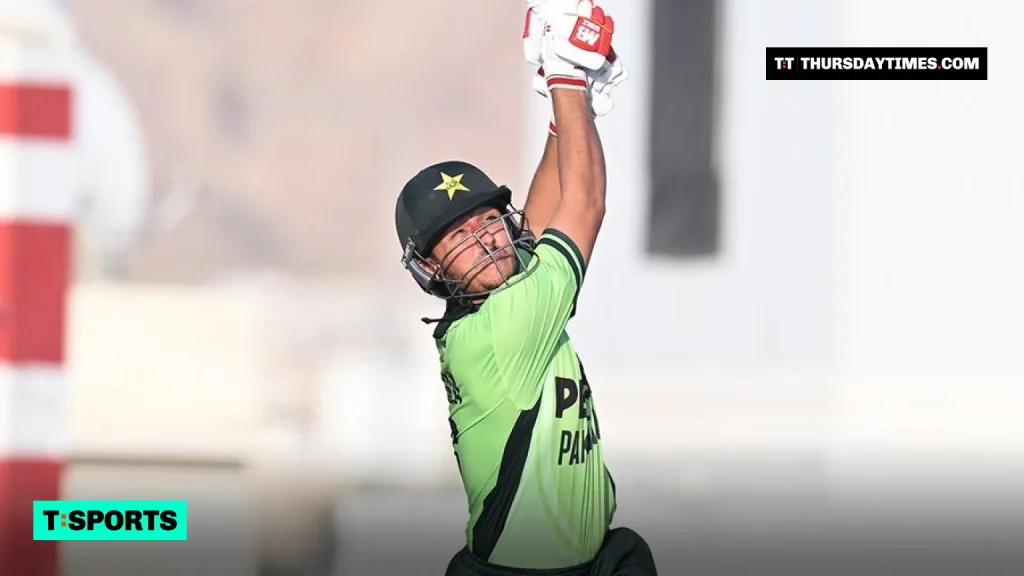
Pakistan Under-19 batter Hamza Zahoor, in a green shirt and helmet, follows through with his bat raised high
Hamza Zahoor plays a shot during his unbeaten century against India at the Al Amerat Cricket Ground in Oman on November 8, 2026. — PCB

Hamza Zahoor’s unbeaten century gives Pakistan U19 win over India

Hamza Zahoor hit an unbeaten century to lead Pakistan to a three-wicket win over India in their Under-19 Asia Cup group match at the Al Amerat Cricket Ground in Oman on Sunday, rescuing a chase that had slumped to 61 for five.

Set 209 to win, Pakistan reached 209 for seven in 48.1 overs. Zahoor walked in with 148 still needed and finished on 100 not out, sealing the win with a boundary. He and Hasnain Abbas Dar put on 107 for the sixth wicket to turn the match, and Dar made 38 off 67 balls before he fell with 41 still needed.

India’s innings: India won the toss, chose to bat and were bowled out for 208 in 46.3 overs. Ali Raza bowled their captain, Lakshya Raichandani, for a duck with the second ball of the match, and India were 22 for three and then 86 for five. Arjun Rajput rescued them with 107 off 85 balls, reaching his century off 80, and made 107 of the 148 runs India added while he was at the crease. Rizwanullah took three for 24, Ali Raza three for 37 and the spinner Niqab Shafiq three wickets.

Niqab dismissed both of India’s famous sons: Aaryavir Sehwag, son of the former India opener Virender Sehwag, and the wicketkeeper Anvay Dravid, son of Rahul Dravid, who was caught by the Pakistan captain, Farhan Yousaf, in a fielding position Yousaf had set for him.

The chase: Pakistan lost their way after the opener Usman Khan, dropped twice, fell for 16. Abdul Qadir made 20, but Yousaf went for two and Ahmed Hussain for eight, leaving them 61 for five in the 15th over. Zahoor and Dar then batted through more than 20 overs without losing a wicket. Mohit Ulva removed Seyam with 26 still needed, and Pakistan needed four off the last two overs before Zahoor finished it.

After the match, Zahoor held up a note to the camera on which he had predicted a half-century for himself. He scored twice as many.

The table: the win takes Pakistan to the top of Group A with four points from two matches, ahead of India on two. Pakistan beat the UAE by nine wickets in their opening game, when Usman Khan made an unbeaten 139 off 120 balls, while India beat Nepal by 10 wickets.

THE THURSDAY TIMES · THURSDAYTIMES.COM7
PULL-OUT · THE THURSDAY TIMES11.11.20268
Westline
BRITAIN, FROM THE OTHER SIDE OF THE LINEWESTLINE × THE THURSDAY TIMES
A STATE THAT STOPPED DECIDING

The backlog Britain built

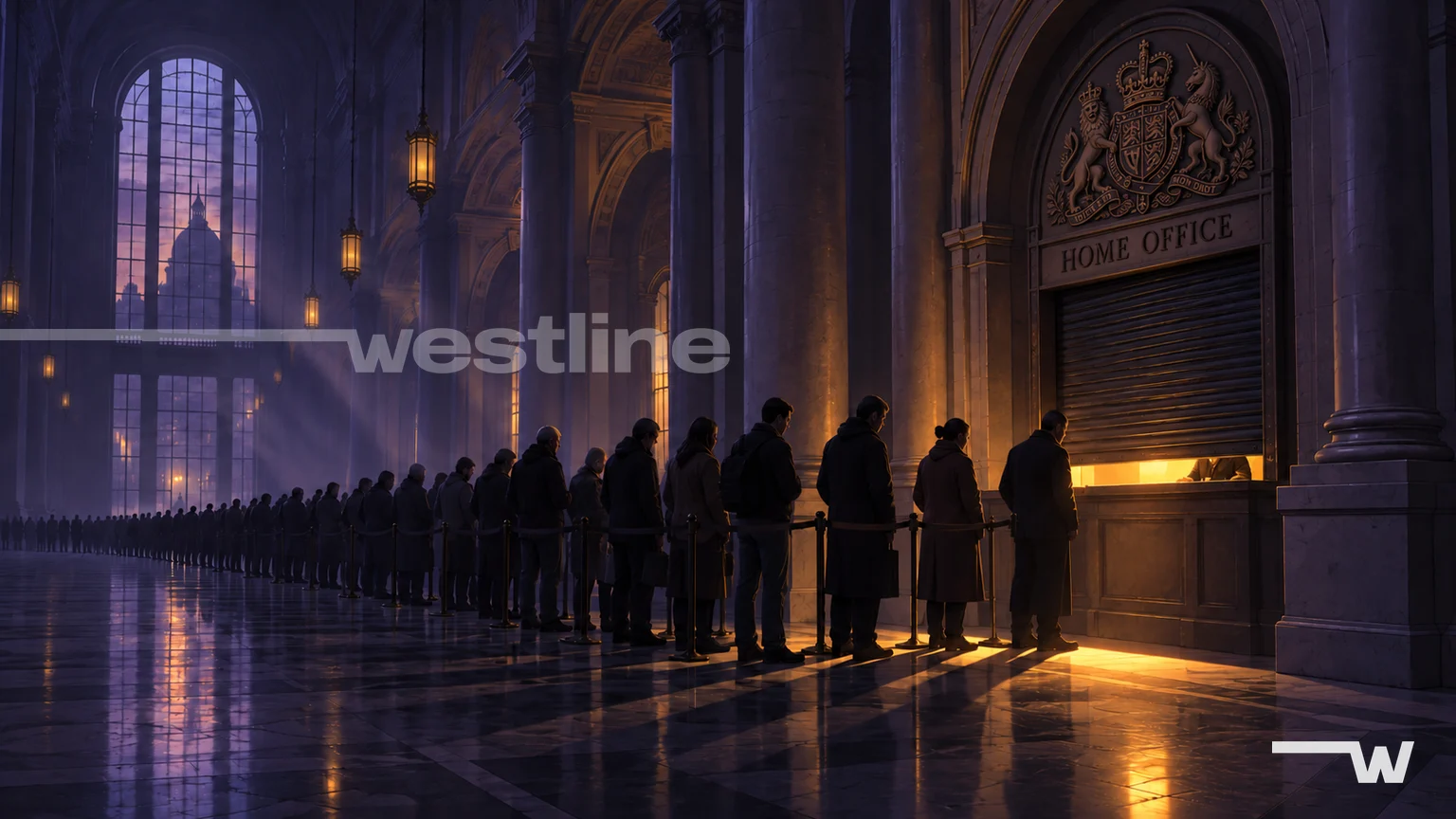
A queue stretches back into the dark while the Home Office counter stays barely open — Illustration: Westline

Ministers of both parties have spent a decade blaming the people in the queue. The numbers point at the people running it.

Abdullah Esquire
Read it in fullthursdaytimes.com/westline

CONSIDER SOMEONE WHO CLAIMED asylum in Britain in January 2023. Where they came from, and how they arrived, matters less than what happened next — which is to say, very little. When the National Audit Office took a sample of 5,000 claims lodged that month and checked on them nearly three years later, more than half were still unresolved. In the meantime our claimant will probably have been housed at public expense, largely barred from working, interviewed by a caseworker who may not have been in post for long, refused, appealed, and then left waiting again: this time for a tribunal that now takes, on average, well over a year to hear a case.

In the political conversation, that person is the problem. The backlog is discussed as though it were a weather system blown in off the Channel — too many boats, too many claims, too many people gaming the system. Arrivals do matter, and nobody serious pretends otherwise. The number of people claiming asylum peaked at around 110,000 in the year to September 2025, the highest figure in nearly two decades.

But a backlog is not a measure of how many people turn up. It is the gap between the cases that come in and the cases a department decides — and decides properly. Judged that way, the story of Britain’s asylum queue is not one of an overwhelmed border. It is the story of an institution that, over ten years, stopped doing its core job, then tried to do it at a sprint, then passed the consequences down the corridor to the courts. The people in the queue designed none of it.

Initial asylum decisions made per year

Home Office annual statistics · output collapsed before small boats became a mass phenomenon, then quadrupled on command

The rot set in long before small boats became a nightly news item. In 2015 the Home Office made 28,623 decisions on asylum applications. By 2017 that had fallen by a quarter, to 21,269, and the department never recovered its old pace. The more striking figure is what happened per head. According to the Institute for Government, in 2011/12 some 380 caseworkers were each producing around 13.7 decisions a month. By December 2022 there were 1,237 of them, managing about four apiece. The workforce had more than tripled; the output of each worker had fallen by over two-thirds.

Then, in January 2019, with ministerial approval, the department dropped its own service standard: the commitment to decide 98 per cent of straightforward claims within six months. The stated reason was to prioritise the most vulnerable cases rather than the simplest. The practical effect was to remove the one clock that had been ticking. The Migration Observatory later found that in 2014 eight in ten applicants received an initial decision within six months; within five years it was one in four.

Why this isn’t a story about the Channel In 2021 the UK had 14.9 cases in its asylum backlog per 10,000 people, more than Germany or France, even though it received far fewer applications per head than either. Countries facing heavier demand were simply getting through their caseloads faster. By December 2022 two-thirds of those waiting — almost 110,000 people — had been in the queue for more than six months. That is not a surge. It is a department that had quietly stopped deciding things.

In December 2022 Rishi Sunak did something the Home Office had not done in years: he set it a deadline. The so-called legacy backlog — roughly 92,000 claims lodged before 28 June 2022 — would be cleared within twelve months. The department doubled its decision-makers to around 2,500 and, for nationalities with very high grant rates such as Afghans, Eritreans and Syrians, swapped lengthy interviews for a questionnaire. The results were instructive. In one four-week stretch in November and December 2023, officials made 20,481 initial decisions, more than in the whole of 2021. Across that year they made 112,138. For anyone who still believed the queue was driven by forces beyond Whitehall’s control, that was the rebuttal.

The sprint had a cost, though, and it was paid in shortcuts. Asylum withdrawals in 2023 were more than four times the 2022 figure, and 79 per cent of them were “implicit” — claims the Home Office itself closed because someone missed an interview, missed a questionnaire deadline or had not updated an address. When the pledge was declared met, 4,537 legacy cases were still awaiting a decision, and the chair of the UK Statistics Authority warned that the episode might affect public trust. A Conservative government that had staked its reputation on control ended up being rebuked by the statistics watchdog for its arithmetic.

Worse, at the same moment that one arm of the department was racing through old cases, another had been told to stop deciding new ones. The Illegal Migration Act meant that claims from those who had arrived irregularly after 7 March 2023 could not be granted. By the end of that year, 55,533 of the 98,599 claims awaiting a decision had been made after the bill was introduced. The backlog stopped falling and, by March 2024, stood at 118,329 people. Those claims were being held for removal to Rwanda, a scheme that by Labour’s later accounting had cost around £700 million — £290 million of it paid to Kigali — to send four volunteers. The Home Affairs Committee later concluded that holding up decisions while the scheme stalled had made the crisis worse. Parliament had, in effect, legislated the state into not processing cases, and then the state paid to house everyone it had declined to process.

Every month a claim sits undecided is a month of bed, board and administration, and this is where the failure becomes a fiscal one. In 2019 the Home Office signed seven regional contracts with Serco, Mears and Clearsprings, expecting them to cost £4.5 billion over ten years. The National Audit Office now puts the figure at £15.3 billion. Between December 2019 and December 2024 the number of asylum seekers in paid-for accommodation rose from about 47,000 to 110,000. Hotels, the emergency option, became the default: at the peak, in September 2023, 56,018 people were in them, spread across roughly 400 sites.

The economics were dreadful. In 2024-25 hotels held around 35 per cent of people in asylum accommodation but swallowed 76 per cent of the contracts’ annual cost.

NAO, asylum accommodation contracts (2025) · hotels held just 35% of people in the system

The three providers made a combined profit of £383 million between 2019 and 2024. The NAO’s verdict was that the department had few levers to control the cost. Across the Home Office and Ministry of Justice, asylum cost £4.9 billion in 2024-25.

For a centre-right reader, this ought to be the scandal. A man waiting for a decision cannot choose to move out of a hotel and is, for the most part, forbidden from earning his own keep. The bill is not run up by his presence so much as by the length of his stay, and the length of his stay is set in Whitehall. Treat the backlog as a migrant problem and you reach for deterrents. Treat it as a productivity problem and you reach for the thing that actually saves money: a decision.

WESTLINE · A THURSDAY TIMES PULL-OUT8
Archive