Saturday 14 November 2026 Archive
SATURDAY 14 NOVEMBER 2026Dangerous to those who trade in lies.THE E-PAPER · ENGLISH EDITION · 8 PAGES
234567Westline pull-out8

Field Marshal Munir pledges security for mines, miners, and investors

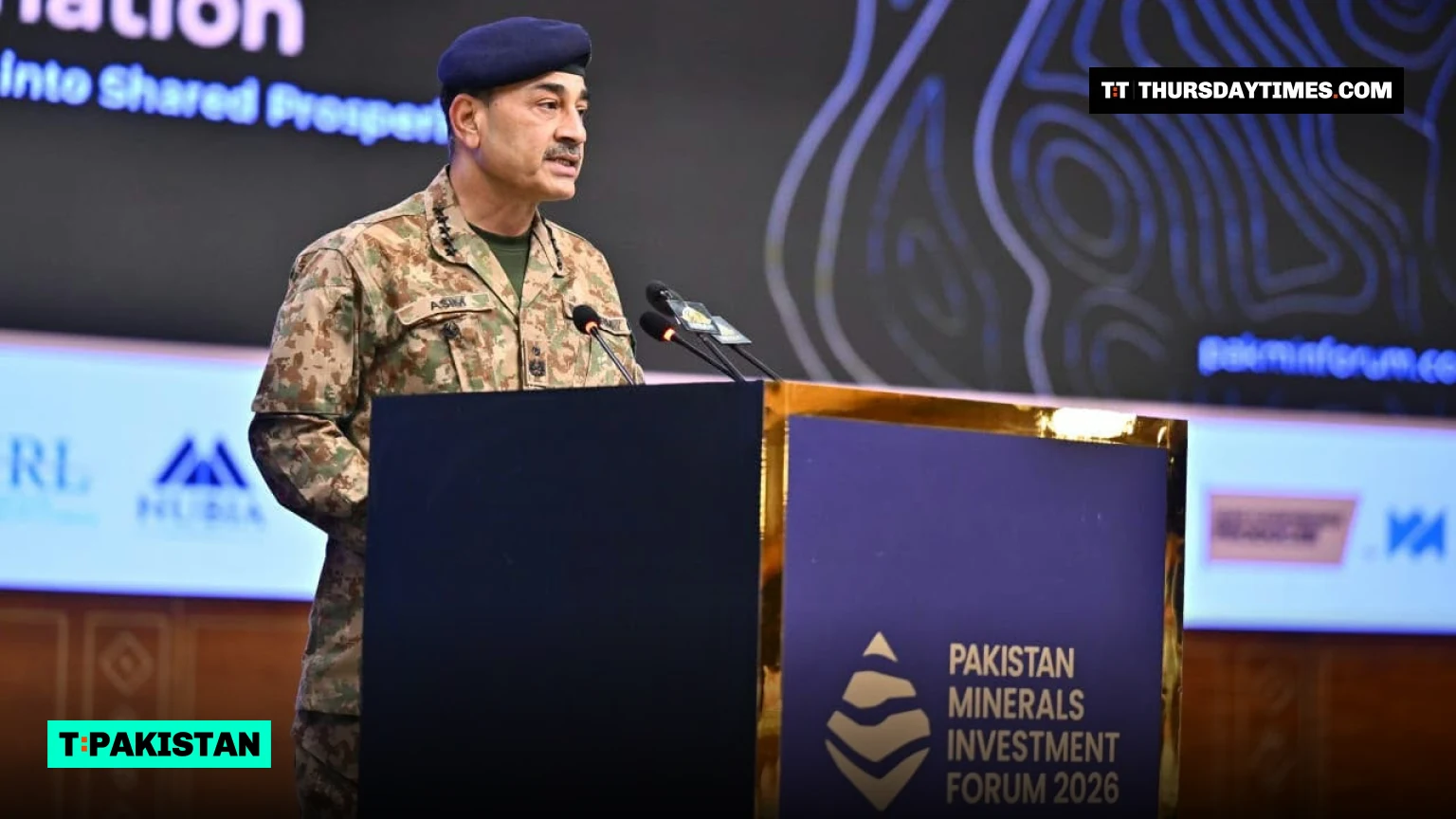
Field Marshal Syed Asim Munir speaking at a podium at the Pakistan Minerals Investment Forum 2026 in Islamabad
Field Marshal Syed Asim Munir addresses the Pakistan Minerals Investment Forum 2026 in Islamabad on Friday. Handout

Pakistan will secure mines, miners, and investors and must move from raw exports to refining and manufacturing, the Field Marshal told the minerals forum, as new copper-gold finds were announced in Chagai.

TT News Desk · Islamabad

Field Marshal Syed Asim Munir, the Chief of Army Staff and Chief of Defence Forces, said on Friday that Pakistan wants to become a competitive and attractive destination for long-term mineral investment, and that the security of mines, miners, investors, industries, and mining projects will be guaranteed.

Addressing the second and final day of the Pakistan Minerals Investment Forum 2026 at the Jinnah Convention Centre in Islamabad, he said every possible step was being taken to secure the mining sector as a whole. “We are taking, and will continue to take, every possible measure to ensure the security of the entire mining ecosystem,” he said.

The protection would cover mines, miners, investments, industries, projects, and the people who work in the sector, he said. His pledge followed similar promises on the forum’s opening day, when Balochistan Chief Minister Sarfraz Bugti offered investors a secure environment and a one-window operation, and Khyber Pakhtunkhwa Governor Faisal Karim Kundi promised security and a one-window facilitation system (read more).

Turning Pakistan’s mineral wealth into economic opportunity was a collective national goal, Field Marshal Munir said. “Our objective is not merely to export raw materials, but to develop the entire value chain, from extraction to refining and manufacturing,” he said.

He said Pakistan wanted long-term international partnerships that would create lasting economic value not only for the country but also for its investment and trade partners.

Stressing the development of mineral-rich regions, he said the benefits of the sector must reach local communities, and that people living in those areas should see a real improvement in their lives through jobs, economic opportunities, and development linked to mining projects.

Field Marshal Munir called the people of Pakistan the country’s greatest strength, describing them as hardworking, brave, and determined. “Our resources provide opportunities, while our people are the source of strength and determination needed to achieve results,” he said.

Calling for practical steps to develop the sector, he said: “We must move from potential to production, from promises to action, and from raw exports to value-added growth.”

Prime Minister Shehbaz Sharif, who also addressed the forum on Friday, made the same case for processing at home. He said Pakistan did not want its minerals extracted only as raw material and sent abroad, and urged investors to mine, process, and manufacture in the country, with refineries, smelters, and cable and conductor factories built around Reko Diq and other projects in the Tethyan belt, before exporting finished goods.

The two-day forum drew government officials, mining companies, and investors from more than 60 countries, as Pakistan pitched mineral reserves that officials put at about $8 trillion (read more). On the opening day, Deputy Prime Minister Ishaq Dar told investors that the Special Investment Facilitation Council was working across federal and provincial governments to clear obstacles through a single window, and that Pakistan wanted to move from exporting raw minerals to refining and manufacturing them at home.

Punjab Chief Minister Maryam Nawaz said the province’s revenue from mines and minerals had risen from Rs10 billion to Rs40 billion in two and a half years.

Canada’s Ivanhoe Mines signed a memorandum with Mari Energies on Thursday to explore for copper and gold in Balochistan’s Chagai district, home to Reko Diq (read more). On Friday, Mari Energies announced a new porphyry copper discovery at its East Siah Diq site in Chagai, about 50 kilometres east of Reko Diq, after some 25,000 metres of drilling, though the company said the find did not yet amount to a formally established mineral resource. Another company, NRL, told the forum it had identified copper-gold mineralisation at eight discoveries in the district.

Security forces kill 74 terrorists in KP and Balochistan, military says

Pakistan’s security forces have killed 74 terrorists in a series of intelligence-based operations in Khyber Pakhtunkhwa and Balochistan, the military’s media wing said on Friday.

In Khyber Pakhtunkhwa, troops killed 35 terrorists in Mir Ali, North Waziristan, and eight in Orakzai over the past 48 hours after “intense and fierce exchanges of fire”, the Inter-Services Public Relations (ISPR) said. It described them as members of Fitna al-Khawarij, the name the state uses for the banned Tehreek-e-Taliban Pakistan, which it says is backed by India.

In Balochistan, an area sanitisation operation in the Kurram area of Quetta district, under way since November 3, killed 31 terrorists from Fitna al-Khawarij and Fitna al-Hindustan, the military said. The state uses the second name for Baloch separatist groups.

Troops recovered a large cache of weapons, ammunition, and explosives, including homemade explosives and improvised explosive devices, which the ISPR said had been meant for terrorist attacks. Sanitisation operations were continuing to clear any terrorists still holed up in the areas, it said.

The campaign under Azm-e-Istehkam, the counterterrorism plan approved by the federal apex committee on the National Action Plan, would continue “at full pace to wipe out the menace of foreign-sponsored and supported terrorism from the country”, the ISPR said.

President Asif Ali Zardari praised the security forces, saying their continued successes reflected national resolve and professional skill, and that eliminating foreign-sponsored terrorist networks was a national security imperative.

Prime Minister Shehbaz Sharif paid tribute to the officers and soldiers involved and commended them for destroying several terrorist hideouts. Interior Minister Mohsin Naqvi said: “I salute the security forces for sending a large number of terrorists to hell.”

The operations came a day after terrorists drove an explosives-laden vehicle at the Frontier Corps’ Kandawa post on the N-25 highway in Mastung, an attack that killed two civilians and injured 16 people. Earlier this week, police in Khyber killed a wanted TTP commander and repelled an attack on a station in Dera Ismail Khan.

Khyber Pakhtunkhwa and Balochistan accounted for about 96% of violence-related deaths in Pakistan in the second quarter of 2026, according to the Centre for Research and Security Studies, with 475 deaths in Khyber Pakhtunkhwa and 265 in Balochistan. Pakistan has repeatedly accused Afghanistan’s Taliban government of letting the TTP operate from Afghan soil, a charge Kabul denies.

“We must move from potential to production, from promises to action, and from raw exports to value-added growth.”Field Marshal Munir pledges security for mines, miners, and investors Page 1

Tax shortfall, rising interest: the sums squeezing Pakistan’s budget

The FBR is Rs95bn behind, interest costs are climbing again, and the foreign debt keeps rolling over. How the pieces fit, and which levers are real.

TT MONITORING DESKPAGE 5 ›

Minerals forum closes with 13 deals as FWO reports Chagai copper find

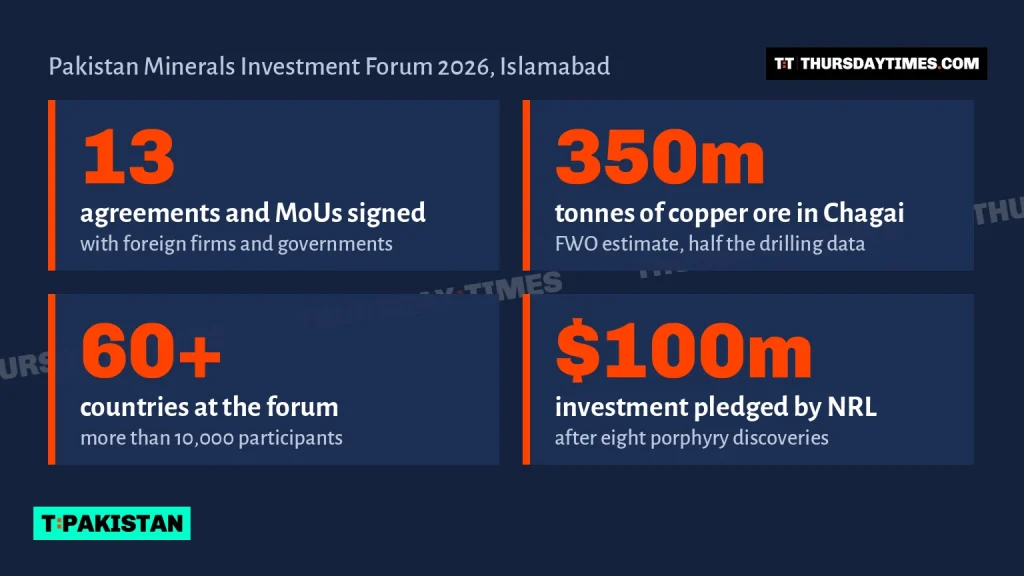
Pakistan’s two-day minerals investment forum ended in Islamabad on Friday with 13 agreements and memorandums of understanding signed between Pakistani bodies and foreign companies and governments, and with the Frontier Works Organisation reporting an estimated 350 million tonnes of copper ore in Balochistan’s Chagai district.

The organisers said more than 10,000 people from over 60 countries attended the Pakistan Minerals Investment Forum 2026, which the government held with the backing of the Special Investment Facilitation Council and with the Oil and Gas Development Company as founding partner.

The agreements announced at the closing session included a joint venture between Türkiye’s Lidiya Mining and Mari Minerals to explore and develop mineral resources in Chagai, and a strategic framework agreement between Türkiye’s MTA International Company and Mari Minerals for exploration and mine development in the same district.

MTA International also formed a joint venture with the Pakistan Mineral Development Corporation to explore for antimony, copper, gold, silver, molybdenum, and other critical minerals in Balochistan’s Pishin district.

The Frontier Works Organisation signed an agreement with Ivanhoe Mines to work together on exploration and mining projects in Balochistan. It was signed by Ivanhoe’s founder and co-chairman, Robert Friedland, and the FWO’s chief executive, Abdul Sami. Two further memorandums were signed with Ivanhoe Atlantic.

Britain’s MSALABS, a subsidiary of Capital Limited, partnered with Mari MSA Labs to set up a commercial mineral testing laboratory in Pakistan. The Geological Survey of Pakistan signed cooperation agreements with Türkiye’s mineral research directorate, with Germany, and with the British Geological Survey, and Pakistan and Japan exchanged a statement of intent on support for the survey.

Other agreements covered an assessment of gemstone resources to international reporting standards, an airborne geophysical survey, and ambient noise tomography, an exploration technique that maps rock beneath the surface using natural ground vibrations.

The FWO said its estimate of 350 million tonnes of copper ore in the Dasht-e-Kain area of Chagai was based on roughly half of the drilling data analysed so far. It did not give a grade, and the figure has not been independently assessed.

National Resources Limited said it had found copper and gold mineralisation across at least eight porphyry discoveries in Chagai after drilling nearly 25,000 metres, and announced a $100 million investment commitment in Pakistan’s mineral sector. Mari Minerals announced its first gold and copper discoveries in Balochistan.

Barrick’s executive chairman, John Thornton, reaffirmed the company’s commitment to Pakistan and to Reko Diq, in which it holds a 50 per cent stake, saying the company intended to remain a long-term partner.

Addressing the closing session, Prime Minister Shehbaz Sharif said mineral development must go hand in hand with environmental protection, and urged investors to use modern technology and meet international standards to protect water resources and the health and safety of mine workers. He and Field Marshal Syed Asim Munir both said Pakistan wanted to move beyond exporting raw minerals to refining, processing, and manufacturing at home.

The forum’s president, Ahmed Hayat Lak, who heads the Oil and Gas Development Company, said the forum had launched a National Minerals Database and Data Centre Portal and a geological portal run by the Geological Survey of Pakistan. He said its true measure would be not the agreements signed but the projects developed and investments realised.

“Pakistan’s mineral wealth is a gift of nature. Transforming it into lasting prosperity is our collective responsibility,” Lak said, inviting delegates back for the next edition in November 2027.

The government opened the forum on Thursday by pitching what it says are $8 trillion in mineral reserves, and the provinces promised investors one-window approvals and security.

Figures from the Pakistan Minerals Investment Forum 2026: 13 agreements, 350 million tonnes of copper ore estimated in Chagai, more than 60 countries, and a $100 million pledge.
What the Pakistan Minerals Investment Forum 2026 produced, according to its organisers and companies. — THE THURSDAY TIMES ILLUSTRATION
Pakistan todayPAGE 2
Karachi court sentences man over 2021 attack on Chinese engineers
Petrol cut by Rs2 to Rs330, diesel unchanged at Rs360 from Saturday
ECP gives PM’s Office two weeks to request cantonment board polls
THE THURSDAY TIMES · PUBLISHED BY THURSDAY MEDIA INTERNATIONAL · THURSDAYTIMES.COM1
US MIDTERMS · THE WORLD · PAKISTAN · SATURDAY 14 NOVEMBER 20262

Kuwait to store and re-export fuel through Pakistan’s ports

Kuwait Petroleum Corporation has agreed to use Pakistan’s storage and port facilities for domestic sales and regional re-exports, Pakistan State Oil says, marking 50 years of partnership between the two.

Thursday Development · Karachi

Kuwait Petroleum Corporation (KPC) has agreed to use Pakistan's storage and port facilities to supply petroleum products to the domestic market and re-export them to the region, Pakistan State Oil (PSO) said on Thursday, a step toward Islamabad's plan to turn the country into a regional fuel distribution hub.

"KPC will utilize Pakistan's storage and port facilities under the Government of Pakistan's recently revised Customs Bonded Storage Policy, which offers a more facilitative framework for international suppliers," PSO said in a statement. "The products will cater to domestic sales and re-exports to regional markets."

The arrangement falls under a policy Pakistan approved about three months ago, letting foreign suppliers hold petroleum products in customs-bonded facilities for local sale or re-export. The policy followed disruptions to oil supplies through the Strait of Hormuz earlier this year, as part of a wider push to strengthen the country's energy security.

PSO did not say which facilities KPC would use, the volumes involved, or when the arrangement would begin.

The agreement was reached during a PSO delegation's visit to Kuwait, led by chief executive Jowad Ahmed Cheema, who met KPC's chief executive and deputy chairman, Sheikh Nawaf Saud Al-Sabah, and the corporation's managing director for international marketing, Sheikh Khaled Ahmad Al-Sabah, who also heads the Kuwait Oil Tanker Company.

Beyond the storage arrangement, PSO and KPC agreed to continue their longstanding gasoil, or diesel, and jet fuel supply arrangements, improving the commercial terms in line with current market conditions. The two sides also agreed to explore expanding Kuwaiti exports to Pakistan to include motor gasoline and petrochemicals, along with cooperation on base oil supplies and lubricant marketing.

They further discussed potential KPC investments in Pakistan's energy sector, including gas, refining, storage infrastructure, shipping and logistics.

"KPC's interest in Pakistan's storage and port infrastructure presents opportunities to strengthen energy security, facilitate regional trade and attract investment," Cheema said. "PSO is committed to translating these discussions into tangible outcomes over the next fifty years."

Sheikh Khaled Ahmad Al-Sabah described the partnership with PSO as one of the most valued in KPC's international portfolio, reflecting the longstanding relationship between Kuwait and Pakistan.

PSO and KPC marked fifty years of uninterrupted gasoil and jet fuel supply to Pakistan in August, and PSO has invited KPC's senior management to Pakistan in early 2027 as part of continued celebrations of the partnership.

Kuwait's role in Pakistan's energy security

Pakistan imports more than 60 per cent of its diesel requirements from Kuwait under its long-term agreement with KPC, making Kuwait one of the country's most important energy partners. In May, Kuwait helped facilitate the safe passage of the vessel Khairpur, carrying about 45,000 tonnes of diesel and 10,000 tonnes of jet fuel to Pakistan, after regional shipping disruptions raised concerns over fuel availability.

Van Hollen to challenge Schumer for Senate Democratic leaderVan Hollen says Democrats need new leadership after their midterm sweep. Schumer says he has the votes to stay on in a closed-door vote due in early December.
Continued from page 1

Minerals forum closes with 13 deals as FWO reports Chagai copper find

Figures from the Pakistan Minerals Investment Forum 2026: 13 agreements, 350 million tonnes of copper ore estimated in Chagai, more than 60 countries, and a $100 million pledge.
What the Pakistan Minerals Investment Forum 2026 produced, according to its organisers and companies. — THE THURSDAY TIMES ILLUSTRATION

Pakistan’s two-day minerals investment forum ended in Islamabad on Friday with 13 agreements and memorandums of understanding signed between Pakistani bodies and foreign companies and governments, and with the Frontier Works Organisation reporting an estimated 350 million tonnes of copper ore in Balochistan’s Chagai district.

The organisers said more than 10,000 people from over 60 countries attended the Pakistan Minerals Investment Forum 2026, which the government held with the backing of the Special Investment Facilitation Council and with the Oil and Gas Development Company as founding partner.

The agreements announced at the closing session included a joint venture between Türkiye’s Lidiya Mining and Mari Minerals to explore and develop mineral resources in Chagai, and a strategic framework agreement between Türkiye’s MTA International Company and Mari Minerals for exploration and mine development in the same district.

MTA International also formed a joint venture with the Pakistan Mineral Development Corporation to explore for antimony, copper, gold, silver, molybdenum, and other critical minerals in Balochistan’s Pishin district.

The Frontier Works Organisation signed an agreement with Ivanhoe Mines to work together on exploration and mining projects in Balochistan. It was signed by Ivanhoe’s founder and co-chairman, Robert Friedland, and the FWO’s chief executive, Abdul Sami. Two further memorandums were signed with Ivanhoe Atlantic.

Britain’s MSALABS, a subsidiary of Capital Limited, partnered with Mari MSA Labs to set up a commercial mineral testing laboratory in Pakistan. The Geological Survey of Pakistan signed cooperation agreements with Türkiye’s mineral research directorate, with Germany, and with the British Geological Survey, and Pakistan and Japan exchanged a statement of intent on support for the survey.

Other agreements covered an assessment of gemstone resources to international reporting standards, an airborne geophysical survey, and ambient noise tomography, an exploration technique that maps rock beneath the surface using natural ground vibrations.

The FWO said its estimate of 350 million tonnes of copper ore in the Dasht-e-Kain area of Chagai was based on roughly half of the drilling data analysed so far. It did not give a grade, and the figure has not been independently assessed.

National Resources Limited said it had found copper and gold mineralisation across at least eight porphyry discoveries in Chagai after drilling nearly 25,000 metres, and announced a $100 million investment commitment in Pakistan’s mineral sector. Mari Minerals announced its first gold and copper discoveries in Balochistan.

Barrick’s executive chairman, John Thornton, reaffirmed the company’s commitment to Pakistan and to Reko Diq, in which it holds a 50 per cent stake, saying the company intended to remain a long-term partner.

Addressing the closing session, Prime Minister Shehbaz Sharif said mineral development must go hand in hand with environmental protection, and urged investors to use modern technology and meet international standards to protect water resources and the health and safety of mine workers. He and Field Marshal Syed Asim Munir both said Pakistan wanted to move beyond exporting raw minerals to refining, processing, and manufacturing at home.

The forum’s president, Ahmed Hayat Lak, who heads the Oil and Gas Development Company, said the forum had launched a National Minerals Database and Data Centre Portal and a geological portal run by the Geological Survey of Pakistan. He said its true measure would be not the agreements signed but the projects developed and investments realised.

“Pakistan’s mineral wealth is a gift of nature. Transforming it into lasting prosperity is our collective responsibility,” Lak said, inviting delegates back for the next edition in November 2027.

The government opened the forum on Thursday by pitching what it says are $8 trillion in mineral reserves, and the provinces promised investors one-window approvals and security.

The world in brief

EVERY STORY IN FULL AT THURSDAYTIMES.COM
Police stop Yadav Mahasabha march as Bageshwar Dham backers block highwaySupporters of the preacher Dhirendra Krishna Shastri blocked National Highway 39 as Mahasabha members tried to march on his shrine over his remarks about Lord Krishna, reports said.
Kremlin denies report it demanded Finland leave NATOA German newspaper said Russian negotiators also sought NATO’s exit from Baltic bases and all of the Donbas. Finland’s defence minister called the idea “absolutely outrageous”.
UN rights chief demands Houthis return body of staffer who died in custodyMohammad el-Shami’s family has had no explanation of how he died, the UN human rights office says, and it fears another detained employee was coerced into a filmed “confession”.
Car bombs in Russia kill serviceman, injure ex-Ukraine PM’s adviserA bomb killed a serviceman in St Petersburg on Thursday, and a car bomb in Moscow on Friday injured Sergei Zavorotnyi, a former aide to ex-Ukrainian prime minister Mykola Azarov, Russian investigators say.
Lutnick agrees to testify as aides reportedly weigh his ousterCommerce Secretary Howard Lutnick has agreed to testify before the Senate Banking Committee, his spokesperson says, as reports say White House officials are discussing whether he should go.
Bus-truck crash near Assam’s Kaziranga kills at least 24A minibus collided head-on with a container truck on National Highway 715 in Golaghat district. Police say the toll may rise.

Pakistan

NATIONAL · ECONOMY · MILITARY

Barrick keen to invest in mineral processing in Karachi, Gwadar, PMO says

TT Business Desk · Islamabad

Barrick Mining Corporation has expressed strong interest in investing in mineral processing industries in Karachi and Gwadar, the Prime Minister’s Office said on Friday, after the company’s chairman, John Thornton, led a delegation to meet Prime Minister Shehbaz Sharif in Islamabad.

The meeting came on the second and final day of the Pakistan Minerals Investment Forum 2026, where the government has been pitching the country’s mineral wealth to foreign investors. The delegation called the forum an important step for the development of Pakistan’s mineral sector, according to the statement.

Shehbaz said he wanted to draw on Barrick’s expertise to develop the mineral sector beyond Reko Diq, the copper and gold project in Balochistan’s Chagai district that the company is building. He described Reko Diq as an important milestone for investment in the sector and said its successful completion would set a benchmark for future mineral investment in Pakistan.

The prime minister said the government wanted the people of Balochistan to benefit directly from mineral projects, through jobs and skills training for local young people and the development of surrounding communities. The two sides also discussed the policy, regulatory, and infrastructure frameworks the sector needs, the statement said.

On Thursday, Planning Minister Ahsan Iqbal met a Barrick delegation and called for faster work on a proposed road corridor linking Nokundi in Chagai with the port of Gwadar. He proposed a joint working group of the planning ministry, the National Highway Authority, the Balochistan government, and mining companies to settle the technical requirements, feasibility, financing, and implementation of the route, according to a statement from his ministry.

Iqbal asked for detailed topographical data and 3D mapping to speed up the feasibility study of what he called the “missing link”, and tied the mining sector to the government’s goal of raising exports to $100 billion under its National Economic Transformation Plan 2035. The Barrick delegation welcomed the proposal, the statement said.

Barrick owns half of Reko Diq, and the federal and Balochistan governments own the rest. The company has said the mine could generate about $70 billion in free cash flow over its life.

Earlier at the forum, Canada’s Ivanhoe Mines signed an agreement with Mari Energies to explore for copper and gold in Chagai, and Field Marshal Syed Asim Munir pledged security for mines, miners, and investors.

Pakistan seeks two winter LNG cargoes after rejecting $27-plus bidsPakistan LNG Ltd turned down offers of $27.10 to $31 per mmBtu for December and January, and has asked for new bids as Hormuz disruption squeezes winter supply.
Gold falls Rs4,900 to Rs411,636 per tola, third drop in three daysThe 10-gram rate fell Rs4,201 to Rs352,911 as world gold slipped $49 to $3,891 an ounce. A tola is now Rs19,200 cheaper than on Tuesday.
Supreme Court rules inheritance rights do not lapse with timeThe clock for a claim starts only when an heir learns of a clear denial of their share, a five-member bench held, ordering officials to notify every heir, including women, before inherited property is transferred.
SpiceJet’s Dubai flights cancelled after airport halts check-in over duesThe struggling Indian airline owes about 14 million dirhams to Dubai Airports and its ground handler, reports say. SpiceJet says it is resolving the matter.
Rain clears Lahore’s air as Delhi overtakes it as world’s most polluted cityLight rain and wind brought Lahore’s air quality index down to about 111, as Delhi took its place at the top of the Swiss monitor IQAir’s ranking with a hazardous 334.
InsideGulf, 3 · Views, 4 · Analysis, 5 · T:LIFE, 6 · Sports, 7 · Westline, 8
2THE THURSDAY TIMES · THURSDAYTIMES.COM
EMIRATES · SAUDI · QATAR · SATURDAY 14 NOVEMBER 20263

Abu Dhabi court jails eight over Nurmagomedov–Dvalishvili hotel brawl

Six people get six months in prison, Dh300,000 fines, and deportation, Abu Dhabi’s judicial department says. Reports say they are from Usman Nurmagomedov’s camp, and that Dvalishvili was fined.

Merab Dvalishvili holding the UFC bantamweight championship belt
Merab Dvalishvili with the UFC bantamweight belt in 2025. File photo. — IMAGN IMAGES VIA REUTERS
Thursday Emirates · Abu Dhabi

An Abu Dhabi court has sentenced eight people to six months in prison over Wednesday’s brawl at a Yas Island hotel involving the former UFC bantamweight champion Merab Dvalishvili and the PFL lightweight champion Usman Nurmagomedov, the emirate’s judicial department said on Friday.

The Abu Dhabi Criminal Court convicted 10 people in all. Six were jailed for six months, fined Dh300,000 each, and ordered to be deported after serving their sentences, for disturbing public security, causing panic, and endangering lives, the Abu Dhabi Judicial Department said.

Two people who filmed the fight and published the footage were also sentenced to six months, for violating privacy through the use of information technology. The court ordered their phones confiscated and the footage deleted.

Two others were fined Dh50,000 each for disturbing public security and assaulting others, with no prison term.

The department did not name any of those convicted. Several reports said the six men who were jailed were members of Nurmagomedov’s camp, and that Nurmagomedov himself was among them. Reports also said Dvalishvili and a friend were the two who were fined, and that both had been released from detention.

Police had arrested 10 people after the fight in the hotel lobby, where Dvalishvili was giving an interview when Nurmagomedov and several others approached him. Footage of the brawl spread widely online, and the organisers of Saturday’s event barred Nurmagomedov from attending.

Dvalishvili is still due to face the Brazilian former UFC title challenger Marlon Moraes in a crossover match at Real American Freestyle’s first event in the Middle East, at Etihad Arena on Saturday.

Chad Bronstein, the organisation’s chief executive and co-founder, said Dvalishvili was “back with us in Abu Dhabi”, thanked the local authorities, and said the organisation was “focused on moving forward”.

Umar Nurmagomedov, who had been due to face Urijah Faber on the same card, has been replaced by Saba Lazishvili, a 21-year-old Georgian friend of Dvalishvili who was also caught up in the brawl, according to reports.

The UFC’s chief executive, Dana White, condemned the brawl at a news conference in New York on Thursday. “It’s absolutely ridiculous and stupid, and they’re all in jail,” he said.

Dvalishvili beat Umar Nurmagomedov by unanimous decision at UFC 311 in January 2025 to keep his bantamweight title, and the two camps clashed again at an RAF event in Georgia in July.

Rory McIlroy at the DP World Tour Championship in Dubai

McIlroy shares Dubai lead with Hatton in bid for eighth Race to Dubai crown

Dubai · thursdaytimes.com
Illustration of a December 2026 calendar with the 2nd, 3rd, and 4th marked, against the colours of the UAE flag

UAE gives federal staff five days and private sector two for Eid Al Etihad

Abu Dhabi · thursdaytimes.com

Saudi Arabia beat South Korea 3-2 for first win over them in 21 years

THE THURSDAY TIMES · THURSDAYTIMES.COM3
EDITORIAL · OPINION · SATURDAY 14 NOVEMBER 20264

Karachi cannot keep running on one pumping station

Friday’s 130m-gallon shortfall is planned. The breakdowns in May and July were not. Dhabeji must stop being a single point of failure, and K-IV must arrive with the pipes to carry its water.

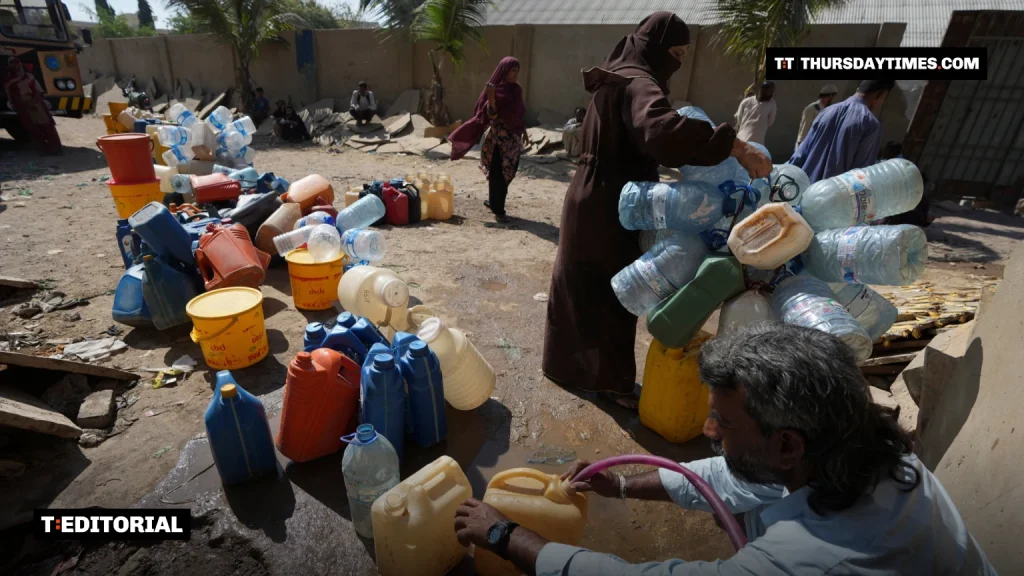
On Friday, about a fifth of Karachi's water will simply not arrive. From 10am to midnight, K-Electric will switch off the power to the Dhabeji grid station for annual maintenance, nine of the pumping station's 21 pumps will stop, and the city's supply will fall from about 650 million gallons a day to about 520 million. Landhi, Korangi, Malir, and Shah Faisal will wait another 22 hours while the water utility does its own repairs. This shutdown, at least, was announced in advance. The question Karachi should be asking is why a city of more than 20 million people still depends so heavily on one set of pumps, on one power supply, in one place, at the far end of a long pipeline.

The Karachi Water and Sewerage Corporation deserves credit for the warning. It named the areas that will be hit, closed the Landhi and Sherpao hydrants for the day, and told residents to store water and use it carefully. K-Electric explained that its engineers will test and service the grid station's transformer and its switchgear, and fix faults while the substation is cleaned. That is how planned maintenance should be handled, and it is better than what Karachi has often had.

But the warning also exposes the problem. A routine day of maintenance at a single site is enough to take 130 million gallons a day out of the city's supply. Unplanned failures at the same site have done far worse.

Karachi has been here before, and recently. At about 10pm on June 26 last year, a fault in an underground cable cut the power to two feeders at Dhabeji. Rainwater delayed the repairs, and four days later the feeders were still down. The shortfall was put at more than 350 million gallons a day, and Nazimabad, New Karachi, Landhi, and Korangi were among the areas hit.

This year has been no kinder. On the evening of May 30, a fault in one of the Dhabeji grid's power transformers forced an emergency shutdown that took 10 of the 21 pumps out of action. The corporation said it had first been told to expect a one-hour maintenance outage. The next day, power was still not fully back, and no one could say when it would be. On the morning of July 26, a cable fault knocked out power to one phase of the station, three pumps stopped, and the corporation estimated a temporary shortfall of 75 million gallons a day across parts of North Nazimabad, Nazimabad, Gulberg, New Karachi, Landhi, Korangi, and Scheme 33.

Four disruptions in 17 months is not bad luck. It is a pattern, and it points to a design flaw rather than a run of careless days. When a cable fails at Dhabeji, half of Karachi feels it within hours, because there is no second route for the power and not enough spare capacity in the pumps to take up the slack.

The shutdowns matter more because Karachi starts every ordinary day behind. The corporation's own estimate of what the city needs is about 1,200 million gallons a day. What reaches it is about 650 million. That demand figure is an estimate, built on assumptions about population and how much each person uses, and some researchers argue that real use in poorer neighbourhoods is far lower. But even on the most generous reading, there is little margin. A city that receives roughly half of what its utility says it needs cannot absorb the loss of another fifth without real hardship.

Who pays for that gap is no mystery. Families in Landhi, Korangi, Malir, and Lyari who cannot store water for a day and a half will buy it. The official price of a 1,000-gallon GPS tanker was set at Rs1,560 this summer, and a commercial one at Rs3,120. Residents have long complained that they pay far more than the notified rate when the taps run dry, and the Sindh High Court asked earlier this year why tankers seem to find water when the pipelines do not. Every hour Dhabeji is down is an hour in which the tanker becomes the city's real water utility.

The answer Karachi has been promised for two decades is K-IV, the bulk water scheme that is meant to bring an extra 260 million gallons a day from Keenjhar Lake. There has been real progress. Wapda put the work at 64 percent complete at the end of last year, with Rs86 billion spent. In February, the federal planning minister, Ahsan Iqbal, visited the site near Thatta, set December 2026 as the new deadline, and said the federal government would bear the whole cost of the revised project, now put at Rs170 billion.

That federal commitment matters, and it should be honoured in full. But water that reaches the edge of Karachi is not water in a kitchen tap. Officials at the water corporation have said that the three augmentation lines needed to carry K-IV's water into the city, known as R-1, R-2, and R-3, will together run 94 kilometres in pipes 72 to 96 inches wide, and that their contracts have not yet been awarded. They put that part of the work at about Rs80 billion, and the wider network of transmission lines, pumping stations, and filtration plants at another Rs124 billion. At the current pace, they say, the full system will not be ready before January 2029.

The first K-IV estimate, more than a decade ago, was about Rs25 billion. Every year of delay has made it dearer, and every year of delay has left the city leaning harder on Dhabeji. Finishing the bulk works by December would be an achievement. Finishing them while the city end of the system waits for contracts would leave Karachi with a new canal and the same dry taps.

None of this needs a new grand plan. It needs the institutions that already exist to do five things, in the open, and on a timetable residents can check.

The first of these is the most urgent, and the cheapest. Planned maintenance at Dhabeji will always be needed. What should not be needed, in 2026, is for a fault in one cable to leave hundreds of thousands of homes without water for days. A second, independent feed and serious standby generation are exactly the kind of resilience the World Bank's water and sanitation programme for Karachi, approved at $240 million in December 2024 and matched by the Asian Infrastructure Investment Bank, is meant to buy. Its stated aim is safe water for 16 million people by 2030. Keeping the main pumps running when the power fails is where that aim begins.

The third matters because Karachi argues about water in numbers no one fully trusts. The 1,200 figure is an estimate. The 650 figure is bulk supply, before leaks and theft. If the corporation published what actually reaches each town, it would be easier to see where pipes leak, where water is stolen, and where tankers are filling a gap the network should fill. It would also make the case for the federal and provincial money Karachi still needs far harder to ignore.

It would be easy to turn Friday's shortfall into a contest of blame between the federal government, Sindh, the city, K-Electric, and the water corporation. That would help no one in Korangi. Each of them has a piece of this. The federal government is paying for the bulk works and has set a deadline. Wapda is building them. Sindh and the corporation own the city network. K-Electric owns the power. Mayor Murtaza Wahab has said he wants to close the city's hydrants and move Karachi from tankers to pipes, and the corporation has warned that this is not yet possible with the network it has. Both are right, and the gap between them is exactly the work set out above.

Karachi pays a large share of Pakistan's taxes, runs its main ports, and is home to people from every province. Its water supply is a national concern, not a municipal one. The city has learned to live with shortage. It should not have to learn to live with fragility. Friday's shutdown is planned and will pass. The next fault at Dhabeji will not come with a warning, and the time to prepare for it is now.

Editorial · The Thursday Times
People fill plastic containers with drinking water at a collection point in Karachi
“K-Electric explained that its engineers will test and service the grid station's transformer and its switchgear, and fix faults while the substation is cleaned.”
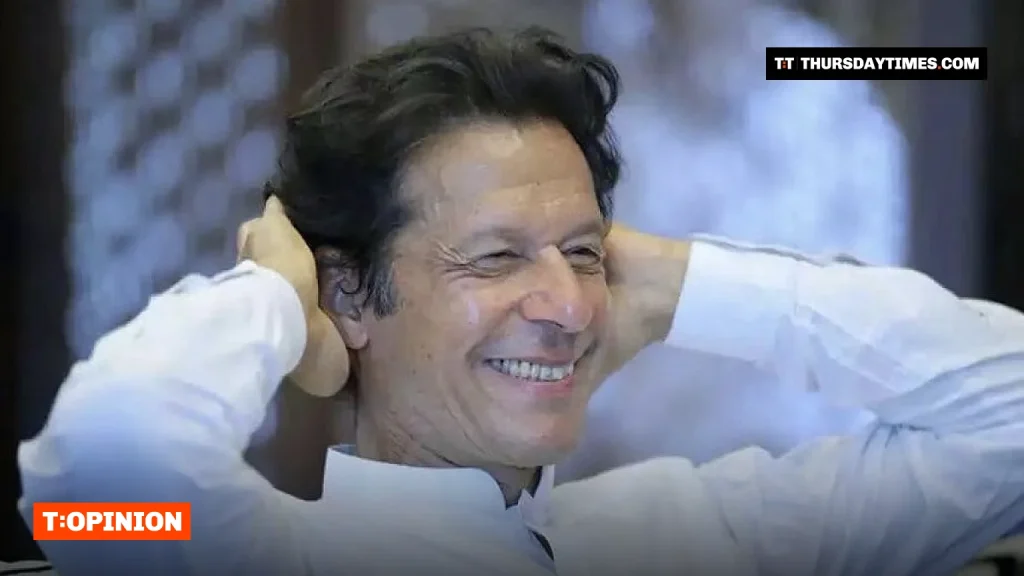
Imran Khan grins with his hands clasped behind his head
Imran Khan, the PTI founder, in an undated file photo. — FILE PHOTO

Imran Khan, the Pied Piper of Adiala, is an idée fixe

“Do Pakistani journalists have nothing else to talk about except Imran Khan? … even if [Imran] is released and returns to power, [he] risks becoming the Pied Piper of Hamelin, leading his followers towards disillusionment and a rude awakening,” writes former Supreme Court of India Justice Markandey Katju.

Words by Justice Markandey Katju

These days, X is crammed with posts from Pakistanis, at home and abroad, asking for the release of the former prime minister Imran Khan from Adiala jail, where he has been held for more than three years.

Much of the conversation seems to revolve around one man, Imran Khan. Psychology has a name for such a fixation: an idée fixe, a fixed idea that crowds out everything else.

In this connection, I posted this:

I also gave an interview to the Pakistani journalist Ameer Abbas, in which I said this (from 8:40 in the video).

In response to my post, many Pakistanis criticised me, some with abuse, though some agreed with me.

No doubt Moeed Pirzada often speaks on topics other than Imran Khan, but rarely, in my view, on Pakistan’s real problems: poverty, unemployment, child malnutrition, the lack of healthcare and good education for the masses, and other socio-economic ills. An example is his recent vlog.

I found most of this to be empty rhetoric. Nowhere does Moeed answer my basic point: a person who abandons his principles just to come to power is not fit to lead a nation.

Nor does he respond to my view that much of the media serves mirch masala to the public to increase readership, circulation, and TRP ratings, which is why it rarely addresses the huge socio-economic issues facing Pakistan and other developing countries.

The test of every political activity and political system is one, and only one: does it raise the standard of living of the people?

Many of Imran Khan’s supporters say all their problems will be solved if he is released and fresh elections are held.

Suppose Imran Khan is released, fresh elections are held, and, as his supporters expect, the PTI wins and he becomes prime minister again.

But the question is: is this relevant?

The test of every political activity and political system is one, and only one: does it raise the standard of living of the people? Does it give them better lives?

From that viewpoint, Imran Khan’s return as prime minister would not by itself change the lives of ordinary Pakistanis. The poverty, the unemployment, the lack of healthcare (one Shaukat Khanum hospital cannot cater to the needs of an entire population), the lack of good education, and the soaring prices of food, electricity, and other essentials would remain.

In my opinion, Imran Khan has no real programme to solve these problems. When he was prime minister, from 2018 to 2022, he relied heavily on religious appeals. He spoke often of Riyasat-e-Madina, and hosted meetings of the Organisation of Islamic Cooperation.

Such appeals may divert attention for a while, but, as the saying goes, you can fool all the people some of the time, and some of the people all the time, but not all the people all the time. In the end, the bread-and-butter issues come back. Unemployment, the lack of healthcare, and rising prices cannot be solved by slogans.

4THE THURSDAY TIMES · THURSDAYTIMES.COM
SATURDAY 14 NOVEMBER 20265

Tax shortfall, rising interest: the sums squeezing Pakistan’s budget

The FBR is Rs95bn behind, interest costs are climbing again, and the foreign debt keeps rolling over. How the pieces fit, and which levers are real.

TT Monitoring Desk · 6 min read
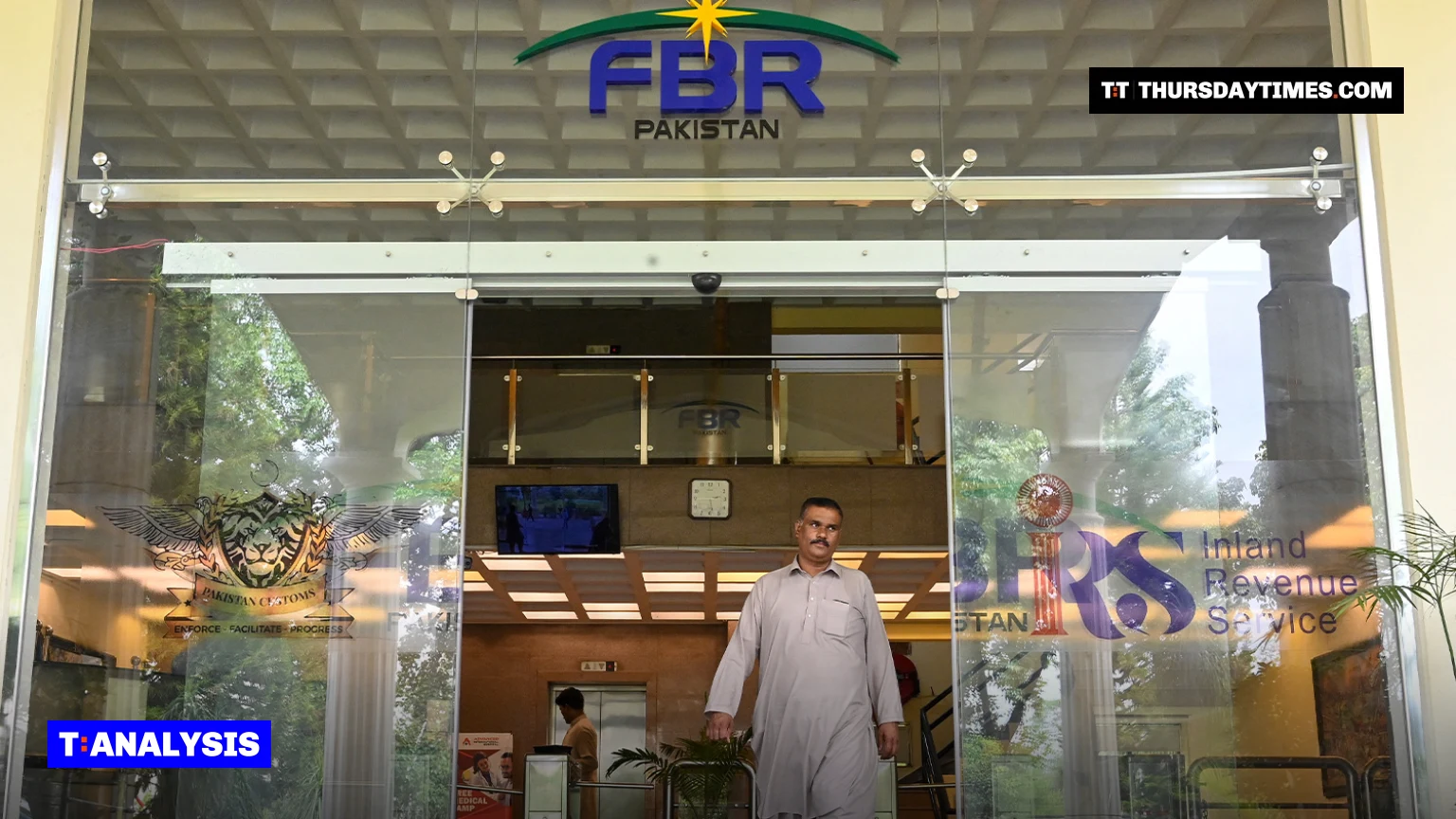
The entrance of the Federal Board of Revenue office in Islamabad
A man walks out of the Federal Board of Revenue office in Islamabad. File photo. — AFP

Two sets of numbers landed in Islamabad this week, and they belong together. The Federal Board of Revenue collected Rs4.089 trillion in the first four months of the fiscal year, about Rs95 billion short of its target. The same week, the economic affairs ministry reported that Pakistan paid $14.44 billion to service its foreign public debt last year, and borrowed $16.16 billion more. On their own, neither figure is a crisis. Read together, they show the bind at the centre of the budget: the state is not collecting enough to cover what it owes, so it borrows to pay what it borrowed, and the interest on that borrowing eats into what it collects.

The FBR’s shortfall is not large in percentage terms. Collections for July to October were up about 6.6% on the same months last year, and the gap to target is a little over 2%. The problem is the shape of the year. The full-year target is Rs15.264 trillion. To reach it, the board has to raise about Rs11.2 trillion in the remaining eight months, roughly Rs1.4 trillion a month. So far it has averaged about Rs1 trillion.

The detail matters more than the total. Sales tax beat its target, bringing in Rs1.524 trillion against Rs1.448 trillion. Income tax, the biggest single source, fell about Rs148 billion short, at Rs1.86 trillion against Rs2.009 trillion. Customs duty also missed. Refunds and rebates rose to Rs265 billion, from Rs206 billion a year earlier.

That pattern says something about where the system is strong and where it is weak. Sales tax is collected at the till and at the factory gate, through registered businesses and withholding, and it is hard to avoid at scale. Income tax depends on people and firms declaring what they earn. When it lags, it usually means the base of people paying is still too narrow, and that the burden falls on those who are already in the net.

The revenue gap would matter less if spending were steady. It is not. The finance ministry’s monthly update showed that Pakistan kept an overall fiscal surplus in the first quarter of the year, at Rs1.198 trillion, but that interest payments rose by almost 37%. The primary surplus, which leaves interest out, was Rs2.3 trillion.

The difference between those two numbers is the interest bill for the quarter: roughly Rs1.1 trillion in three months. Over the same three months, by the FBR’s own figures, it collected a little under Rs3.1 trillion. In other words, interest alone took the equivalent of about a third of everything the board raised, before the provinces received their share of the divisible pool.

This follows a better year. In 2025-26, interest payments fell by Rs1.94 trillion, or 21.7%, to Rs6.95 trillion, as borrowing costs came down. But the structure of the domestic debt means relief can reverse quickly. Only 27% of government securities are on fixed rates. The average time to maturity is about 3.8 years, but the average time to re-fixing is just 1.4 years. When rates move, most of the domestic interest bill moves with them within about a year and a half. The ministry’s update did not break down the first-quarter rise. But with so much debt on floating rates, the interest bill follows the policy rate closely.

The foreign side works on a similar logic. Last fiscal year, Pakistan paid $14.44 billion on its external public debt: $11.2 billion in principal and $3.24 billion in interest. It received $16.16 billion in new financing. New money more than covered the repayments, and external public debt rose from $91.8 billion to about $98.1 billion.

Much of this is routine. A large share of what Pakistan owes abroad is held by friendly governments and development lenders who expect to roll over their money rather than take it home. This year’s gross foreign repayments are about $21.5 billion, but the finance ministry told a Senate committee that $7.3 billion of that is deposits from three friendly countries that are expected to be rolled over. After rollovers and refinancing, the net requirement is about $11 billion. About $5 billion had been paid by early November, leaving roughly $6 billion for the rest of the year, against reserves of about $21.5 billion.

That is manageable, and it is a long way from the near-default of 2023. But it is not the same as paying the debt down. Of last year’s budget support, Naya Pakistan Certificates brought in $3.05 billion and time deposits from friendly countries $3 billion. Both are useful, and both have to be renewed or repaid.

The domestic and foreign stories join in the budget. Pakistan’s programme with the International Monetary Fund is built around an underlying primary surplus of 2% of GDP for this fiscal year. The Fund reached a staff-level agreement on its latest review in October, which would unlock about $1.2 billion once its board approves it, and it has asked Pakistan to keep to the budget.

A primary surplus target sets the budget’s order of business. If tax revenue falls short, the government has three choices. It can cut spending, which in practice usually means the development budget. It can raise other revenue, through petroleum levies, new taxes, or one-off measures. Or it can miss the target. The first two have costs at home, and the third has costs with lenders. Development spending is already under pressure: the government spent only about 10% of its Rs1 trillion development budget in the first four months.

The total debt picture is improving on one measure. Public debt rose to about Rs91 trillion in June, but fell as a share of the economy, from 74.3% to 71.7% of GDP, because the economy grew faster in nominal terms. That ratio can keep falling only if growth holds, the primary surplus holds, and interest costs stay contained. A rising interest bill and a widening tax gap push against all three.

There is no shortage of advice on what Pakistan should do, and the IMF’s own framing at a tax workshop in Islamabad last month was blunt: a broader, fairer, simpler, and more predictable system, with under-taxed sectors addressed and concessions rationalised. Four levers stand out, because each is already partly in motion.

None of these is new, and none is quick. Widening the base means taxing groups with political weight. Enforcement depends on administrative capacity and on taxpayers trusting that notices are fair. Lengthening debt costs more upfront. Export growth depends on energy costs and on demand in markets Pakistan does not control.

The next markers are close. The FBR’s November and December collections will show whether the gap is closing or widening as the targets steepen. The finance ministry’s next monthly update will show whether the first-quarter jump in interest costs continued. The IMF board’s decision on the latest review will confirm whether the programme stays on track, and the government’s review of its tax mix, including plans to phase out the super tax, will show how it means to pay for the second half of the year.

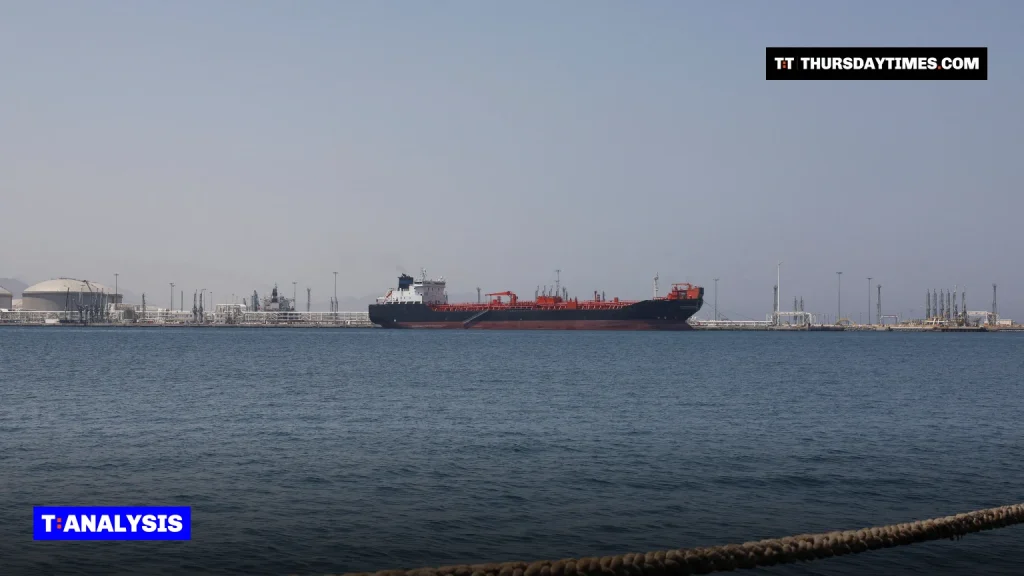
An oil tanker moored at the Port of Fujairah
An oil and chemical tanker at the Port of Fujairah in the United Arab Emirates, as the war with Iran limits traffic through the Strait of Hormuz, on May 6, 2026. File photo. — REUTERS/Amr Alfiky

In Hormuz, claims move faster than the tankers

Between Wednesday and Friday, Iran’s armed forces said they had disabled six vessels in and around the Strait of Hormuz, shot down an American drone, and destroyed an American radar in Bahrain. Not one of the six ships has been named. The United States says the radar was never hit, and that the two Iranian drones sent towards Bahrain were shot down without causing any damage. The only tanker struck this week whose name, crew, and position are publicly known, the Liberia-flagged Dominica Prosperity, was not among the ships Iran claimed. That gap, between what is said and what can be shown, is now one of the main things moving oil prices, insurance premiums, and the fuel bill of every country that buys from the Gulf, Pakistan included.

The pattern is easiest to see laid out in order. Each Iranian statement came through state media or agencies close to the Revolutionary Guards. Each described ships that had ignored warnings, switched off their navigation systems, or used a route Tehran has declared off-limits. Almost none could be checked.

None of this means every Iranian claim is false. Ships have been hit this month, and badly. Maritime monitors counted at least 37 attacks on ships in and near the strait in the first eleven days of November, the most in any month since the war began on February 28. The International Maritime Organization had recorded 134 confirmed incidents in the region by November 11, with 25 seafarers killed. On Tuesday, a vessel operated by ADNOC was damaged in an attack inside the UAE’s own waters, which the company confirmed. The danger is real. What is in doubt is the detail, and in a war fought partly over who controls a waterway, the detail is the point.

Iran’s statements are aimed less at proving what happened than at shaping what shipowners do next. Tehran says ships must use routes it approves, and its security chief, Mohsen Rezaei, has said the strait will stay shut until Washington meets seven conditions. Every report of a burning tanker on an “unauthorised route” tells captains, owners, and insurers that the American escort on the southern route does not buy safety. The army’s statement on Thursday made that explicit, putting responsibility first on President Donald Trump and then on owners who had trusted what it called his “misleading statements”.

The commercial world cannot wait for proof. An underwriter pricing a voyage this week has to weigh an unconfirmed claim of four disabled tankers against a confirmed strike on a fifth, and the cheapest decision is to treat the whole area as dangerous. That is why a statement nobody can verify still raises premiums, delays sailings, and adds a risk margin to every barrel loaded in the Gulf. On Thursday, Brent crude traded at about $93 a barrel, edging higher after earlier falls, as tension in the region offset rising output elsewhere.

Washington plays the same game from the other side. The United States says it has cleared the strait of mines, which is why Iranian reports of mine strikes are so pointed. Secretary of State Marco Rubio said this week that the “economic campaign” against Iran was so devastating that major combat was unnecessary. On Thursday, Trump wrote that Washington no longer needed a deal with Iran because it already had Iran’s money and “their Strait”. Each side is telling shipping companies that it, not the other, sets the terms of passage.

There are, in practice, three kinds of information coming out of the region. The first is a named ship, with a flag, a crew, and a position, reported by a government or a maritime agency that has to answer for it. The second is a statement from a party to the war, which may be true, partly true, or invented. The third is the silence that follows a claim, which is often the most telling. When a supertanker carrying two million barrels is genuinely disabled, its owner, its insurer, and its flag state usually say so within hours. When nobody says anything at all, that silence is information too.

A careful reader can apply a few simple tests. Is the ship named? Has UKMTO, a flag state, a port authority, or the owner confirmed it? Has anyone with no stake in the war reported damage, injuries, or pollution? By those tests, this week’s verified record is short: the Dominica Prosperity off Ras Al Khaimah, the supertanker Fujairah Energy hit by a projectile on Tuesday with four crew injured, the Saudi-flagged NCC Fajr in a possible attack, and the ADNOC vessel. All four were confirmed by people who had to put their names to it.

The same caution applies away from the sea. On Friday, the UN’s nuclear watchdog said in a confidential report that its lack of information about Iran’s nuclear material was “a matter of serious proliferation concern”. It said it had never inspected an underground enrichment plant near Isfahan that Iran declared last year, though it did not say enrichment was taking place there. Iran says inspectors cannot return while the United States threatens it. In other words, the agency’s blind spot is now itself a fact that both sides will use.

In Israel, caretaker Prime Minister Benjamin Netanyahu gave Gadi Eisenkot, who is trying to form the next government, a two-hour security briefing on Thursday, as a dispute over whether to strike Iran again spilled into the open. US Central Command called reports that it had told Israel to prepare for renewed war “mere speculation”. Further south, Yemen’s Houthis said they had hit a pumping station on Saudi Arabia’s East-West pipeline, which has been moving about four million barrels of crude a day around the closed strait. Riyadh has not confirmed it, though the Saudi energy ministry said a strike on Monday caused a limited fire that was quickly put out. In Aden, military officials say government forces are digging in as the Houthis advance on the city’s edge.

For Pakistan, the war of claims is not an abstraction. Most of its fuel and liquefied natural gas comes from the Gulf by sea, and the government has been reviewing fuel prices daily rather than weekly since July because the market moves so fast. This week, for once, the movement was in Pakistan’s favour. Petrol was cut three times in three days, and diesel with it.

That relief is fragile. The latest cut to Rs332 for petrol and Rs360 for diesel reflects a world market that has priced in a great deal of risk already. One confirmed attack on a large tanker, or one Iranian claim that the market decides to believe, could undo it within days. Diesel feeds straight into freight, bus fares, and food prices, so the strait’s rumours reach Pakistani kitchens faster than its tankers reach Karachi.

Pakistan has been building some insulation. This week Pakistan State Oil said Kuwait would keep diesel and jet fuel flowing, and that Kuwait Petroleum Corporation would use Pakistani storage and ports under the government’s revised Customs Bonded Storage Policy. That policy was written after this year’s disruptions in the strait. Fuel stored in Pakistan before a scare is worth more than fuel bought during one, and a role as a regional storage point gives Pakistan a stake in calm that its neighbours share.

The Gulf also pays Pakistan’s bills. Overseas Pakistanis sent home $3.89 billion in October, and Saudi Arabia and the UAE alone accounted for $1.8 billion of it. Millions of Pakistani workers live within range of the drones and missiles now being claimed and denied. A wider war on the Arabian side of the Gulf, of the kind the Houthi claims and the fighting near Aden hint at, would put both their safety and those remittances at risk.

Pakistan’s own position this week has been consistent and clear. At the UN Security Council on Thursday it voted for Resolution 2837, renewing sanctions on the Houthis, and its permanent representative, Ambassador Syed Haider Shah, condemned their attacks on Saudi Arabia as “terrorist attacks” and offered the kingdom Pakistan’s “full and unwavering solidarity”. That stand sits alongside the role Pakistan played earlier this year, when it hosted talks between Washington and Tehran that produced the June memorandum.

Those two roles are not in tension. Standing firmly with Saudi Arabia against attacks on its territory, while keeping open the channels that let Pakistan talk to both Washington and Tehran, is what makes Islamabad useful to all three. In a war where each side’s statements are built to move markets and frighten shipowners, a country that sticks to what it can verify, and says plainly what it opposes, has a credibility that is worth something.

THE THURSDAY TIMES · THURSDAYTIMES.COM5
HOME · CULTURE · FOOD · SATURDAY 14 NOVEMBER 20266

US travel curbs force two African contestants out of Miss Universe

Mexico’s Fátima Bosch is crowned Miss Universe 2025
Mexico’s Fátima Bosch reacts after being crowned Miss Universe 2025 in Nonthaburi, Thailand, on 21 November 2025. File photo. — LILLIAN SUWANRUMPHA/AFP VIA GETTY IMAGES

Zambia and the Republic of Congo have withdrawn their contestants after failing to get US visas, while Zimbabwe’s and South Sudan’s are still waiting, with the final on November 24.

TT Foreign Desk · Harare

Two African contestants have pulled out of this year’s Miss Universe pageant in Puerto Rico after failing to get US visas, and two more are still waiting for theirs, as US travel restrictions keep some of Africa’s beauty queens at home.

The representatives of Zambia and the Republic of Congo have withdrawn. The contestants from Zimbabwe and South Sudan are still without visas, although delegates began arriving in Puerto Rico, a US territory, on November 8 for rehearsals and fittings.

Zambia’s organisers said their contestant, Mubanga Pamela Hatyoka, a registered nurse crowned on October 8, was kept out by the US presidential travel restrictions rather than by any problem with her own papers. “She earned her crown, she earned her title, and she deserves the opportunity to represent the nation she proudly serves,” they said. They said five other African countries faced similar difficulties, but did not name them.

In the Republic of Congo, Georgina Kambongo was the country’s first Miss Universe contestant. National organisers said her inability to travel was linked solely to the US restrictions.

Zimbabwe’s Roseanna Hall, who has spent weeks in South Africa trying to get a visa, said on Instagram that she had been going “back and forth” over her application. “American visa challenges have delayed that journey, but the fight is not over,” she wrote. “After months of preparation, I am not giving up.”

South Sudan’s organisers said their contestant’s participation was still uncertain after months of effort. “South Sudan deserves to be seen, heard, and represented,” they said.

Zimbabwe is among 19 countries under partial US travel restrictions that took effect on January 1, which suspend visitor, student, and exchange visas for their nationals. The restrictions were widened last December to include Zambia, while nationals of the Republic of Congo and South Sudan face a full suspension of entry, according to reports.

About 120 contestants are expected at the 75th edition. The national costume round is on November 21, followed by the swimsuit and evening gown rounds, and the winner will be crowned on November 24 at the José Miguel Agrelot Coliseum in San Juan. Pakistan’s entrant, Misbah Arshad, set off for Puerto Rico earlier this month.

Rosalía holds her Latin Grammy for song of the year on stage in Las Vegas

Rosalía wins Latin Grammy album of the year for a third time

TT Foreign Desk · Las Vegas

Rosalía won the Latin Grammy for album of the year on Thursday for Lux (Complete Works), her third win in the category after El Mal Querer and Motomami.

The Spanish singer won five awards at the 27th Latin Grammy Awards at the MGM Grand Garden Arena: album of the year, song of the year for “La Perla”, best alternative music album, best pop song for “La Perla” with Yahritza y Su Esencia, and best short form music video for “Sauvignon Blanc”. She also performed a medley from the album during the ceremony.

She beat a field for the top prize that included Karol G, Jorge Drexler, Carín León, Anitta, and Milo J, and went into the night tied for the most nominations, with seven.

Milo J, the Argentine singer, won record of the year for “Niño”, as well as best folk music album for La Vida Era Más Corta and best urban/urban fusion performance for “Gil”, featuring Trueno. Aria Vega, a Colombian singer, was named best new artist.

Karol G won best urban music album and best reggaeton performance, Juanes took best pop/rock album, and Edgar Barrera was named producer of the year. Daddy Yankee, the Latin Recording Academy’s Person of the Year, was honoured during the telecast, with Janet Jackson presenting the award.

Ireland’s 12,000 banned books head to the National Archives
Alan Walker’s Lahore-made ‘Alfaaz’ is out, with James Arthur on vocalsThe Norwegian DJ’s “Relight” of the Pakistani hit, with Hamza Malik, Zain Zohaib, and James Arthur, comes with a video shot at Lahore Fort.
Ebola money isn’t reaching DR Congo’s front line, MSF says
6T:LIFE · THE THURSDAY TIMES · THURSDAYTIMES.COM
CRICKET · FOOTBALL · THE WORLD · SATURDAY 14 NOVEMBER 20267
David Beckham smiles as he greets young fans at an Inter Miami match
FOOTBALL

Beckham elected to US National Soccer Hall of Fame

The former England captain, whose 2007 move to LA Galaxy brought in the “Beckham Rule”, will be inducted on April 16, 2027, alongside Megan Rapinoe and Jozy Altidore.

TT Football Desk · Frisco, Texas

David Beckham has been elected to the National Soccer Hall of Fame in the United States, the Hall said, honouring the former England captain whose move to LA Galaxy in 2007 changed the economics of the American game.

Beckham, 51, was chosen on the Hall’s Veterans’ Ballot and will be inducted with the class of 2027 at a ceremony in Texas on April 16, 2027.

He learned of the honour from Major League Soccer’s commissioner, Don Garber, during a league board meeting. “It is my honour to welcome you to the National Soccer Hall of Fame,” Garber told him. “This has been an incredible journey,” Beckham replied.

His arrival at the Galaxy brought in the designated player rule, widely known as the “Beckham Rule”, which let clubs sign players whose wages exceeded their salary-budget charge and opened the door for other international stars. He won consecutive MLS Cup titles with the Galaxy in 2011 and 2012, setting up Landon Donovan’s winner in the first final.

After retiring in 2013, he returned to the league as a founding co-owner of Inter Miami in 2018 and in 2023 helped bring Lionel Messi to the club. The Galaxy unveiled a statue of him in 2019, and he was knighted in November 2025.

Before America, Beckham won six Premier League titles with Manchester United, a Spanish league title with Real Madrid, and a French title with Paris Saint-Germain, and earned 115 England caps.

The class of 2027 also includes the former US women’s stars Megan Rapinoe, elected in her first year of eligibility, and Julie Ertz; the former US men’s striker Jozy Altidore, whose 42 international goals are the third most in the men’s team’s history; the Brazilian indoor football specialist Tatu; and the former US men’s coach Lothar Osiander.

Pakistan to host FIH hockey Nations Cup in Lahore in February

Ten teams will play in Lahore from 19 to 28 February 2027, the FIH says, with promotion to the Pro League for the winners.

Pakistan will host the FIH Hockey Men’s Nations Cup in Lahore from 19 to 28 February 2027, the International Hockey Federation (FIH) said on Friday, bringing a major international hockey tournament back to the country.

The tournament’s fifth edition will be the first with 10 teams, up from eight. Pakistan will be joined by Egypt, Ireland, Japan, Malaysia, New Zealand, Scotland, South Africa, South Korea, and the United States, the FIH said.

The winners will earn promotion to the 2027–28 season of the FIH Hockey Pro League, the sport’s top tier.

“Pakistan hosting the 2026-27 FIH Hockey Men’s Nations Cup marks a deeply significant moment for global hockey,” said Tayyab Ikram, the FIH president. “Pakistan holds a cherished and foundational place in the heritage of our sport, driven by an extraordinary passion from its fans and an undeniable legacy of champions.”

The Pakistan Hockey Federation (PHF) and the FIH signed the hosting agreement at a ceremony in Islamabad attended by Information Minister Attaullah Tarar, Rana Sanaullah, the prime minister’s adviser on inter-provincial coordination, Ikram, members of parliament, and former Olympians.

Rana Sanaullah said Prime Minister Shehbaz Sharif had directed that Pakistan hockey regain its former standing, and that the government would give the federation every support, including for its preparations for the Nations Cup.

He said the federation’s ad hoc set-up, under the government-appointed president Mohiuddin Wani, would end soon, with elections to choose a permanent president.

He also regretted the national team’s recent results, saying internal disputes had badly damaged the national game and that only committed and capable people should be trusted to run it.

Pakistan finished runners-up at the 2024–25 Nations Cup before playing a season in the Pro League in 2025–26, the FIH said.

The Nations Cup, launched in 2022 as a route into the Pro League, has previously been held in South Africa, Poland, and Malaysia. South Africa won the first edition, New Zealand have won it twice, and France are the reigning champions.

Pakistan hockey players stand behind a large Pakistan flag before a match
Pakistan’s players line up behind the national flag before an FIH Hockey Pro League match. File photo. — FIH
Pat Cummins in an Australia cap at a news conference
Australia’s Test captain, Pat Cummins, speaks to the media. File photo. — JOEL CARRETT/EPA

Cummins calls Khawaja’s sandpaper claims ‘complete and utter nonsense’

Australia’s Test captain, Pat Cummins, has dismissed as “complete and utter nonsense” Usman Khawaja’s claim that he and other players were behind the 2018 ball-tampering plot, as the row over Sandpapergate reopened on the eve of Australia’s home season.

Cummins called a news conference himself at the Sydney Cricket Ground on Friday to answer the allegations in Khawaja’s new autobiography, Sabr. He said he was ready to take questions all day so the episode would not be dragged up again with every new book or claim. It lasted more than an hour.

“When he says we all knew, if by that he means that we knew sandpaper was going out in the field, he’s 100 per cent wrong. I’ve said that consistently for the last eight years,” Cummins said. “I did not know that was happening.”

“But Usman actually says things that are actually far more serious than that. He says that I and others were architects of a scheme to ball tamper with sandpaper. That’s complete and utter nonsense.”

Cummins, who was playing only his 13th Test when the plot unfolded in Cape Town in 2018, said Khawaja had been careless with his former team-mates’ reputations. “Usman’s a friend, but friends aren’t casual with each other’s lives and reputations,” he said. “In his book, Ussie has been casual with my life and the lives of many others, and I think Australian cricket.”

He said he did not intend to take legal action. He also said a video of him and his wife, Becky, in a heated discussion a day earlier had been prompted by her anger at Khawaja’s claims.

David Warner, one of the three players banned over the affair, has sided with Khawaja. Speaking on a television commentary panel before Australia’s one-day international against England in Perth, he said Cummins had thrown Khawaja “under the bus”. “I stand by Uzzy and his comments,” Warner said. “For me it’s about accepting the truth, and I just don’t think this will rest.”

Earlier in the week, Warner said Khawaja’s account was “100 per cent accurate”.

Steve Smith and Warner, then captain and vice-captain, were banned for 12 months after the 2018 Test in Cape Town, and Cameron Bancroft, who was caught on camera using sandpaper on the ball, for nine months. The rest of the team and the coaching staff denied knowing about the plan. Cricket Australia has ruled out reopening its investigation.

Khawaja, the Pakistan-born former opener who retired from Test cricket in January, has said he told the story to support the three players he believes were made scapegoats.

THE THURSDAY TIMES · THURSDAYTIMES.COM7
PULL-OUT · THE THURSDAY TIMES14.11.20268
Westline
BRITAIN, FROM THE OTHER SIDE OF THE LINEWESTLINE × THE THURSDAY TIMES
A STATE THAT STOPPED DECIDING

The backlog Britain built

A queue stretches back into the dark while the Home Office counter stays barely open — Illustration: Westline

Ministers of both parties have spent a decade blaming the people in the queue. The numbers point at the people running it.

Abdullah Esquire
Read it in fullthursdaytimes.com/westline

CONSIDER SOMEONE WHO CLAIMED asylum in Britain in January 2023. Where they came from, and how they arrived, matters less than what happened next — which is to say, very little. When the National Audit Office took a sample of 5,000 claims lodged that month and checked on them nearly three years later, more than half were still unresolved. In the meantime our claimant will probably have been housed at public expense, largely barred from working, interviewed by a caseworker who may not have been in post for long, refused, appealed, and then left waiting again: this time for a tribunal that now takes, on average, well over a year to hear a case.

In the political conversation, that person is the problem. The backlog is discussed as though it were a weather system blown in off the Channel — too many boats, too many claims, too many people gaming the system. Arrivals do matter, and nobody serious pretends otherwise. The number of people claiming asylum peaked at around 110,000 in the year to September 2025, the highest figure in nearly two decades.

But a backlog is not a measure of how many people turn up. It is the gap between the cases that come in and the cases a department decides — and decides properly. Judged that way, the story of Britain’s asylum queue is not one of an overwhelmed border. It is the story of an institution that, over ten years, stopped doing its core job, then tried to do it at a sprint, then passed the consequences down the corridor to the courts. The people in the queue designed none of it.

Initial asylum decisions made per year

Home Office annual statistics · output collapsed before small boats became a mass phenomenon, then quadrupled on command

The rot set in long before small boats became a nightly news item. In 2015 the Home Office made 28,623 decisions on asylum applications. By 2017 that had fallen by a quarter, to 21,269, and the department never recovered its old pace. The more striking figure is what happened per head. According to the Institute for Government, in 2011/12 some 380 caseworkers were each producing around 13.7 decisions a month. By December 2022 there were 1,237 of them, managing about four apiece. The workforce had more than tripled; the output of each worker had fallen by over two-thirds.

Then, in January 2019, with ministerial approval, the department dropped its own service standard: the commitment to decide 98 per cent of straightforward claims within six months. The stated reason was to prioritise the most vulnerable cases rather than the simplest. The practical effect was to remove the one clock that had been ticking. The Migration Observatory later found that in 2014 eight in ten applicants received an initial decision within six months; within five years it was one in four.

Why this isn’t a story about the Channel In 2021 the UK had 14.9 cases in its asylum backlog per 10,000 people, more than Germany or France, even though it received far fewer applications per head than either. Countries facing heavier demand were simply getting through their caseloads faster. By December 2022 two-thirds of those waiting — almost 110,000 people — had been in the queue for more than six months. That is not a surge. It is a department that had quietly stopped deciding things.

In December 2022 Rishi Sunak did something the Home Office had not done in years: he set it a deadline. The so-called legacy backlog — roughly 92,000 claims lodged before 28 June 2022 — would be cleared within twelve months. The department doubled its decision-makers to around 2,500 and, for nationalities with very high grant rates such as Afghans, Eritreans and Syrians, swapped lengthy interviews for a questionnaire. The results were instructive. In one four-week stretch in November and December 2023, officials made 20,481 initial decisions, more than in the whole of 2021. Across that year they made 112,138. For anyone who still believed the queue was driven by forces beyond Whitehall’s control, that was the rebuttal.

The sprint had a cost, though, and it was paid in shortcuts. Asylum withdrawals in 2023 were more than four times the 2022 figure, and 79 per cent of them were “implicit” — claims the Home Office itself closed because someone missed an interview, missed a questionnaire deadline or had not updated an address. When the pledge was declared met, 4,537 legacy cases were still awaiting a decision, and the chair of the UK Statistics Authority warned that the episode might affect public trust. A Conservative government that had staked its reputation on control ended up being rebuked by the statistics watchdog for its arithmetic.

Worse, at the same moment that one arm of the department was racing through old cases, another had been told to stop deciding new ones. The Illegal Migration Act meant that claims from those who had arrived irregularly after 7 March 2023 could not be granted. By the end of that year, 55,533 of the 98,599 claims awaiting a decision had been made after the bill was introduced. The backlog stopped falling and, by March 2024, stood at 118,329 people. Those claims were being held for removal to Rwanda, a scheme that by Labour’s later accounting had cost around £700 million — £290 million of it paid to Kigali — to send four volunteers. The Home Affairs Committee later concluded that holding up decisions while the scheme stalled had made the crisis worse. Parliament had, in effect, legislated the state into not processing cases, and then the state paid to house everyone it had declined to process.

Every month a claim sits undecided is a month of bed, board and administration, and this is where the failure becomes a fiscal one. In 2019 the Home Office signed seven regional contracts with Serco, Mears and Clearsprings, expecting them to cost £4.5 billion over ten years. The National Audit Office now puts the figure at £15.3 billion. Between December 2019 and December 2024 the number of asylum seekers in paid-for accommodation rose from about 47,000 to 110,000. Hotels, the emergency option, became the default: at the peak, in September 2023, 56,018 people were in them, spread across roughly 400 sites.

The economics were dreadful. In 2024-25 hotels held around 35 per cent of people in asylum accommodation but swallowed 76 per cent of the contracts’ annual cost.

NAO, asylum accommodation contracts (2025) · hotels held just 35% of people in the system

The three providers made a combined profit of £383 million between 2019 and 2024. The NAO’s verdict was that the department had few levers to control the cost. Across the Home Office and Ministry of Justice, asylum cost £4.9 billion in 2024-25.

For a centre-right reader, this ought to be the scandal. A man waiting for a decision cannot choose to move out of a hotel and is, for the most part, forbidden from earning his own keep. The bill is not run up by his presence so much as by the length of his stay, and the length of his stay is set in Whitehall. Treat the backlog as a migrant problem and you reach for deterrents. Treat it as a productivity problem and you reach for the thing that actually saves money: a decision.

WESTLINE · A THURSDAY TIMES PULL-OUT8
Archive