Thursday 19 November 2026 Archive
THURSDAY 19 NOVEMBER 2026Dangerous to those who trade in lies.THE E-PAPER · ENGLISH EDITION · 8 PAGES
234567Westline pull-out8

Air forces directory lists India with 32 Rafales against 36 ordered

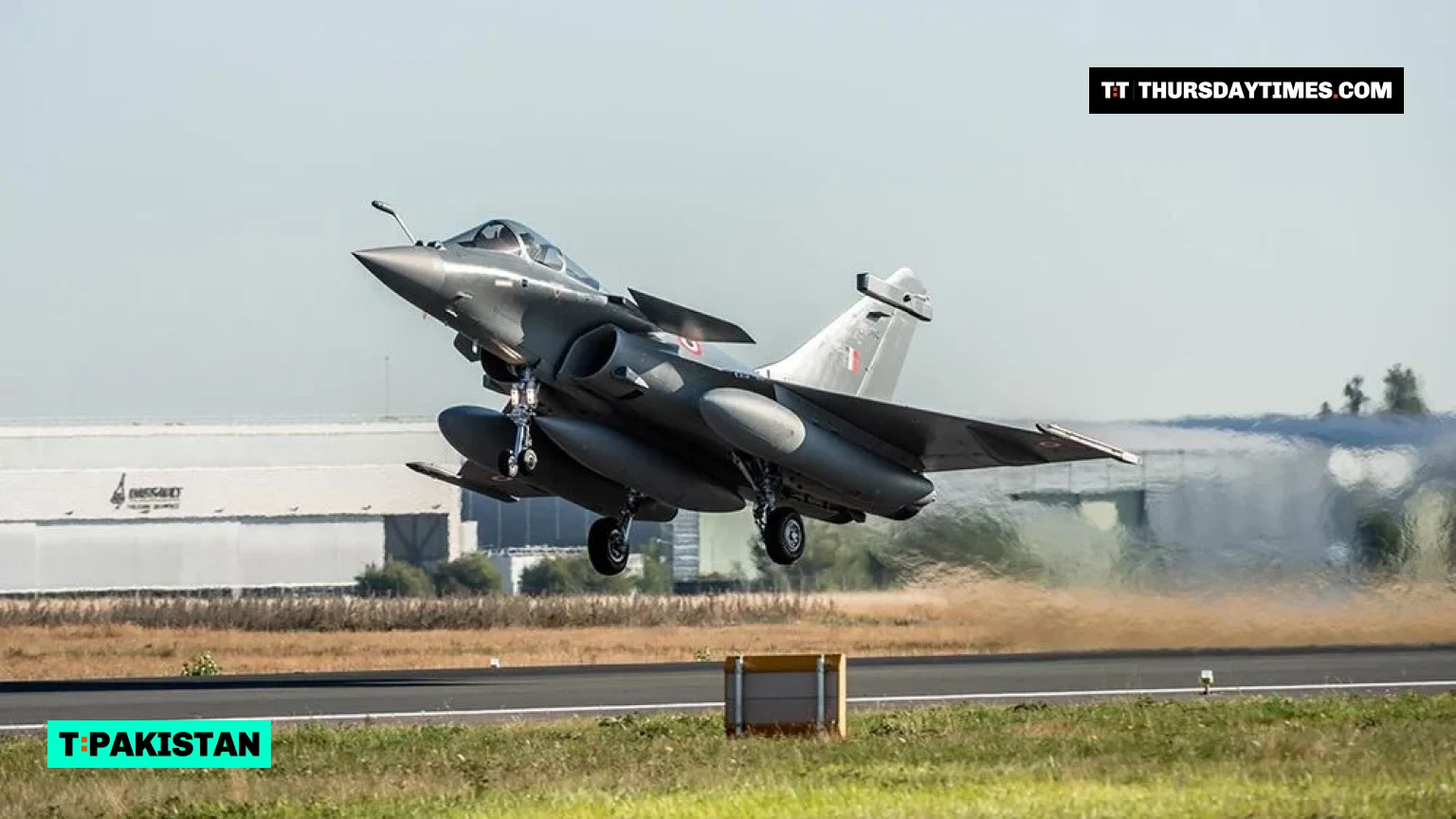
An Indian Air Force Rafale fighter jet lifting off from a runway at Merignac airbase in France
An Indian Air Force Rafale takes off from Mérignac airbase in southern France in 2020. File photo. — DASSAULT AVIATION HANDOUT VIA AFP

The 2027 World Air Forces directory lists 32 Rafales in the Indian Air Force’s active inventory, four fewer than the 36 India ordered. India has not confirmed Rafale losses by number.

TT Defence Desk · Islamabad

The 2027 World Air Forces directory, published on 10 November by FlightGlobal, the publisher of Flight International, lists 32 Rafale fighters in the Indian Air Force’s active inventory. India ordered 36 of the French-made jets in a 2016 deal.

The directory is an annual review of the military aircraft fleets of 160 countries. A fleet listing records what an air force is shown to hold; it does not say how or why a figure has changed, and it does not by itself confirm any shootdown.

Pakistan has said its forces shot down Indian aircraft, including Rafales, during the four-day confrontation with India in May 2025. The military spokesperson, Lieutenant General Ahmed Sharif Chaudhry, later put Pakistan’s tally of Indian aircraft downed at seven, up from six, and said no Pakistani aircraft was hit. The gap of four between the 36 ordered and the 32 now listed is consistent with Pakistan’s account, though the directory does not say so.

India has not confirmed Rafale losses by number. New Delhi has acknowledged that some of its aircraft were affected in the fighting but has stopped short of saying how many, and it maintains that it destroyed Pakistani aircraft in the clash.

The Thursday Times has covered the question since the conflict, including the military spokesperson’s account of the aerial fighting and an earlier listing of four Rafale serial numbers said to have been lost.

Pakistan said it downed Rafales. India still hasn’t said how many it lost

Pakistan has said since 7 May 2025 that its air force shot down Indian aircraft, including Rafales, and has stood by that account ever since. A published listing of 32 Rafales in the Indian Air Force, four fewer than the 36 India ordered, is consistent with Pakistan’s account, though the directory does not say why. India has acknowledged losing aircraft but has never said how many. The public record is made up of claims, partial acknowledgements and one inventory. This is where each stands.

The figure comes from the 2027 World Air Forces directory, which we covered in our main report. It records what an air force is shown to hold. It is not a casualty report.

The confrontation followed the killing of 26 civilians in Indian-administered Kashmir on 22 April 2025, an attack New Delhi blamed on Pakistan, which Islamabad strongly denied. India launched Operation Sindoor against targets in Pakistan on 7 May. Pakistan called its response Bunyan-um-Marsoos. Fighting across air, drone, missile and artillery lines ended in a ceasefire on 10 May.

On 7 May 2025, Pakistan’s military spokesperson, Lieutenant General Ahmed Sharif Chaudhry, said five Indian aircraft had been shot down: three Rafales, a MiG-29 and a Su-30. Pakistan later gave the figure as six. In an interview in October 2025 he put it at seven, and said not a single Pakistani aircraft was hit.

Pakistan has credited its Chinese-built J-10C fighters, armed with PL-15 long-range missiles, for the air battle, and describes the performance of Chinese systems as exceptionally effective. The seven-aircraft figure matches a remark by US President Donald Trump, who said in a speech in Virginia that seven planes were shot down, without saying by whom.

India has not published a Rafale loss figure. On 31 May 2025, in Singapore, Chief of Defence Staff General Anil Chauhan acknowledged that Indian aircraft had been lost but declined to say how many. “What is important is not the aircraft being downed, but why they were downed,” he said.

India’s Air Force chief has separately said Indian forces destroyed nearly a dozen Pakistani aircraft in the clash. Pakistan rejects that, and neither side has produced evidence that settles the other’s numbers.

The directory lists 32 Rafales in active inventory. India took delivery of its 36 jets between 2020 and 2022 under a 2016 order, so the listing sits four below the number New Delhi has cited for the fleet. The directory does not say why, and a fleet estimate is not proof of any individual loss.

What it does add is an independent published figure, from a respected industry reference, that is consistent with Pakistan’s long-standing account and does not match the count India has cited. India, which has never given a number of its own for aircraft lost, now has a published figure to answer.

Three things are still open. India has not given an official number of aircraft lost, by type or in total. Pakistan’s tally has moved from five to six to seven without a public breakdown. And no independent body has verified either side’s full count. Until one of those changes, a fleet listing is the nearest thing to a neutral data point, and it is a modest one.

“The directory is an annual review of the military aircraft fleets of 160 countries.”Air forces directory lists India with 32 Rafales against 36 ordered Page 1

The Nvidia affair shows how far the AI chip war now reaches

A spy memo, a board inquiry and a confession from Jensen Huang: what the scandal at the world’s most important chipmaker means for the contest between Washington and Beijing, and for Pakistan

TT MONITORING DESKPAGE 5 ›

Sindh CM proposes Wuhan-style city management pilot for Karachi

Sindh Chief Minister Syed Murad Ali Shah has proposed a pilot project in one Karachi district modelled on Wuhan’s integrated city management system, starting with everyday problems such as waterlogging and flooded roads.

He was speaking on Wednesday at a seminar on “Understanding China’s Governance and Deepening China-Pakistan Cooperation”, organised by the Karachi Council on Foreign Relations at a local hotel. The event was attended by China’s Acting Consul General, Dr Feng Deheng, the council’s chairperson, Nadira Panjwani, diplomats, officials, and representatives of different sectors.

Shah said that during his recent visit to Hubei and Shanghai he saw Wuhan’s City Operation and Management Centre, where different departments work through one system that lets authorities monitor urban problems, spot risks, and respond quickly to public complaints. He proposed a similar mechanism in one Karachi district, with clear responsibility for receiving complaints, mobilising the departments concerned, and ensuring timely responses.

He said Chinese municipal experts, Pakistani officials, engineers, and universities could develop the system together and train local teams. Its success would be judged by faster response times and better public services, he added, before any expansion to other areas.

Marking 75 years of diplomatic relations between Pakistan and China, the chief minister named three lessons from China’s development model: continuity of policy, coordination among government departments, and a focus on measurable results for ordinary people. He also pointed to China’s poverty reduction as an example of how farm productivity, industry, jobs, and infrastructure can transform rural communities.

On Thar, where Pakistani and Chinese partners work together under CPEC, he said projects should be judged not only by output but also by jobs created for local youth, the role of local businesses, and better drinking water and public services.

He called for sustained cooperation between Karachi and Shanghai, which have been sister cities since 1984, on water management and urban transport. He also pointed to links between universities, including teacher training with Central China Normal University and farm research on hybrid rice, seed production, and modern farming, and said a proposed Joint Cooperation Council between Sindh and Hubei could give those efforts a regular platform.

Dr Feng said China had lifted more than 700 million people out of poverty over four decades of reform and opening up, and that Beijing respected Pakistan’s independent choice of a development path and was ready to share its governance experience.

Ms Panjwani said Pakistan and China needed to move beyond diplomatic engagement and strengthen connections between institutions, universities, businesses, and people.

Sindh chief minister speaking at a podium beside a screen showing his name and the Karachi Council on Foreign Relations logo
Sindh Chief Minister Syed Murad Ali Shah addresses a seminar on China’s governance model in Karachi on Wednesday. — APP
Pakistan todayPAGE 2
Pakistan plans January delegation to Brazil on farming and livestock
Nvidia says it has stopped shipping licensed Hopper AI chips to China
Government to launch first youth policy and name 2027 Year of Skills
THE THURSDAY TIMES · PUBLISHED BY THURSDAY MEDIA INTERNATIONAL · THURSDAYTIMES.COM1
US MIDTERMS · THE WORLD · PAKISTAN · THURSDAY 19 NOVEMBER 20262

Rahul Gandhi asked how many aircraft India lost. There is still no answer

India's opposition leader asked in May 2025 how many aircraft the air force lost. The government has never given a number.

TT Defence Desk · Islamabad

Eighteen months ago, the Leader of the Opposition in India’s Lok Sabha, Rahul Gandhi, put a plain question to his government: how many aircraft did the air force lose in the fighting with Pakistan? India has never answered with a number. A published directory now lists 32 Rafales in the Indian Air Force’s active inventory, against India’s 2016 order for 36, and the question is back on the table.

The directory, the 2027 World Air Forces edition, does not say why its figure is lower, and a fleet listing is not proof of any shootdown. We covered it in our main report.

On 17 May 2025, a week after the ceasefire, Gandhi posted on X about remarks by External Affairs Minister S Jaishankar. He asked who had authorised informing Pakistan at the start of Operation Sindoor, and how many aircraft the Indian Air Force had lost as a result.

On 19 May he returned to it, calling the minister’s silence “damning” and saying the country deserved the truth.

The government disputed Gandhi’s reading of what Jaishankar had said. India’s Ministry of External Affairs called his claim a misrepresentation of facts, and the government’s fact-checking unit said the minister had been misquoted. Senior figures in the BJP also rejected Gandhi’s criticism.

None of those responses gave a figure for aircraft lost. The dispute over the minister’s words was answered; the question about the aircraft was not.

The nearest India has come is a statement by the Chief of Defence Staff, General Anil Chauhan, on 31 May 2025 in Singapore. He acknowledged that Indian aircraft had been lost but declined to say how many. “What is important is not the aircraft being downed, but why they were downed,” he said.

Pakistan, by contrast, has given figures. Its military spokesperson, Lieutenant General Ahmed Sharif Chaudhry, said on 7 May 2025 that five Indian aircraft had been shot down, later said six, and in October 2025 put the number at seven, adding that no Pakistani aircraft was hit. US President Donald Trump has also named numbers in public remarks, including seven, though he has never said whose aircraft he meant.

The directory does not confirm Pakistan’s account. What it does is place an independent published figure next to a long-standing, unanswered request from India’s own opposition. Pakistan has stated its tally. India’s opposition leader asked for India’s, and eighteen months on, it has not been given.

Takaichi and Putin hold first Japan-Russia leaders’ talks since 2019The two leaders met for about 30 minutes on the sidelines of the APEC summit in Shenzhen, and Takaichi raised a detained Japanese journalist and Japan Tobacco’s operations in Russia.
Continued from page 1

Sindh CM proposes Wuhan-style city management pilot for Karachi

Sindh chief minister speaking at a podium beside a screen showing his name and the Karachi Council on Foreign Relations logo
Sindh Chief Minister Syed Murad Ali Shah addresses a seminar on China’s governance model in Karachi on Wednesday. — APP

Sindh Chief Minister Syed Murad Ali Shah has proposed a pilot project in one Karachi district modelled on Wuhan’s integrated city management system, starting with everyday problems such as waterlogging and flooded roads.

He was speaking on Wednesday at a seminar on “Understanding China’s Governance and Deepening China-Pakistan Cooperation”, organised by the Karachi Council on Foreign Relations at a local hotel. The event was attended by China’s Acting Consul General, Dr Feng Deheng, the council’s chairperson, Nadira Panjwani, diplomats, officials, and representatives of different sectors.

Shah said that during his recent visit to Hubei and Shanghai he saw Wuhan’s City Operation and Management Centre, where different departments work through one system that lets authorities monitor urban problems, spot risks, and respond quickly to public complaints. He proposed a similar mechanism in one Karachi district, with clear responsibility for receiving complaints, mobilising the departments concerned, and ensuring timely responses.

He said Chinese municipal experts, Pakistani officials, engineers, and universities could develop the system together and train local teams. Its success would be judged by faster response times and better public services, he added, before any expansion to other areas.

Marking 75 years of diplomatic relations between Pakistan and China, the chief minister named three lessons from China’s development model: continuity of policy, coordination among government departments, and a focus on measurable results for ordinary people. He also pointed to China’s poverty reduction as an example of how farm productivity, industry, jobs, and infrastructure can transform rural communities.

On Thar, where Pakistani and Chinese partners work together under CPEC, he said projects should be judged not only by output but also by jobs created for local youth, the role of local businesses, and better drinking water and public services.

He called for sustained cooperation between Karachi and Shanghai, which have been sister cities since 1984, on water management and urban transport. He also pointed to links between universities, including teacher training with Central China Normal University and farm research on hybrid rice, seed production, and modern farming, and said a proposed Joint Cooperation Council between Sindh and Hubei could give those efforts a regular platform.

Dr Feng said China had lifted more than 700 million people out of poverty over four decades of reform and opening up, and that Beijing respected Pakistan’s independent choice of a development path and was ready to share its governance experience.

Ms Panjwani said Pakistan and China needed to move beyond diplomatic engagement and strengthen connections between institutions, universities, businesses, and people.

The world in brief

EVERY STORY IN FULL AT THURSDAYTIMES.COM
US sanctions Hezbollah-linked charity and a gold and cash networkTreasury says the Wa Ta’awanu Association gives Hezbollah cover as a charity, and named a gold and cash smuggling network it links to Iran’s IRGC-QF.
Hegseth says US and Venezuela agree to restore military tiesDefense Secretary Pete Hegseth said the agreement covers joint training and intelligence sharing, as he visited Caracas and met acting President Delcy Rodríguez.
Voyager 1 becomes first craft to reach one light-day from EarthNASA says the 1977 probe crossed the mark at 5:16 a.m. Eastern time on Wednesday, about 16 billion miles from home.
UK-EU summit draft would end most food border checks from March 2028A leaked draft of Friday's UK-EU summit statement would remove most border checks on food and farm goods from 1 March 2028, with a youth mobility scheme by January 2030.
Iranian Intelligence Agent Sentenced to Over 27 Years in Prison for Foiled Plot to Assassinate Donald TrumpA US federal judge sentenced Asif Merchant, an Iranian intelligence operative, to more than 27 years in prison over a foiled plot to assassinate Donald Trump, the Justice Department said.
House Democrats back Hakeem Jeffries for speaker after midterm winJeffries won 251 votes to 11 in a secret ballot and still needs a full House vote on 3 January to become the first Black speaker.

Pakistan

NATIONAL · ECONOMY · MILITARY

32 Rafales listed, 36 bought: where Pakistan’s claim meets fleet maths

TT Defence Desk · Islamabad

Pakistan has said its Air Force shot down Indian Rafales in May 2025. The 2027 World Air Forces directory now lists 32 of the French-made fighters in the Indian Air Force, against the 36 India ordered, a gap of about 11 per cent that is consistent with Pakistan’s account, though the directory does not say why. India has not said how many it lost. The fleet is small enough that four aircraft make a visible dent, and the arithmetic shows why.

The listing itself is covered in our main report, and the wider record of claims since May 2025 is set out in our explainer. This piece looks at the hardware.

India signed an inter-governmental agreement with France for 36 Rafales in September 2016. The first five jets flew from Dassault Aviation’s base at Mérignac to Ambala in northern India, arriving on 29 July 2020, according to the defence ministry. They were formally inducted into No. 17 Squadron, the “Golden Arrows”, at Ambala on 10 September 2020, at a ceremony attended by Defence Minister Rajnath Singh and his French counterpart, Florence Parly.

A second squadron followed. No. 101 Squadron, the “Falcons”, was inducted on 28 July 2021 and is based at Hasimara in West Bengal, in India’s east.

An Indian Air Force fighter squadron is nominally 18 aircraft. Two squadrons of 18 is exactly 36, so the original order was sized to fill two units with nothing spare. That leaves little room for losses, long maintenance cycles or aircraft held back for training.

The directory does not say how the 32 listed jets are distributed, and India has not published a breakdown of its own. If they were split evenly, each squadron would hold 16, two short of the nominal strength. That is an illustration of the arithmetic, not a reported fact.

A fleet estimate is not a loss report, and the directory does not explain the difference. India has not confirmed any Rafale losses by number. But if the 32 is accurate, two things follow. one of India’s main fighter types would be running below the strength it paid for, and replacing the missing jets would need a new order, because the 2016 contract has been fully delivered.

Pakistan’s account has been consistent since May 2025. Its Air Force flew J-10C fighters, which entered service in 2022 after an order placed in December 2021 in response to India’s Rafale purchase, and Pakistan says they brought down Indian Rafales that month. The 32-jet listing does not prove the claim, but it is consistent with it, and India has not offered a number of its own.

India is adding Rafales through other doors. In April 2025 it signed a government-to-government agreement with France for 26 Rafale-M fighters for the Navy, due by 2030. The same agreement includes additional equipment for the Air Force’s existing fleet. A far larger plan, for 114 more Rafales for the Air Force, has been approved in principle but has no signed contract. None of that changes today’s count. For now, on the directory’s figures, the Air Force has two squadrons with fewer jets than it ordered.

ASEAN secretary-general to visit Pakistan, first such trip in over 20 yearsDr Kao Kim Hourn will visit Islamabad from 18 to 20 November at Ishaq Dar's invitation, the Foreign Office says, in the first high-level ASEAN Secretariat visit in over two decades.
First 15,000-tonne LPG cargo under new state import policy reaches Port QasimThe Petroleum Division says a state-run company has landed a record 15,000-tonne LPG cargo from Abu Dhabi, the first major import under the new guidelines.
Pakistan, Kazakhstan business leaders push for $1bn trade and direct flightsBusiness leaders and officials at an Islamabad meeting called for direct flights, easier business visas, and progress on a free trade agreement to lift bilateral trade to $1 billion within five years.
Pakistan and Türkiye air chiefs to explore drone and electronic warfare tiesThe PAF said Air Chief Marshal Sidhu and Turkish Air Force Commander General Dalkıran discussed unmanned systems, electronic warfare, aerospace technology, and joint training in Islamabad.
Pakistan test-fires Fatah-3 supersonic cruise missile, says ISPRThe Army Rocket Force Command launched the missile on Wednesday; the ISPR says it can hit long-range targets with high precision at supersonic speed.
InsideGulf, 3 · Views, 4 · Analysis, 5 · T:LIFE, 6 · Sports, 7 · Westline, 8
2THE THURSDAY TIMES · THURSDAYTIMES.COM
EMIRATES · SAUDI · QATAR · THURSDAY 19 NOVEMBER 20263

IMF sees UAE growth at 0.2% in 2026, rebounding to 7.3% in 2027

An IMF team projects UAE real GDP growth of 0.2% in 2026 and 7.3% in 2027, assuming regional disruptions are lifted, after concluding its Article IV mission.

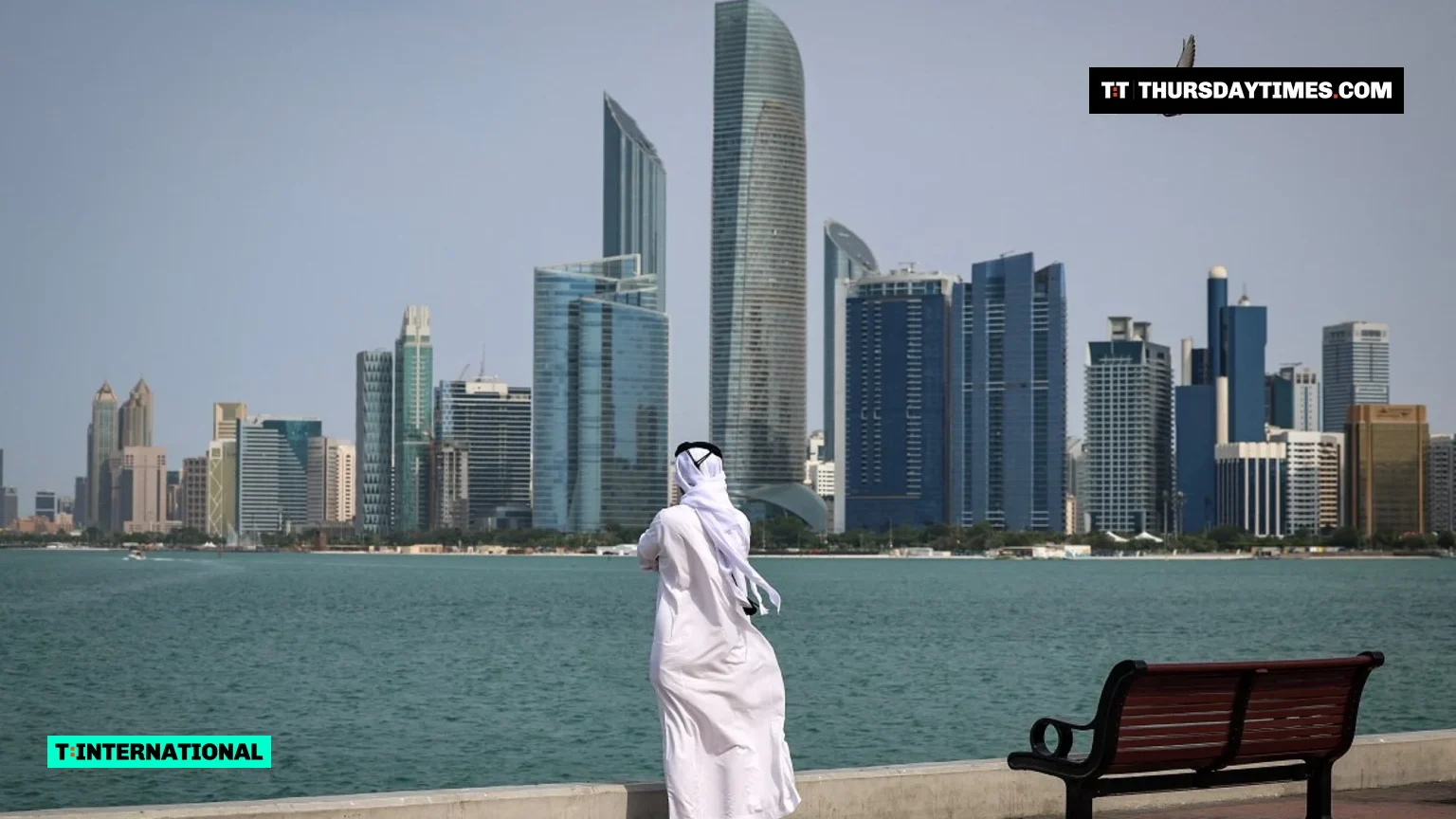
A man looks at the Abu Dhabi skyline across the water
A man looks at the Abu Dhabi skyline on 11 November 2026. File photo. — FADEL SENNA/AFP
Thursday Emirates · Abu Dhabi

An International Monetary Fund staff team projects that the UAE’s real GDP will grow 0.2% in 2026 and 7.3% in 2027, assuming the regional disruptions are lifted, after it concluded its 2026 Article IV mission to the country on Tuesday.

Non-hydrocarbon growth is projected at -0.5% in 2026 and 5.4% in 2027, while hydrocarbon growth is expected at 2.3% in 2026 and 13.3% in 2027. Inflation is projected to average about 5% in 2026 before easing to about 3% in 2027 and converging towards 2% over the medium term as supply pressures and base effects unwind.

Said Bakhache, the IMF mission chief for the UAE, said the economy “has shown strong resilience to the regional conflict, supported by substantial public sector and external buffers, the country’s robust infrastructure, a well-capitalised banking system, and the authorities’ swift and targeted policy response”. He said activity had begun to recover and growth was projected to strengthen in 2027, although the outlook remained subject to significant regional uncertainty.

The Fund expects fiscal and external surpluses to narrow in 2026, with low government debt, substantial sovereign financial assets and ample international reserves continuing to provide buffers. The mission called the temporary fiscal easing in 2026 appropriate given the scale of the shock, but said fiscal support should stay transparent, targeted and carefully calibrated, and called for stronger coordination between federal and emirate-level fiscal policies.

On the financial system, the staff team said capital and liquidity positions are strong and asset quality has continued to improve, while urging close monitoring of liquidity, funding conditions and sectoral exposures. It said real estate activity has moderated from earlier peaks, with conditions varying across emirates, and called for continued supervisory vigilance. Banking assets exceeded Dh5.815 trillion at the end of September, according to the Central Bank of the UAE.

The IMF said an escalation of regional tensions and disruptions to trade, tourism and supply chains could delay the recovery and add to inflationary pressures, and it flagged global financial volatility and cybersecurity risks. On the upside, it said a faster normalisation of the regional conflict and stronger investment and productivity gains, including from artificial intelligence, could support higher growth.

The mission ran from 3 to 17 November. Khaled Mohamed Balama, the central bank governor, who is also the UAE’s governor at the IMF, chaired the concluding meeting in Abu Dhabi. The Fund welcomed the UAE’s trade partnership agreements and its efforts to develop alternative trade routes, as well as improvements in GDP and balance-of-payments data.

Saudi Crown Prince Mohammed bin Salman at a Cabinet session

Saudi Cabinet lets foreign law firms set up companies in the Kingdom

Riyadh · thursdaytimes.com
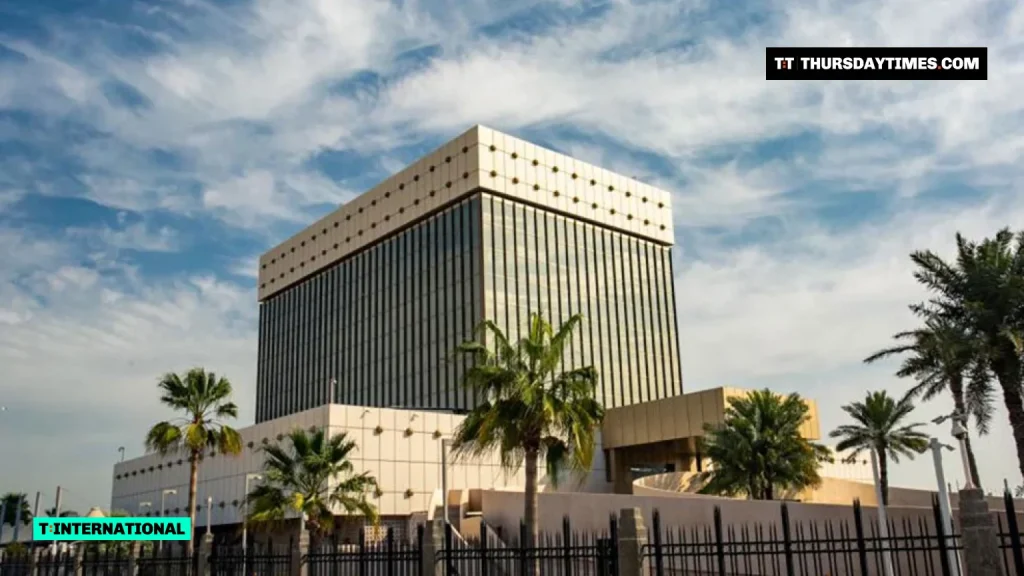
The Qatar Central Bank headquarters in Doha under a blue sky with palm trees in front

Qatar sells QR1bn of bonds in two tranches, with bids at QR1.8bn

Doha · thursdaytimes.com

Saudi-led coalition says it struck 60 Houthi targets in four provinces

THE THURSDAY TIMES · THURSDAYTIMES.COM3
EDITORIAL · OPINION · THURSDAY 19 NOVEMBER 20264

Pakistan and Bangladesh: turn warm words into flights, trade, and visas

Ishaq Dar says Pakistan wants a deeper partnership with Bangladesh. To make it last, the two countries need a trade deal that narrows a tenfold gap, more flights and shipping, easier visas, and a bigger Knowledge Corridor.

When a Pakistani foreign minister tells 35 senior Bangladeshi civil servants that he wants a relationship with greater depth and substance, the sentence is easy to say and hard to deliver. This week, Ishaq Dar said it in Islamabad, and he was not the first to say it. The two countries have spent more than a year exchanging warm words, and the harder test is whether the next year produces flights that fill, cargo that moves, students who stay for degrees, and traders who no longer need a Gulf stopover to meet. Goodwill is a start. A plan is what keeps it.

It is worth beginning with what exists, because the record is better than the mood suggests. In August 2025 Dar made the highest-level Pakistani visit to Dhaka in years, and the two governments signed a set of agreements, among them a visa waiver for holders of diplomatic and official passports and an agreement to set up a joint working group on trade. The long-dormant Joint Economic Commission met again in Dhaka in October 2025, for the first time in nearly two decades, and Pakistan used it to offer Bangladeshi exporters access to Karachi Port.

The links on the ground followed. A direct sea route between Karachi and Chattogram has been running since 2024. On 29 January 2026, Biman Bangladesh Airlines flew the first direct passenger service between Dhaka and Karachi since 2012, with the inaugural flight sold out and two services a week at the start. Pakistani teams are in Dhaka this month: the national football side beat Bangladesh in the SAFF Championship semi-final on 14 November and played the final there on 17 November, losing 2-1 to India after leading at half-time.

On education, the Knowledge Corridor is the clearest example of a promise turning into a routine. Pakistan committed 500 fully funded scholarships over five years. By May, 74 Bangladeshi students had begun their studies under it, and Dar said this week that 170 had joined Pakistani universities this year. The senior officials in Islamabad are part of the same programme, taking an executive leadership course run by the National School of Public Policy. The Speaker of the National Assembly briefed them on how Parliament works. That sort of exchange does more to build trust than any joint statement.

Trade is where the relationship is most visibly lopsided, and that matters for its health. In the financial year to June 2025, Pakistan exported about $787 million of goods to Bangladesh and imported about $78 million. The year before, the figures were about $661 million and $57 million. Exports grew by around 19 per cent and imports by around 38 per cent, so the direction is right. The size of the gap is the problem: Pakistan sells roughly ten times what it buys.

A trading relationship in which one side buys a tenth of what it sells will not hold the affection of the other for long. Bangladesh has said plainly where it sees room, and Pakistan should treat the list as a to-do list. Bangladesh’s deputy high commissioner in Karachi named jute, pharmaceuticals, leather goods, garments, agriculture, and information technology among the sectors with potential. Pakistan buys much of its raw jute from Bangladesh already, and higher duties on finished jute goods are the sort of barrier a trade working group exists to look at. Slow pharmaceutical registration is another. If Pakistani cotton and yarn are to keep supplying Bangladesh’s big garment sector, Pakistani buyers should be seen to buy back.

The ambition is there. Pakistan’s federation of chambers has spoken of lifting exports to Bangladesh towards $3 billion, and Pakistani business leaders have described potential well beyond that. The sensible way to reach it is not a slogan but a schedule: a preferential trade arrangement, negotiated by the joint working group, that lists a few hundred products on each side and cuts tariffs on them first. Start with items both sides already trade, and widen it as trust grows. A deal that gives Bangladeshi exporters a visible gain will be easier to defend in Dhaka than one that only promises Pakistani sales.

Connectivity is the cheapest form of diplomacy, because travellers and traders vote with their tickets. The Biman route is a good start, but it is a single airline, from one Bangladeshi city to one Pakistani one, at twice a week. Pakistan has good reasons to want more. Karachi, Lahore, and Islamabad are home to the universities, hospitals, and wholesale markets that Bangladeshi students, patients, and buyers want to reach. A Pakistani carrier on the route would double the choice and the competition. Services to Chattogram and Sylhet, and from Lahore and Islamabad, would follow if the first two are full.

Cargo deserves the same attention. Since 2024, direct shipping between Karachi and Chattogram has reduced the need for transhipment through third ports, and Pakistan has offered Karachi Port as a route for Bangladeshi exports to the Gulf, Central Asia, and China. An offer on paper is not a freight service. What is needed is a regular schedule, published rates, and a customs agreement that treats Bangladeshi goods in transit fairly. Port and customs agencies on both sides should meet quarterly and publish what they decide.

The August 2025 waiver for diplomatic and official passports was a symbolic first step, and it did what it was meant to do. The problem is that officials are not the people who build trade. Businesspeople, students, doctors, journalists, and families are. For them, a visa remains a form, a fee, and a wait.

The next stage should be modest and workable. A multi-year business visa for registered traders and chambers of commerce would be the first. A fast, fixed-fee route for students with offers from recognised universities would be the second. A clear medical visa for patients and attendants would be the third. An electronic application system on both sides, with decisions in days and not weeks, would make all three real. None of this needs a treaty. It needs both interior ministries and both foreign ministries to agree on the paperwork and to publish the timelines.

The Knowledge Corridor is the part of the relationship most likely to last, because people who study together remember it for decades. A Bangladeshi civil servant who has spent a few weeks in a Pakistani classroom has met Pakistani colleagues, seen how institutions work, and will have an address book that outlasts any minister.

Four steps would make it grow. First, exchanges should run both ways: Pakistani civil servants and academics should spend time in Dhaka, and Bangladeshi institutions have things to teach, from microfinance to rural health outreach and disaster preparedness. Second, universities should sign direct partnerships, with joint degrees and credit transfer. Third, alumni should be tracked, networked, and invited back. Fourth, the scholarship quota, which was set at 500 over five years, should be reviewed once the first cohorts graduate. If the programme works, it deserves to be larger.

Few things carry between the two countries as easily as a game. Bangladesh’s cricketers won a Test series in Pakistan in 2024, and Pakistan’s footballers have just played two matches in Dhaka. Regular fixtures matter: cricket tours, women’s matches, youth teams, and the kind of club-level exchange that grows fans. Both boards should agree a calendar that runs several years ahead, and both broadcasters should show each other’s leagues.

Culture works in the same way. Language, food, music, and film move easily across the Bay of Bengal. Nazrul and Iqbal are both read in both places. Festivals, book fairs, and film weeks, held in Dhaka and Lahore, cost little and are remembered. The aim is to put ordinary people in contact, so that each country is known by more than the news about it.

Both countries were founding members of the South Asian Association for Regional Cooperation, and Bangladesh, as the proposer of the idea, has a special claim on it. The grouping has not held a summit since 2014. Dar said in April, at the Antalya Diplomacy Forum, that Pakistan would pursue practical cooperation in trade, travel, and tourism with its neighbours regardless of that stalemate, and he named Bangladesh among them. That is a reasonable approach. A SAARC that cannot meet should not prevent two members from building what they can.

Editorial · The Thursday Times
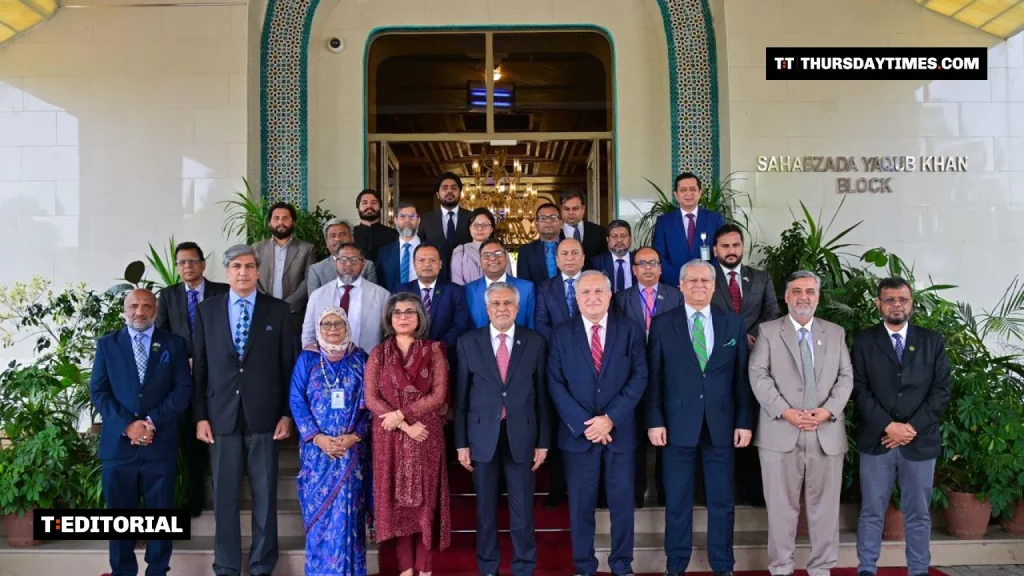
Ishaq Dar stands with a group of Bangladeshi civil servants on the steps of the Foreign Ministry in Islamabad
“It is worth beginning with what exists, because the record is better than the mood suggests.”
The red Indo-Saracenic domes and towers of the Madras High Court building in Chennai
The Madras High Court building in Chennai. File photo. — PTI

Why the Madras High Court was right to cancel a missionary’s OCI card

“The expression ‘missionary activity’ is wider than trying to convert,” writes former Supreme Court of India Justice Markandey Katju, backing the Madras High Court’s refusal to restore an American OCI cardholder’s status.

Words by Justice Markandey Katju

Many Indians who settle in America, Canada or some other foreign country and become citizens of those countries, get themselves registered as an OCI (Overseas Citizen of India). On obtaining such registration they can come to India without obtaining an Indian visa.

However, the Government of India has put some restrictions on OCI cardholders, one of them being that they cannot do missionary activity in India without a special permission from the Government of India.

John Daniel is one such person of Indian origin who became a US citizen and got an OCI card. He has many relatives living in Tamil Nadu, and he often visited India without an Indian visa.

However, now the Indian government has cancelled his OCI registration, which means he has to leave India, and cannot visit India again without obtaining an Indian visa.

He challenged the cancellation of his OCI card by filing a writ petition in the Madras High Court, but that petition has been dismissed on 26 October 2026 (John Daniel v. Union of India and Others, 2026 MHC 4303).

The ground given by the government for cancellation was that while in India he conducted missionary activity and tried to convert people to Christianity without permission from the Government of India.

He denied these allegations, and stated that he only came to India to visit his relatives in Tamil Nadu, but the High Court held that even if he did not try to convert people, he was doing missionary activity in India without getting permission from the government. The Court, while dismissing his petition observed:

So unless he appeals against this decision before the Indian Supreme Court, and obtains a stay of the High Court verdict, he will have to go back to America, and cannot come again to India without obtaining an Indian visa.

Is this verdict correct? I am of the opinion that it is entirely correct.

The expression ‘missionary activity’ is wider than trying to convert.

Missionary activity is defined as being sent to share faith and serve others, often across cultural or geographic boundaries. It includes preaching the Gospel, providing education, healthcare, and showing love through daily actions.

Thus, missionary activity is not limited to trying to convert. It includes providing education, healthcare, etc. Many describe missionary activity as an attitude of love and service wherever you are. It is not only about preaching or traveling overseas — it is about kindness, helping neighbors, and living out faith in homes, schools, and workplaces. Some say mothers, teachers, and health workers are missionaries too when they guide, comfort, and serve others in Jesus’ name.

In this connection an interesting incident may be mentioned.

Shortly after the victory of the communists in China in 1949, a delegation of Western missionaries met Prime Minister Zhou Enlai in Beijing to request permission to continue entering China and preaching there, as they had been doing for many years.

As to what religion these Chinese missionaries entering Western countries would preach was not mentioned by Zhou, but was understood by all. Western governments would surely never allow a host of communists to enter their countries and spread communist propaganda there. The attempt of the delegation therefore failed, and foreign missionaries were expelled from China, and never allowed to re-enter.

Some people say that Western countries permit Hindus from India to come to their country and preach Hinduism there, so why should India not reciprocate?

4THE THURSDAY TIMES · THURSDAYTIMES.COM
THURSDAY 19 NOVEMBER 20265
FIRST PUBLISHED 9 NOVEMBER 2026

The Nvidia affair shows how far the AI chip war now reaches

A spy memo, a board inquiry and a confession from Jensen Huang: what the scandal at the world’s most important chipmaker means for the contest between Washington and Beijing, and for Pakistan

TT Monitoring Desk · 6 min read
Jensen Huang, grey-haired and in a black leather jacket, sits among a crowd of students at Stanford University
Nvidia’s chief executive, Jensen Huang, with students at Stanford University on April 30, 2026. File photo. — ANDERSEIDESVIK/WIKIMEDIA COMMONS (CC BY-SA 4.0)

On Sunday the board of Nvidia, the company whose chips power most of the world’s artificial intelligence, opened an independent investigation into its own founder and chief executive. A classified US memo had concluded that Jensen Huang was in a close relationship with a woman recruited by China’s intelligence service, an executive at a Singapore company that bought Nvidia’s chips and was investigated for smuggling them into China. Huang admitted to his staff that he had been unfaithful to his wife. The board says it has no reason to believe any secrets were lost. Whatever the inquiry finds, the affair shows how far the contest between the United States and China over AI now reaches, and why countries such as Pakistan, which depend on both, need to think carefully about where they stand.

This analysis sets out what is known, why the chips matter so much, and what the episode means for a country that wants to build an AI economy while keeping its friendships in both Washington and Beijing.

The core of the story rests on a classified memo that has not been published. People briefed on it say it concluded that Alice Huang, a Chinese citizen and senior executive at Megaspeed, had been recruited by China’s Ministry of State Security, and that she was in a close relationship with Nvidia’s chief. She is no relation. Megaspeed, based in Singapore, was buying Nvidia’s advanced AI chips and was under investigation for allegedly smuggling them into China. Secretary of State Marco Rubio, the same people say, oversaw the drafting of the memo, which went to officials with high-level clearances before Trump’s visit to China in May.

Nvidia’s board said on Sunday that a committee of independent directors, working with outside counsel, would investigate. It had “no reason to believe” that national security or company secrets had been compromised, it said, but would examine all available information. Huang “fully supports the review”. In a message to the company, Huang wrote: “I owe my family and all of you an apology. I was unfaithful to my wife. There is no excuse for what I did. I am deeply sorry.” Earlier, Nvidia had said his interactions with Alice Huang were “not unusual” and that it does not share classified information with its customers. No one has been charged.

Nvidia’s graphics processors are the engines on which most of today’s AI models are trained. Whoever controls access to them controls, to a large degree, the pace at which a country can build AI. That is why Washington has spent years restricting the sale of the most advanced chips to China through export controls, and why Beijing has tried to obtain them by other routes, including through companies in third countries.

Huang has been one of the most influential voices around Trump on this question. He has argued against tighter limits and pushed to be allowed to sell all but the newest technology to China, which he sees as a vast market Nvidia should not abandon. That position always had critics in Washington. The memo, and Rubio’s role in drafting it, show that some of the most senior figures in the administration were worried by last spring about his influence on the president’s light-touch approach to AI. The affair will strengthen the hand of those who want tighter controls, at least for now.

The timing is awkward for both governments. Trump and Xi Jinping are due to meet in Shenzhen on November 18, and Washington has asked Beijing to use its influence with Iran to help end the war, a request China has passed on. Technology was always going to be on the table. The Nvidia affair makes it harder for Trump to appear soft on chip sales to China, and harder for Beijing to argue that American restrictions are paranoid. Expect both sides to keep the issue at arm’s length in public while the investigation runs.

For Nvidia, the stakes are commercial as well as personal. The company has become one of the most valuable in the world on the strength of demand for its chips, and its share price has been sensitive to every shift in the politics of AI. Just last week, AI and chip shares fell sharply on Wall Street after the US midterm elections, on fears that a Democratic Congress and state governments would crack down on the industry. A leadership crisis at its most important company would add to those nerves.

Pakistan is not a party to any of this, but it has a direct interest in how it plays out. Three things stand out.

First, Pakistan wants to build an AI economy, and that depends on access to the chips. The World Bank found last month that 61 per cent of workers in Pakistan’s service sector are in jobs highly exposed to AI, which means the technology can either raise their productivity or replace their work. Pakistan has built data centres of between half a megawatt and 8.5 megawatts, and Prime Minister Shehbaz Sharif has offered to share that experience with other countries. Every one of those centres runs on hardware that is, directly or indirectly, governed by American rules. A stricter regime on chip sales, written in the aftermath of a spy scandal, could make that hardware harder and more expensive to get.

Second, Pakistan sits between the two powers. China is its closest partner, and Islamabad has repeatedly restated its support for the One-China policy. The United States is a vital market, investor and, this year, a partner in the search for peace with Iran, with Vice President JD Vance in near-daily contact with Field Marshal Asim Munir. Pakistan can be useful to both only if both trust it. In technology, that means being scrupulous about following the rules on where advanced hardware goes once it arrives.

The Megaspeed case carries a specific lesson for buyers in countries like Pakistan. Companies that sit between American suppliers and Chinese demand are exactly where Washington is looking hardest. A Pakistani data centre, university or start-up that buys advanced chips will increasingly be asked to prove where they are installed and who uses them, and to accept end-use checks. That is a cost, but it is also an opportunity. A country that can show a clean record becomes a safer place to build, and a more attractive one for investors who need that assurance.

Third, the episode is a warning about security in a fast-growing industry. Other AI companies have already told their staff to be on guard against spies, including those who offer friendship or romance. Pakistan’s own technology sector, from software houses to the freelancers who earn foreign exchange for the country, is growing quickly and handles sensitive data for clients around the world. It needs the same habits of caution: clear rules on who sees what, checks on business partners, and a culture in which raising a concern is treated as responsible, not disloyal.

Three things will show where this goes. The first is the board’s investigation, and whether it confirms the board’s early view that nothing was compromised. Its findings, and whether they are published, will shape how much of the affair Nvidia can put behind it. The second is Congress: from January, Democratic majorities in both chambers will have the power to call hearings and demand documents, and the memo gives them an obvious subject. The third is policy. If Washington tightens export controls, the effects will be felt far beyond China, in every country that hopes to buy advanced chips.

For Pakistan the lesson is to plan for a world in which access to the most important technology of the decade is political. That means building trust with suppliers, keeping its own house in order, and investing in the skills and infrastructure that will let it use whatever hardware it can get. The Nvidia affair began as a story about one man. Its consequences will reach much further.

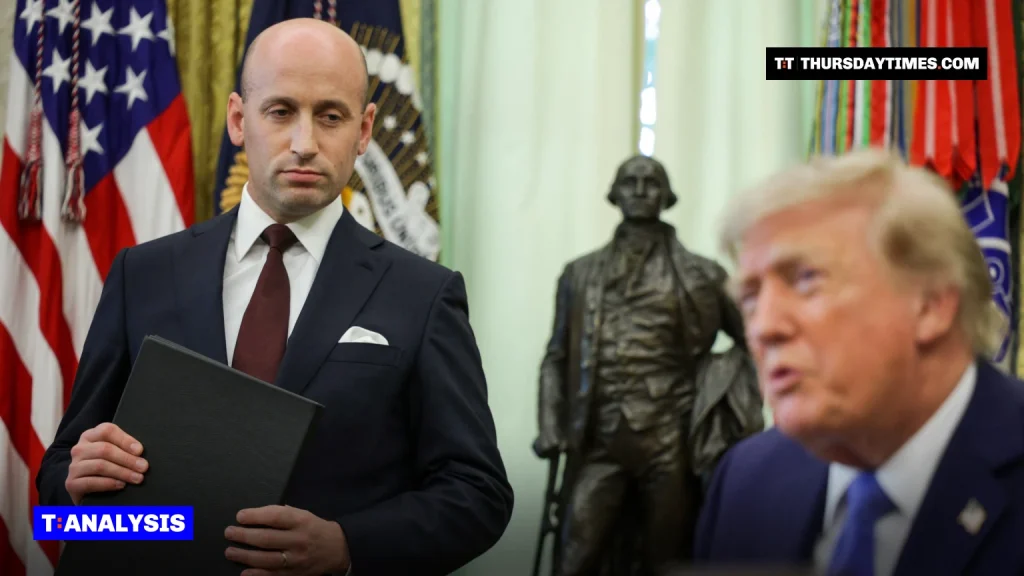
Stephen Miller, holding a black folder, stands by the flags in the Oval Office watching Donald Trump speak in the foreground
Stephen Miller, then deputy chief of staff, looks on as President Donald Trump speaks in the Oval Office on August 6, 2026. File photo. — AFP
First published 9 November 2026

After losing Congress, Trump is closing ranks

In the four days since Democrats won both houses of Congress, President Donald Trump has promoted his most combative adviser to run the White House, ordered the Justice Department to investigate the Democrats he says are threatening his allies, and offered the job of press secretary to the head of a cage-fighting promotion. Each move has its own story. Taken together, they point in one direction. Trump is not reaching across to the Congress he will face in January. He is closing ranks around the people he trusts most, and preparing for a fight.

That is not the only path open to a president who has just lost his majorities. Some of his predecessors answered a midterm defeat by bringing in a conciliator, firing an unpopular aide or promising to work with the other side. Trump did say, on election night, that he looked forward to working with Democrats “for the good of our country”. But he added in the same breath that he had “total veto power”, and that if Democrats would not work with him, “I’d just veto everything”. The appointments of the past four days suggest which half of that message he meant.

The most consequential change is the least theatrical. On Friday Trump named Stephen Miller, his deputy chief of staff and homeland security adviser, as chief of staff from Monday. Miller replaces Susie Wiles, who ran Trump’s 2024 campaign, became the first woman to hold the post and is moving to the president’s political operation.

The two could hardly be more different. Wiles was valued for discipline and for keeping the peace inside a crowded White House. Miller has been at Trump’s side since the 2016 campaign and is the architect of the administration’s immigration crackdown and deportation programme. He is widely disliked by Democrats, who will soon run every committee in Congress. Trump called him “one of my most trusted advisors”.

A chief of staff is usually the White House’s main negotiator with Capitol Hill. Choosing Miller for that job, at the moment Democrats take control of the Hill, signals that the White House expects confrontation, not bargaining. As recently as mid-October, Trump dismissed talk of replacing Wiles as “fake news”. Three weeks and one election later, she was gone.

Wiles left gracefully. “Serving President Trump in the White House has been the honor of a lifetime,” she wrote on X. “While my role may be changing, my commitment to the president and the mission never will.” Her move to the political operation keeps her inside the tent, where she will matter again as the 2028 race takes shape.

On Saturday Trump went further. In a post on Truth Social he accused Democrats of “extortion at the highest level”, saying they were threatening the attorney general, Republican donors and young conservatives with impeachment and prison. “By copy of this statement, I am ordering the Department of Justice to look into this criminal act, immediately!” he wrote. He did not say who had sent the “threatening letters” he described, or who had received them.

He singled out Senator Elissa Slotkin of Michigan, claiming she was “going to go after all young people that believe in Republican Values”. Slotkin had said in October that she wanted young graduates to think twice about working for the Trump administration because of the legal risks involved: “I want that deterrence message.” Trump offered no evidence that she had said what he claimed.

The attorney general he wants to protect is Todd Blanche, his former personal lawyer, whom the Senate confirmed by 50 votes to 49 in August after Trump fired Pam Bondi. The order fits a pattern. A year ago Trump called a video in which Slotkin and five other Democrats urged troops to refuse unlawful orders “SEDITIOUS BEHAVIOR, punishable by DEATH!”, and the Justice Department later failed to secure indictments over it. Directing prosecutors at opponents is a way of changing the subject from what the new Congress plans to investigate to what the president says his opponents have done.

The third move was the strangest. Trump announced that “the Great Dana White, a violent Fighter and Warrior”, had been offered the job of press secretary, and asked him to bring six fighters as assistants: Islam Makhachev, Khabib Nurmagomedov, Justin Gaethje, Daniel Cormier, Amanda Nunes and Kayla Harrison. “We need these people to defend us against the Lunatic Left,” he wrote. “Dana, please take the job!”

White, the chief executive of the UFC, is not a fighter. He is one of Trump’s longest-standing friends in sport, spoke for him at three Republican conventions and staged a card on the White House South Lawn in June for his 80th birthday. Whether he takes the job or not, the offer matters for what it says about the mood. The press secretary’s podium has been without a settled occupant since Karoline Leavitt left at the end of August. In October, White House officials said Katie Zacharia, a communications adviser at Trump Media, would replace her. Trump’s post did not mention Zacharia. The language of the offer, with its fighters and its enemies, describes a White House preparing for combat with the press and with Congress, not a reset.

Not everyone around Trump reads the defeat the same way. Vice President JD Vance was blunt the day after the vote. “The reason we lost is the war,” he wrote, citing a pollster whose findings he did not publish: Trump voters who switched to Democrats wanted the war with Iran ended, a focus on prices, “America First” and a change in the relationship with Israel. Trump has been more equivocal. “A part of it was Iran,” he said, but “I don’t think it’s the war. I think it’s a gasoline price.” The war, he added, would end “when I say it ends”.

Secretary of State Marco Rubio, who is also Trump’s national security adviser, was reported on Thursday to be weighing whether to leave, according to people familiar with the matter. The State Department called the report “complete and total fake news”. Whatever the truth, the speculation itself shows how unsettled the administration is: its vice president is publicly blaming the president’s war for the defeat, and its top diplomat has had to deny he is on his way out.

From January, Democrats will hold majorities in both chambers and every committee, with the power to issue subpoenas, open investigations and block the president’s nominees, including to the courts. “Lawyer up,” wrote Robert Garcia, the congressman expected to lead the House Oversight Committee. Party leaders have signalled inquiries into the administration’s handling of the Epstein files and Trump’s business interests.

Their limits are as important as their powers. Democrats lack the two-thirds majorities needed to override a veto, so any law they pass still needs Trump’s signature. The House can impeach an official by a simple majority, but removal needs two-thirds of the Senate, which Democrats do not have. The likeliest result is a long stand-off: investigations from Congress, vetoes and counter-accusations from the White House, and very little new law.

Trump’s appointments suggest he has accepted that and chosen his ground. A chief of staff who relishes confrontation, a Justice Department pointed at his critics and a press operation framed as a fight are the tools of a White House that expects to spend the next two years defending itself, and attacking.

THE THURSDAY TIMES · THURSDAYTIMES.COM5
HOME · CULTURE · FOOD · THURSDAY 19 NOVEMBER 20266

Study finds school phone bans add one to two weeks of learning

Students hold locked phone pouches and phones at a California school
Students unlock their phones from locked pouches at a California school. File photo, August 2024. — LEA SUZUKI/AP

A Harvard-led study of 3.3 million US students found locked phone pouches add roughly one to two weeks of learning a year, a modest gain that its authors say is no cure-all.

TT News Desk · New York

Strict phone restrictions in US schools lead to small academic gains, according to a large study published on Tuesday, 17 November, by Harvard’s Center for Education Policy Research.

The researchers compared the test scores of 3.3 million students in about 4,600 schools. Schools that required students to keep phones in locked pouches for the whole day saw “modest” improvements in academic growth compared with similar schools without such rules. The study estimates the gain at roughly one to two weeks of extra learning over a school year.

“Our answer is yes, phone bans do have a positive effect on growth. But it’s not a panacea,” said Thomas Kane, the Harvard professor who led the work. He said the gain is about half the annual decline in test scores since smartphones became widespread, and that further gains could come if schools keep the bans in place. The study used maths and reading results for grades four to 10 over the past five academic years.

The finding sits uneasily with earlier research. A study published in May by researchers at Stanford, the University of Michigan, Duke, and the University of Pennsylvania, covering the same number of schools using the pouches, found “close to zero” effect on test scores overall, though it did record modest gains in high school maths over three years. One of its authors, Stanford economist Thomas Dee, said the early results from phone bans were “largely disappointing” and that he was not comfortable projecting future gains from small estimates based on a few years of data.

More than 40 US states now have laws restricting phones in schools, but the rules vary widely and enforcement is patchy. San Diego State University psychologist Jean Twenge said some bans were largely cosmetic, with students stowing spare phones in their pouches. Students may also simply move to laptops, and phone use outside school may matter more. Kane said researchers cannot yet test that, because social media companies have not shared data that could link time spent on their platforms to student results.

David Beckham in sunglasses and a navy blazer

Beckham’s brand sues Coty for $41m over discount fragrance sales

TT News Desk · New York

David Beckham’s brand company has sued the perfume maker Coty, alleging that his fragrances were sold through discount channels it never approved, including the British retailer Poundland and a “bargain bin” at a petrol station, according to court documents.

DB Ventures, which licenses the Beckham name, filed the claim in the supreme court in New York. Its lawyers said the company felt “shock and dismay” on finding the products on sale in a gas station and in Poundland. “How could this possibly have happened? Desperation and greed,” the filing said.

The lawyers allege that Coty sold at least $24m of Beckham products through “unapproved distribution channels” and under-reported net sales by $123m, which they say left DB Ventures $6m short in unpaid royalties. They are asking for compensation and damages totalling $41m.

Coty, which is headquartered in the Netherlands, has worked with the Beckham brand for more than a decade and has produced more than 30 fragrances bearing his name. In Britain they sell for about £20 a bottle.

Coty has filed a defence asking for the case to be dismissed. It denies ever selling the fragrances in Poundland, but argues it had the right to decide where to sell the range.

DB Ventures said it ensures that all of its licensing partnerships “maintain the lifestyle and luxury image of the brand that Sir David has carefully cultivated for decades”. None of the claims has been tested in court.

Raye leads Grammy nominations with 11 as Beyoncé hits 100th
Apple opens 200,000-person study on how people use AI for healthThe Apple Health AI Usage Study, run with OpenEvidence, will recruit up to 200,000 US iPhone users to examine trust, comprehension, and real-world use of health chatbots.
Eurovision seeks answers over Malaysian TV cuts to Asia final
6T:LIFE · THE THURSDAY TIMES · THURSDAYTIMES.COM
CRICKET · FOOTBALL · THE WORLD · THURSDAY 19 NOVEMBER 20267
Chelsea players jump for a header beside a Paris Saint-Germain player during a Women’s Champions League match
FOOTBALL

Chelsea edge PSG 1-0 in Women’s Champions League

Veerle Buurman scored a late near-post winner from a corner as Chelsea beat Paris Saint-Germain 1-0 in London on Wednesday.

TT Football Desk · London

Chelsea beat Paris Saint-Germain 1-0 in the Women’s Champions League league phase on Wednesday night, with Veerle Buurman scoring a late winner at the near post.

The game stayed goalless until the closing stages. Substitute Sjoeke Nüsken forced a save from PSG goalkeeper Katarzyna Kiedrzynek, and from the resulting corner Buurman squeezed the ball in after the visitors failed to clear Erin Cuthbert’s delivery.

Chelsea, coached by Sonia Bompastor, dominated possession in the first half, with seven attempts on goal to PSG’s six at the break. PSG’s first shot on target came after the restart, when Merveille Kanjinga forced a near-post save from Hannah Hampton.

Chelsea were without several injured players, including Melvine Malard, Lauren James and Naomi Girma, and had been held 0-0 by Häcken on 10 November. PSG, beaten 2-1 by Bayern Munich in their previous league-phase game, travelled to London without their injured captain Sakina Karchaoui.

Chelsea’s final league-phase match is away to OH Leuven on 16 December, the same day PSG host Juventus.

Pochettino arrives at Carrington to begin Manchester United job

The new head coach flew in from Cincinnati overnight and faces Liverpool at Anfield on Sunday, with United 18th in the Premier League.

Mauricio Pochettino said it was “an honour” and “a privilege” to be Manchester United’s new head coach after arriving in England on Wednesday for his first day at the club’s Carrington training ground.

Pochettino flew overnight from Cincinnati to Manchester after his final game in charge of the United States. Members of his staff landed earlier in the week and have started work at Carrington. His assistant Jesús Pérez, goalkeeping coach Toni Jiménez and fitness coach Sebastiano Pochettino, who is the coach’s son, have already taken training with the players not away on international duty.

Those players will return to the club on Thursday, when they are expected to meet Pochettino for the first time and hold meetings. Pochettino has also spoken with departments across the club as he looks to understand the squad’s health and find areas to improve. He is reunited with strength and conditioning coach Silvia Tuya, analyst Alec Scott, and his long-term assistant Miki D’Agostino.

His first match is at Anfield on Sunday, when 18th-placed United face Liverpool, as the club turns to him after Michael Carrick’s exit.

“It’s a big challenge but at the same time, it’s adrenaline that you want to feel,” Pochettino said. “We know that the situation is not a situation that a club like Manchester United deserves. The fanbase is amazing, and after we signed here in America, of every 10 people I crossed in the street, nine are Manchester United fans.”

Told by former United States international DaMarcus Beasley, who once had a loan spell at Manchester City, that “Manchester’s blue and always will be blue”, Pochettino replied: “No way. You will see. Give me time, give me time and that is going to start to change.”

Mauricio Pochettino smiling in Manchester United training kit at Carrington
Mauricio Pochettino arrives at Carrington for his first day as Manchester United head coach. — Ash Donelon/Manchester United/Getty Images
Argentina player during the friendly against Costa Rica
Argentina's number 18 during the 7-0 friendly win over Costa Rica in Córdoba. — GETTY IMAGES

Argentina thrash Costa Rica 7-0, three players score twice

Argentina beat Costa Rica 7-0 in an international friendly at the Mario Alberto Kempes Stadium in Córdoba on Tuesday night, with Nico Paz, Julián Álvarez, and Franco Mastantuono each scoring twice and Alexis Mac Allister adding the seventh.

Paz opened the scoring in the eighth minute with a left-footed strike on the move, finishing a quick passing sequence that began with Álvarez and ended with a back-heeled pass from Enzo Fernández. He added a second in the 38th minute, firing a right-footed shot into the top corner. Álvarez scored in the 35th minute and again before half-time to make it 4-0.

Mastantuono, who replaced Paz at the break, scored in the 48th minute from a through ball by Máximo Perrone and added his second late on from a pass by Giuliano Simeone. Mac Allister completed the scoring.

The result followed a 2-1 defeat to Uruguay at La Bombonera on Friday, as TT reported, in Argentina’s first match without Lionel Messi. Coach Lionel Scaloni made five changes for the Costa Rica game.

Goalkeeper Emiliano Martínez, back in the side after recovering from a fractured jaw, wore the captain’s armband because of an injury to defender Cristian Romero. It was his 47th clean sheet for Argentina, equalling the record held by Sergio Romero.

“We want to make the fans fall in love with the team all over again,” Martínez said. “We wanted to start winning in this new phase now without Leo.”

Asked about inheriting Messi’s number 10 shirt, Paz said: “I don’t think about that. What I think about is enjoying and having fun on the pitch.”

THE THURSDAY TIMES · THURSDAYTIMES.COM7
PULL-OUT · THE THURSDAY TIMES19.11.20268
Westline
BRITAIN, FROM THE OTHER SIDE OF THE LINEWESTLINE × THE THURSDAY TIMES
A STATE THAT STOPPED DECIDING

The backlog Britain built

A queue stretches back into the dark while the Home Office counter stays barely open — Illustration: Westline

Ministers of both parties have spent a decade blaming the people in the queue. The numbers point at the people running it.

Abdullah Esquire
Read it in fullthursdaytimes.com/westline

CONSIDER SOMEONE WHO CLAIMED asylum in Britain in January 2023. Where they came from, and how they arrived, matters less than what happened next — which is to say, very little. When the National Audit Office took a sample of 5,000 claims lodged that month and checked on them nearly three years later, more than half were still unresolved. In the meantime our claimant will probably have been housed at public expense, largely barred from working, interviewed by a caseworker who may not have been in post for long, refused, appealed, and then left waiting again: this time for a tribunal that now takes, on average, well over a year to hear a case.

In the political conversation, that person is the problem. The backlog is discussed as though it were a weather system blown in off the Channel — too many boats, too many claims, too many people gaming the system. Arrivals do matter, and nobody serious pretends otherwise. The number of people claiming asylum peaked at around 110,000 in the year to September 2025, the highest figure in nearly two decades.

But a backlog is not a measure of how many people turn up. It is the gap between the cases that come in and the cases a department decides — and decides properly. Judged that way, the story of Britain’s asylum queue is not one of an overwhelmed border. It is the story of an institution that, over ten years, stopped doing its core job, then tried to do it at a sprint, then passed the consequences down the corridor to the courts. The people in the queue designed none of it.

Initial asylum decisions made per year

Home Office annual statistics · output collapsed before small boats became a mass phenomenon, then quadrupled on command

The rot set in long before small boats became a nightly news item. In 2015 the Home Office made 28,623 decisions on asylum applications. By 2017 that had fallen by a quarter, to 21,269, and the department never recovered its old pace. The more striking figure is what happened per head. According to the Institute for Government, in 2011/12 some 380 caseworkers were each producing around 13.7 decisions a month. By December 2022 there were 1,237 of them, managing about four apiece. The workforce had more than tripled; the output of each worker had fallen by over two-thirds.

Then, in January 2019, with ministerial approval, the department dropped its own service standard: the commitment to decide 98 per cent of straightforward claims within six months. The stated reason was to prioritise the most vulnerable cases rather than the simplest. The practical effect was to remove the one clock that had been ticking. The Migration Observatory later found that in 2014 eight in ten applicants received an initial decision within six months; within five years it was one in four.

Why this isn’t a story about the Channel In 2021 the UK had 14.9 cases in its asylum backlog per 10,000 people, more than Germany or France, even though it received far fewer applications per head than either. Countries facing heavier demand were simply getting through their caseloads faster. By December 2022 two-thirds of those waiting — almost 110,000 people — had been in the queue for more than six months. That is not a surge. It is a department that had quietly stopped deciding things.

In December 2022 Rishi Sunak did something the Home Office had not done in years: he set it a deadline. The so-called legacy backlog — roughly 92,000 claims lodged before 28 June 2022 — would be cleared within twelve months. The department doubled its decision-makers to around 2,500 and, for nationalities with very high grant rates such as Afghans, Eritreans and Syrians, swapped lengthy interviews for a questionnaire. The results were instructive. In one four-week stretch in November and December 2023, officials made 20,481 initial decisions, more than in the whole of 2021. Across that year they made 112,138. For anyone who still believed the queue was driven by forces beyond Whitehall’s control, that was the rebuttal.

The sprint had a cost, though, and it was paid in shortcuts. Asylum withdrawals in 2023 were more than four times the 2022 figure, and 79 per cent of them were “implicit” — claims the Home Office itself closed because someone missed an interview, missed a questionnaire deadline or had not updated an address. When the pledge was declared met, 4,537 legacy cases were still awaiting a decision, and the chair of the UK Statistics Authority warned that the episode might affect public trust. A Conservative government that had staked its reputation on control ended up being rebuked by the statistics watchdog for its arithmetic.

Worse, at the same moment that one arm of the department was racing through old cases, another had been told to stop deciding new ones. The Illegal Migration Act meant that claims from those who had arrived irregularly after 7 March 2023 could not be granted. By the end of that year, 55,533 of the 98,599 claims awaiting a decision had been made after the bill was introduced. The backlog stopped falling and, by March 2024, stood at 118,329 people. Those claims were being held for removal to Rwanda, a scheme that by Labour’s later accounting had cost around £700 million — £290 million of it paid to Kigali — to send four volunteers. The Home Affairs Committee later concluded that holding up decisions while the scheme stalled had made the crisis worse. Parliament had, in effect, legislated the state into not processing cases, and then the state paid to house everyone it had declined to process.

Every month a claim sits undecided is a month of bed, board and administration, and this is where the failure becomes a fiscal one. In 2019 the Home Office signed seven regional contracts with Serco, Mears and Clearsprings, expecting them to cost £4.5 billion over ten years. The National Audit Office now puts the figure at £15.3 billion. Between December 2019 and December 2024 the number of asylum seekers in paid-for accommodation rose from about 47,000 to 110,000. Hotels, the emergency option, became the default: at the peak, in September 2023, 56,018 people were in them, spread across roughly 400 sites.

The economics were dreadful. In 2024-25 hotels held around 35 per cent of people in asylum accommodation but swallowed 76 per cent of the contracts’ annual cost.

NAO, asylum accommodation contracts (2025) · hotels held just 35% of people in the system

The three providers made a combined profit of £383 million between 2019 and 2024. The NAO’s verdict was that the department had few levers to control the cost. Across the Home Office and Ministry of Justice, asylum cost £4.9 billion in 2024-25.

For a centre-right reader, this ought to be the scandal. A man waiting for a decision cannot choose to move out of a hotel and is, for the most part, forbidden from earning his own keep. The bill is not run up by his presence so much as by the length of his stay, and the length of his stay is set in Whitehall. Treat the backlog as a migrant problem and you reach for deterrents. Treat it as a productivity problem and you reach for the thing that actually saves money: a decision.

WESTLINE · A THURSDAY TIMES PULL-OUT8
Archive