Saturday 21 November 2026 Archive
SATURDAY 21 NOVEMBER 2026Dangerous to those who trade in lies.THE E-PAPER · ENGLISH EDITION · 8 PAGES
234567Westline pull-out8

Dar: “Weaponizing water is not acceptable”; talks depend on New Delhi

Ishaq Dar in a dark pinstriped suit and purple tie seated at a desk, with the Pakistan government flag behind him at right
Deputy Prime Minister and Foreign Minister Ishaq Dar in Islamabad. File photo. — MOFA/HANDOUT

In a television interview recorded in Islamabad, the deputy prime minister said talks with India depend on New Delhi and called the weaponizing of water unacceptable. He also spoke on the Makkah pact, the US, and the economy.

TT Foreign Desk · Islamabad

Deputy Prime Minister and Foreign Minister Ishaq Dar has said that restarting dialogue with India “depends on New Delhi”, and that “weaponizing water is not acceptable”, in a wide-ranging television interview recorded in Islamabad and broadcast by a European broadcaster on 19 November.

Dar said India refused Pakistan’s offer of an impartial investigation after the Pahalgam attack and then put the Indus Waters Treaty in abeyance, and that the Hague Court of Arbitration has ruled the treaty remains fully valid. He also spoke on the Middle East, relations with the United States, the economy, and the Makkah defence pact, which he said could be the start of a regional security architecture.

Dar said: “Restarting dialogue depends on New Delhi. The actions of August 5, 2019, changing Kashmir’s status, remain unacceptable under UN resolutions calling for a plebiscite.” He was referring to India’s 2019 move on Indian-administered Kashmir.

“After the Pahalgam attack, India blamed Pakistan immediately and refused our offer of an impartial investigation. Then came the real objective: they put the Indus Waters Treaty in abeyance,” he said.

“That treaty sustains 240 million people’s food security. No country can hold it in abeyance unilaterally, and the Hague Court of Arbitration has ruled it remains fully valid.” He added: “Weaponizing water is not acceptable. Treaties must be respected, big or small, that’s how we restore a rules-based order.”

Dar said: “Pakistan has a very clear, independent foreign policy. We believe in multilateralism, respect for even the smallest of states, and equal dignity and sovereignty for all.”

He added: “Block politics and unilateral politics will not work. Even in extreme conflicts like Iran, diplomacy and dialogue are the only way forward.”

Describing Pakistan’s part in the US-Iran talks, Dar said he called Iranian Foreign Minister Abbas Araghchi on the morning of 28 February, the first day of the war, to urge restraint. The diplomatic process, he said, “began on that day”.

“On March 31, China’s Foreign Minister Wang Yi and I came up with a five-point peace initiative for the Middle East,” he said.

Of the negotiations, he said: “It was 21 hours of a marathon session with no real breaks, but only consultative breaks.” After the fifth round, he said, he was sure the sixth would reach a point of agreement. “We didn’t give up,” he said. The effort later led to the US-Iran memorandum of understanding signed on 18 June.

On the Strait of Hormuz, Dar said: “One core point, supported by almost every country: no toll or fee for passage through the Strait of Hormuz. Pakistan hasn’t given up, we continue to persuade both parties to respect what we signed on June 18.” He said the European Union and the United Kingdom also backed the process.

Dar said: “In March, we had a meeting of 12 foreign ministers of Islamic countries in Riyadh, and we came up with a consensus document, calling a spade a spade.”

“We also have the R4, Pakistan, Saudi Arabia, Türkiye and Egypt, regularly promoting dialogue and restraint. On October 23, we met the E3, UK, France and Germany, in Istanbul, with Italy joining too.”

He said: “This is a shared responsibility: there’s no solution through kinetic action, only dialogue and diplomacy, for peace that benefits the entire globe.” He added that regional peace across the Middle East should now be built through a special mechanism, with attention to the consequences for the global economy.

“We’ve had cyclical relations with the US, highs and lows, but the current leadership’s engagement has been very proactive,” Dar said.

On the talks, he said: “Iran’s choice for talks was Muscat or Islamabad, America’s was Doha or Islamabad, Islamabad was the common ground. Our interest wasn’t which country hosted it, it was bringing peace to the region.”

Islamabad police bid farewell to SHO who died of cardiac arrest on duty

Sub-Inspector Imran Munir, the station house officer (SHO) of Margalla Police Station, has died of a cardiac arrest while on duty in the federal capital. His funeral prayers were offered at Police Lines Headquarters on Friday, according to an Islamabad police official.

Islamabad Inspector General of Police (IGP) Muhammad Sohail Chaudhry, National Cyber Crime Investigation Agency (NCCIA) Director General Syed Ali Nasir Rizvi, senior police officers, representatives of civil society and the business community, and a large number of police personnel attended the prayers.

Afterwards, Munir’s body was sent to his native area for burial with full official honours.

The IGP met the bereaved family and offered his condolences over the sudden death, the official said. He added that the police department stood firmly with the family and would continue to support them. The IGP, together with other senior officers and police personnel, offered Fateha and prayed for the departed soul.

“saved dozens of precious lives.”Munir visits North Waziristan and vows to ‘decisively eliminate’ terrorism Page 2

Sri Lanka urges Pakistani exporters to tap its $19bn import market

Sri Lanka’s Consul General in Karachi, Sanjeewa Pattiwila, on Friday urged Pakistani exporters to expand their presence in Sri Lanka’s import market, worth nearly $19 billion, by using the existing free trade agreement (FTA), particularly in textiles, rice, cement, and other sectors.

He was speaking during a visit to the SITE Association of Industry in Karachi, where he met business representatives and answered their questions. Pattiwila said Pakistan and Sri Lanka had long benefited from GSP and GSP+ market access and had complementary export strengths, notably in textiles and garments, construction materials, and pharmaceuticals.

Sri Lanka has permitted rice imports of up to 6,000 metric tonnes from Pakistan, Pattiwila said, adding that Basmati was gaining popularity in the Sri Lankan market. He said his government floated rice import tenders every six months, giving Pakistani exporters recurring openings. In response to a proposal from Majyd Aziz, a former head of the association, he agreed to work towards facilitating cement imports from Pakistan.

The consul general invited Pakistani businessmen to take part in Sri Lanka Expo 2027, scheduled for January 2027. He also highlighted the longstanding defence ties between the two countries and thanked the Pakistani government and its armed forces for their continued support.

Aziz called for a review of the FTA, which has been in force since June 2005, so that it works better for business communities in both countries. He urged the consul general to explore wider market access for Pakistani textile exporters, saying high freight charges still burden them despite the agreement. He noted that Pakistan already exports oranges, Basmati rice, and engineering goods to Sri Lanka.

Sri Lanka's consul general and SITE Association of Industry members in Karachi
Sri Lankan Consul General Sanjeewa Pattiwila visits the SITE Association of Industry in Karachi. — APP
Pakistan todayPAGE 2
Pakistan says Israeli envoy’s Geneva credentials act was procedural
Kospi, Nikkei drop 5% as AI sell-off erases Nasdaq’s 2026 gains
Govt flags 10 federal bodies, including FBR and BISP, for corruption risk
THE THURSDAY TIMES · PUBLISHED BY THURSDAY MEDIA INTERNATIONAL · THURSDAYTIMES.COM1
US MIDTERMS · THE WORLD · PAKISTAN · SATURDAY 21 NOVEMBER 20262

Munir visits North Waziristan and vows to ‘decisively eliminate’ terrorism

The army chief received a briefing on intelligence-based operations in Miranshah, laid a wreath for martyrs and praised the K-P Police as a frontline force.

TT Defence Desk · Miranshah

Field Marshal Syed Asim Munir, the Chief of Defence Forces and Chief of the Army Staff, visited Miranshah in North Waziristan on Friday and reaffirmed the security forces’ resolve to “decisively eliminate the menace of terrorism” in Khyber Pakhtunkhwa (K-P), the military’s media wing said.

According to the Inter-Services Public Relations (ISPR), he received a briefing on the prevailing security situation, ongoing intelligence-based operations and measures to consolidate the gains of sustained counter-terrorism efforts. He laid a floral wreath at Yadgar-e-Shuhada, the Martyrs’ Memorial, to pay tribute to soldiers who gave their lives in the line of duty.

The field marshal interacted with officers and troops and appreciated their preparedness, professionalism and commitment to the defence of the country, the ISPR said. He described the K-P Police as a “brave frontline force” and expressed pride in its resilience and sacrifices, adding that effective coordination among law enforcement agencies would lead to the elimination of terrorism.

The visit came a day after he was briefed on operations in Turbat, Balochistan. North Waziristan has remained a focus of counter-terrorism operations. On 14 November, the ISPR said, security forces killed 16 terrorists, including two Afghan nationals, in the Mir Ali, Datta Khel and Ali Khel areas, and two soldiers were martyred. The ISPR also reported that 22 terrorists were killed in operations in South Waziristan, Bannu and Tank on 16 and 17 November.

Separately on Friday, K-P Police said they foiled an attack in Lakki Marwat after receiving intelligence that terrorists had prepared an explosives-laden truck. Officers spotted the vehicle within the limits of Bargai Police Station and killed a suicide bomber in an exchange of fire. The bomb disposal squad later found a large quantity of explosives in drums inside the truck, a police official said. The bomber was reportedly an Afghan national, and formal identification is under way. Inspector General of Police Zulfiqar Hameed said the personnel had “saved dozens of precious lives.”

Security reports presented to the federal cabinet in October showed that terrorist incidents in K-P rose by 195 per cent between March 2024 and September 2026, and that 73 per cent of attacks recorded in the province in 2026 targeted police and security personnel.

BepiColombo set to enter Mercury orbit on Saturday after eight yearsEurope and Japan’s BepiColombo is due to be captured by Mercury’s gravity on 21 November, with its two orbiters set to separate on 9 December.
Continued from page 1

Sri Lanka urges Pakistani exporters to tap its $19bn import market

Sri Lanka's consul general and SITE Association of Industry members in Karachi
Sri Lankan Consul General Sanjeewa Pattiwila visits the SITE Association of Industry in Karachi. — APP

Sri Lanka’s Consul General in Karachi, Sanjeewa Pattiwila, on Friday urged Pakistani exporters to expand their presence in Sri Lanka’s import market, worth nearly $19 billion, by using the existing free trade agreement (FTA), particularly in textiles, rice, cement, and other sectors.

He was speaking during a visit to the SITE Association of Industry in Karachi, where he met business representatives and answered their questions. Pattiwila said Pakistan and Sri Lanka had long benefited from GSP and GSP+ market access and had complementary export strengths, notably in textiles and garments, construction materials, and pharmaceuticals.

Sri Lanka has permitted rice imports of up to 6,000 metric tonnes from Pakistan, Pattiwila said, adding that Basmati was gaining popularity in the Sri Lankan market. He said his government floated rice import tenders every six months, giving Pakistani exporters recurring openings. In response to a proposal from Majyd Aziz, a former head of the association, he agreed to work towards facilitating cement imports from Pakistan.

The consul general invited Pakistani businessmen to take part in Sri Lanka Expo 2027, scheduled for January 2027. He also highlighted the longstanding defence ties between the two countries and thanked the Pakistani government and its armed forces for their continued support.

Aziz called for a review of the FTA, which has been in force since June 2005, so that it works better for business communities in both countries. He urged the consul general to explore wider market access for Pakistani textile exporters, saying high freight charges still burden them despite the agreement. He noted that Pakistan already exports oranges, Basmati rice, and engineering goods to Sri Lanka.

The world in brief

EVERY STORY IN FULL AT THURSDAYTIMES.COM
Students and workers rally across Europe over living costsProtesters rallied in more than 20 European countries on Friday over living costs, education funding, and military spending, as Italy’s biggest union held a general strike.
Pakistan joins 14 states in welcoming UK, Australia settlement sanctionsForeign ministers of 15 countries, including Pakistan, welcomed UK and Australian sanctions over Israeli settlements and condemned Israel’s military escalation in Gaza.
Indian man gets 19 years in US over plot to kill Sikh separatist PannunA New York judge sentenced Nikhil Gupta to 235 months for a murder-for-hire plot against Sikh separatist Gurpatwant Singh Pannun. India denies any role.
Burnham and EU agree deal to cut food checks and open youth schemeThe UK and EU agreed to scrap most checks on British food exports and link carbon markets, both from 2028, and to open a youth scheme.
Ahsan Iqbal announces 10 National Catapults to take research to marketPlanning Minister Ahsan Iqbal said 10 National Catapults will give universities, start-ups, and manufacturers shared testing, prototyping, and pilot production facilities.
Trump says US, Russia, and China agreed nuclear conflict must never happenThe president said the three powers agreed nuclear conflict “must never be allowed to happen”, and spoke of Cambodia and Thailand, the Nobel, Shenzhen’s roads, data centres, India, and the Quad.

Pakistan

NATIONAL · ECONOMY · MILITARY

CDWP clears seven projects worth Rs19.3bn, sends four to ECNEC

TT Business Desk · Islamabad

The Central Development Working Party (CDWP) on Friday approved seven development projects worth Rs19.3 billion and recommended four others, costing Rs172.4 billion, to the Executive Committee of the National Economic Council (ECNEC).

Planning Minister Ahsan Iqbal, who is also Deputy Chairman of the Planning Commission, chaired the meeting. It considered 11 projects with a combined estimated cost of Rs191.8 billion, covering agriculture, infrastructure, governance, health, information technology, manpower and employment, power, transport and communications, and the environment, according to official details.

The largest is Punjab’s Resilient and Inclusive Agriculture Transformation project, costing Rs104.4 billion and financed through the World Bank and the Punjab government. It aims to raise farmers’ incomes and improve access to irrigation water through better irrigation infrastructure, solar-powered irrigation, water storage ponds, certified seeds and plants, crop diversification and better market linkages.

The forum also gave in-principle approval to the third revised Prime Minister’s Youth Skill Development Programme (2023-28), costing Rs47.6 billion, and referred it to ECNEC. Iqbal directed that the project cost be rationalised and duplication of work avoided.

Two road schemes were recommended as well: the revised Sibi-Talli and Kohlu-Rakhni road project at Rs11.1 billion and the Sui-Kashmore black-topped road project at Rs9.3 billion.

The CDWP approved the Pakistan Atomic Energy Commission’s project to explore radioactive minerals in the Marwat Range, costing Rs1.4 billion and aimed at reducing reliance on imported fuel for nuclear power generation. It also cleared a revised Rs3.415 billion project for the Mirwaiz Molvi Muhammad Farooq Shaheed Medical College in Muzaffarabad, and a Rs4.4 billion project to expand cellular services in Azad Jammu and Kashmir and Gilgit-Baltistan.

Two border terminals on the Pakistan-Iran border, at Taftan and Gabd, were approved at Rs4.804 billion and Rs4.345 billion respectively. The projects aim to regulate cross-border trade, create jobs, curb smuggling and promote quality trade.

In Sindh, the Rs600 million Youth Education, Employment and Empowerment Project will run in 16 districts and aims to reach 15,000 young people, about half of them women, through skills training, entrepreneurship, internships and private-sector jobs. The forum also approved the revised Strengthening Institutions for Refugees’ Administration project, worth Rs255.8 million, sponsored by the Ministry of Kashmir Affairs, Gilgit-Baltistan and States and Frontier Regions.

Pakistan and Russia to hold payment talks in Moscow on 23-24 NovPakistan and Russia will meet in Moscow on 23 and 24 November on how to settle bilateral trade payments, ahead of the prime minister’s expected visit later this month.
Islamabad health office seizes 27 suspected fake flu vaccine injectionsDrug inspectors raided a laboratory after a citizen’s complaint; three people were arrested and the health minister ordered legal action.
Trump calls Vance’s Iran-war verdict on the midterms ‘very accurate’The president said he did not say he was unhappy with his deputy, and that the result would have been “a whole different story” had he been on the ballot.
Trump says the Iran war lifted fuel prices ‘far less’ than he expectedAt a White House news conference the president called the recent fall in petrol prices a record drop, and said Canada has been “ripping us off for many, many years”.
PTI and Tarar back a referendum on new provincesThe opposition and the information minister both favour a public vote, while Hanif Abbasi says no formal decision has been made.
InsideGulf, 3 · Views, 4 · Analysis, 5 · T:LIFE, 6 · Sports, 7 · Westline, 8
2THE THURSDAY TIMES · THURSDAYTIMES.COM
EMIRATES · SAUDI · QATAR · SATURDAY 21 NOVEMBER 20263

Somalia orders UAE ambassador out within 72 hours over ‘open invasion’

Somalia gave the UAE’s ambassador 72 hours to leave and recalled its own envoy, alleging an “open invasion”; Abu Dhabi called the move “escalatory and hostile”.

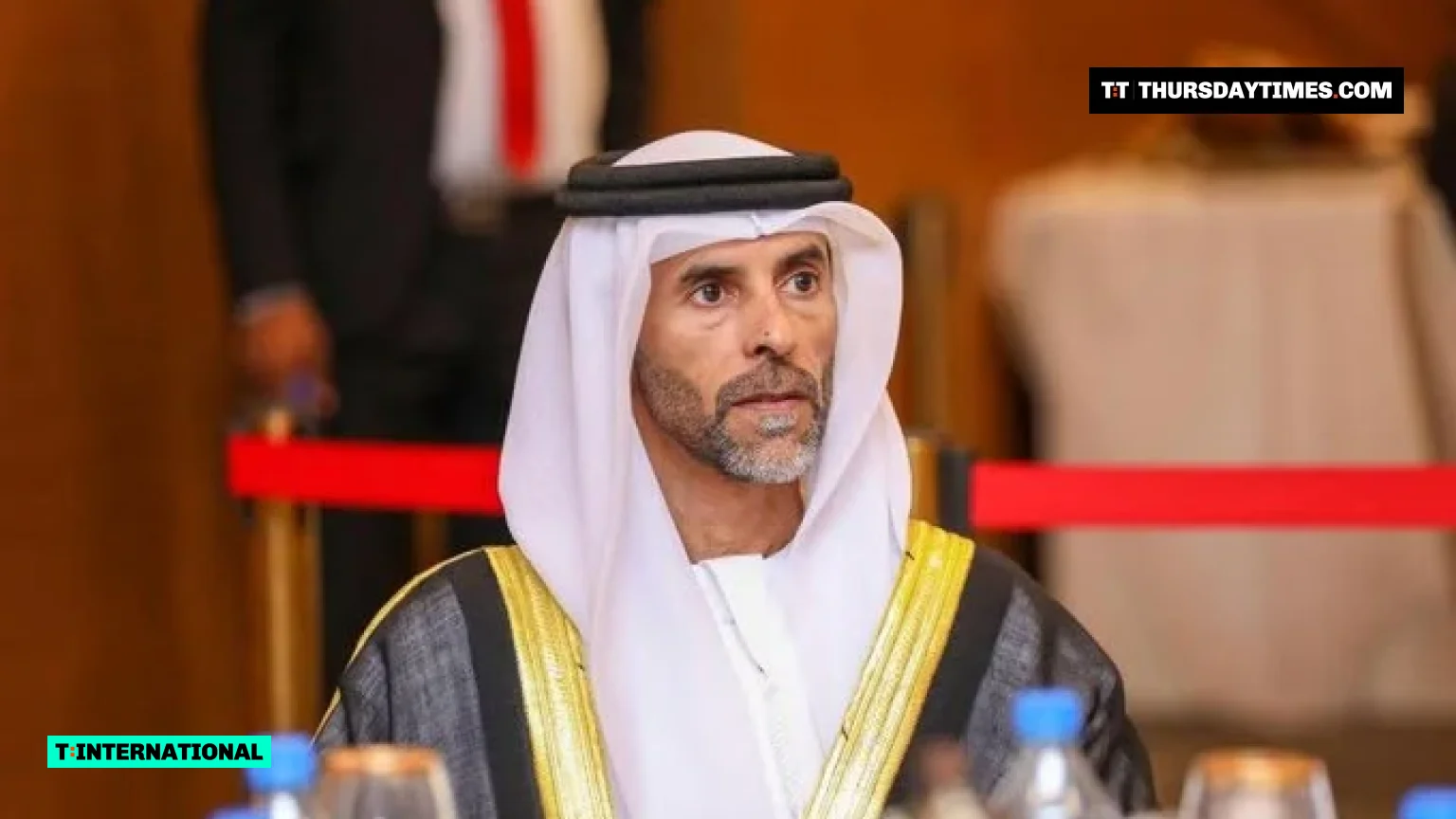
Ahmad Juma Al-Rumaithi, the UAE ambassador to Somalia
The UAE’s ambassador to Somalia, Ahmad Juma Al-Rumaithi, in a file photo. — UAE MINISTRY OF FOREIGN AFFAIRS/HANDOUT
Thursday Emirates · Mogadishu

Somalia has ordered the United Arab Emirates’ ambassador to leave the country within 72 hours and recalled its own envoy from Abu Dhabi, accusing the Emirates of violating its sovereignty in what the government called an “open invasion”. The UAE condemned the decision on Thursday as “escalatory and hostile”.

Information Minister Abdifatah Kasim Mohamud announced the measures in a broadcast on the state news agency. He said the UAE had acted against Somalia’s sovereignty, territorial integrity, national unity, internal security and independence, and warned that action would be taken against anyone who cooperates with the UAE in the “invasion”. He urged Somalis to unite in defence of the country. He did not say what had prompted the expulsion.

Two days earlier, President Hassan Sheikh Mohamud accused the UAE of giving economic and political backing to regional administrations that oppose the federal government. According to the Somali state news agency, he said Abu Dhabi had signed agreements covering the ports of Berbera in Somaliland, Bosaso in Puntland and Kismayo in Jubaland with those administrations rather than with Mogadishu.

A Crisis Group analyst said the ports are major sources of income that give the regional authorities more independence from the capital. Mogadishu, he said, regards such deals as a breach, because it holds that international agreements should go through the internationally recognised federal government.

The UAE foreign ministry said the order reflected “irresponsible positions” that weaken cooperation between the two countries. It expressed regret at what it called attempts by the Somali government to bring its “internal power struggles” into bilateral relations, and said decisions affecting relations between states should be guided by shared interests and kept free of political considerations.

Ties were already strained. The UAE closed its embassy in Mogadishu and withdrew its diplomatic staff in January, accusing Somalia of “hostile policies” that included cancelling bilateral agreements.

Protesters gathered in Mogadishu on Thursday in support of the expulsion, according to reports. The 72-hour deadline falls due over the weekend.

Damaged glass facade on the upper floors of the PIF tower in Riyadh

Houthi strike damages PIF tower, Riyadh’s tallest skyscraper

Riyadh · thursdaytimes.com
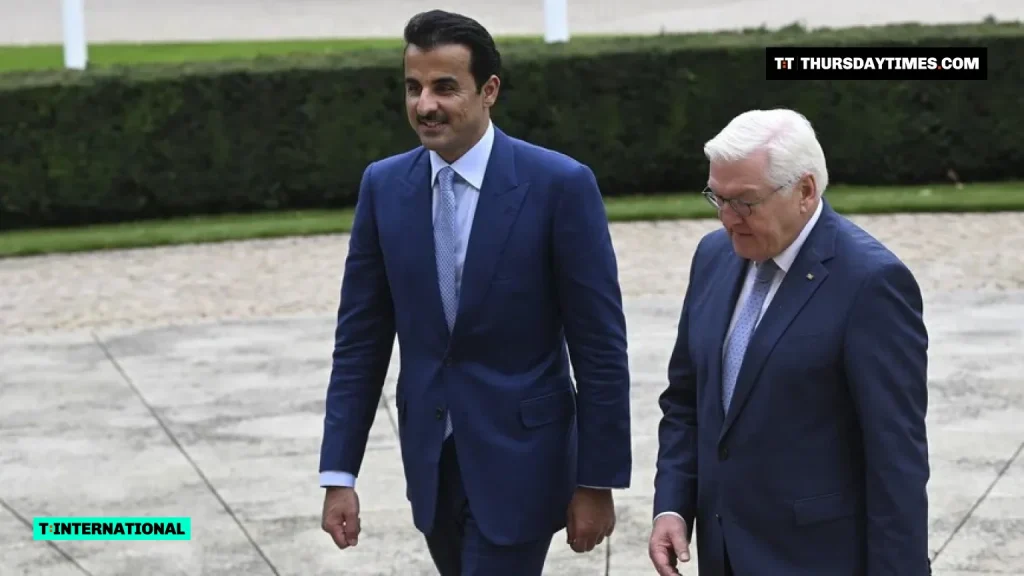
Sheikh Tamim bin Hamad Al Thani and Frank-Walter Steinmeier walking in Berlin

Qatar pledges 15 billion euros for Germany as Amir visits Berlin

Berlin · thursdaytimes.com

Qatar’s Amir and Swiss president hold talks on first state visit

THE THURSDAY TIMES · THURSDAYTIMES.COM3
EDITORIAL · OPINION · SATURDAY 21 NOVEMBER 20264

Bilawal has lost the plot, and must now choose: govern or go

The PPP chairman has contradicted himself, talked of fire and bloodshed over new provinces, and attacked the coalition he sits in. He should use parliament and the CCI, or leave the government.

Bilawal Bhutto Zardari has lost the plot. In three days he has told the country that the system was “made to collapse”, told his own coalition partner to “come to your senses”, and warned that Sindh will burn if it is divided by force. He said all this as the leader of a party that holds the presidency, the chairmanship of the Senate, the government of Sindh, and a place in the federal coalition. A party cannot hold those offices and also play the aggrieved outsider. It is time for the PPP chairman to choose between governing responsibly and leaving the government.

The row began on 17 November at the Karachi Press Club, where the PPP chairman argued that the governance system had not collapsed on its own but had been “made to collapse”. He called for a political and democratic reset, opposed a referendum on new provinces, and said the 27th Amendment had been passed by a “brute majority” rather than by consensus. He urged the return of reserved seats to the opposition.

He then repeated and sharpened the message in back-to-back television interviews. He asked why only the interior minister, who also chairs the cricket board, seemed to have the right to speak about a reset. He said that neither he nor President Asif Ali Zardari had been consulted on new provinces. He said that if Sindh were divided by force there would be a fire that would be hard to put out, and that he was sounding an alarm, not issuing a threat. He said his party had never issued death threats. He said he still wanted Shehbaz Sharif to succeed, that carrying the burden of this government was harming his own politics, and that the PPP could move to the opposition benches if the government did not change its attitude. He said he had told “a little too much truth”, and that the reaction proved politicians lacked the courage to hear it.

That is a lecture, not an argument. It also comes from a man who, in the same interviews, said he was not backing away from the 27th Amendment and called the new federal constitutional court a historic achievement.

The first and plainest fault is contradiction. Bilawal says the system has been made to collapse. The system he describes is one the PPP helped to build and still helps to run. Defence Minister Khawaja Asif reminded him on X that the party has governed Sindh for 18 years and has been a partner of the PML-N at the centre since 2022. Information Minister Attaullah Tarar put it more simply.

Mr Tarar is right. Bilawal criticises the way the 27th Amendment was passed, yet says he is not backing away from it. His party voted for it, and Minister of State for Interior Talal Chaudhry has pointed out that a party cannot vote for a measure, take credit for it, and later distance itself by claiming pressure. Bilawal calls what happened with reserved seats a joke, yet his own party was among the beneficiaries. He says he wants the prime minister to succeed, and in the same breath says the government has decided to fight everyone, himself included. He says carrying this government harms his politics, and he has still not left it.

This is not a coherent position. It is the position of a politician who wants the protection of office and also the applause of the opposition. The public is not obliged to guess which of the two Bilawals is speaking on a given evening.

The second fault is graver. A leader with national standing, speaking about the division of a province, chose to speak of fire, of conditions going out of his control, and of unrest that would be hard to contain. He says it was an alarm and not a threat, and that his party has never issued death threats. The defence will not do. When the chairman of the largest party in the province says that violence will follow a particular decision, and adds that he cannot guarantee to control it, listeners hear a forecast that doubles as a warning, and some will hear an invitation. Health Minister Mustafa Kamal, who leads the MQM-P, answered that Bilawal would be responsible if even a single drop of blood was shed. That is also a reckless sentence, but it was provoked by the first.

Sindh has a painful memory of ethnic violence. Karachi in particular does not need its political leaders to rehearse that memory for the cameras. Pakistan is fighting terrorists on its western border and carrying a punishing economic crisis; it cannot afford party chiefs who treat the street as a bargaining chip. If Bilawal believes the federal government is mishandling the question of provinces, he has parliament, the courts, and the coalition table. He has no business reaching for the vocabulary of fire.

His remark that the MQM’s history includes violence did nothing to cool matters either. It turned a debate about constitutional procedure into an ethnic quarrel in Karachi, at the very moment when the city needs the opposite.

The third fault is timing. The country is dealing with an economic crisis, terrorist violence in Balochistan and Khyber Pakhtunkhwa, and a tense neighbourhood. Bilawal himself rattled through that list in his interviews. Having listed it, he proceeded to add to it. He told the government to calm down, hinted at crossing to the opposition benches, and suggested that the interior minister, a federal minister and a member of the very system he is part of, was unfit to speak. Whatever the merits of the point, a coalition partner who wants to be taken seriously raises such matters with the prime minister in private, and does not stage them for the television audience.

He has also given the government an easy answer. Rana Sanaullah has said that if Bilawal meant that he voted for the 27th Amendment under pressure, the remark could raise questions about his eligibility. That was a political reading and not a legal finding, and it was a clumsy overreach, which the government should drop. But the PPP chairman handed it the opening. Every ill-judged line from Bilawal now gives ministers a reason to change the subject from provinces to the PPP’s own record.

The fourth fault is where he chose to argue. If the PPP has a case on how new provinces are created, and the Constitution does set out a method, the place for it is parliament and the Council of Common Interests. The PPP has the numbers and the standing to table a proposal, call for a debate, and demand a constitutional answer. Instead the chairman went to a press club and then to the evening talk shows, where applause is easier than votes. A press conference does not bind anyone. A resolution does.

The party itself seems to sense the problem. Its spokesman said the Central Executive Committee would discuss the chairman’s statement on the 27th Amendment, and reports on 19 November said Bilawal was heading to Islamabad to meet his father. The committee should ask him why a plan to defend Sindh required talk of unrest, and why a man with a constitutional case chose the street over the chamber.

His case on process is sound: a referendum organised by the executive is not the constitutional route, and ministers from both parties have said as much. That is one line in a long speech, and he squandered it.

Bilawal Bhutto Zardari has now to choose, and the choice cannot wait for the next press conference. If the PPP wishes to remain in the coalition, it must act like a coalition partner: raise its objections with the prime minister, press its case in parliament and the Council of Common Interests, and stop using the language of bloodshed. It must stand by the amendments it voted for, or explain exactly why it will not. It must accept that a party holding the presidency, the Senate chair, and the Sindh government is part of the system it describes as broken.

Editorial · The Thursday Times
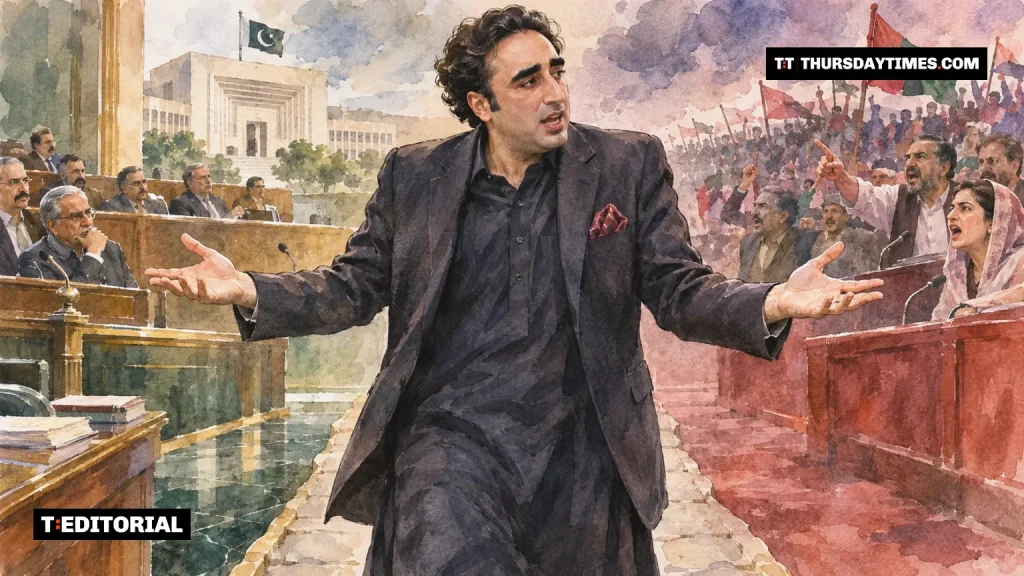
Watercolour illustration of Bilawal Bhutto Zardari with arms spread, parliament on one side and an angry crowd on the other
“He asked why only the interior minister, who also chairs the cricket board, seemed to have the right to speak about a reset.”
Chief Justice of India Surya Kant in judicial robes signing documents at Rashtrapati Bhavan
Chief Justice of India Surya Kant signs documents after taking the oath of office at Rashtrapati Bhavan in New Delhi on 24 November 2025. — Rashtrapati Bhavan via PTI

The law of contempt of court in India needs to be revisited

“In a democracy there is no need for judges to vindicate their authority or display pomp and majesty,” writes former Supreme Court of India Justice Markandey Katju.

Words by Justice Markandey Katju

The Supreme Court on Wednesday, 18 November 2026, issued notice on a petition filed by the Supreme Court Bar Association seeking initiation of contempt proceedings against a lawyer, Pravin Singhal, for allegedly making disparaging remarks about Chief Justice of India Justice Surya Kant in open court.

Do disparaging remarks against a judge in court amount to contempt of court? To answer this question, it is necessary to delve deep into the issue.

The present law of contempt of court in India is a hangover of the original law on this subject in England. This law originated from an undelivered judgment of Justice Wilmot in 1765, where the judge said the power of contempt of court was necessary to maintain the dignity and majesty of judges and vindicate their authority.

But whence comes this dignity, majesty and authority of judges? In England, in feudal times, it came from the king, who was the fountain of justice, and would often decide cases himself. Later, when he had many other duties, he delegated judicial functions to his delegates, who were called judges. Thus, in a monarchy, the judge really exercises the sovereign function of the king, which has been delegated to him by the latter, and for this he requires the dignity, authority and majesty which a king must have, to secure obedience.

In feudal times, the king was supreme, and the people were his subjects. They could not criticise him, and such criticism was punishable. The judges, who performed the delegated functions of the king, could also therefore not be criticised, since criticising them amounted to criticism of the king, and was therefore a crime.

In a democracy like India, however, this relationship is reversed. Now it is the people, not a king, who are supreme, and all state authorities, including judges, are nothing but their servants.

The Preamble to the Indian Constitution uses the words “We, the people of India,” and states that India is a democracy and a republic. This makes it clear that it is the Indian people who are supreme in India, not any state authority. It follows that the British law of contempt of court is obsolete, antiquated and outdated in independent India, but surprisingly it has been continued.

In a democracy there is no need for judges to vindicate their authority or display pomp and majesty. Their authority comes not from fear of contempt but from public confidence, and this in turn depends on their own conduct, integrity, impartiality and learning.

This view is accepted now even in England. As observed by Lord Salmon in AG vs BBC (1981) A.C. 303, “The description contempt of court no doubt has a historical basis, but it is nevertheless misleading. Its object is not to protect the dignity of the court, but to protect the administration of justice.”

“Justice is not a cloistered virtue,” said Lord Atkin. “It must suffer the scrutiny and outspoken comments of ordinary men.”

In R. vs Commissioner of Police (1968) 2 QB 150, Lord Denning observed: “Let me say at once that we will never use this jurisdiction to uphold our own dignity. That must rest on surer foundations. Nor will we use it to suppress those who speak against us. We do not fear criticism, nor do we resent it. For there is something far more important at stake. It is no less than freedom of speech itself. All that we ask is that those who criticize us should remember that, from the nature of our duties, we cannot reply to their criticism. We cannot enter into public controversy. We must rely on our conduct itself to be its own vindication.”

Sometimes an upright judge is unjustifiably criticised. The best course of action for such a judge is to ignore baseless criticism (but pay heed to honest and correct criticism). He should have broad enough shoulders to shrug off baseless comments without getting perturbed or influenced.

Once a British newspaper ran a banner headline calling the majority judges of the House of Lords who decided the Spycatcher case (Attorney General vs Guardian Newspaper, 1987, 3 All ER 316) “YOU FOOLS”. Fali Nariman, who was present in England at that time, asked Lord Templeman, who was one of the majority, why the judges did not take contempt action. Lord Templeman smiled, and said that judges in England took no notice of personal insults. Although he did not regard himself as a fool, others were entitled to their opinion.

In Balogh vs Crown Court at St Albans (1975) AC 373, the defendant told the judge, “You are a humourless automaton. Why don’t you self-destruct?” The judge smiled, but took no action.

Now, coming to the law of contempt in India, we find it is uncertain. Nariman described it in a speech as “Dog’s Law”.

He quoted Bentham, who said that when a dog does something nasty we beat him for it. Similarly, the laws in England become known only when someone is punished by the courts. The same is true of the law of contempt in India, and thus it is a standing threat to freedom of speech.

4THE THURSDAY TIMES · THURSDAYTIMES.COM
SATURDAY 21 NOVEMBER 20265
THE THURSDAY TIMES · THURSDAYTIMES.COM5
HOME · CULTURE · FOOD · SATURDAY 21 NOVEMBER 20266

Daily pill daraxonrasib shrinks pancreatic tumours in early trial

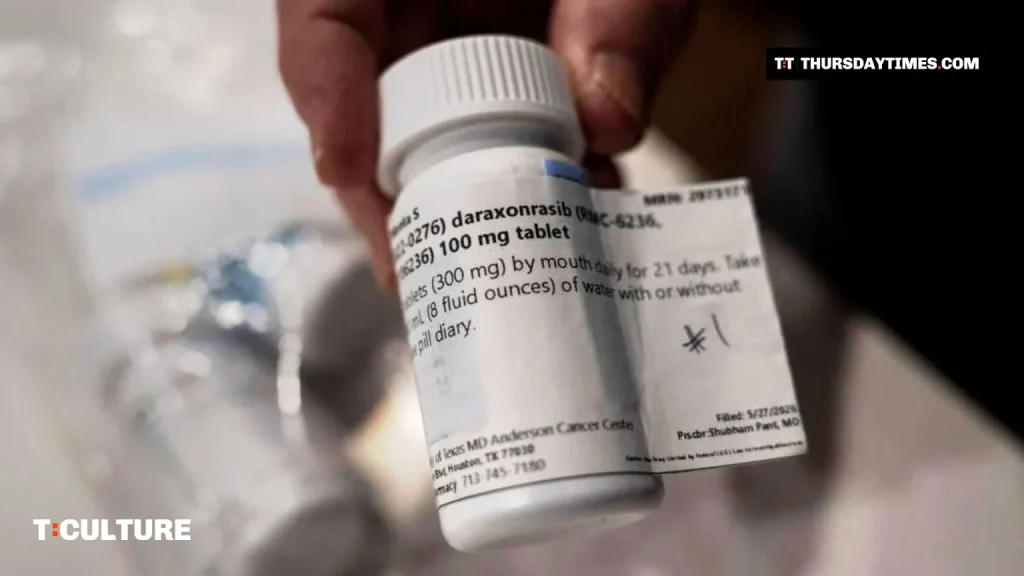
A hand holds a bottle of daraxonrasib tablets
A bottle of daraxonrasib tablets labelled by the MD Anderson Cancer Center in Houston. File photo. — REUTERS

A daily pill combined with chemotherapy shrank or cleared tumours in just over 60 per cent of 61 patients, though doctors say it is not a cure.

TT News Desk · London

A daily pill called daraxonrasib, taken alongside chemotherapy, shrank or cleared tumours in just over 60 per cent of patients with advanced pancreatic cancer in an early trial, results that cancer charities are calling the biggest advance in decades.

Tumours stopped growing in almost all of the 61 patients, who had recently been diagnosed with advanced disease that had spread to other parts of the body. In about 8 per cent, or one in 12, the cancer became undetectable on CT scans.

Doctors stress it is not a cure, and it is unclear how long the treatment might keep the disease at bay. Patients were followed for a year and a half on average, and some did not see their cancer return in that time. Longer studies are needed to learn whether any can be put into remission, and for how long.

Pancreatic cancer is notoriously hard to treat and has the lowest survival rate of all common cancers in the UK. Chemotherapy can shrink tumours a little, but the cancer often grows back, and most patients with advanced disease survive months, not years.

Cancer Research UK called the result “the biggest leap forward in decades”. Its Dr Sam Godfrey said the drug had “found a way of drugging the undruggable”. Dr Wungki Park of Memorial Sloan Kettering Cancer Center in the US, who is involved in the trial, said doctors were seeing deeper responses and “a near doubling in the duration of disease control”, which may eventually translate into longer survival.

Daraxonrasib is a targeted inhibitor that has already been approved in the US. It locks on to and shuts off RAS mutations, which are found in most pancreatic cancers and drive tumour growth. Dozens of other cancers, including lung and ovarian, can carry similar mutations, so the drug might help other patients too. Godfrey said he hoped the early success could be rolled out to other cancers. The work is being presented at the EORTC–NCI–AACR Symposium 2026.

Pancreatic cancer accounts for about 3 per cent of all cancers in the United States and about 8 per cent of cancer deaths, killing around 53,000 people a year. In Britain there are about 11,500 diagnoses and around 10,200 deaths a year, according to Cancer Research UK.

Students hold locked phone pouches and phones at a California school
First published 17 November 2026

Study finds school phone bans add one to two weeks of learning

TT News Desk · New York

Strict phone restrictions in US schools lead to small academic gains, according to a large study published on Tuesday, 17 November, by Harvard’s Center for Education Policy Research.

The researchers compared the test scores of 3.3 million students in about 4,600 schools. Schools that required students to keep phones in locked pouches for the whole day saw “modest” improvements in academic growth compared with similar schools without such rules. The study estimates the gain at roughly one to two weeks of extra learning over a school year.

“Our answer is yes, phone bans do have a positive effect on growth. But it’s not a panacea,” said Thomas Kane, the Harvard professor who led the work. He said the gain is about half the annual decline in test scores since smartphones became widespread, and that further gains could come if schools keep the bans in place. The study used maths and reading results for grades four to 10 over the past five academic years.

The finding sits uneasily with earlier research. A study published in May by researchers at Stanford, the University of Michigan, Duke, and the University of Pennsylvania, covering the same number of schools using the pouches, found “close to zero” effect on test scores overall, though it did record modest gains in high school maths over three years. One of its authors, Stanford economist Thomas Dee, said the early results from phone bans were “largely disappointing” and that he was not comfortable projecting future gains from small estimates based on a few years of data.

More than 40 US states now have laws restricting phones in schools, but the rules vary widely and enforcement is patchy. San Diego State University psychologist Jean Twenge said some bans were largely cosmetic, with students stowing spare phones in their pouches. Students may also simply move to laptops, and phone use outside school may matter more. Kane said researchers cannot yet test that, because social media companies have not shared data that could link time spent on their platforms to student results.

Beckham’s brand sues Coty for $41m over discount fragrance sales
Raye leads Grammy nominations with 11 as Beyoncé hits 100thRosalía is second with nine, and Dolly Parton is nominated three times after her death in August. The ceremony is on 7 February.
Apple opens 200,000-person study on how people use AI for health
6T:LIFE · THE THURSDAY TIMES · THURSDAYTIMES.COM
CRICKET · FOOTBALL · THE WORLD · SATURDAY 21 NOVEMBER 20267
Formula 1 cars after the start of the Spanish Grand Prix
SPORTS

F1 and FIA agree to bring back V8 engines from 2030

The FIA says the teams, manufacturers, and Formula One Management have unanimously agreed a framework for a 2.1-litre turbocharged V8.

TT Sports Desk · Paris

Formula 1 is set to bring back V8 engines from 2030 after the sport’s governing body said on Friday that every party involved had agreed a technical framework for the switch.

The FIA said the framework had been agreed unanimously by the federation, Formula One Management, the teams, and the power unit manufacturers. The plan is for a 2.1-litre turbocharged V8, carrying over some geometrical specifics from the current engines.

“The overriding objective is to deliver a power unit which is a lot less complex, lighter and cheaper than the current power units,” the FIA said. It added that the engine would feature limited hybridisation and sustainable technology, with the aim of enhancing attack-oriented racing and a sound that resonates with fans.

The V8 is to be paired with a chassis that is also lighter and more agile, putting greater emphasis on driver skill and close racing, according to the FIA.

FIA president Mohammed Ben Sulayem called the agreement a significant milestone. “The return of V8 engines represents an opportunity to reconnect with the DNA of this Championship, bringing back the sound, emotion and pure racing that is loved worldwide,” he said. “Our vision is clear, lighter, simpler and more affordable cars that put driver skill at the heart of the competition.”

Formula 1 last used V8 engines in 2013. All regulatory changes remain subject to approval, and a definitive 2030 regulatory framework is due to go before the FIA World Motor Sport Council at its meeting in Shanghai next month.

Courtois signs Real Madrid extension until June 2028

The Belgium goalkeeper, 34, has extended his stay at the Bernabéu by a year; Real are second in LaLiga, three points behind Barcelona.

Real Madrid goalkeeper Thibaut Courtois has signed a contract extension that keeps him at the Santiago Bernabéu until June 2028, the club announced on Friday.

The 34-year-old Belgium international joined Real from Chelsea in 2018. His previous deal was due to expire in June 2027.

Courtois has made 348 appearances for the club in all competitions and kept 133 clean sheets. He has won three LaLiga titles and two Champions League crowns with Real, and was named player of the match in the 2022 final in Paris, when a string of saves helped Real beat Liverpool for a record-extending 14th European Cup.

His individual honours include the Golden Glove at the 2018 World Cup, the Best FIFA Goalkeeper award the same year, and the Yashin Trophy in 2022.

Real are second in LaLiga with 30 points from 12 matches, three behind leaders Barcelona. They host Celta Vigo on Saturday.

Thibaut Courtois of Real Madrid after a LaLiga match
Real Madrid goalkeeper Thibaut Courtois after a LaLiga match against Real Sociedad at the Santiago Bernabéu on 26 August 2026. File photo. — REUTERS/JUAN BARBOSA
Imam-ul-Haq in Yorkshire kit holding up a hand on the field during a one-day match
Imam-ul-Haq batting for Yorkshire in the One-Day Cup semi-final against Hampshire in August 2025. File photo. — Allan McKenzie/SWpix.com

Imam-ul-Haq signs for Yorkshire for the full 2027 season

Pakistan batter Imam-ul-Haq has signed for Yorkshire as their overseas player for the 2027 season, and will be available for every County Championship match and the whole of the One-Day Cup, the club announced on Friday.

Imam, 30, returns to Headingley after a prolific spell in 2025, when he averaged 98.28 across eight List A matches for the club, including four centuries. He has played 31 Tests for Pakistan, and his uncle, Inzamam-ul-Haq, also played for Yorkshire.

“Yorkshire has always felt like a special place to play cricket, and I’m really pleased to be coming back next year,” Imam said. “Being able to commit for the entire season is really important for me. I want to play as much cricket as possible, contribute across the different formats, and help us win the silverware that I know this group is capable of.”

Gavin Hamilton, Yorkshire’s general manager of cricket, said Imam’s run of big scores kept the side in contention deep into the One-Day Cup last year, after he joined at short notice. “We’re delighted that Imam has committed to a full season with us,” Hamilton said. “Securing overseas experience for an entire domestic campaign is becoming ever harder.”

Hamilton also described Imam as “a great teammate who wants everyone around him to do well”. He will join Anthony McGrath’s squad, the club said.

Imam played in the first two Tests of Pakistan’s tour of England this summer and has not featured for his country since.

THE THURSDAY TIMES · THURSDAYTIMES.COM7
PULL-OUT · THE THURSDAY TIMES21.11.20268
Westline
BRITAIN, FROM THE OTHER SIDE OF THE LINEWESTLINE × THE THURSDAY TIMES
A STATE THAT STOPPED DECIDING

The backlog Britain built

A queue stretches back into the dark while the Home Office counter stays barely open — Illustration: Westline

Ministers of both parties have spent a decade blaming the people in the queue. The numbers point at the people running it.

Abdullah Esquire
Read it in fullthursdaytimes.com/westline

CONSIDER SOMEONE WHO CLAIMED asylum in Britain in January 2023. Where they came from, and how they arrived, matters less than what happened next — which is to say, very little. When the National Audit Office took a sample of 5,000 claims lodged that month and checked on them nearly three years later, more than half were still unresolved. In the meantime our claimant will probably have been housed at public expense, largely barred from working, interviewed by a caseworker who may not have been in post for long, refused, appealed, and then left waiting again: this time for a tribunal that now takes, on average, well over a year to hear a case.

In the political conversation, that person is the problem. The backlog is discussed as though it were a weather system blown in off the Channel — too many boats, too many claims, too many people gaming the system. Arrivals do matter, and nobody serious pretends otherwise. The number of people claiming asylum peaked at around 110,000 in the year to September 2025, the highest figure in nearly two decades.

But a backlog is not a measure of how many people turn up. It is the gap between the cases that come in and the cases a department decides — and decides properly. Judged that way, the story of Britain’s asylum queue is not one of an overwhelmed border. It is the story of an institution that, over ten years, stopped doing its core job, then tried to do it at a sprint, then passed the consequences down the corridor to the courts. The people in the queue designed none of it.

Initial asylum decisions made per year

Home Office annual statistics · output collapsed before small boats became a mass phenomenon, then quadrupled on command

The rot set in long before small boats became a nightly news item. In 2015 the Home Office made 28,623 decisions on asylum applications. By 2017 that had fallen by a quarter, to 21,269, and the department never recovered its old pace. The more striking figure is what happened per head. According to the Institute for Government, in 2011/12 some 380 caseworkers were each producing around 13.7 decisions a month. By December 2022 there were 1,237 of them, managing about four apiece. The workforce had more than tripled; the output of each worker had fallen by over two-thirds.

Then, in January 2019, with ministerial approval, the department dropped its own service standard: the commitment to decide 98 per cent of straightforward claims within six months. The stated reason was to prioritise the most vulnerable cases rather than the simplest. The practical effect was to remove the one clock that had been ticking. The Migration Observatory later found that in 2014 eight in ten applicants received an initial decision within six months; within five years it was one in four.

Why this isn’t a story about the Channel In 2021 the UK had 14.9 cases in its asylum backlog per 10,000 people, more than Germany or France, even though it received far fewer applications per head than either. Countries facing heavier demand were simply getting through their caseloads faster. By December 2022 two-thirds of those waiting — almost 110,000 people — had been in the queue for more than six months. That is not a surge. It is a department that had quietly stopped deciding things.

In December 2022 Rishi Sunak did something the Home Office had not done in years: he set it a deadline. The so-called legacy backlog — roughly 92,000 claims lodged before 28 June 2022 — would be cleared within twelve months. The department doubled its decision-makers to around 2,500 and, for nationalities with very high grant rates such as Afghans, Eritreans and Syrians, swapped lengthy interviews for a questionnaire. The results were instructive. In one four-week stretch in November and December 2023, officials made 20,481 initial decisions, more than in the whole of 2021. Across that year they made 112,138. For anyone who still believed the queue was driven by forces beyond Whitehall’s control, that was the rebuttal.

The sprint had a cost, though, and it was paid in shortcuts. Asylum withdrawals in 2023 were more than four times the 2022 figure, and 79 per cent of them were “implicit” — claims the Home Office itself closed because someone missed an interview, missed a questionnaire deadline or had not updated an address. When the pledge was declared met, 4,537 legacy cases were still awaiting a decision, and the chair of the UK Statistics Authority warned that the episode might affect public trust. A Conservative government that had staked its reputation on control ended up being rebuked by the statistics watchdog for its arithmetic.

Worse, at the same moment that one arm of the department was racing through old cases, another had been told to stop deciding new ones. The Illegal Migration Act meant that claims from those who had arrived irregularly after 7 March 2023 could not be granted. By the end of that year, 55,533 of the 98,599 claims awaiting a decision had been made after the bill was introduced. The backlog stopped falling and, by March 2024, stood at 118,329 people. Those claims were being held for removal to Rwanda, a scheme that by Labour’s later accounting had cost around £700 million — £290 million of it paid to Kigali — to send four volunteers. The Home Affairs Committee later concluded that holding up decisions while the scheme stalled had made the crisis worse. Parliament had, in effect, legislated the state into not processing cases, and then the state paid to house everyone it had declined to process.

Every month a claim sits undecided is a month of bed, board and administration, and this is where the failure becomes a fiscal one. In 2019 the Home Office signed seven regional contracts with Serco, Mears and Clearsprings, expecting them to cost £4.5 billion over ten years. The National Audit Office now puts the figure at £15.3 billion. Between December 2019 and December 2024 the number of asylum seekers in paid-for accommodation rose from about 47,000 to 110,000. Hotels, the emergency option, became the default: at the peak, in September 2023, 56,018 people were in them, spread across roughly 400 sites.

The economics were dreadful. In 2024-25 hotels held around 35 per cent of people in asylum accommodation but swallowed 76 per cent of the contracts’ annual cost.

NAO, asylum accommodation contracts (2025) · hotels held just 35% of people in the system

The three providers made a combined profit of £383 million between 2019 and 2024. The NAO’s verdict was that the department had few levers to control the cost. Across the Home Office and Ministry of Justice, asylum cost £4.9 billion in 2024-25.

For a centre-right reader, this ought to be the scandal. A man waiting for a decision cannot choose to move out of a hotel and is, for the most part, forbidden from earning his own keep. The bill is not run up by his presence so much as by the length of his stay, and the length of his stay is set in Whitehall. Treat the backlog as a migrant problem and you reach for deterrents. Treat it as a productivity problem and you reach for the thing that actually saves money: a decision.

WESTLINE · A THURSDAY TIMES PULL-OUT8
Archive