Tuesday 24 November 2026 Archive
TUESDAY 24 NOVEMBER 2026Dangerous to those who trade in lies.THE E-PAPER · ENGLISH EDITION · 8 PAGES
234567Westline pull-out8

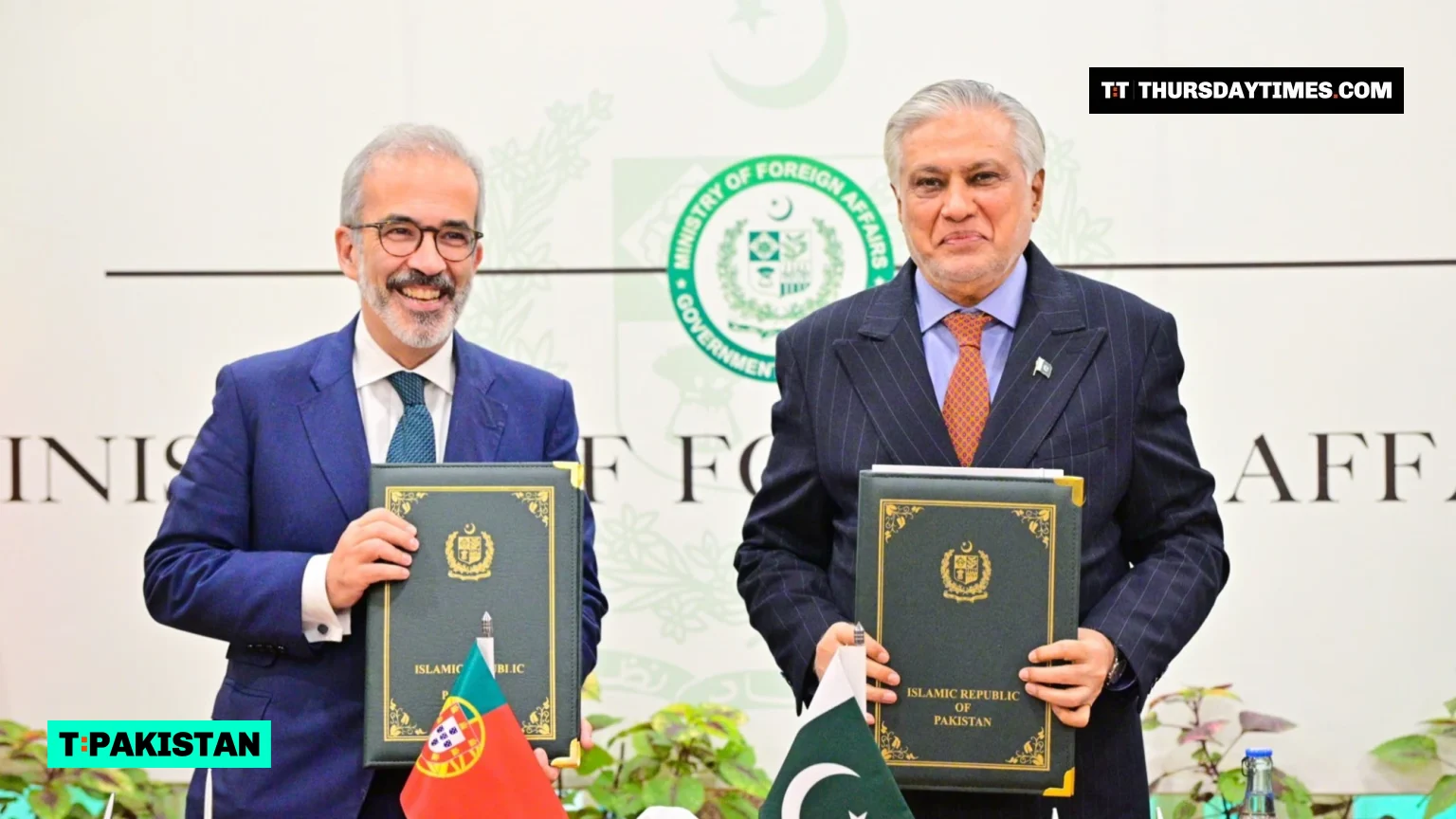
Portugal backs Pakistan’s GSP+ status as Dar and Rangel hold talks

Ishaq Dar and Paulo Rangel stand holding signed folders at the Ministry of Foreign Affairs in Islamabad
Foreign Minister Ishaq Dar and Portuguese Foreign Minister Paulo Rangel at the Ministry of Foreign Affairs in Islamabad. — MOFA/HANDOUT

Portuguese Foreign Minister Paulo Rangel told Ishaq Dar in Islamabad that Portugal fully supports Pakistan’s GSP+ status; the two sides agreed to begin setting up a joint ministerial commission.

TT Islamabad Bureau · Islamabad

Portuguese Foreign Minister Paulo Rangel said on Monday that Portugal fully backs Pakistan’s GSP+ trade status with the European Union, as he held talks with Deputy Prime Minister and Foreign Minister Ishaq Dar in Islamabad.

“In GSP+, you have all our support,” Rangel said at a joint press talk with Dar. He added that the Pakistan-Portugal Business Forum, held the same day, was key to developing bilateral trade, and that Pakistan and the European Union could find mutual advantage through closer cooperation within the European framework.

Dar said the two sides had agreed to begin the process of setting up a joint ministerial commission on trade and investment. “Once that is done, then we will work together to promote the business and trade and investment,” he said. Rangel called the commission decisive to boosting the economic dynamics of the relationship and said both countries had “a high potential” and “can really deliver”.

The ministers held a one-on-one meeting followed by delegation-level talks. Dar proposed holding the business forum regularly so that companies can find partners and joint ventures, and suggested that the two sides identify priority proposals for early implementation and review progress through bilateral political consultations. He also called for stronger parliamentary exchanges and a Pakistan-Portugal Parliamentary Friendship Group.

Rangel said his was the first visit by a Portuguese foreign minister to Pakistan in 19 years. He noted that Portugal will hold the presidency of the UN Security Council in January 2027 and said it looks forward to close consultations with Pakistan during its two-year Council term. He also praised the Pakistani community in Portugal as dynamic and well integrated.

“I want to praise Pakistan,” Rangel said. “It has really been showing the world that it wants to be a peace-building actor on a global level, and everything it has done for Middle East dialogue, in every aspect, most recently on Gaza and the Palestine issue, is really remarkable.”

“We want an open dialogue with Pakistan,” he said. “Pakistan’s work over the last two years has been a real inspiration, concrete, not just words. Even with everything difficult happening in the Gulf, without your mediation, things would have been much harder than they are.” He added: “In today’s world politics, Pakistan is a premier actor. We see huge potential in our relationship on the global stage, and we believe our interaction can be very positive.”

Pakistan’s trade with Portugal reached $288 million in the 2025 fiscal year, up from $189 million in 2020, according to Pakistani government figures, with the balance in Pakistan’s favour. The business forum, which brings together companies from both countries, covers agri-food, renewable energy, pharmaceuticals, information technology, and textiles.

Later on Monday, Rangel said: “Connect Karachi to Sines, and you connect the Pacific to the Atlantic, the Indian Ocean to both. In today’s geopolitical situation, our ports are safe harbors for commerce and trade. We have a huge opportunity, and we should not be less ambitious than we have to be. We have to have ambition. That’s why I really welcome this business forum.”

Rangel arrived in Islamabad on Sunday for a two-day visit marking 77 years of diplomatic relations, as The Thursday Times reported ahead of the trip. He was accompanied by a delegation of about 20 companies.

Nvidia board reinstates Jensen Huang as chief executive

Nvidia’s board has reinstated Jensen Huang as president, chief executive and a member of the board, effective immediately, the company announced on Monday.

The directors voted unanimously after a series of discussions and meetings with Huang, and said they were satisfied with his candor and ability to lead the company. The board added that it had received input from senior levels of the US government and was confident that his reinstatement poses no national security risk.

Harvey Jones, who remains board chair, said: “The Board believes Jensen is the right person to lead NVIDIA, and that his reinstatement is in the best interests of our stockholders, employees, partners and customers.” He thanked Colette Kress for her service as interim chief executive; she continues as chief financial officer.

Huang said: “I am honored to return to NVIDIA and lead one of the most consequential technology companies in the world at the beginning of a new industrial revolution.” He thanked the board, employees, shareholders and partners, and added: “I can’t wait to get back to work.”

The board said that, in light of recent reporting that Huang has been the target of a foreign intelligence effort, it had formed a committee of independent directors to investigate, with the help of independent counsel. That investigation will proceed to conclusion, it said, and Huang fully supports it and is committed to cooperating.

Nvidia also recently formed a National Security and Export Control Committee to oversee trade compliance and national security risks, and is starting a search for a chief compliance officer. The company said it will continue to cooperate with ongoing government investigations and inquiries.

President Donald Trump praised the decision in a post, writing: “Congratulations to NVIDIA on having made, what I consider to be, an absolutely GREAT decision!”

Huang resigned as chief executive on Thursday 12 November. The Thursday Times reported earlier that he said he would return if the board asked; see Huang says he would return as Nvidia CEO if board asks, admits mistakes.

“Once that is done, then we will work together to promote the business and trade and investment.”Portugal backs Pakistan’s GSP+ status as Dar and Rangel hold talks Page 1

Malaysian PM Anwar receives Field Marshal Munir, backs closer defence cooperation

Malaysian Prime Minister Anwar Ibrahim received a courtesy call from Field Marshal Syed Asim Munir, Pakistan’s Chief of Army Staff and Chief of Defence Forces, on 23 November, and congratulated him on his induction into the Hall of Fame of Malaysia’s Armed Forces Staff College, known by its Malay initials MTAT.

Writing in a social media post, Anwar said the meeting gave the two men a chance to exchange views on regional and international security developments. These included efforts to ease tensions in West Asia and the importance of ensuring global maritime security. The discussion also covered the need to put dialogue and restraint first in handling border tensions, while respecting the sovereignty of states and protecting civilians.

Anwar said Malaysia and Pakistan share a commitment to strengthen defence and security cooperation, including through trilateral cooperation with Türkiye. They also agreed to explore collaboration in maritime security and in efforts to counter terrorism. “This close cooperation is important in supporting shared security, stability, and safety, especially in the region,” he said.

Pakistan’s military media wing said Munir was in Malaysia on an official visit to strengthen defence and military cooperation, and that he called on the prime minister at Perdana Putra in Putrajaya. It said Anwar warmly welcomed him, acknowledged the long-standing friendship, mutual trust, and cooperation between the two countries, and reaffirmed Malaysia’s commitment to deeper ties in defence and security. Munir, for his part, appreciated Malaysia’s constructive role in promoting peace and stability in Southeast Asia.

On arrival at the Ministry of Defence in Kuala Lumpur, the Field Marshal was given a ceremonial guard of honour. General Tan Sri Haji Malek Razak Sulaiman, Malaysia’s Chief of Defence Force, was present along with the chiefs of the army, navy, and air force. Munir also met Defence Minister Mohamed Khaled Nordin, and the two discussed expanding defence cooperation, strengthening military-to-military engagement, and exploring new areas of collaboration.

The military’s media wing added that Munir was also to visit the National Defence Studies Centre, where a ceremony was being held to induct him as the 21st member of its Hall of Fame.

Field Marshal Syed Asim Munir in uniform with Malaysian Prime Minister Anwar Ibrahim during a courtesy call
Malaysian Prime Minister Anwar Ibrahim receives Field Marshal Syed Asim Munir. — PRIME MINISTER'S OFFICE MALAYSIA/HANDOUT
Pakistan todayPAGE 2
Trump says he ‘made the deal’ to bring Huang back at Nvidia
Pakistan and Türkiye courts sign judicial cooperation MoU in Islamabad
PM Shehbaz to visit Russia from 30 Nov, then ECO summit in Tehran
THE THURSDAY TIMES · PUBLISHED BY THURSDAY MEDIA INTERNATIONAL · THURSDAYTIMES.COM1
US MIDTERMS · THE WORLD · PAKISTAN · TUESDAY 24 NOVEMBER 20262

Trump orders faster federal executions and wider death-penalty use

President Trump has signed a memorandum directing the Attorney General to seek the death penalty in more federal murder cases and to speed up executions.

TT Foreign Desk · Washington

President Donald Trump has signed a memorandum directing the Attorney General to seek the death penalty in a wider range of federal murder cases and to carry out federal death sentences “as expeditiously as possible,” according to the White House text.

The memorandum, dated 23 November, tells the Attorney General, “when appropriate and consistent with applicable law,” to pursue federal jurisdiction and seek capital punishment for particularly heinous and egregious federal crimes. It lists the first-degree murder of a minor; murder committed in the course of rape, sexual abuse, sexual exploitation of a child, or sex trafficking; and murder committed in the course of kidnapping or human trafficking. These are in addition to the crimes already identified in Executive Order 14164 of 20 January 2025, which restored the federal death penalty.

For sentences that have already been handed down, the memorandum orders the Justice Department to prioritise the prompt resolution of direct appeals, habeas corpus petitions, and other post-conviction proceedings. It also tells the department to oppose what it calls dilatory litigation tactics, to seek expedited judicial consideration wherever appropriate, and to eliminate unnecessary administrative delays. The text says a prolonged delay in carrying out a death sentence denies a victim’s family the closure they deserve.

The memorandum adds that it must be implemented consistent with applicable law and subject to the availability of appropriations, and that it creates no right or benefit enforceable against the United States.

Trump announced the move on Monday at the Department of Justice in Washington, alongside families of crime victims and Attorney General Todd Blanche. He urged Congress to pass the Just Punishment for Murder Act, sponsored by Republican Representative Brandon Gill, and used much of the speech to attack California Governor Gavin Newsom, calling him “a terrible governor.”

Newsom, a Democrat who leaves office on 4 January, commuted the sentences of all 548 people on California’s death row to life without parole on 5 November. He described the step as an extension of the execution moratorium he imposed in 2019. Governor-elect Xavier Becerra has pledged to continue the moratorium when he takes office.

India offers Nepal Rs 15,000 crore in aid during PM Shah’s Delhi visitIndia has announced INR 15,000 crore in grants and credit for Nepal during Prime Minister Balendra Shah’s state visit, alongside new trade, rail, and bridge links.
Continued from page 1

Malaysian PM Anwar receives Field Marshal Munir, backs closer defence cooperation

Field Marshal Syed Asim Munir in uniform with Malaysian Prime Minister Anwar Ibrahim during a courtesy call
Malaysian Prime Minister Anwar Ibrahim receives Field Marshal Syed Asim Munir. — PRIME MINISTER'S OFFICE MALAYSIA/HANDOUT

Malaysian Prime Minister Anwar Ibrahim received a courtesy call from Field Marshal Syed Asim Munir, Pakistan’s Chief of Army Staff and Chief of Defence Forces, on 23 November, and congratulated him on his induction into the Hall of Fame of Malaysia’s Armed Forces Staff College, known by its Malay initials MTAT.

Writing in a social media post, Anwar said the meeting gave the two men a chance to exchange views on regional and international security developments. These included efforts to ease tensions in West Asia and the importance of ensuring global maritime security. The discussion also covered the need to put dialogue and restraint first in handling border tensions, while respecting the sovereignty of states and protecting civilians.

Anwar said Malaysia and Pakistan share a commitment to strengthen defence and security cooperation, including through trilateral cooperation with Türkiye. They also agreed to explore collaboration in maritime security and in efforts to counter terrorism. “This close cooperation is important in supporting shared security, stability, and safety, especially in the region,” he said.

Pakistan’s military media wing said Munir was in Malaysia on an official visit to strengthen defence and military cooperation, and that he called on the prime minister at Perdana Putra in Putrajaya. It said Anwar warmly welcomed him, acknowledged the long-standing friendship, mutual trust, and cooperation between the two countries, and reaffirmed Malaysia’s commitment to deeper ties in defence and security. Munir, for his part, appreciated Malaysia’s constructive role in promoting peace and stability in Southeast Asia.

On arrival at the Ministry of Defence in Kuala Lumpur, the Field Marshal was given a ceremonial guard of honour. General Tan Sri Haji Malek Razak Sulaiman, Malaysia’s Chief of Defence Force, was present along with the chiefs of the army, navy, and air force. Munir also met Defence Minister Mohamed Khaled Nordin, and the two discussed expanding defence cooperation, strengthening military-to-military engagement, and exploring new areas of collaboration.

The military’s media wing added that Munir was also to visit the National Defence Studies Centre, where a ceremony was being held to induct him as the 21st member of its Hall of Fame.

The world in brief

EVERY STORY IN FULL AT THURSDAYTIMES.COM
Guterres calls on states to begin talks on global AI risk frameworkSpeaking at the close of the Bridgetown summit on AI safety in Barbados, the UN chief said protections against AI risks remain fragmented and governments are playing catch-up.
NASA releases Europa Clipper documentary ‘The Europa Concept’The film, available on NASA+ from 23 November, follows the mission from idea to launch and its journey to Jupiter’s moon Europa.
Webb dust map hints dying star’s layers merged before explosionNASA says Webb’s mid-infrared dust map of Cassiopeia A supports a shell merger inside the star, possibly just hours before it exploded.
WHO says Ebola responders sheltered in Ituri hospital as fighting ragesThe WHO says staff and responders in Ituri province sheltered in a hospital maternity ward and is working to evacuate them safely.
NASA’s Johnson Space Center marks 65 years of human spaceflightNASA traced the Houston centre’s path from Gemini and Apollo to the space station and the planned return to the Moon.
INS Sahyadri completes Da Nang port call in Vietnam on Far East deploymentThe Indian Navy frigate visited Da Nang from 20 to 22 November, with talks, ship visits, and cultural exchanges alongside the Vietnam People’s Navy.

Pakistan

NATIONAL · ECONOMY · MILITARY

Drone strikes kill four near Khartoum and damage a UN building

TT Foreign Desk · Khartoum

Drone strikes killed four people in and around Sudan’s capital and damaged a United Nations building on Sunday 22 November, according to local reports and UN officials. The attacks are blamed on the paramilitary Rapid Support Forces (RSF).

Explosions were heard across Khartoum from about 2am until roughly 4.30am, witnesses said, as the army’s air defences tried to intercept the drones. The drones were reportedly aimed at government buildings and the city’s airport, but the strikes hit residential areas.

Three people were killed and nine wounded when a drone hit a home in northern Omdurman, across the Nile from Khartoum, according to local reports. A child was killed in a separate attack south of the capital. In Jebel Aulia, about 45km (28 miles) south of Khartoum, a witness said a drone struck the home of a mosque muezzin, and residents searched the rubble for trapped relatives.

Denise Brown, the UN’s humanitarian coordinator in Sudan, said one of its buildings was damaged while staff were inside. The UN humanitarian office, OCHA, said the premises are in a civilian neighbourhood and called the danger to aid workers “unacceptable”. Saudi Arabia, which has supported the Sudanese army, said it “categorically rejects these brutal attacks”.

A Sudanese army source said the drones were launched from Ethiopia’s Bahir Dar airport. The claim could not be independently verified. Ethiopia has denied Sudanese accusations that it lets the RSF attack from its territory, and Sudan has complained to the UN Security Council and the African Union over alleged drone operations from Ethiopian soil.

Both the army and the RSF rely more and more on drones. The UN says drones killed more than 1,100 people in Sudan in the first half of 2026, and UNICEF says they account for about two-thirds of the children killed or injured between January and September. The war began in April 2023 and has displaced 13 million people, with some regions facing famine.

Separately on Sunday, the government accused RSF fighters of executing captured soldiers in Blue Nile state, near the Ethiopian border, calling the alleged killings violations of international humanitarian law. The accusation has not been independently verified.

NASA’s new laser tracking station starts work in SvalbardThe next-generation system at Ny-Ålesund is the first of its kind in service and the northernmost laser ranging site on Earth, NASA said.
Indonesia factory fire toll rises to 24 as about 30 remain missingAuthorities confirmed 24 deaths on Monday as rescuers searched unstable wreckage for about 30 missing workers at a confectionery factory in Banten province.
Belgian strike grounds flights as air traffic control shuts for a daySkeyes suspended regular air traffic control from 7am to 9pm as unions staged a national day of action against austerity, leaving Belgian airports almost without flights.
InsideGulf, 3 · Views, 4 · Analysis, 5 · T:LIFE, 6 · Sports, 7 · Westline, 8
2THE THURSDAY TIMES · THURSDAYTIMES.COM
EMIRATES · SAUDI · QATAR · TUESDAY 24 NOVEMBER 20263

Dubai unveils Blue Line metro train as Dh20.5bn project nears 30% done

Dubai showed off the new Blue Line trains on Sunday, saying the Dh20.5 billion metro extension is nearly 30 per cent complete and due to open on 9 September 2029.

Inside a new Dubai Metro Blue Line train
Inside a Dubai Metro Blue Line train during the visit to the project site on Sunday. — DUBAI MEDIA OFFICE/HANDOUT
Thursday Emirates · Dubai

Dubai on Sunday showed off the new trains that will run on its Dh20.5 billion Blue Line metro, saying construction is nearly 30 per cent complete and the line is on track to open on 9 September 2029.

Sheikh Hamdan bin Mohammed, the Crown Prince of Dubai, Deputy Prime Minister and Minister of Defence, visited the Blue Line site at Dubai Festival City and was briefed on the design and interiors of the fleet and the stations. Mattar Al Tayer, director general of the Roads and Transport Authority (RTA), and officials from the MAPA–LIMAK–CRRC consortium building the project took him through the progress.

“Today, I reviewed progress on the Dubai Metro Blue Line project during a visit to Dubai Festival City,” Sheikh Hamdan said in a post on X. He said 14,000 workers, engineers and supervisors had logged 33 million working hours so far.

Each Blue Line train can carry up to 1,246 passengers a journey and has Gold Class, Silver Class and a dedicated carriage for women and children. Gold Class will have wireless chargers, digital screens and smart lighting that adjusts to ambient conditions, while a ceiling design meant to evoke a star-studded sky is a centrepiece of the interior. The trains also carry cameras that detect obstacles on the track and count passengers to monitor crowding, with image and data processed in real time.

The line will add 30km to the Dubai Metro, 15.5km of it underground, taking the network to 131km with 78 stations and 168 trains. Its 14 new stations follow five architectural concepts. The Emaar Properties Station at Dubai Creek Harbour, at 74 metres, is planned as the world’s highest metro station; others take their themes from water, air, fire and earth.

The Blue Line will link Mirdif, Dubai Silicon Oasis, Dubai Creek Harbour and Dubai International City, and connect with the existing Red and Green lines. The opening date marks the 20th anniversary of the Dubai Metro’s launch in 2009.

Sheikh Hamdan was also told of the RTA’s plans to use artificial intelligence in railway inspection and maintenance, and to set up a research and development centre with CASCO Signal. It would house what the authorities described as the Middle East’s first train systems development laboratory.

“We continue to invest in world-class infrastructure and a pioneering mobility network that anticipates future needs and keeps pace with the ambitions of Dubai and its people,” Sheikh Hamdan said.

Ahmad Juma Al-Rumaithi, the UAE ambassador to Somalia

Somalia orders UAE ambassador out within 72 hours over ‘open invasion’

Mogadishu · thursdaytimes.com
Damaged glass facade on the upper floors of the PIF tower in Riyadh

Houthi strike damages PIF tower, Riyadh’s tallest skyscraper

Riyadh · thursdaytimes.com

Qatar pledges 15 billion euros for Germany as Amir visits Berlin

THE THURSDAY TIMES · THURSDAYTIMES.COM3
EDITORIAL · OPINION · TUESDAY 24 NOVEMBER 20264
4THE THURSDAY TIMES · THURSDAYTIMES.COM
TUESDAY 24 NOVEMBER 20265
THE THURSDAY TIMES · THURSDAYTIMES.COM5
HOME · CULTURE · FOOD · TUESDAY 24 NOVEMBER 20266

Daily pill daraxonrasib shrinks pancreatic tumours in early trial

A hand holds a bottle of daraxonrasib tablets
A bottle of daraxonrasib tablets labelled by the MD Anderson Cancer Center in Houston. File photo. — REUTERS

A daily pill combined with chemotherapy shrank or cleared tumours in just over 60 per cent of 61 patients, though doctors say it is not a cure.

TT News Desk · London

A daily pill called daraxonrasib, taken alongside chemotherapy, shrank or cleared tumours in just over 60 per cent of patients with advanced pancreatic cancer in an early trial, results that cancer charities are calling the biggest advance in decades.

Tumours stopped growing in almost all of the 61 patients, who had recently been diagnosed with advanced disease that had spread to other parts of the body. In about 8 per cent, or one in 12, the cancer became undetectable on CT scans.

Doctors stress it is not a cure, and it is unclear how long the treatment might keep the disease at bay. Patients were followed for a year and a half on average, and some did not see their cancer return in that time. Longer studies are needed to learn whether any can be put into remission, and for how long.

Pancreatic cancer is notoriously hard to treat and has the lowest survival rate of all common cancers in the UK. Chemotherapy can shrink tumours a little, but the cancer often grows back, and most patients with advanced disease survive months, not years.

Cancer Research UK called the result “the biggest leap forward in decades”. Its Dr Sam Godfrey said the drug had “found a way of drugging the undruggable”. Dr Wungki Park of Memorial Sloan Kettering Cancer Center in the US, who is involved in the trial, said doctors were seeing deeper responses and “a near doubling in the duration of disease control”, which may eventually translate into longer survival.

Daraxonrasib is a targeted inhibitor that has already been approved in the US. It locks on to and shuts off RAS mutations, which are found in most pancreatic cancers and drive tumour growth. Dozens of other cancers, including lung and ovarian, can carry similar mutations, so the drug might help other patients too. Godfrey said he hoped the early success could be rolled out to other cancers. The work is being presented at the EORTC–NCI–AACR Symposium 2026.

Pancreatic cancer accounts for about 3 per cent of all cancers in the United States and about 8 per cent of cancer deaths, killing around 53,000 people a year. In Britain there are about 11,500 diagnoses and around 10,200 deaths a year, according to Cancer Research UK.

Students hold locked phone pouches and phones at a California school
First published 17 November 2026

Study finds school phone bans add one to two weeks of learning

TT News Desk · New York

Strict phone restrictions in US schools lead to small academic gains, according to a large study published on Tuesday, 17 November, by Harvard’s Center for Education Policy Research.

The researchers compared the test scores of 3.3 million students in about 4,600 schools. Schools that required students to keep phones in locked pouches for the whole day saw “modest” improvements in academic growth compared with similar schools without such rules. The study estimates the gain at roughly one to two weeks of extra learning over a school year.

“Our answer is yes, phone bans do have a positive effect on growth. But it’s not a panacea,” said Thomas Kane, the Harvard professor who led the work. He said the gain is about half the annual decline in test scores since smartphones became widespread, and that further gains could come if schools keep the bans in place. The study used maths and reading results for grades four to 10 over the past five academic years.

The finding sits uneasily with earlier research. A study published in May by researchers at Stanford, the University of Michigan, Duke, and the University of Pennsylvania, covering the same number of schools using the pouches, found “close to zero” effect on test scores overall, though it did record modest gains in high school maths over three years. One of its authors, Stanford economist Thomas Dee, said the early results from phone bans were “largely disappointing” and that he was not comfortable projecting future gains from small estimates based on a few years of data.

More than 40 US states now have laws restricting phones in schools, but the rules vary widely and enforcement is patchy. San Diego State University psychologist Jean Twenge said some bans were largely cosmetic, with students stowing spare phones in their pouches. Students may also simply move to laptops, and phone use outside school may matter more. Kane said researchers cannot yet test that, because social media companies have not shared data that could link time spent on their platforms to student results.

Beckham’s brand sues Coty for $41m over discount fragrance sales
6T:LIFE · THE THURSDAY TIMES · THURSDAYTIMES.COM
CRICKET · FOOTBALL · THE WORLD · TUESDAY 24 NOVEMBER 20267
Senegal captain Idrissa Gueye calls players off the pitch during the AFCON final against Morocco
FOOTBALL

CAS to rule on Senegal’s Afcon title appeal on 24 Nov

The court will release its ruling on Tuesday on Senegal’s appeal against losing the January final to a 3-0 forfeit.

TT Football Desk · Lausanne

The Court of Arbitration for Sport will announce on Tuesday 24 November whether Senegal keep the Africa Cup of Nations title that was taken from them after January’s final against Morocco. The court confirmed the date on Monday but gave no time for the ruling.

Senegal beat the hosts 1-0 after extra time in the final in Rabat. They had walked off the pitch for 14 minutes after a late penalty was awarded against them in regulation time, with several players going to the dressing room in protest before play resumed. Morocco missed the spot kick, and Senegal scored the winner in extra time.

Two months later, the Confederation of African Football’s Appeal Board ruled that Senegal had forfeited the match by walking off, overturned the result, and awarded Morocco a 3-0 victory. Senegal took the case to the Court of Arbitration for Sport on 25 March. Their argument is that the referee’s decision is final and that he allowed the match to be completed.

The court heard Senegal, Morocco, and CAF in Lausanne in early October, on 8 October. It first promised a decision within days of the hearing, then chose to issue a complete award that includes the legal grounds, a process that takes several weeks. A CAS award carries the same weight as a national court judgment and can be enforced by sports federations or state courts, depending on the circumstances, under the New York Convention.

The panel is presided over by French sports law expert Gerald Simon, with Italian international law professor Luigi Fumagalli and Hamburg-based lawyer Ulrich Haas. Senegal had already booked their place at the 2027 tournament this month, as TT reported earlier.

Ramos ends drought as Milan hit Frosinone for five to go fourth

Gonçalo Ramos broke a five-match goalless run as Ruben Amorim’s side recorded their biggest win since he took charge.

Gonçalo Ramos ended a five-match goal drought as Milan thrashed Frosinone 5-1 in Serie A on Sunday, returning to fourth place in the table.

Milan made a fast start at San Siro. Gabriele Calvani put through his own net, and Ramos added a composed finish inside 19 minutes after Adrien Rabiot teed him up. Rabiot became the first Milan midfielder since Kaká in 2004 to score or assist in seven straight league games.

Patrizio Masini pulled one back for Frosinone, but Milan moved clear in the second half through substitutes Ardon Jashari and Alphadjo Cisse, before Christian Pulisic completed the scoring with a dinked finish.

Ruben Amorim’s side sealed back-to-back wins for the first time in over a month and are five points behind leaders Lazio. It was the biggest victory of the Amorim era. Ramos, the club’s record signing, had scored only twice in his first 11 league games after joining from Paris Saint-Germain in the summer.

Gonçalo Ramos of Milan celebrating a goal
Gonçalo Ramos enjoys ending his scoring drought for Milan. — Roberto Bregani/EPA
Nick Woltemade of Juventus scoring against Venezia
Nick Woltemade scores Juventus’ opening goal in their 4-0 home win over Venezia. — Alessandro Garofalo/Reuters

Juventus thrash Venezia 4-0 as Woltemade sparks second-half surge

Juventus beat Venezia 4-0 in Serie A on Sunday, scoring four times in the second half to move into the top six after being booed off at the break.

Luciano Spalletti’s side were goalless at half-time, but all four goals came between the 53rd and 71st minutes. Nick Woltemade, who came off the bench, pounced on a loose ball to score his second league goal in two games, then turned provider for Teun Koopmeiners, who whipped in the second.

Juan Cabal headed in the third, and Randal Kolo Muani won a penalty and converted it to complete the rout. The result stretched Juventus’ unbeaten run to four games in all competitions.

“In the first half, we gave the ball away too much,” Spalletti said. “It was crucial the players recognised something was missing … in the second half, the players were decisive and more relaxed.”

Venezia’s defeat left them bottom of the table, after Udinese climbed off the foot of the standings with a 1-1 draw against Bologna.

THE THURSDAY TIMES · THURSDAYTIMES.COM7
PULL-OUT · THE THURSDAY TIMES24.11.20268
Westline
BRITAIN, FROM THE OTHER SIDE OF THE LINEWESTLINE × THE THURSDAY TIMES
A STATE THAT STOPPED DECIDING

The backlog Britain built

A queue stretches back into the dark while the Home Office counter stays barely open — Illustration: Westline

Ministers of both parties have spent a decade blaming the people in the queue. The numbers point at the people running it.

Abdullah Esquire
Read it in fullthursdaytimes.com/westline

CONSIDER SOMEONE WHO CLAIMED asylum in Britain in January 2023. Where they came from, and how they arrived, matters less than what happened next — which is to say, very little. When the National Audit Office took a sample of 5,000 claims lodged that month and checked on them nearly three years later, more than half were still unresolved. In the meantime our claimant will probably have been housed at public expense, largely barred from working, interviewed by a caseworker who may not have been in post for long, refused, appealed, and then left waiting again: this time for a tribunal that now takes, on average, well over a year to hear a case.

In the political conversation, that person is the problem. The backlog is discussed as though it were a weather system blown in off the Channel — too many boats, too many claims, too many people gaming the system. Arrivals do matter, and nobody serious pretends otherwise. The number of people claiming asylum peaked at around 110,000 in the year to September 2025, the highest figure in nearly two decades.

But a backlog is not a measure of how many people turn up. It is the gap between the cases that come in and the cases a department decides — and decides properly. Judged that way, the story of Britain’s asylum queue is not one of an overwhelmed border. It is the story of an institution that, over ten years, stopped doing its core job, then tried to do it at a sprint, then passed the consequences down the corridor to the courts. The people in the queue designed none of it.

Initial asylum decisions made per year

Home Office annual statistics · output collapsed before small boats became a mass phenomenon, then quadrupled on command

The rot set in long before small boats became a nightly news item. In 2015 the Home Office made 28,623 decisions on asylum applications. By 2017 that had fallen by a quarter, to 21,269, and the department never recovered its old pace. The more striking figure is what happened per head. According to the Institute for Government, in 2011/12 some 380 caseworkers were each producing around 13.7 decisions a month. By December 2022 there were 1,237 of them, managing about four apiece. The workforce had more than tripled; the output of each worker had fallen by over two-thirds.

Then, in January 2019, with ministerial approval, the department dropped its own service standard: the commitment to decide 98 per cent of straightforward claims within six months. The stated reason was to prioritise the most vulnerable cases rather than the simplest. The practical effect was to remove the one clock that had been ticking. The Migration Observatory later found that in 2014 eight in ten applicants received an initial decision within six months; within five years it was one in four.

Why this isn’t a story about the Channel In 2021 the UK had 14.9 cases in its asylum backlog per 10,000 people, more than Germany or France, even though it received far fewer applications per head than either. Countries facing heavier demand were simply getting through their caseloads faster. By December 2022 two-thirds of those waiting — almost 110,000 people — had been in the queue for more than six months. That is not a surge. It is a department that had quietly stopped deciding things.

In December 2022 Rishi Sunak did something the Home Office had not done in years: he set it a deadline. The so-called legacy backlog — roughly 92,000 claims lodged before 28 June 2022 — would be cleared within twelve months. The department doubled its decision-makers to around 2,500 and, for nationalities with very high grant rates such as Afghans, Eritreans and Syrians, swapped lengthy interviews for a questionnaire. The results were instructive. In one four-week stretch in November and December 2023, officials made 20,481 initial decisions, more than in the whole of 2021. Across that year they made 112,138. For anyone who still believed the queue was driven by forces beyond Whitehall’s control, that was the rebuttal.

The sprint had a cost, though, and it was paid in shortcuts. Asylum withdrawals in 2023 were more than four times the 2022 figure, and 79 per cent of them were “implicit” — claims the Home Office itself closed because someone missed an interview, missed a questionnaire deadline or had not updated an address. When the pledge was declared met, 4,537 legacy cases were still awaiting a decision, and the chair of the UK Statistics Authority warned that the episode might affect public trust. A Conservative government that had staked its reputation on control ended up being rebuked by the statistics watchdog for its arithmetic.

Worse, at the same moment that one arm of the department was racing through old cases, another had been told to stop deciding new ones. The Illegal Migration Act meant that claims from those who had arrived irregularly after 7 March 2023 could not be granted. By the end of that year, 55,533 of the 98,599 claims awaiting a decision had been made after the bill was introduced. The backlog stopped falling and, by March 2024, stood at 118,329 people. Those claims were being held for removal to Rwanda, a scheme that by Labour’s later accounting had cost around £700 million — £290 million of it paid to Kigali — to send four volunteers. The Home Affairs Committee later concluded that holding up decisions while the scheme stalled had made the crisis worse. Parliament had, in effect, legislated the state into not processing cases, and then the state paid to house everyone it had declined to process.

Every month a claim sits undecided is a month of bed, board and administration, and this is where the failure becomes a fiscal one. In 2019 the Home Office signed seven regional contracts with Serco, Mears and Clearsprings, expecting them to cost £4.5 billion over ten years. The National Audit Office now puts the figure at £15.3 billion. Between December 2019 and December 2024 the number of asylum seekers in paid-for accommodation rose from about 47,000 to 110,000. Hotels, the emergency option, became the default: at the peak, in September 2023, 56,018 people were in them, spread across roughly 400 sites.

The economics were dreadful. In 2024-25 hotels held around 35 per cent of people in asylum accommodation but swallowed 76 per cent of the contracts’ annual cost.

NAO, asylum accommodation contracts (2025) · hotels held just 35% of people in the system

The three providers made a combined profit of £383 million between 2019 and 2024. The NAO’s verdict was that the department had few levers to control the cost. Across the Home Office and Ministry of Justice, asylum cost £4.9 billion in 2024-25.

For a centre-right reader, this ought to be the scandal. A man waiting for a decision cannot choose to move out of a hotel and is, for the most part, forbidden from earning his own keep. The bill is not run up by his presence so much as by the length of his stay, and the length of his stay is set in Whitehall. Treat the backlog as a migrant problem and you reach for deterrents. Treat it as a productivity problem and you reach for the thing that actually saves money: a decision.

WESTLINE · A THURSDAY TIMES PULL-OUT8
Archive