The backlog Britain built
Ministers of both parties have spent a decade blaming the people in the queue. The numbers point at the people running it.
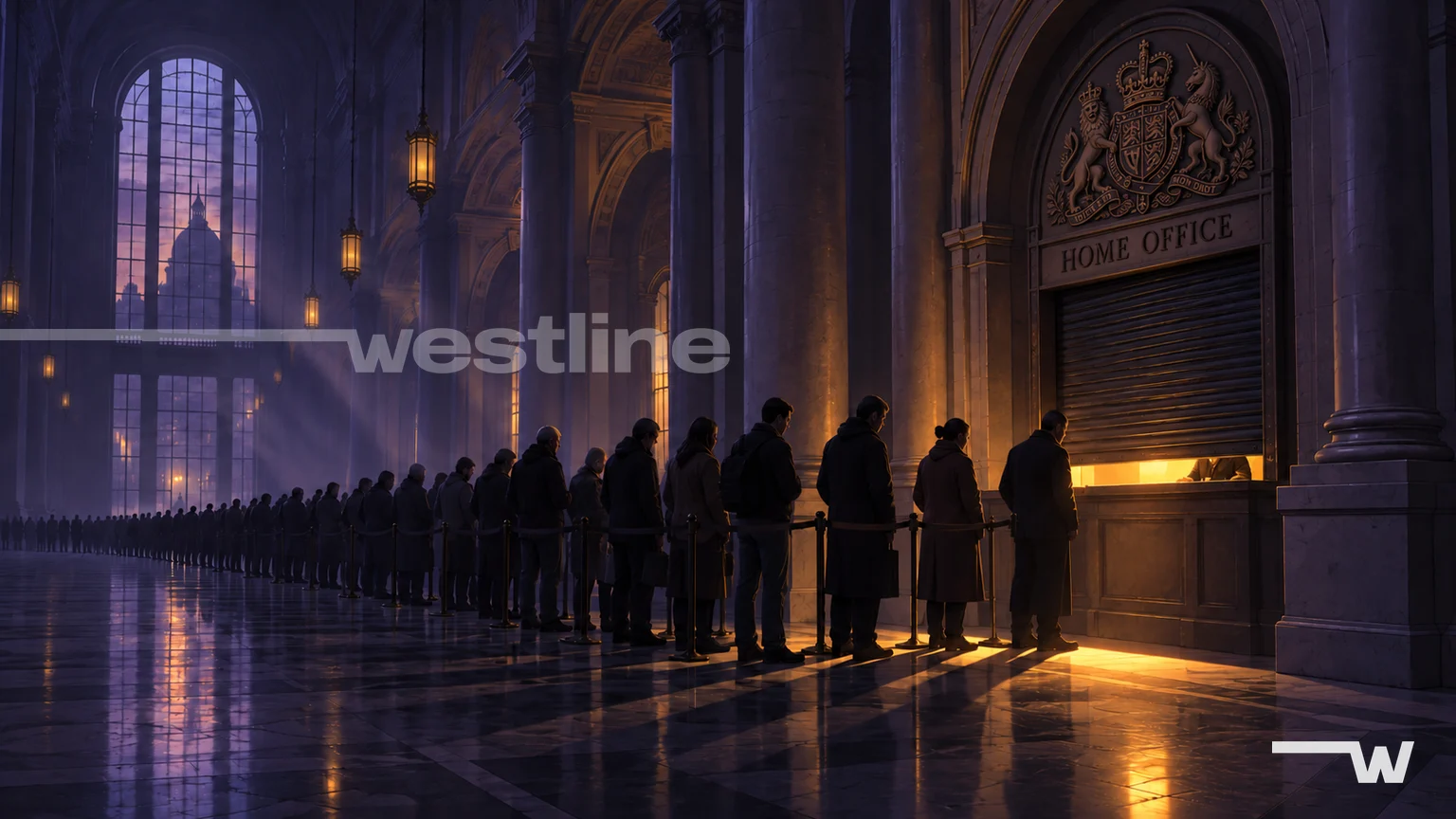
CONSIDER SOMEONE WHO CLAIMED asylum in Britain in January 2023. Where they came from, and how they arrived, matters less than what happened next — which is to say, very little. When the National Audit Office took a sample of 5,000 claims lodged that month and checked on them nearly three years later, more than half were still unresolved. In the meantime our claimant will probably have been housed at public expense, largely barred from working, interviewed by a caseworker who may not have been in post for long, refused, appealed, and then left waiting again: this time for a tribunal that now takes, on average, well over a year to hear a case.
In the political conversation, that person is the problem. The backlog is discussed as though it were a weather system blown in off the Channel — too many boats, too many claims, too many people gaming the system. Arrivals do matter, and nobody serious pretends otherwise. The number of people claiming asylum peaked at around 110,000 in the year to September 2025, the highest figure in nearly two decades.
A backlog is not a measure of how many people turn up. It is the gap between the cases that come in and the cases a department decides — and decides properly.
But a backlog is not a measure of how many people turn up. It is the gap between the cases that come in and the cases a department decides — and decides properly. Judged that way, the story of Britain’s asylum queue is not one of an overwhelmed border. It is the story of an institution that, over ten years, stopped doing its core job, then tried to do it at a sprint, then passed the consequences down the corridor to the courts. The people in the queue designed none of it.
Initial asylum decisions made per year
Home Office annual statistics · output collapsed before small boats became a mass phenomenon, then quadrupled on command
The rot set in long before small boats became a nightly news item. In 2015 the Home Office made 28,623 decisions on asylum applications. By 2017 that had fallen by a quarter, to 21,269, and the department never recovered its old pace. The more striking figure is what happened per head. According to the Institute for Government, in 2011/12 some 380 caseworkers were each producing around 13.7 decisions a month. By December 2022 there were 1,237 of them, managing about four apiece. The workforce had more than tripled; the output of each worker had fallen by over two-thirds.
Then, in January 2019, with ministerial approval, the department dropped its own service standard: the commitment to decide 98 per cent of straightforward claims within six months. The stated reason was to prioritise the most vulnerable cases rather than the simplest. The practical effect was to remove the one clock that had been ticking. The Migration Observatory later found that in 2014 eight in ten applicants received an initial decision within six months; within five years it was one in four.
Why this isn’t a story about the Channel In 2021 the UK had 14.9 cases in its asylum backlog per 10,000 people, more than Germany or France, even though it received far fewer applications per head than either. Countries facing heavier demand were simply getting through their caseloads faster. By December 2022 two-thirds of those waiting — almost 110,000 people — had been in the queue for more than six months. That is not a surge. It is a department that had quietly stopped deciding things.
In December 2022 Rishi Sunak did something the Home Office had not done in years: he set it a deadline. The so-called legacy backlog — roughly 92,000 claims lodged before 28 June 2022 — would be cleared within twelve months. The department doubled its decision-makers to around 2,500 and, for nationalities with very high grant rates such as Afghans, Eritreans and Syrians, swapped lengthy interviews for a questionnaire. The results were instructive. In one four-week stretch in November and December 2023, officials made 20,481 initial decisions, more than in the whole of 2021. Across that year they made 112,138. For anyone who still believed the queue was driven by forces beyond Whitehall’s control, that was the rebuttal.
Given political will, the department could decide cases at four times its usual rate.
The sprint had a cost, though, and it was paid in shortcuts. Asylum withdrawals in 2023 were more than four times the 2022 figure, and 79 per cent of them were “implicit” — claims the Home Office itself closed because someone missed an interview, missed a questionnaire deadline or had not updated an address. When the pledge was declared met, 4,537 legacy cases were still awaiting a decision, and the chair of the UK Statistics Authority warned that the episode might affect public trust. A Conservative government that had staked its reputation on control ended up being rebuked by the statistics watchdog for its arithmetic.
Worse, at the same moment that one arm of the department was racing through old cases, another had been told to stop deciding new ones. The Illegal Migration Act meant that claims from those who had arrived irregularly after 7 March 2023 could not be granted. By the end of that year, 55,533 of the 98,599 claims awaiting a decision had been made after the bill was introduced. The backlog stopped falling and, by March 2024, stood at 118,329 people. Those claims were being held for removal to Rwanda, a scheme that by Labour’s later accounting had cost around £700 million — £290 million of it paid to Kigali — to send four volunteers. The Home Affairs Committee later concluded that holding up decisions while the scheme stalled had made the crisis worse. Parliament had, in effect, legislated the state into not processing cases, and then the state paid to house everyone it had declined to process.
Every month a claim sits undecided is a month of bed, board and administration, and this is where the failure becomes a fiscal one. In 2019 the Home Office signed seven regional contracts with Serco, Mears and Clearsprings, expecting them to cost £4.5 billion over ten years. The National Audit Office now puts the figure at £15.3 billion. Between December 2019 and December 2024 the number of asylum seekers in paid-for accommodation rose from about 47,000 to 110,000. Hotels, the emergency option, became the default: at the peak, in September 2023, 56,018 people were in them, spread across roughly 400 sites.
The economics were dreadful. In 2024-25 hotels held around 35 per cent of people in asylum accommodation but swallowed 76 per cent of the contracts’ annual cost.
NAO, asylum accommodation contracts (2025) · hotels held just 35% of people in the system
The three providers made a combined profit of £383 million between 2019 and 2024. The NAO’s verdict was that the department had few levers to control the cost. Across the Home Office and Ministry of Justice, asylum cost £4.9 billion in 2024-25.
For a centre-right reader, this ought to be the scandal. A man waiting for a decision cannot choose to move out of a hotel and is, for the most part, forbidden from earning his own keep. The bill is not run up by his presence so much as by the length of his stay, and the length of his stay is set in Whitehall. Treat the backlog as a migrant problem and you reach for deterrents. Treat it as a productivity problem and you reach for the thing that actually saves money: a decision.
Credit where it is due. In the year to June 2026 the Home Office made 116,000 initial decisions, more than four times its 2010-19 annual average. The number of people awaiting a first decision fell to 40,168, the lowest since June 2019, and the number in hotels halved to 16,021. Shabana Mahmood can fairly say the front door is moving again. What she cannot say is that the problem has been solved, because much of it has simply been moved down the corridor.
The department’s own quality checks found that only 52 per cent of decisions met its standard in 2023/24. The NAO found significant or outright fail errors in 42 per cent of sampled decisions in the year to May 2025. The chief inspector of borders, in a report finally published this June, judged decision quality to have fallen to an “unacceptable level”, and found that 882 decision-makers had left in a little over a year, an attrition rate of 42 per cent. A UNHCR audit in March found key parts of the claim still unclear in 19 of the 60 interviews it reviewed. Meanwhile the initial grant rate has fallen from 77 per cent in 2022 to 38 per cent. Practitioners have noticed how neatly the falling grant rate tracks the rising speed. Whether that is rigour or haste is a question the appeals data answers.
The tribunal shows what those refusals are worth. Pending asylum appeals rose from 19,459 at the end of 2023 to 80,333 at the end of 2025, and 90,341 by the middle of this year. More than a third of appeals are now withdrawn before a hearing, almost always by the Home Office itself, conceding it got the case wrong or wants another go.
Tribunal statistics, MoJ · a refusal that collapses on appeal is not toughness, it is a delay with a letterhead
Of those appeals that reach a judge, around 39 per cent succeed. In the year to March 2025, 45 per cent of refusals the tribunal reviewed were overturned.
A refusal that collapses on appeal eighteen months later is not toughness. It is a delay with a letterhead.
And every month of it keeps someone in state-funded accommodation while the people who genuinely have no right to stay are no nearer the departure gate. The Public Accounts Committee’s chair, Sir Geoffrey Clifton-Brown, put it bluntly this summer: at the time of its inquiry, control of the system “had been all but lost”.
Three objections deserve a proper hearing, because each contains something true.
The first is that the numbers were simply unprecedented: no department could have kept pace with the boats. The scale was real, but the chronology runs the wrong way. Productivity collapsed between 2015 and 2019, before small-boat crossings became a mass phenomenon, and by 2021 Britain already had a bigger backlog per head than Germany or France on a smaller inflow per head. The last two years offer something close to a natural experiment. In the year to June 2026 claims were still running at about 86,000, near a two-decade high, yet the queue for first decisions fell by more than half, because decisions rose. Over the same period, new appeals fell to 11,596 a quarter while the appeals backlog kept climbing, because hearings did not. In both cases the queue tracked the state’s output, not the Channel’s input. High demand is an argument for building capacity in advance, not an alibi for lacking it — and arrivals have been visibly rising since 2018.
Isn’t a falling grant rate just firmness? Part of it is. The mix of claimants has shifted towards nationalities with low success rates: Pakistanis are now the largest group of claimants, and their grant rate fell from 46 to 25 per cent. The Syrian grant rate fell from 98 to 10 per cent after the fall of the Assad regime changed the facts on the ground. Refusing weak claims is precisely what a functioning system should do. But firmness has a test, and it is whether a decision survives scrutiny. The 42 per cent error rate comes from the Home Office’s own quality sampling, audited by the NAO, not from campaigners. Historically, the final grant rate for each year’s claims has ended up 8 to 29 points higher than the first-instance rate once appeals and reconsiderations play out. Real toughness is a refusal that holds, because only a refusal that holds can end in a removal.
The third objection is that Rwanda was never given a fair test. There is force in that. The scheme was fought through the courts, ruled unlawful by the Supreme Court in November 2023, revived by statute in 2024 and scrapped by Labour before a single enforced flight left. Whether a third-country deterrent can work remains a live question, and plenty on the centre-right still think it can. But that is not the question here. The error was not the deterrent; it was making the processing of tens of thousands of claims wait on a scheme that, even on its own terms, could only ever take a fraction of arrivals. Deciding claims quickly and removing those refused — to Rwanda or anywhere else — are complements, not alternatives. By coupling them, the government ensured that every legal setback for the deterrent became another month of hotel bills. A policy designed to signal control produced the clearest symbol of its absence: a queue that was not allowed to move.
Faced with a swelling appeals queue, the government’s answer is to replace the court. The Immigration and Asylum Chamber of the First-tier Tribunal is to be abolished in favour of an Independent Immigration Appeals Authority, staffed by trained lay adjudicators on something like the magistrates’ model. Ms Mahmood told Parliament the existing tribunal is overwhelmed, and on the raw numbers she is right: across all immigration cases it carried more than 151,000 appeals in March, each taking an average of 61 weeks.
Yet the tribunal is the one part of the machine that has not, on the evidence, been malfunctioning. The Institute for Fiscal Studies finds the number of cases resolved per sitting day broadly stable through the recent surge; the pressure came from a flood of first-instance refusals that the system was never resourced to absorb. The Law Society notes that earlier experiments with non-legally qualified adjudicators were abandoned as unfit for purpose. Rebuilding the appeals stage while leaving the decisions that feed it unreformed is a little like sacking the referee because one side keeps fouling.
There is a conservative argument here, and it is not a soft one. A state that wants to control its borders needs a system whose refusals stick, because only refusals that stick lead to removals, and only removals make the rules mean anything. That requires the boring virtues the right is supposed to prize: a stable workforce, a service standard with teeth, decisions made once and made properly, and contracts the taxpayer can actually control. None of those depends on how many boats cross the Channel this month. All of them are within a Home Secretary’s gift.
Which brings us back to our claimant from January 2023. Perhaps he deserves protection; perhaps he should be on a plane. Either way, he and the people paying for his room were owed an answer within months, not years.
The queue is long not because too many people joined it, but because for most of a decade the counter was barely open.
The queue is long not because too many people joined it, but because for most of a decade the counter was barely open.
Sources
NAO, the Home Office’s asylum accommodation contracts (2025); EIN summary of NAO asylum system analysis · Institute for Government, asylum backlog explainer · Free Movement, understanding the Home Office’s problem with asylum decisions; latest statistics, year ending June 2026; asylum appeal backlog coming under control · The Justice Gap, Migration Observatory on decision times · Civil Service World, Sunak’s legacy backlog claim; Irish News/PA, withdrawals and UKSA warning · British Red Cross, Illegal Migration Act and the backlog; EIN, Refugee Council on the March 2024 backlog · Express & Star/PA, Rwanda scheme cost; Eastern Eye, Home Affairs Committee on asylum hotels · Rainbow Radio/BBC, contractor profits; The Justice Gap, PAC report; LBC/PA, PAC chair · Newswav/Independent, hotel numbers, June 2026; Parallel Parliament, written answer on backlog · GOV.UK, grants of asylum, year ending June 2026; EIN, grant rate falls to 38% · EIN, ICIBI asylum casework inspection; VisaVerge, UNHCR interview audit; ECRE, AIDA UK report 2025 · Law Society, drop plans for new appeals body; Law Society Gazette (Ireland), IIAA announcement; Westminster Brief, Lords debate, 29 June 2026 · IFS, rising demand and tribunal backlogs∎