
IKRAMULLAH MEHSUD DOES NOT creep into history. He strolls into it. He walks through the gate of a Taliban security compound in Khost, unsearched, unhurried, greeted with an easy, knowing line: “Bhutto’s killer has arrived.” The officials smile. His car is never dry of fuel, the pumps are always open for him. A man once dispatched to help assassinate a former prime minister of Pakistan is not only alive and free, he is domesticated into the routines of state power in Taliban-ruled Afghanistan. No code words, no disguise, no denial. It is casual, almost intimate. It is also an x-ray image of a relationship everyone insists does not exist.
From that unremarkable entrance in Khost, the geography widens. It runs from safe houses in Kabul to the ridges of Kunar, through the corridors of Khost, Paktia and Paktika, then down toward the invisible stitches of the Durand Line. On this terrain, the Tehreek-e-Taliban Pakistan is not simply an exiled group hiding under tarpaulins. It is an ecosystem: commanders, couriers, bomb-makers, preachers, traders, wives and children, crossing roads that only appear on tribal maps. Their movements are not the hurried scuttle of men on borrowed time. They are the movements of people confident that the ground belongs, at least partly, to them.
In some districts, the truth announces itself in small, dissonant details. Enter the Zadran-e-Ghobargi area and, without any formal decree, cars begin to keep left instead of right. It is a quiet reversal that speaks loudly. Drivers have adapted to the habits of Pakistani Taliban fighters, men who spent their formative years in Waziristan’s war economy and imported their rules with their rifles. Around them, a lattice of tribal councils and Taliban intermediaries regulate disputes, guard routes, distribute favours. It is an order that feels official, but is not quite the state; intimate, but not entirely accountable. A kind of soft annexation, written in the direction of traffic.
Hafiz Gul Bahadur’s journey runs like a thread through this tapestry. Once presented by segments of the Pakistani security establishment as a “good Taliban” mediator, a containable actor, he watched their categories collapse. When Pakistan finally turned guns on North Waziristan, Bahadur and his men did not vanish. They shifted sideways, settling into the wooded seams and highlands that straddle the border, then deeper inside Afghanistan. There, his network rebuilt: madrassas, training, suicide units with names that sound like vows. Under pressure, he melts away from one district, surfaces in another. The pattern repeats. This resilience is not magic. It is permission.
Behind that permission lies a memory that cannot be politely erased: Mir Ali. Before Kabul fell, senior figures from the Afghan Taliban, the TTP, al Qaeda-linked networks and other allied groups sat together in that North Waziristan town and framed an understanding. They would pour blood and logistics into the Emirate’s long war. In return, the future Emirate would not strand them in the wilderness when victory came. It was a covenant spoken in the language of jihad, solidarity, betrayal by states and shared graves. Doha, with its careful English clauses about non-use of Afghan soil, arrived later. Mir Ali came first, and in Afghan and Pakistani militant politics, the first promise is the one that counts.
When pressure arrives from Islamabad or foreign capitals, the Emirate reaches for choreography. A limited number of TTP families are moved from the raw edges of Khost and Paktika to compound-style camps in Ghazni. The conditions are soft. No biometric registration. Pseudonyms on paper. Monthly stipends. Transportation covered. Security inside the fences entrusted to the TTP itself. Some families comply. Some walk back. Many never go. The commanders, the weapons caches, the meeting places along the border ridges remain untouched. To a camera lens, it can be presented as relocation. To anyone who has walked those valleys, it is stage management, not rupture.
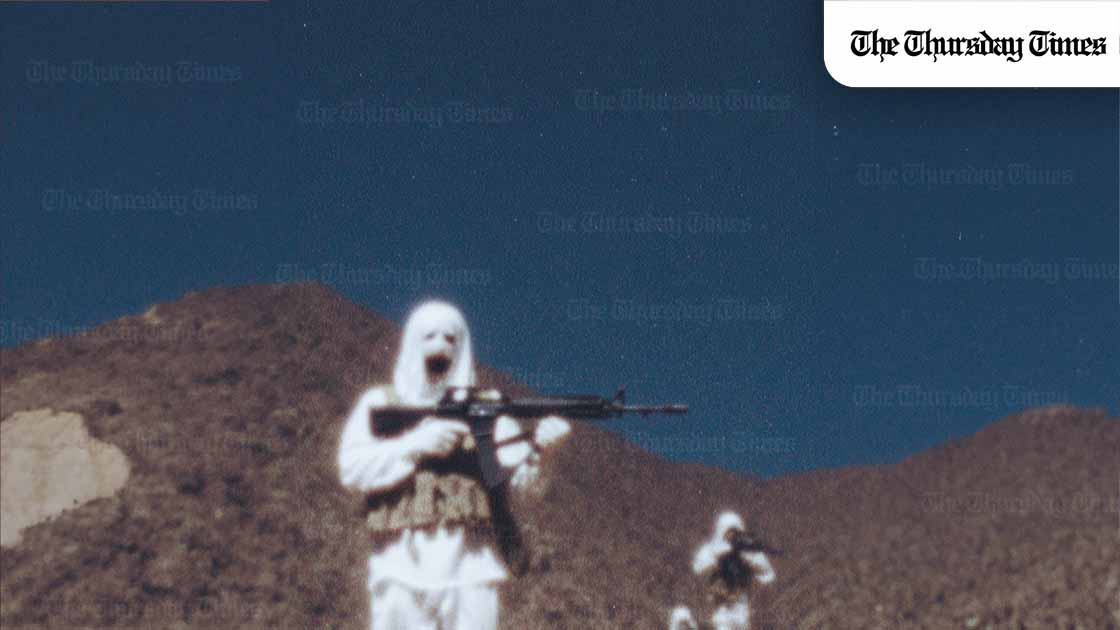
Beyond the fences, an arms market hums with its own cold arithmetic. When the Afghan Republic disintegrated, its arsenals did not evaporate. American-made M4s that once sat in Western-supplied inventories now move across Khost and Paktika for roughly $4,285 apiece, M16s for about $1,428, with Chinese M4 variants trading at around three-quarters of that price. Russian-made AK-47s fetch between $1,370 and $1,540, PK machine guns hover near $1,710, and hand grenades are casually sold for $12 to $14. Heavy ordnance has its own menu: BM1 rockets at roughly $424, Russian RPG-7 systems in the mid-$500 range, and 82mm systems climbing towards $1,784, with each shell around $71. These are not abstract figures; they are the going rates of a permanent war economy. Much of this kit, often fitted with night-capable optics or adapted for longer range and heavier impact, flows into the hands of TTP cells, Baloch outfits, al Qaeda remnants and freelance gunmen along the Durand Line. Taliban decrees from Kandahar demand that such weapons be pulled back under central control. Commanders, smugglers and old comrades-in-arms answer instead to profit, memory and leverage. The TTP that now hits Pakistani positions is armed, quite literally, by the afterlife of America’s withdrawal and the Emirate’s willingness to let that trade run.
Up above, war is learning to see differently. Pakistani-made drones and quadcopters trace patterns over North Waziristan, over suspected tracks, wadis and compounds. Grainy clips circulate: small human figures caught in the open, then a white flash, a plume of dust, the clean erasure of a stone house that took years to build. It is presented as precision and consequence, as proof that no militant sanctuary is beyond reach. On the other side of the border, militants are watching the same footage, pausing, rewinding, taking notes. TTP groups send quiet envoys into Kabul, not for talks with ministers but to find traders who can import Chinese quadcopters and parts. They experiment with jury-rigged bomb drops, improvised mounts and motorbike batteries. For now, their drones are clumsy, noisy, easily jammed. But each failed trial is a rehearsal for a future in which the sky is no longer the state’s monopoly.
In Kabul and Kandahar, the Taliban leadership frames this tension as a delicate balance. Pakistan, they remind their own ranks, sheltered senior Taliban figures for years, allowed fundraising networks, tolerated madrassas and clinics. To break with Islamabad outright risks border escalation, economic strangulation, diplomatic isolation. The TTP, al Qaeda veterans and other foreign militants, they remind themselves, are not abstractions; they are men who shared trenches, exile and graves, men whose loyalty is bound up with the Emirate’s own mythology of survival. To discard them feels like rewriting their origin story under foreign dictation. Meanwhile, delegations from Western states, China, Russia and Iran arrive with one convergence: if the Emirate wants to be treated as a government, it cannot remain the landlord of everyone else’s insurgency.
The Emirate’s response is a language of narrowing deniability. Commanders are told to lower their profiles, to avoid cameras, to stay away from big public gatherings. Journalists find doors closing in once-accessible districts. Foreign fighters and TTP cadres are nudged from visible urban presence to the semi-visible peripheries. The official line is simple: if you cannot see them, they are not here. Yet along the ridges and valleys of the Durand Line, where residents know the difference between a guest and a governor, the truth is entirely ordinary. TTP couriers move between compounds. Families settle in rented houses. Clinics quietly treat men whose wounds tell their own stories. Shops sell ammunition, food and fuel without mystique. It is not a rumour ecosystem. It is an embedded order.
For Pakistan, watching this is like waking into its own bad metaphor. The architecture of plausible deniability and proxy leverage it once championed across the border has matured into a system that now shelters those targeting Pakistani troops, police and civilians. The fiction of “good” and “bad” Taliban, once convenient for lecture halls and press briefings, collapses in the face of networks that disregard such lines. Islamabad demands decisive Afghan action against men whom Kabul still views as strategic depth of a different kind: ideological kin, border shock absorbers, bargaining chips. Every frustrated cross-border strike, every accusation hurled at Kabul, tightens the Emirate’s instinct to protect its own flank by leaning closer to those very actors.
Beyond this binary feud, other capitals study the same terrain with quieter alarm. Beijing sees in these sanctuaries a potential disruption to the China-Pakistan Economic Corridor and a reminder that its infrastructure lives inside someone else’s unfinished wars. Tehran and Moscow, eager to market the Taliban as a stabilising force that keeps Western troops out and Islamic State Khorasan in check, must contend with the optics of al Qaeda-linked and TTP-linked figures roaming Afghan soil. Even those prepared to deal with the Emirate as a fact on the ground are forced to ask whether it is consolidating sovereignty or subcontracting it.
For the Taliban, the road ahead is a narrowing corridor of unwelcome options. To move meaningfully against the TTP and other allied militants would mean sending fighters to arrest former comrades, uprooting networks interwoven with their own logistics and legitimacy, and risking splinter groups that could ignite new fronts. To continue offering space and strategic indulgence, whether through active coordination or deliberate blindness, is to accept intensified economic isolation, deeper mistrust, more frequent Pakistani strikes and the creeping possibility that Afghanistan is once again framed as a legitimate theatre for targeted foreign action. It is not a choice between safety and risk. It is a choice between different kinds of blowback.
In the villages that never make it into communiqués, where traffic changes side with the flag and the outline of a drone shares the sky with kites and migrating birds, these calculations are not theoretical. Residents see Pakistani Taliban families arriving with trucks and stipends, new compounds rising with suspicious speed, roads graded and wired for select enclaves. They hear the distant thud of airstrikes, the closer rattle of test-firing, the murmurs that certain areas are off-limits unless you are carrying the right name. They escort the bodies of young men back from ambushes on both sides of the border. They understand, more clearly than any speech from Kabul or Islamabad, that these militants are no longer visitors.
This is the quiet heart of the story that begins with one man’s unsearched walk through a gate in Khost. The Pakistani Taliban in Afghanistan are no longer a temporary expedient or a pressure card that Kabul can casually cash in. They have thickened into a parallel sovereignty, funded by a post-war arms bazaar, shielded by old promises and leveraged in new rivalries. They are a test of what kind of state the Emirate is willing to become, and whether Pakistan can live with the reflection it now sees taking shape beyond a border it drew, armed, exploited, and never truly controlled.
This is a comment of an article originally published in Afghanistan International.


