
THE IMRAN-EPSTEIN NEXUS IS is not a figment of conspiracy Twitter, nor is it dissolvable with the lazy shrug of “pure coincidence.” It lives in that uncomfortable space where power always does its worst work: in overlapping social circles, family networks, and private judgments that never expected to see daylight. Jeffrey Epstein knew the Goldsmith world. He moved easily around the same Anglo-elite circles that once treated Imran Khan and Jemima Goldsmith as their beautiful, exotic centrepiece. Decades later, when Imran became the prime minister at the head of a nuclear-armed Muslim country, Epstein’s correspondence shows not ignorance, but obsession. To pretend there was no connection at all is as dishonest as claiming they were partners in crime.
The most direct bridge in this story is not Imran himself, but the Goldsmith dynasty he married into. Isabel Goldsmith, Jemima’s half-sister, turns up in Epstein’s infamous contact infrastructure not as an afterthought but as a fixture: multiple numbers, multiple addresses, a name that recurs because she was part of his regular social orbit. Epstein did not just know of the Goldsmiths; he knew at least one of them well enough to make her a hub in his Rolodex. That alone tells you the distance between his world and that of the man who would later be Pakistan’s prime minister was not measured in continents, but in dinner tables.
From Isabel, the line to Imran and Jemima is not speculative, it is familial. When Imran married Jemima in 1995, it was not a private, anonymous union: it was front-page news in the very same Anglo-American media ecosystem that orbited Epstein and Ghislaine Maxwell. A Pakistani cricket legend, the darling of London’s social pages, marrying the daughter of financier James Goldsmith and the half-sister of Epstein’s friend Isabel, then guiding her conversion to Islam and transplanting her to Lahore – this is exactly the kind of story that would ripple through that world. You did not need to be best friends to feel the shockwave. At the level of elite gossip, Imran and Jemima walked straight through Epstein’s mental living room.
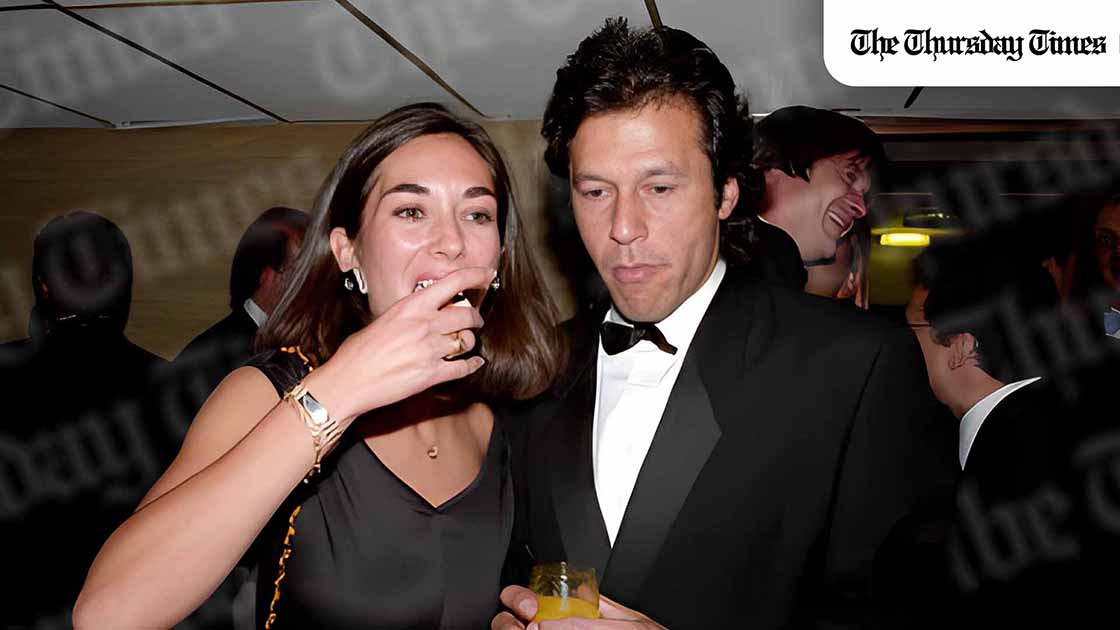
The photograph of Imran and Ghislaine Maxwell in black tie at a London party is not, on its own, proof of anything more than shared oxygen. But placed against the Goldsmith background, it becomes a fragment of a real social map. Maxwell was Epstein’s closest associate and gatekeeper, the person who curated his access to the very set that Imran and Jemima briefly ruled. When she appears beside Imran at a Savoy event, it confirms that these were not parallel universes. They were the same rooms, the same circles, the same after-dinner conversations where a charismatic Pakistani sportsman and a pair of Anglo-Jewish heiresses could become objects of fascination, resentment, or both.
Fast-forward to 2018, and the nexus hardens from social geometry into explicit text. In emails now attributed to Epstein, written around the time of Pakistan’s general election, he does not ask “Who is this Imran Khan?” He launches into him. He reportedly calls Imran a “devout Islamist,” labels him “really bad news,” and ranks him as a greater threat to peace than Erdogan, Khomeini, Xi or Putin. That is not the language of a man encountering a stranger on a map. It is the language of someone who has been carrying a grudge, watching a familiar figure move from the gossip pages to the nuclear launch codes.
Layered within that hostility is a more intimate sting: the references to Imran’s marriage to “Jewish socialite” Jemima Goldsmith and to women Epstein describes as “friends of mine.” Whether those words are reproduced verbatim or paraphrased from the email threads, the pattern is unmistakable. Epstein is not simply talking about a Pakistani politician in abstraction. He is looking back at a former London It-couple whose story cut across his own world: a Muslim from the post-colony marries into a European Jewish banking dynasty, carries off the glamorous daughter, presides over her conversion, and then years later ascends to high office on an overtly Islamic, anti-establishment platform. In that scenario, Imran is not just a geopolitical data point. He is an affront.
At this point, to say there is “no connection” is less accurate than to say there is no criminal connection proven. The connection that does exist is ideological and social. Epstein watched Imran’s rise with a mixture of dread and bitterness coloured by his own relationship to the Goldsmith orbit. He knew the family; he had at least one of them on speed dial; and he later wrote about Imran and Jemima in a way that betrays familiarity, not distance. That is a connection. It may not satisfy the lurid fantasies of those who want flight logs and island guest lists, but it is more than the random alignment of strangers.
Around this real, documentable nexus, of course, swirls a cloud of opportunistic smear. The digitally faked “kissing video” that animates a still photo of Imran and Maxwell is a textbook example of disinformation building on a grain of truth. The story of a mystery Caribbean island trip, stripped of dates and geography, is aggressively stapled onto Epstein’s property to retrofit a scandal that the timelines simply do not support. Those who insist Imran is “on the list” ignore the actual files and instead rely on the symbolic power of the claim. Yet even these distortions are parasitic on something genuine: they work precisely because Imran, Jemima, Maxwell and Epstein occupied overlapping worlds. A smear does not land unless it feels, at some level, imaginable.
The other distortion, favoured by those desperate to sever Imran completely from this polluted universe, is the soothing narrative of coincidence. They insist the photo means nothing, the Goldsmith entries mean nothing, Epstein’s furious emails are merely the ramblings of a man who happened to read a headline, as if global elites live in separate silos and never cross-contaminate. That version is no more honest than the island fantasies. It underestimates how small that upper-tier Anglo-Atlantic ecosystem really is, and how much its members track one another’s fortunes even when oceans and decades intervene.
Recognising a nexus is not the same as alleging complicity. The evidence we have does not place Imran on Epstein’s planes or in his criminal operations, and it does not place Jemima in any direct contact with him beyond being a character in his world’s ongoing drama. What it does show is that Imran Khan and Jemima Goldsmith were seen from within the Epstein–Maxwell–Goldsmith milieu, that their marriage and its religious dimension registered there as something to talk about, judge and, later, weaponise in private correspondence. That is already a form of power: to decide how someone is narrated in the rooms you control.
Seen this way, “The Imran–Epstein Nexus” is less a smoking gun than a case study in twenty-first-century smear politics. A disgraced financier, embedded in Western elite networks, carries a long memory of a glamorous couple from his social universe. When that man becomes a byword for predatory decadence, any trace of his gaze on them becomes toxic in the public imagination. Political actors then seize it, bolt on fabrications, and turn a web of proximity and resentment into either an indictment or a badge of honour. What gets lost is the more interesting truth: long before Pakistanis argued about Imran Khan in Lahore or Islamabad, he was already a story in rooms he never controlled.
In the end, the nexus is real, but it is a nexus of attention, class and narrative control. Epstein’s world knew who Imran and Jemima were. It talked about them; it judged them; it later cast Imran as a symbol of everything it feared in an Islamist, nuclear-armed democracy led by a man who had once moved so comfortably through its own parties. That knowledge is now being recycled, crudely, into memes and counter-memes. If there is a smear here, it lies not only in the lies told about flights and islands, but in the fact that one of the darkest figures of the Western establishment could turn a Pakistani politician and his ex-wife into characters in his private, poisonous morality play – and that even in exposure, his frame continues to shape the way the story is told∎


