
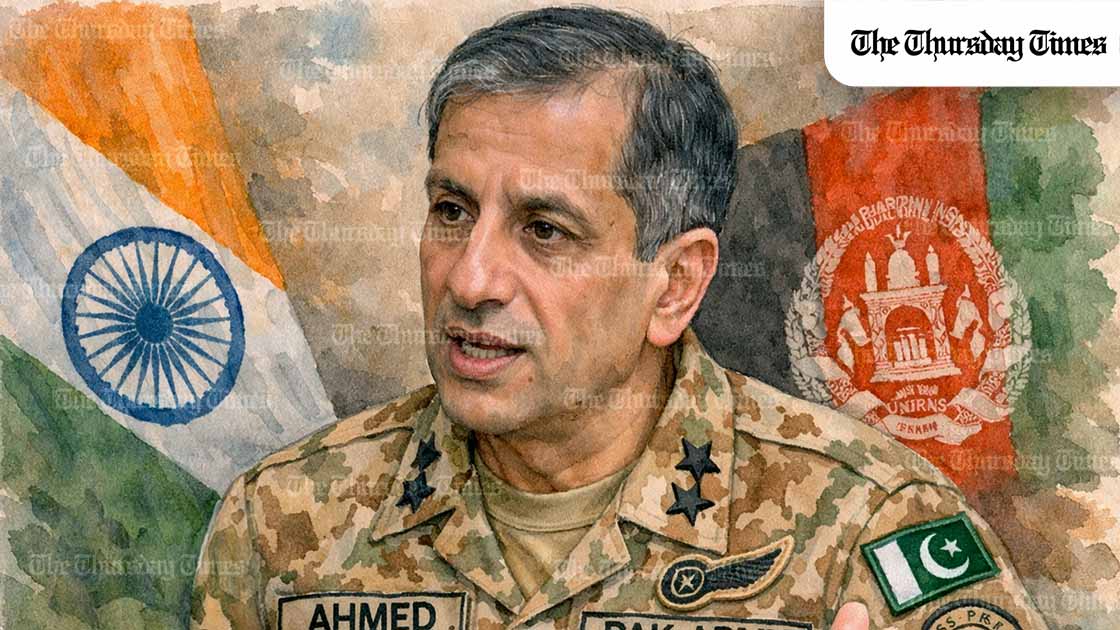
RAWALPINDI HAS SEEN ITS FAIR SHARE of briefings that arrive with a cautious tone and leave with a carefully boxed headline. This one did not come to soften anything. Lt Gen Ahmed Sharif Chaudhry walked in as if the microphone itself were part of the battlefield, not an accessory to it, and he spoke with the kind of focus that makes a room feel smaller. Not because he was loud, but because he was precise.
He did what too many official pressers avoid. He put the year on the table as a ledger, not a mood. Operations, incidents, deaths, disruptions. The shape of the threat, he implied, is not best understood through outrage alone, but through scale. There is a certain discipline in that choice. It refuses melodrama. It also refuses denial. If Pakistan is to argue its case, he seemed to say, it must first show its working.
And yet the presser was not a sterile spreadsheet. It had a narrative spine: that a country can be in an undeclared war and still be expected to conduct itself as if violence were an unfortunate weather system. He treated that expectation with quiet contempt. Terrorism, in his framing, is not a background nuisance. It is an organised project, and it only becomes survivable when a society stops naming it clearly.
The interesting part was not the anger, because anger was not his performance. The interesting part was the insistence on clarity. He spoke as though Pakistan’s greatest weakness is not capacity, but confusion. The kind that seeps in when every incident becomes a partisan tool, when the language of extremism gets domesticated into excuses, when even victims are turned into talking points. He was not selling heroism. He was selling a principle: that a state cannot defeat what it is too timid to define.
That clarity sharpened when he pivoted to Afghanistan. He described it not as a distant tragedy but as a geographic fact with a security bill attached. The core argument was simple and therefore effective: if militant ecosystems are allowed to regenerate across the border, the border stops being a line and becomes a corridor. His tone here was not theatrical. It was prosecutorial. He wanted the audience to treat regional ambiguity as a strategic luxury Pakistan cannot afford.
He then leaned into the uncomfortable specifics, the kind that are designed to travel beyond the hall. He spoke of foreign militants reappearing in the region’s gaps, of training and direction, of networks that do not politely confine themselves to one country’s misery. Even if you do not accept every claim as settled fact, you could not miss the point of the presentation: Pakistan will not keep explaining its wounds as if they are self-inflicted.
From there, he took the risk most briefers avoid: he put sponsors on the record. Not in the abstract, not in the “unnamed hands” way that leaves everyone guessing and nothing changing. He argued a chain, not a slogan: Afghanistan as operational depth, and India as patronage. He did not merely say “external hands.” He suggested a system, a pipeline, a logic of support that turns local militants into regional instruments.
What gave this section bite was that he did not treat it like Cold War melodrama. He treated it like an account of incentives. War economies do not disappear, he implied. They mutate. They seek new funding, new protection, new narratives that can be laundered through politics and media. It was a reminder that terrorism is not only ideology. It is logistics. It is supply. It is procurement. It is someone, somewhere, paying for the “capability” to become repeatable.
If the presser had a defining image, it was not a map. It was the air just above the crowd. He spoke about drones and quadcopters as weapons, not gadgets. About a battlefield that is becoming cheaper, more portable, and less predictable. This is where the briefing felt most modern: an acknowledgement that the next phase of violence will not always announce itself with convoys and camps. It will arrive with small machines, commercial parts, and a knowledge transfer that is easy to deny and hard to stop. It was one of the few moments where an official security narrative sounded like it had kept pace with the threat.
There was also a harder edge to his deterrence argument: that Pakistan’s response cannot be forever limited to condolences and cordons. He spoke about cross-border dynamics in a way that was meant to be understood as policy, not merely emotion: that action changes behaviour, that facilitation can be squeezed, that friction at the border can shrink space for movement. He delivered this without the swagger of someone chasing applause. It sounded more like a man trying to convince the country that restraint is not always a virtue when it becomes routine.
Still, the presser was not only outward-facing. The subtext was domestic, and perhaps that is why it landed. He seemed to be telling Pakistan that the fight is not only in the mountains or across the line, but in the national temperament. In whether citizens allow fatigue to become surrender. In whether politics treats terror as a bargaining chip. In whether the state permits a culture of half-sentences where everyone knows what is being implied but nobody will state it.
Then he did something that many briefings shy away from because it cannot be managed like a statistic. He introduced grief as a political reality, not a sentimental afterthought. He made space for the dead, for the families, for the human cost that sits beneath every neat operational claim. It did not feel like performance. It felt like a refusal to let sacrifice become routine.
To praise him properly, you do not need to pretend he is flawless, or that a single presser resolves a decade of complex war. What he offered instead was rarer and arguably more valuable: a posture of seriousness. Not triumphalism. Not chest-thumping. Seriousness, which is the willingness to put claims on the record, to speak in specifics, to treat terrorism as a structured enemy rather than a hazy curse, and to insist that the country is allowed to describe what is happening to it without embarrassment.
“On the offensive” is not about bravado. It is about control of the narrative without collapsing into propaganda. It is about refusing to speak as if Pakistan must forever react, forever apologise, forever wait for permission to call its crisis what it is. The presser did not ask for sympathy. It demanded comprehension. And in a region where confusion is often weaponised, that demand itself is a form of strength. ∎


