
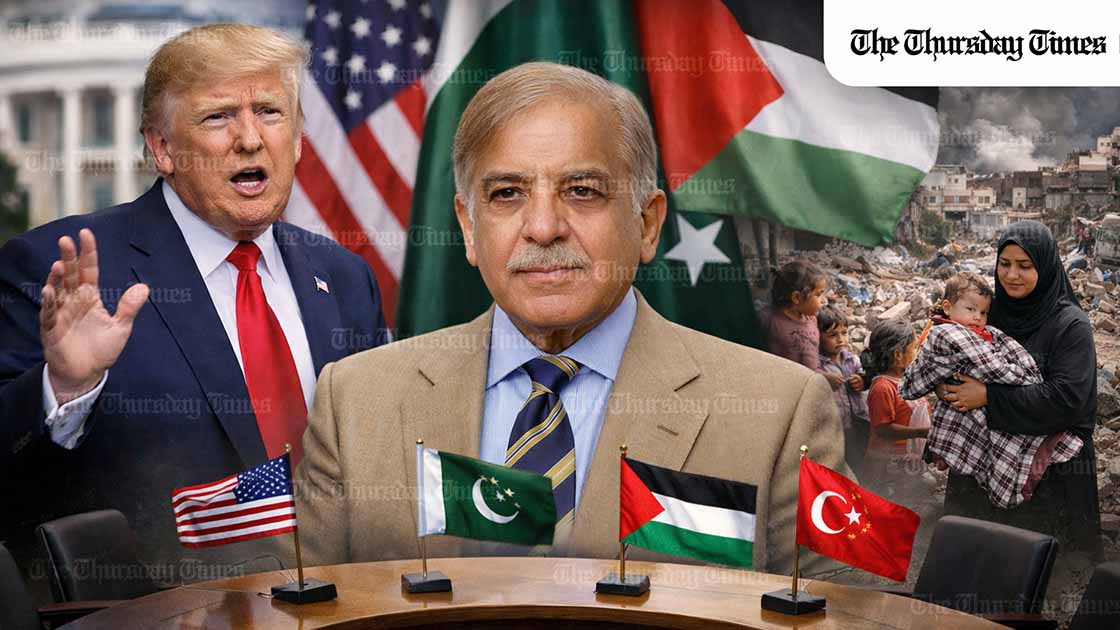
US President Donald Trump has invited Pakistan’s Prime Minister, Shehbaz Sharif, to join a new US-backed “Gaza Peace Board”, a move Islamabad is framing as more than symbolism and one that could reshape the politics of representation in any post-war arrangement for Gaza.
The invitation matters first because it signals access. Pakistan, often treated as peripheral in Middle East diplomacy, is being asked to step into a structured process that Washington is attempting to assemble. For Pakistan, that is recognition of growing diplomatic relevance and a degree of credibility as a state that can contribute to crisis management rather than merely comment on it.
Pakistan’s inclusion also changes the optics and potentially the legitimacy of the mechanism itself. Any body claiming to work on Gaza’s future without meaningful participation from the Muslim world risks being dismissed as externally imposed. Pakistan’s seat, if it accepts, allows organisers to argue that the board carries broader representation, making it harder to portray as a purely Western initiative.
Pakistan’s long-standing stance on Palestine is central to why this invitation resonates beyond Pakistan. The country has consistently called for an immediate ceasefire, unhindered humanitarian access, and a political settlement rooted in internationally recognised principles. For Palestinians and for Arab capitals that have watched Gaza diplomacy swing between rhetoric and paralysis, Pakistan’s presence offers reassurance that humanitarian priorities and political rights will not be quietly traded away for short-term stability.
Pakistan also arrives without the kind of direct entanglements that complicate other actors’ roles. It has no military footprint in Gaza and no operational ownership of Gaza’s internal politics, which allows it to present itself as a comparatively unencumbered voice within a process crowded by competing agendas. That does not mean Pakistan is neutral, but it may be seen as credible in arguing for civilian protection and humanitarian relief without being accused of managing the war’s mechanics.
For Trump, the outreach suggests an acknowledgement that Gaza cannot be handled through unilateral pronouncements alone. A durable framework requires some level of inclusive diplomacy, especially one that can withstand scrutiny from regional states and the wider Muslim public. Inviting Pakistan is a way of widening the circle, even if the circle remains contested and fragile.
Pakistan’s potential leverage, however, lies not only in its Palestine position but in its relationships. Shehbaz Sharif leads a government that has worked to maintain functional ties with the United States while also engaging China, keeping channels open with European partners, and retaining standing in the Muslim world. In a conflict where alliances are rigid and mistrust is reflexive, that mix gives Pakistan an argument for bridge-building, not as a mediator replacing others, but as a state capable of carrying messages across political divides.
There is also an institutional rationale. Pakistan has decades of experience contributing to United Nations peacekeeping missions and participating in international de-escalation efforts, a record it routinely cites as evidence of competence in stabilisation work. In the context of a Gaza board, that background supports the claim that participation is not merely diplomatic theatre, but a chance to add practical depth to discussions about protecting civilians, enabling aid flows, and supporting long-term recovery.
Still, the invitation does not guarantee influence. Any Gaza mechanism will be fought over, challenged in public, and pressured behind closed doors. If Pakistan joins, it will have to navigate competing demands from allies, sceptics, and regional stakeholders who may want its legitimacy but not its priorities. Yet Pakistan’s presence increases the likelihood that the board’s agenda will be judged against real humanitarian outcomes, not just political optics.
For Pakistan, the larger significance is reputational. Participation would reinforce Pakistan’s claim that it can act as a responsible global actor beyond South Asia, one capable of contributing to international diplomacy when the stakes are highest. For the board, Pakistan’s inclusion could strengthen the prospects of a framework that is more credible, more inclusive, and, if it survives the politics around it, more durable than the declarations that have repeatedly failed Gaza.


