

NEW DELHI (The Thursday Times) — India wanted a showcase of its technological confidence. It got a viral embarrassment instead.
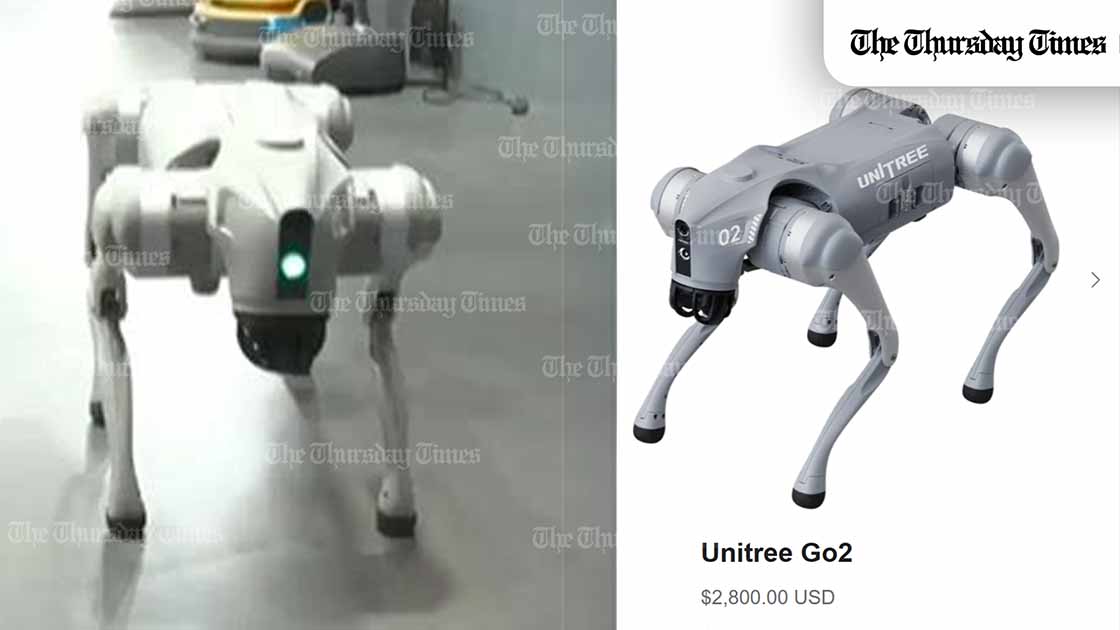
At the centre of the uproar is a robot dog displayed at a major AI summit in the capital, presented under an Indian label but quickly identified online by critics as a commercially available Chinese-made model. Within hours, the clip was everywhere, and the summit’s headline shifted from policy and partnerships to provenance and credibility, igniting a political backlash and raising uncomfortable questions about what, exactly, India is showcasing when it markets “innovation”.
The controversy focused on a university stall that presented the robot dog under an Indian label. Almost immediately, footage from the exhibition floor began circulating alongside product screenshots and comparisons that appeared to match the machine to a Chinese manufacturer’s off the shelf model. The speed of the identification became part of the scandal: in a country that speaks often about digital prowess and data power, the basic due diligence of “what is this device and who made it” seemed absent at the very event meant to project national seriousness.
The opposition Congress party endorsed the claim and framed it as national humiliation, arguing that the Modi government had reduced a serious field to theatre and invited ridicule abroad. Rahul Gandhi amplified the charge, calling the summit a disorganised public relations spectacle and alleging that Chinese products were being showcased while India’s own talent and data advantages were being squandered.
Instead of leveraging India’s talent and data, the AI summit is a disorganised PR spectacle – Indian data up for sale, Chinese products showcased. https://t.co/5liaoX0XXp
— Rahul Gandhi (@RahulGandhi) February 18, 2026
Organisers moved to contain the fallout, and the exhibitor associated with the display was reported to have been asked to vacate its stall, a corrective step that doubled as an admission that something had gone wrong in the event’s basic verification. The government response, meanwhile, leaned heavily on crowd control and coordination, offering apologies for disruption and promising internal fixes rather than directly addressing the allegation at the heart of the row.
“Chinese Robot” row deepens India’s AI summit embarrassment after power was reportedly cut at the Galgotias University pavilion following orders to vacate the expo. Congress and Rahul Gandhi have backed claims the robot dog showcased as Indian was a Chinese-made commercial model. pic.twitter.com/ADHQN1Zkyh
— The Thursday Times (@thursday_times) February 18, 2026
The episode has exposed a recurring vulnerability in India’s technology pageantry: the temptation to treat a dramatic demonstration as proof of progress, even when the origin of the hardware is not clearly disclosed. In an age where products can be traced in minutes, credibility depends less on what appears on stage and more on what can be verified.
It also revealed a deeper insecurity about China. India wants to compete with China in technology, yet remains entangled in supply chains and hardware realities that China dominates. Using imported platforms in research or demonstration is not, by itself, discreditable, but it becomes corrosive when the line between “we used it” and “we built it” is blurred, or when organisers allow ambiguity to stand until the internet forces clarity.
The robot dog row is not only about one machine. It is about a reflex, a reflex to chase spectacle, to substitute branding for proof, and to treat verification as an afterthought. That is not a communications problem. It is a governance problem.
For the government, the risk is that the summit’s intended narrative, India as a serious AI contender, has been interrupted by a question it should have anticipated: what is being claimed here, and can it be proven. For the opposition, the incident offers a potent symbol, one that compresses a complex policy debate into a single, shareable allegation of incompetence.
For now, the summit that was meant to celebrate India’s AI leap has instead reminded the world that competence is not announced, it is demonstrated.


