

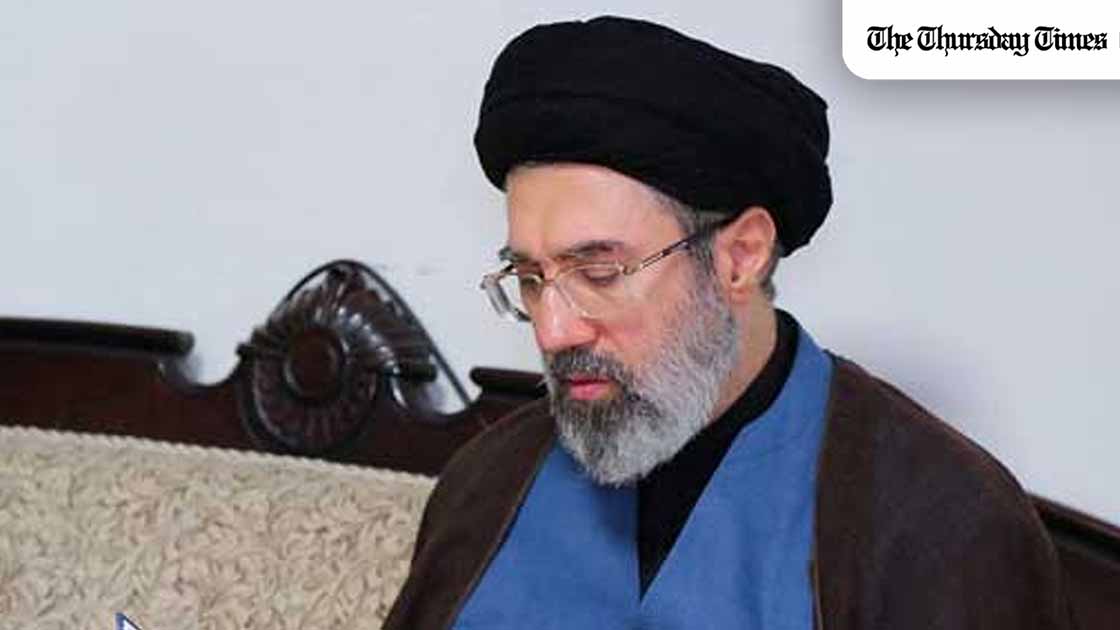
TEHRAN (The Thursday Times) — Ayatollah Seyyed Mojtaba Hosseini Khamenei was named Iran’s new supreme leader on Saturday, formalising one of the most consequential transfers of power in the history of the Islamic Republic and placing the country’s highest office in the hands of the son of its late ruler, Ayatollah Ali Khamenei. The appointment was announced by Iran’s Assembly of Experts as the country remains locked in conflict with the United States and Israel.
The succession had long been whispered about in Tehran’s political and clerical circles, but its confirmation under wartime conditions gives it a different weight. Mojtaba Khamenei, a mid-ranking cleric with longstanding ties to Iran’s security establishment and conservative power networks, now inherits a state under military pressure, economic strain and extraordinary internal uncertainty.
His rise is significant not only because of timing, but because of symbolism. Since the 1979 revolution, the Islamic Republic has cast itself as an ideological state built against monarchy and dynastic rule. The choice of the late leader’s son is therefore likely to deepen debate over whether Iran’s revolutionary system has drifted towards hereditary succession in all but name. That question, once sensitive, is now unavoidable.
The transition comes after the killing of Ali Khamenei in strikes linked to the widening war, an event that shattered the political order that had governed Iran for decades and accelerated a succession process already under intense speculation. Reuters reported before the announcement that hardline clerics were moving quickly to install a successor, with Mojtaba emerging as the dominant candidate because of his influence within the Revolutionary Guards and other core institutions of power.
For Iran’s leadership, the calculation appears to be one of continuity. Mojtaba Khamenei is widely seen as a figure closely aligned with the security-first instincts of the existing establishment rather than a break from it. His appointment suggests that, at least for now, the system has chosen preservation over reinvention, discipline over experimentation and control over any visible opening to reform. That is an inference drawn from his reported political base and the circumstances of his elevation.
Yet continuity may not bring calm. Iran enters this new phase under bombardment, with regional tensions rising and the leadership facing pressure from abroad and anxiety at home. The new supreme leader takes office not in a moment of ceremonial stability, but in the middle of war, with the country’s command structure, legitimacy and future direction all under scrutiny.
Whether Mojtaba Khamenei consolidates authority quickly or faces resistance from within the clerical and political order remains unclear. What is clear is that the Islamic Republic has crossed a threshold. The state founded in revolution has handed ultimate authority to the son of its most powerful ruler, and it has done so at the moment of its greatest external peril in years.


