
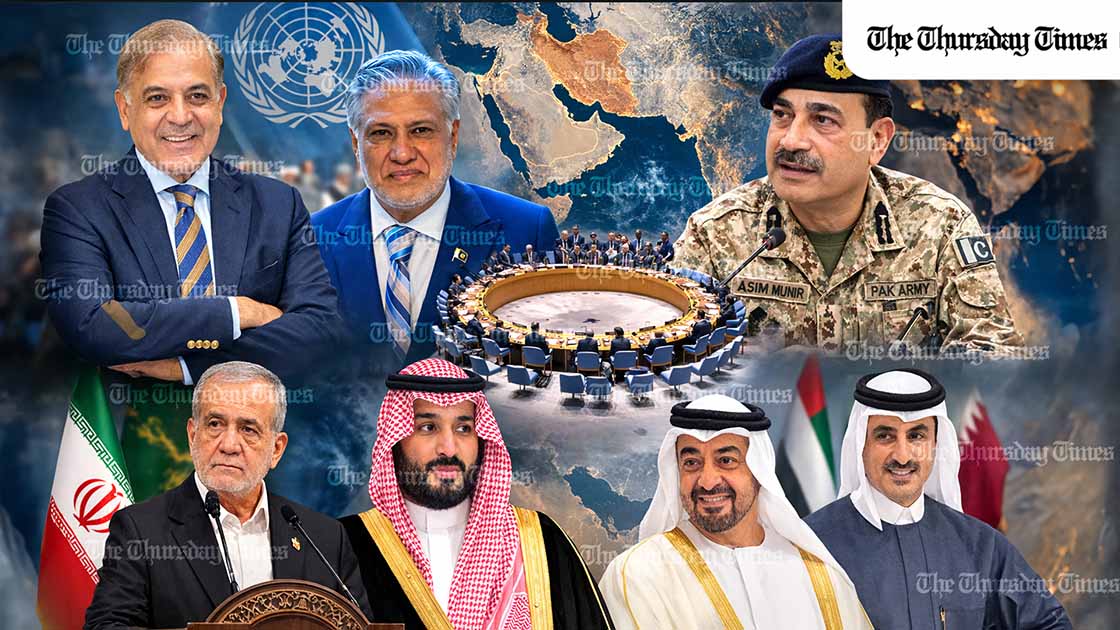
Pakistan has tried to hold one line through the current Middle East crisis – condemn the attacks, reject wider war and push all sides back toward talks. As violence spread from the initial strikes on Iran to retaliatory attacks across Gulf states, Islamabad did not frame the crisis as a one-sided story. Instead, it publicly opposed the use of force, backed the sovereignty of affected states and positioned itself as a country trying to contain escalation rather than feed it.
Pakistan’s official line has been more disciplined than many states caught in moments of regional upheaval. Rather than condoning violence by one side because of outrage over violence by another, Islamabad has tried to preserve a principle: war is not a solution and escalation only widens the circle of damage. That is why Pakistan’s messaging has consistently combined solidarity with affected countries and repeated calls for negotiations, international law and regional restraint.
That principle was visible in Pakistan’s explanation of vote at the UN Security Council. Ambassador Asim Iftikhar Ahmad said Pakistan supported both draft resolutions before the Council:the Bahrain-backed text responding to attacks on Gulf countries and the Russian draft focused on stopping military activity and restoring negotiations. Pakistan’s vote, in other words, was not built around escalating one side’s case against the other. It was built around a larger insistence that the conflict had to be halted and pushed back toward diplomacy.
The core of Pakistan’s posture is that it has condemned all the attacks. At the UN, Ambassador Asim Iftikhar Ahmad described the “unwarranted attacks on the Islamic Republic of Iran” as having seriously jeopardised international peace and security, while also affirming Pakistan’s strong solidarity with Bahrain, Kuwait, Oman, Qatar, Saudi Arabia, the UAE and Jordan and condemning attacks on civilians and critical civilian infrastructure in those states.
That matters because it undercuts the claim that Pakistan has treated the crisis selectively. Islamabad’s public position is that attacks on Iran are unacceptable, attacks on Gulf states are unacceptable, and the region cannot be allowed to slide into a retaliatory spiral in which every violation becomes the justification for the next. This is not the language of bloc politics. It is the language of crisis containment.
The most consistent idea running through Pakistan’s official statements is that violence is not a path to regional order. Foreign Minister Ishaq Dar said Pakistan’s position was clear that all countries must abide by the principles of the UN Charter and international law, while Pakistan was making “full diplomatic efforts” to de-escalate heightened tensions.
Prime Minister Shehbaz Sharif’s messaging has echoed that same logic. In calls with regional leaders, he stressed restraint, de-escalation and dialogue, saying the conflict had endangered peace and security across the region and that Pakistan remained committed to working with brotherly countries to promote peace and stability. He also said Pakistan was ready to play a constructive role for peace.
This is what gives Pakistan’s position its coherence. Islamabad is not presenting war as a regrettable but useful tool. It is presenting war as the problem itself.
Pakistan’s argument is that the crisis has already passed the point where military logic can produce stability. At the Security Council, Pakistan said that the conflict should never have happened, warned that its regional and global dimensions were now obvious, and called for an immediate and complete cessation of hostilities and a return to the dialogue table. Pakistan Ambassador at the UN said only a peaceful settlement would serve everyone’s interest.
That same emphasis on talks has been repeated across Pakistan’s public diplomacy. Prime minister Shehabaz Sharif calls with regional leaders shows a repeated focus on dialogue, de-escalation and diplomacy as the route back to stability. In one account, Shehbaz Sharif explicitly said the attacks had derailed delicate diplomatic efforts already underway and undermined the space for dialogue in the region.
Pakistan is not only speaking in declaratory terms. It is also trying to frame itself as an active diplomatic actor. Ambassador Asim Iftikhar Ahmad told the Security Council that Pakistan’s leadership had remained in close contact with neighbours, friends and partners throughout the region and beyond, and continued to play a constructive role in mediation efforts.
That is reinforced by public statements from the civilian leadership. Shehbaz Sharif said Pakistan had engaged in diplomatic outreach in the wake of the crisis and was prepared to contribute constructively to peace. Foreign Minister Ishaq Dar said he had spoken to counterparts and that Pakistan was trying through diplomacy to push the parties away from escalation and back toward talks.
This is where Pakistan is trying to place itself strategically: not as a passive observer, not as an inciter, but as a state trying to keep channels open across competing capitals.
Pakistani officials have also linked senior-level military engagement to the same broader diplomatic effort. Deputy Prime Minister & Foreign Minister Ishaq Dar said that the message being passed by Pakistan was one of restraint, dialogue and diplomacy, adding that “whosoever Field Marshal Asim Munir speaks to, on the defence side, is also carrying the same message.”
That framing is important. It suggests Pakistan wants its military leadership to be seen not only through a security lens but also as part of a wider de-escalatory architecture. In the current context, Field Marshal Asim Munir is being presented by Pakistani officials as someone in contact with relevant states and carrying the same anti-escalation message that the civilian leadership is voicing publicly. That does not make Pakistan the decisive broker in the crisis, but it does show a coordinated attempt to use both diplomatic and defence channels in service of the same goal. This is an inference from the available public statements rather than a full public record of each contact.
Why Pakistan’s stance is also about self-preservation
Pakistan’s insistence on de-escalation is not only principled. It is practical. At the UN, Pakistan’s Ambassador said the crisis had already affected Pakistan directly: Pakistani nationals had been killed in attacks on the UAE, millions of Pakistanis living in Gulf countries remained vulnerable, fuel supplies had been hampered, and aviation links had been disrupted.
The Foreign Office also issued an advisory for Pakistani nationals in the Gulf, warning them to exercise utmost caution and stay in contact with Pakistani missions. That underlines how seriously Islamabad views the spillover risks.
In other words, Pakistan is not speaking about peace from a comfortable distance. It has citizens in harm’s way, economic exposure to Gulf instability, and a direct national interest in stopping the region from sliding further into conflict.
Pakistan’s line has become increasingly clear: it has condemned attacks on Iran, condemned attacks on Gulf states, reaffirmed solidarity with affected countries, and insisted that the answer lies in talks rather than war. It is trying to present itself as a constructive actor at a moment when the region is being driven by retaliation, fear and strategic overreach.
Pakistan’s message is simple and deliberate: Pakistan is against violence and war. Pakistan wants resolution through talks. And, Pakistan says it is using every relevant channel, including leadership-level outreach, to help de-escalate a crisis that is already threatening far more than one battlefield.


