

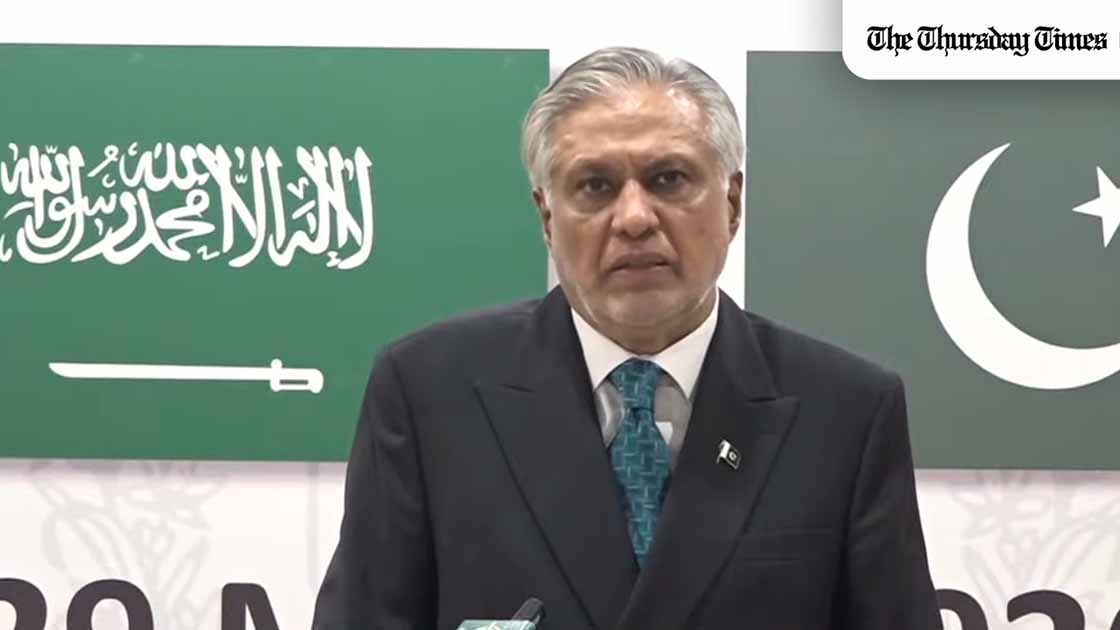
ISLAMABAD (The Thursday Times) — Pakistan has said that both the United States and Iran have expressed confidence in its role as a potential facilitator for talks, placing Islamabad at the centre of an increasingly delicate diplomatic effort to contain a widening regional crisis.
Both the United States and Iran have expressed confidence in Pakistan to facilitate potential talks. Pakistan says it would be honoured to host and support meaningful negotiations between the two sides aimed at securing a comprehensive and lasting settlement to the conflict. The… pic.twitter.com/E7rOo20JYL
— The Thursday Times (@thursday_times) March 29, 2026
Speaking at a press conference, Pakistan’s Deputy Prime Minister and Foreign Minister, Ishaq Dar, said he had given a detailed briefing to the foreign ministers of Saudi Arabia, Türkiye and Egypt on the prospects for possible US-Iran talks in Islamabad. He said the initiative had received strong backing from all three visiting ministers.
Dar said the four countries had reaffirmed their unity in seeking to contain the situation, reduce the risk of further military escalation and create the conditions for meaningful negotiations between the relevant parties. He said there was shared agreement that dialogue and diplomacy remained the only effective way to promote peace and stability in the region.
The remarks come at a moment of acute strain across the Middle East, where fears of a broader confrontation have sharpened diplomatic urgency. Pakistani officials are seeking to position the country not as a partisan actor but as a state able to maintain communication with rival capitals at a time when direct channels have become more fragile.
Dar said that both Washington and Tehran had conveyed confidence in Pakistan’s role, describing that trust as welcome and significant. He said Pakistan would regard it as an honour to host and facilitate substantive talks aimed at securing a comprehensive and durable settlement to the conflict.
He added that Pakistan’s peace effort had also received support from the United Nations, China and several other friendly countries, suggesting that Islamabad’s initiative had found wider international resonance beyond the immediate regional players.
According to Dar, the ministers also stressed the need to uphold the principles of the United Nations Charter, including respect for sovereignty and territorial integrity. That language reflected a broader attempt to anchor any diplomatic process within internationally recognised norms at a time when military calculations risk overtaking political ones.
Dar also said the foreign ministers of Saudi Arabia, Türkiye, Egypt and Pakistan had discussed ways to deepen cooperation among the four countries, indicating that the meeting was not confined to the immediate crisis alone but was also part of a wider effort to consolidate regional coordination.
He expressed gratitude to the foreign ministers of Saudi Arabia, Türkiye and Egypt for their support for Pakistan’s efforts to advance peace, and said Islamabad had remained in regular contact with both regional and international partners under the leadership of the prime minister.
That outreach, he said, includes continued high-level engagement with the United States, which Pakistan regards as an important relationship in its broader diplomatic effort to reduce tensions and encourage a political resolution.
Dar said the ministers had also discussed the wider human and economic costs of the war, agreeing that the conflict was in no one’s interest and was inflicting grave damage on lives and livelihoods across the region. In that sense, Pakistan’s message was not only strategic but cautionary: that continued escalation risks producing consequences far beyond the battlefield.
For Islamabad, the significance of the moment lies not only in the possibility of hosting talks, but in the suggestion that Pakistan may once again be carving out a role for itself as a diplomatic intermediary at a time of regional fracture. Pakistan is making clear that it wants to be seen as ready, available and politically invested in the search for an exit from war.


