

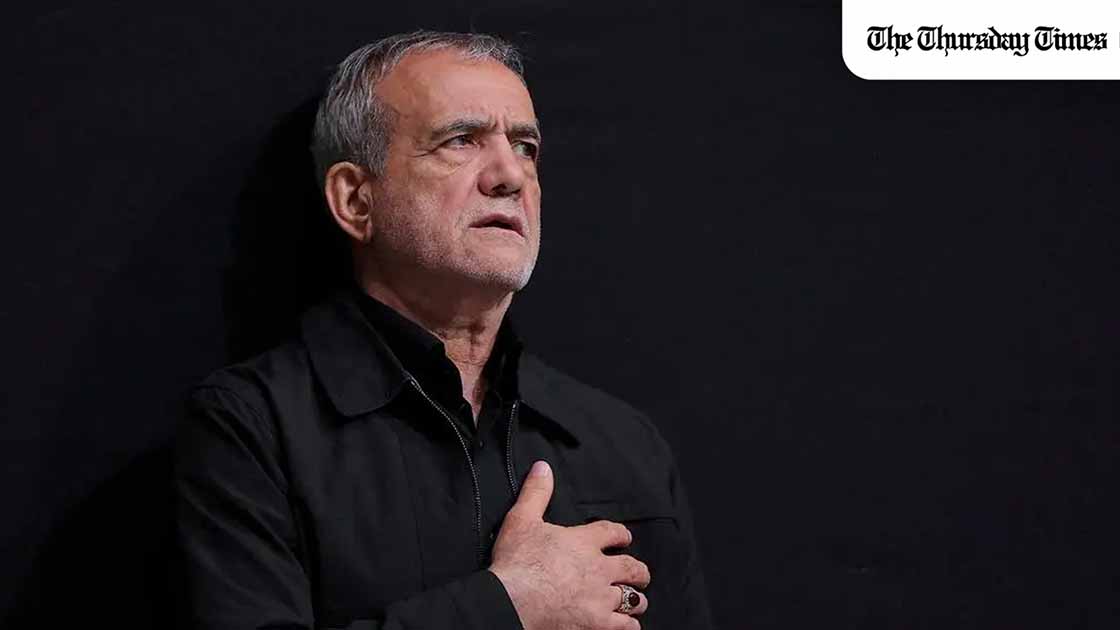
TEHRAN (The Thursday Times) — Hours before US President Donald Trump was due to deliver a national address on the Middle East conflict, Iranian President Masoud Pezeshkian issued an open letter aimed not at Washington’s officials but at the American public. In the message, he said Iran held no hostility towards ordinary Americans and rejected the idea that Tehran is, by nature, a threat to US security.
The timing was pointed. Trump was preparing to address a war that has entered a dangerous new phase, while Reuters reported that Pezeshkian used his letter to argue that claims about Iran’s menace do not match “historical reality”. He cast Iran as an old civilisation that has not pursued aggression in its modern history, but has instead defended itself when attacked.
Open letter to the American people
To the people of the United States,
I write to you at a grave and painful moment, when the language of war once again threatens to drown out the language of reason. Too often, Iran is presented to you as a danger, a menace, a nation defined only by confrontation. I ask you, sincerely and directly, to pause and consider whether this picture reflects truth, history, or reality.
Iran is one of the world’s oldest continuous civilisations. Ours is a nation shaped by memory, endurance, culture and dignity. We are not a people who have sought to erase others, nor a country that has built its identity on conquest. In our modern history, we have not pursued expansion or aggression. When we have fought, it has been because we were attacked, threatened, isolated, or forced to defend our sovereignty.
I know that many of you have heard for years that Iran is a source of instability. You have been told that pressure, punishment and force are the only ways to deal with us. Yet I ask you to look carefully at what these policies have produced. Have they brought peace to the region? Have they brought security to ordinary families, whether in Iran, in America, or across the Middle East? Or have they instead deepened fear, hardened mistrust, and made diplomacy more distant?
The truth is simple. Ordinary Americans are not our enemy. We do not define an entire people by the actions of governments, by military decisions, or by the rhetoric of political leaders. We know that behind the headlines are millions of mothers, fathers, workers, students and young people who wish for safety, dignity and a better future, just as we do.
That is why I appeal to you not in the language of propaganda, but in the language of human responsibility. Ask yourselves: whose interests does this war really serve? Who benefits when another generation is taught to see conflict as inevitable? Who profits when diplomacy is abandoned, when sanctions tighten, when bombs fall, and when every crisis becomes a justification for a still greater one?
Continued attacks on Iran will not produce peace. They will not create stability. They will not erase history or bend a nation of millions into submission. What they will do is bring more human suffering, more regional disorder, more bitterness, and more lasting resentment. They will deepen wounds that may take decades to heal.
Iran does not seek enmity with the American people. We do not seek a future defined by endless confrontation. We seek peace, but a peace grounded in justice, mutual respect and credible guarantees against future aggression. No nation can be expected to trust calls for restraint while living under constant threat of force. No people can be asked to embrace dialogue while their security is treated as expendable.
If there is to be a better path, it must begin with honesty. It must begin by rejecting the false idea that war is wisdom, that pressure is policy, or that entire nations can be reduced to caricature. It must begin with the recognition that peace is not weakness, and diplomacy is not surrender. It is the only serious alternative to a cycle that has already cost this region too much.
I ask you, the American people, to look beyond the slogans, beyond the fear, and beyond the convenient myths that have too often shaped this relationship. Demand from your leaders a politics of engagement, not perpetual escalation. Demand a future in which nations speak before they strike, and where disagreements are handled at the negotiating table, not on the battlefield.
History will judge all of us by the choices made in moments such as this. Let those choices be guided not by anger, nor by vengeance, but by wisdom. Let them reflect not the certainty of force, but the courage of peace.
Masoud Pezeshkian
President of the Islamic Republic of Iran


