
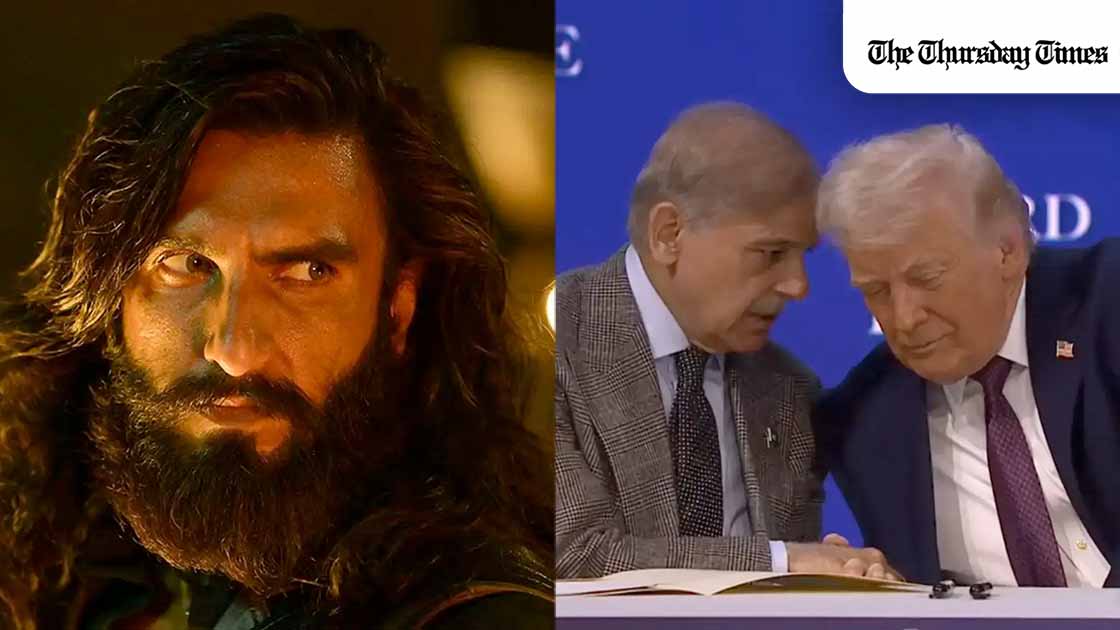
FOR YEARS, INDIA HAS SOLD itself a convenient story about Pakistan: that it is, by nature, a state of disorder, extremism and permanent hostility. That story has been repeated so often in politics, television studios and popular culture that it now functions less as analysis than as national folklore. But folklore has a weakness. It begins to crack when reality moves in the opposite direction. Pakistan’s recent role in facilitating U.S.-Iran de-escalation and hosting follow-up diplomacy in Islamabad has done exactly that, exposing how outdated India’s internal image of Pakistan has become.
One of the clearest windows into this Indian fantasy is Dhurandhar 2. The film has been widely described as a story in which an Indian spy enters Karachi, Pakistan-linked actors are tied to terror and destabilisation, and Pakistan is once again rendered as the permanent villain in India’s national imagination. Its enormous visibility matters because cinema does not merely entertain in such contexts; it trains the public to see one country as civilisation and the other as pathology.
That is precisely where India gets Pakistan wrong. Pakistan’s deepest strategic interest is not chaos but stability. A country sitting at the junction of South Asia, Central Asia, China and the Gulf has every reason to prefer de-escalation over conflagration. Trade routes, energy security, regional connectivity and domestic economic recovery all depend on a calmer neighbourhood, not a burning one. That is why Pakistan’s diplomacy has increasingly centred on mediation, crisis management and political bridge-building rather than the cartoonish aggression so often projected across Indian screens. Pakistan’s active role in facilitating negotiations between Washington and Tehran is not an aberration from its interests; it is a reflection of them.
India, however, remains trapped inside a feedback loop of its own making. It portrays Pakistan internally as a terrorist state, repeats that line until it hardens into dogma, then struggles to process events that do not fit the script. When Pakistan acts as an intermediary, hosts talks, or becomes useful to powers that need an off-ramp from war, India’s commentariat is left trying to explain away what the facts plainly show: Pakistan is increasingly being treated as a diplomatic actor, not just a security problem.
That is why Dhurandhar matters beyond cinema. It is not just a film; it is a symptom. It reflects an India that still needs Pakistan to remain frozen in an old role, because too much of its internal storytelling depends on that image. A peaceful, mediating, internationally engaged Pakistan is inconvenient for this worldview. It disrupts the emotional economy of grievance on which so much Indian political rhetoric has long relied. The villain must remain a villain, even when he is the one trying to stop the fire.
Meanwhile, Pakistan has been moving in the other direction. In recent days it has been publicly identified as facilitating talks related to the U.S.-Iran crisis, with Islamabad hosting the next phase of diplomacy and international reporting describing Pakistan as the broker of a fragile ceasefire effort. Even where outside actors such as Turkey or China were reported to have supported the process, Pakistan remained the central public channel through which the diplomacy was organised and presented.
This is the real contrast. Pakistan is trying to accumulate diplomatic capital. India is still spending emotional capital on fantasy. Pakistan is attempting to become useful to the world at moments of crisis. India too often seems content to remain useful to its own domestic mythmaking. That may win applause in a television studio or at the box office, but it is not how serious states rise in moments of geopolitical volatility. Serious states build channels. Serious states carry messages. Serious states create off-ramps before wars spiral. That is where Pakistan has recently been operating.
None of this requires pretending that Pakistan and India have no disputes, no history, and no reasons for mistrust. But there is a difference between caution and delusion. Caution studies reality as it evolves. Delusion keeps recycling old scripts long after the world has moved on. India’s problem today is not simply that it mistrusts Pakistan. It is that it increasingly appears to need a fictional Pakistan in order to avoid confronting the real one.
And the real Pakistan, whatever its flaws, is not the caricature India still sells to itself. It is a state seeking diplomatic relevance, strategic balance and regional calm because peace serves its interests far more than perpetual fire. That is the point India keeps missing. While New Delhi rehearses old suspicions and projects them through films like Dhurandhar, Islamabad is trying to place itself where power now matters most: at the negotiating table. The irony is becoming harder to ignore. India keeps portraying Pakistan as a threat to peace, even as Pakistan works to make peace its calling card. ∎


