
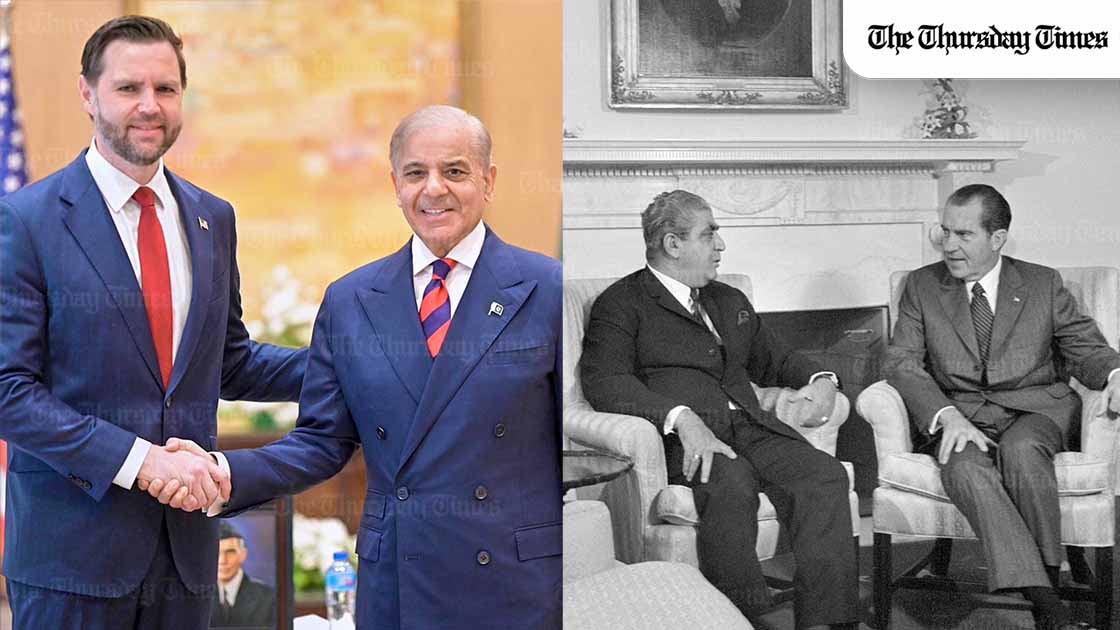
PAKISTAN’S RISE AS THE SETTING and channel for U.S.-Iran diplomacy in April 2026 did not begin with a conference table in Islamabad. It began in the older, quieter realm of statecraft, where countries become useful not because they are the strongest in the room, but because they can still speak to everyone left standing. By the time American and Iranian officials met face to face in Pakistan’s capital, Islamabad had already spent days, and by some accounts weeks, doing the less visible work that makes formal talks possible at all: carrying messages, testing intentions, absorbing panic and preventing a crisis from hardening into a permanent breakdown.
That is the first point worth fixing in the public imagination. Islamabad was not chosen first and then entrusted with diplomacy. Pakistan was entrusted with diplomacy first, and Islamabad became the venue because the process had already begun to run through Pakistani hands. Reuters reported that Pakistan had been mediating between Washington and Tehran before the talks opened, and that its proposal involved an immediate ceasefire followed by broader negotiations, with Islamabad envisaged as the place where the effort would be consolidated in person.
The atmosphere in which this happened matters. These were not routine talks emerging from patient multilateralism. They came amid an active regional war, a blockade of the Strait of Hormuz, severe disruption to global energy markets, and a broader fear that the conflict could spill across the Gulf and Levant. Reuters and the Associated Press both described the diplomacy as unfolding against a fragile ceasefire and amid continuing military tension, which meant Pakistan was not handling a neat diplomatic file but a live crisis in which delay could itself become a strategic event.
What appears to have turned Pakistan from intermediary into indispensable broker was the moment the process nearly collapsed. Reuters reported that ceasefire diplomacy was badly shaken after an Iranian strike on a Saudi petrochemical facility triggered fury in Riyadh and threatened to derail weeks of back-channel work. Pakistan then mounted what Reuters described as a last-ditch push, passing messages between Tehran and Washington while also engaging Saudi Arabia and seeking assurances that would keep the diplomatic track alive. This is the part that often gets flattened into a generic phrase like “Pakistan mediated talks.” In reality, mediation here meant holding together a structure that was already splintering under pressure from events on the ground.
Only after that rescue effort did Islamabad fully emerge as the capital of the process. Reuters reported on April 11 that U.S.-Iran negotiations were underway in Pakistan, while the Associated Press described the marathon discussions that followed as 21 hours of face-to-face ceasefire talks in Islamabad. However one chooses to interpret the outcome, the fact of those meetings was itself significant: high-level representatives of the United States and Iran, after years of estrangement and amid an open crisis, were meeting directly on Pakistani soil under Pakistani mediation.
There is a temptation to treat this as an extraordinary improvisation, a lucky convergence of personalities and timing. But Pakistan has played this role before, and on one of the grandest diplomatic stages of the twentieth century. The closest historical parallel is not in the Middle East at all, but in the Cold War opening between the United States and the People’s Republic of China. The U.S. State Department’s Office of the Historian records that Richard Nixon established a secret channel to Beijing through Pakistani President Yahya Khan because Pakistan had good relations with both Washington and Beijing and offered a discreet way to bypass the normal bureaucracy.
That historical record is unusually direct. The State Department’s own summary of the period says that in the late summer and autumn of 1969, Yahya Khan offered to play an active role in rapprochement and that Nixon and Henry Kissinger found in the Pakistani channel a secret avenue of communication that bypassed the Department of State. It also notes that in December 1969 the Pakistani ambassador in Washington, Agha Hilaly, transmitted the first direct message from the People’s Republic of China. Pakistan, in other words, was not simply a friendly observer to the U.S.-China opening; it was one of the hidden mechanisms through which that opening became real.
The archival trail goes further. U.S. historical documents show Nixon responding to messages from Zhou Enlai that had been conveyed “through the courtesy of President Yahya Khan,” and other memoranda show Pakistani officials acting on the belief that Washington wanted accommodation with Communist China and would appreciate Pakistan passing that signal to Beijing. Those records are important because they show a pattern, not a myth. Pakistan was functioning not as a ceremonial go-between, but as an active courier of political intent at a moment when neither side was yet ready to rely on normal channels.
The symbolism of that role reached its fullest form in 1971, when Kissinger’s secret trip to China was arranged through Pakistan. U.S. archival material records the exchanges leading up to the journey, and later White House conversation records include Kissinger explicitly saying that the Pakistani ambassador “put me on the plane to Peking,” with Nixon replying that Pakistan had been “most helpful and discreet.” Those lines matter because they distil the entire strategic value of Pakistan in one phrase: helpful and discreet. That was the currency then, and it remains the currency now.
Seen against that background, Islamabad’s 2026 role with Iran looks less like a diplomatic miracle than a revival of an older Pakistani specialty. Pakistan has repeatedly become most relevant when formal relationships are brittle, when direct contact is politically sensitive, and when leaders need a channel that is neither fully public nor wholly deniable. In 1969 to 1971, that channel connected Washington and Beijing. In April 2026, it connected Washington and Tehran while also intersecting with Saudi concerns and the wider crisis over energy security and the Strait of Hormuz. The context changed; the method did not.
That continuity tells us something larger about Pakistan’s place in international politics. Too often, middle powers are discussed only through the lens of their vulnerabilities, dependencies or domestic turbulence. Yet diplomacy does not always reward the most orderly state or the richest one. Sometimes it rewards the state that can still carry a message across lines of suspicion. Pakistan’s advantage in both the China opening and the U.S.-Iran crisis lay not in abstract prestige, but in usable relationships: enough access in Washington to be taken seriously, enough credibility elsewhere to be heard, and enough political agility to operate in the interval between war and negotiation. This is partly an inference from the record, but it is a strongly grounded one.
None of this means Pakistan is a neutral saint floating above great-power competition. Mediation is not moral weightlessness. It is a strategic role, and like any strategic role it serves the mediator’s own interests as well. Stabilising a nearby conflict, preventing wider regional collapse, keeping trade routes open and expanding diplomatic relevance are all obvious Pakistani interests. Reuters’ reporting on Pakistan’s ceasefire efforts explicitly tied the crisis to shipping disruption and broader regional fallout, making clear that Islamabad was not acting in a vacuum of altruism. It was acting because peace, or at least managed de-escalation, aligned with Pakistani interests and capacities at the same time.
Still, there is a difference between having an interest in peace and having the ability to make oneself useful to it. Many states wanted de-escalation between the United States and Iran. Far fewer could become the place where both sides would actually sit. That is the distinction Islamabad earned in April 2026. The talks may not have delivered a full agreement; Reuters, AP and other reports made clear that key differences remained and that the marathon round ended without a breakthrough. But the failure to produce a final settlement should not obscure the prior achievement of creating a channel robust enough to survive a regional war, a ceasefire crisis and direct confrontation between long-standing adversaries.
The deeper historical lesson is that Pakistan’s diplomacy is easiest to underestimate when one mistakes visibility for importance. Its most consequential contributions have often happened in the half-light: a message carried, a mistrust absorbed, a secret journey arranged, a ceasefire salvaged overnight before the public sees the communiqué. In 1971, that half-light helped redraw the Cold War map by helping Washington reach Beijing. In 2026, it helped create the narrow diplomatic corridor through which the United States and Iran could at least attempt to step back from the brink. That is not a small tradition. It is one of the more consequential continuities in Pakistan’s foreign policy history.
And so the real timeline is not a neat list of dates but a recurring political habit. First comes estrangement. Then crisis. Then the search for a channel no one fully controls but everyone can still use. Pakistan has filled that role before. It filled it again in 2026. Whether the latest effort matures into durable diplomacy remains uncertain, but the path by which Islamabad reached that moment is already clear: not by accident, not by symbolism, and not by one dramatic weekend alone, but through the old hard craft of being the state that adversaries can still talk through when they are no longer ready to talk to one another directly. ∎


