

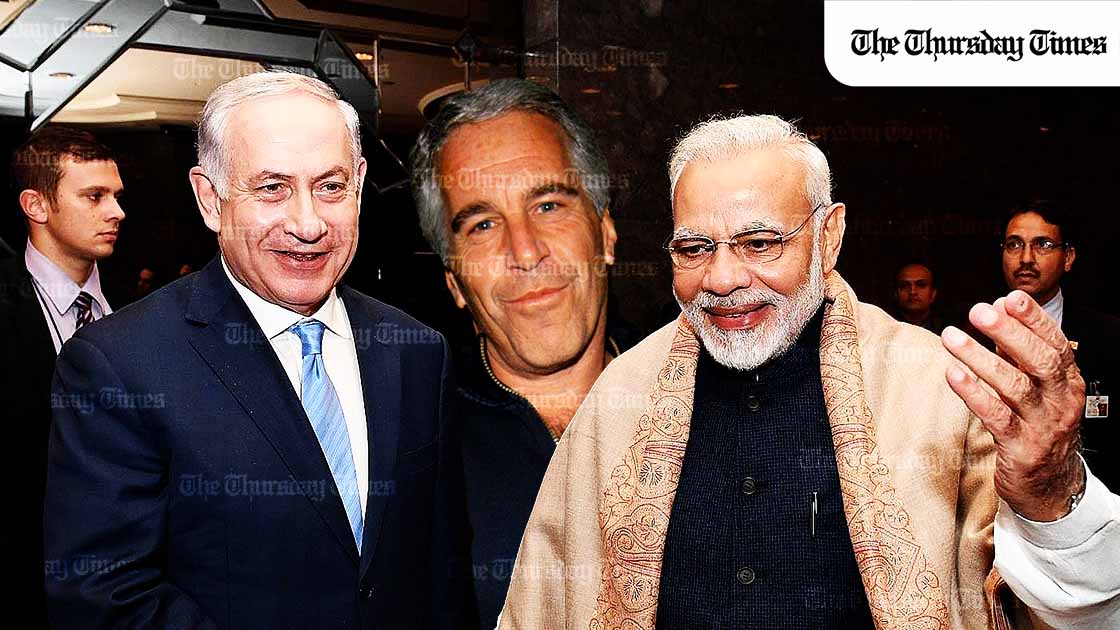
LONDON (The Thursday Times) — The re-emergence of a 2017 email attributed to Jeffrey Epstein has ignited a narrative that now places Narendra Modi inside one of the most toxic archives of modern political scandal. The line at the centre of the storm—brief, loaded, and emphatic—has been elevated from correspondence into accusation: “The Indian Prime Minister Modi took advice and danced and sang in Israel for the benefit of the US President… IT WORKED!”
The sentence is not descriptive, but directional. It does not merely recount events; it implies causation, intention, and outcome. Modi “took advice.” Modi then “danced and sang” in Israel. The action was “for the benefit of” Donald Trump. And finally, the verdict is delivered in capital letters: IT WORKED. The structure reads less like commentary and more like a mission report.
The narrative constructed around this line relies heavily on sequencing. Modi met Trump in late June 2017. Days later, he travelled to Israel in early July. Epstein’s email follows immediately after. In this framing, proximity in time becomes proof of design. A diplomatic calendar is recast as a choreography of influence: meeting, instruction, performance, reward. The simplicity of the sequence is its strength: it invites readers to see strategy where they might otherwise see routine diplomacy.
Language does much of the work. “Took advice” is a phrase that presumes hierarchy. Advice flows from someone who knows to someone who listens. In the narrative now circulating, this phrase is weaponised to suggest that a sitting prime minister was receptive to private guidance from a figure operating outside formal state structures. The implication is not merely consultation, but dependence; an inversion of expected power relations.
Then comes the phrase that has generated the most visceral reaction: “danced and sang.” Whether metaphorical or literal is beside the point in this construction. The wording is chosen for humiliation. It reduces statecraft to spectacle, policy to performance. It invites the reader to imagine a head of government not negotiating, but entertaining: seeking approval rather than asserting sovereignty. The imagery is deliberately undignified.
The clause “for the benefit of the US President” reframes the entire Israel visit. In this telling, Israel is not the primary interlocutor but the stage. Modi is not the principal actor but the intermediary. The true audience is Washington. The visit is no longer bilateral diplomacy but triangular signalling, with India demonstrating alignment in a way meant to please Trump and reinforce his worldview.
And then there is the sentence fragment that closes the loop: IT WORKED. The phrase is stark, final, and intentionally vague. Worked how? For whom? Toward what end? The narrative thrives on that silence. By refusing to specify the outcome, the line becomes a blank cheque for inference. Readers are invited to supply their own conclusions; policy concessions, political favour, strategic alignment, or something darker.
What makes this construction potent is not detail but implication. No explicit allegation is spelled out. Instead, the reader is led through suggestion after suggestion until the emotional destination is reached without the need for evidence to be named. This is classic insinuative rhetoric: the power lies in what is implied, not what is proven.
The narrative also depends on moral contamination. Epstein is not introduced as a neutral observer but as a symbol of corruption and abuse. By placing Modi in the same sentence, the narrative attempts a transfer of stigma. The logic is not articulated, but it is felt: proximity to Epstein’s words becomes proximity to Epstein’s sins. The revulsion directed at one figure is meant to spill onto the other.
From there, escalation is rapid. A single email line is stretched into claims of a “deep and long-standing connection.” Temporal coincidence is reinterpreted as sustained relationship. Ambiguous phrasing becomes evidence of a pattern. The leap is not analytical; it is rhetorical. Its purpose is to move the discussion from what was written to what must be answered for.
This is where the language of national honour enters. The issue is framed not as curiosity but as crisis. “National dignity” and “international reputation” are invoked as stakes too high for ambiguity. Once those terms are introduced, silence itself is recast as guilt. Explanation is no longer optional; it is demanded as a matter of patriotic duty.
The three questions posed—what advice, why the performance, what did “worked” mean—are not neutral inquiries. They are prosecutorial prompts, designed to imply that only incriminating answers are possible. In this structure, denial becomes evasion, and clarification becomes confirmation. The frame is closed before the response is heard.
What emerges, taken strictly at face value, is not just an allegation but a story with a moral arc: secret advice, theatrical obedience, foreign benefit, declared success. It is a narrative engineered to provoke outrage, to collapse complexity into suspicion, and to convert an ambiguous sentence into a demand for reckoning.


