
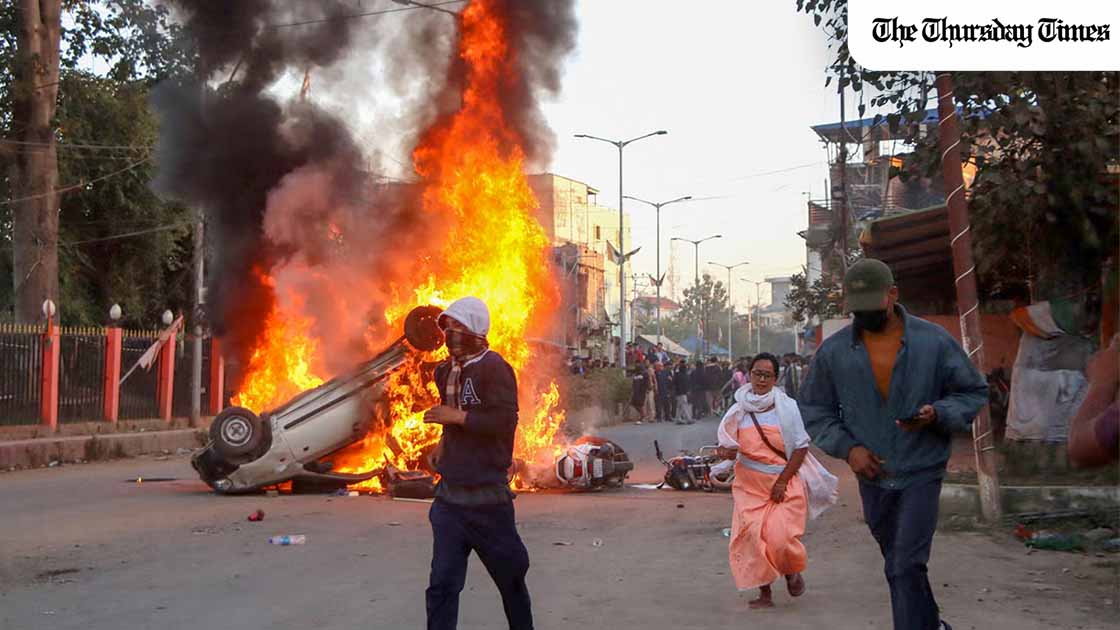
BHARAT’S NORTHEASTERN STATE OF MANIPUR has stopped behaving like a state and started behaving like a border. Not the kind drawn neatly on a map, but the kind that moves. A line that appears overnight between neighbourhoods, between markets, between people who once shared the same roads and festivals. When a society lives like that for long enough, it begins to develop the instincts of a separate place, with its own rules of fear, its own vocabulary of loyalty, its own sense of what is safe and what is not.
The protests in Churachandpur this week were not simply an outbreak. They were a reminder that politics in Manipur is no longer confined to institutions. A cabinet appointment can now land like a provocation. A confidence vote can be won inside the Assembly while the street delivers its own verdict outside. In the smoke of burning tyres and the hard choreography of tear gas, there is a message that keeps returning. The state exists on paper. On the ground, many people do not feel governed, they feel contained.
This is where the question in the title stops being rhetorical. Republic of Manipur is not a constitutional claim. It is a description of a condition. A place in which competing ideas of legitimacy live side by side and do not recognise one another. A place in which authority is local, grievance is communal, and the language of the centre arrives like a foreign broadcast.
Every fresh protest is framed as the latest spark, but the fire is older. Once violence becomes a recurring rhythm, it reorganises daily life. Families relocate. Trade routes shift. Schools stop, restart, and stop again. Entire districts learn to rely less on government and more on their own networks. Over time, that is how separatism is quietly built, not always through slogans, but through survival.
The most dangerous part is the normalisation. Security convoys become background noise. Curfews become a seasonal weather. Internet blackouts become a known instrument. When emergency measures are repeated often enough, they stop looking like a response and start looking like a system. And a system that cannot deliver normal life teaches people to imagine alternatives.
If you wanted to design the psychology of a new country, you would begin exactly here. You would create separation, then make it routine. You would allow public services to fragment, then let communities fill the vacuum. You would make trust impossible, then insist on unity as a slogan. In time, people stop asking when the state will return. They start asking who they are without it.
That is why Manipur is not just a local crisis or a regional headache. It is a warning signal for Asia, a continent that still carries unresolved borders like old scars. Many states in Asia were constructed through rushed partitions, fragile compacts, and bargains that worked only as long as politics remained stable. When stability breaks, the old questions return with a sharper edge: Who belongs. Who rules. Who is protected. Who is heard.
The idea of a new country in Asia is not fantasy. The modern world has produced new states through the slow grinding of legitimacy, not only through sudden war. A new country begins when a population believes the centre is not theirs. It begins when the shared story of citizenship collapses. It begins when the costs of remaining feel higher than the risks of leaving.
Manipur today feels like a place drifting toward that psychological threshold. Not because everyone wants separation, but because too many people have stopped believing in reintegration. They do not see a route back to common life. They see rival administrations of fear. They see competing moral universes. They see politics as an arena where their safety is negotiated, not guaranteed.
New Delhi’s instinct has been to manage the crisis as a security problem, but security management cannot substitute for political settlement. It can freeze violence, but it cannot melt distrust. It can disperse crowds, but it cannot rebuild a shared public sphere. Each time force becomes the primary language of governance, it quietly confirms the separatist argument that the relationship is coercive.
The tragedy is that the rest of Bharat is learning to look away. The country has grown used to the idea that certain places burn more often than others, as if geography can explain away injustice. But indifference is not neutral. Indifference is fuel. When communities feel unseen, they stop speaking in the language of the nation and start speaking in the language of grievance, identity, and retaliation.
So the question is not whether Manipur will declare itself a republic. The question is whether Bharat will treat Manipur as a full member of the union in practice, not only in principle. That means a settlement that is credible, inclusive, and enforced by institutions rather than by ad hoc deployments. It means rebuilding trust through safety, accountability, and a political process that is not a performance.
If that does not happen, the phrase Republic of Manipur will keep gaining weight. It will shift from metaphor to mood, from mood to movement. And one day, Asia may wake up to a new name being spoken as if it has always existed, not because a border was drawn overnight, but because a state dissolved slowly in the minds of its people. ∎


