

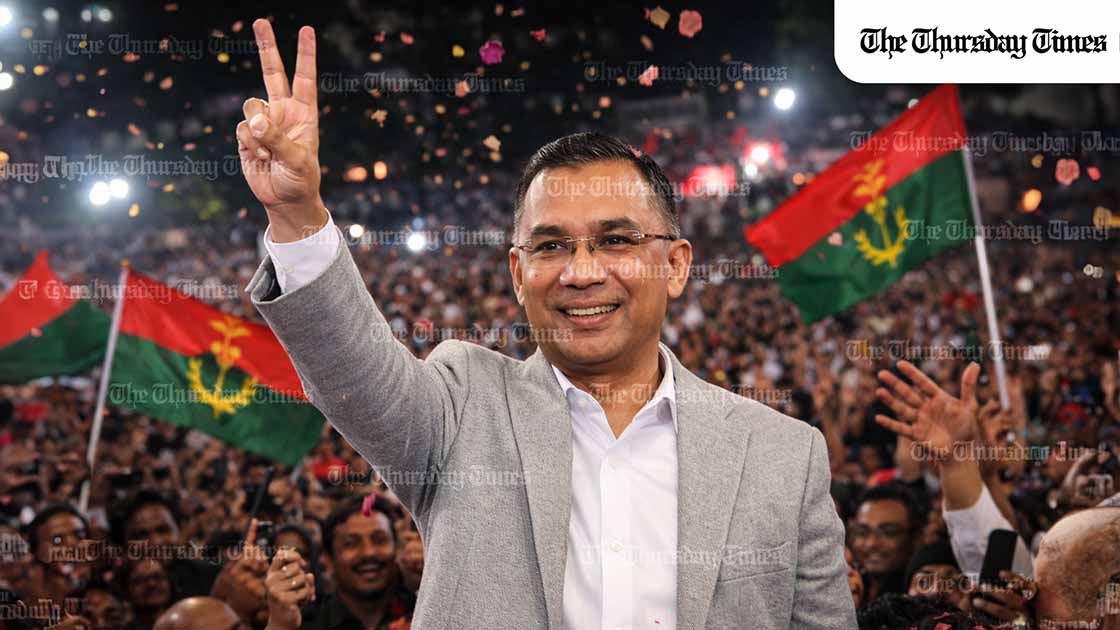
DHAKA (The Thursday Times) — Bangladesh’s long-awaited parliamentary election has delivered a decisive political upheaval, with the Bangladesh Nationalist Party surging beyond a two-thirds majority in parliament after a vote marked by heavy turnout and scenes of public celebration across the country.
Final seat counts released through official results and party tallies showed the BNP winning 210 seats in the 299-seat legislature, clearing the threshold that grants a government extraordinary legislative leverage. The scale of the victory positions Tarique Rahman, the party’s chairman, as the leading contender to become Bangladesh’s next prime minister, and places the BNP back at the centre of national power after nearly two decades in opposition.
Bangladesh National Parliamentary Election 2026
Total seats: 299Bangladesh Nationalist Party (BNP) surges past two-thirds majority in Bangladesh’s parliamentary election. Tarique Rahman poised to become the new Prime Minister.
BNP – 210 seats
Jamaat – 69 seats pic.twitter.com/fgg2fsMdVG— The Thursday Times (@thursday_times) February 13, 2026
For many voters, the day carried the feel of civic release. Across cities and rural districts, men and women queued for hours at polling centres, including elderly citizens and people with disabilities, determined to cast ballots in what officials described as a largely peaceful process. Women turned out in conspicuous numbers, often arriving in groups, underscoring broad participation across age and gender.
The election also produced a striking secondary result: Bangladesh Jamaat-e-Islami emerged with a substantial bloc of 69 seats, giving it an outsized role in shaping parliamentary dynamics, whether as a force of support, resistance, or negotiation on key legislation. The gains signalled a reconfiguration of political influence beyond the BNP’s own resurgence.
Senior BNP figures declared the outcome an emphatic mandate, framing it as a popular demand for change after years of turbulence and contested legitimacy. Party representatives said the breadth of victories across constituencies suggested not merely a swing in a handful of battlegrounds but a nationwide shift.
Rahman’s ascent is laden with symbolism. After spending years outside the country, including a long period in the United Kingdom, he returned to find a political landscape shaped by fatigue, anger and institutional strain. Supporters cast his leadership as proof that exile had not diminished the party’s hold on its base, while opponents warned that an overwhelming majority could sharpen, rather than ease, Bangladesh’s polarisation.
Beyond the parliamentary race, voters also took part in a referendum on constitutional reforms, with two votes held simultaneously for the first time in the nation’s history. The combined ballot framed the day as both an election and a contest over the country’s political rulebook, raising expectations that the next government would move quickly on institutional change.
The immediate question now is not who won, but what this magnitude of power will be used for. A two-thirds majority can enable rapid legislative action, but it can also test restraint in a political system where trust has been repeatedly eroded. Whether the new parliamentary arithmetic brings stability, reform and reconciliation, or a deeper cycle of rivalry, will define the months ahead.
For Bangladesh, the election’s headline numbers are unmistakable. The BNP has returned with force, Jamaat has secured a meaningful foothold, and the country enters a new phase with its political centre of gravity abruptly shifted.


