

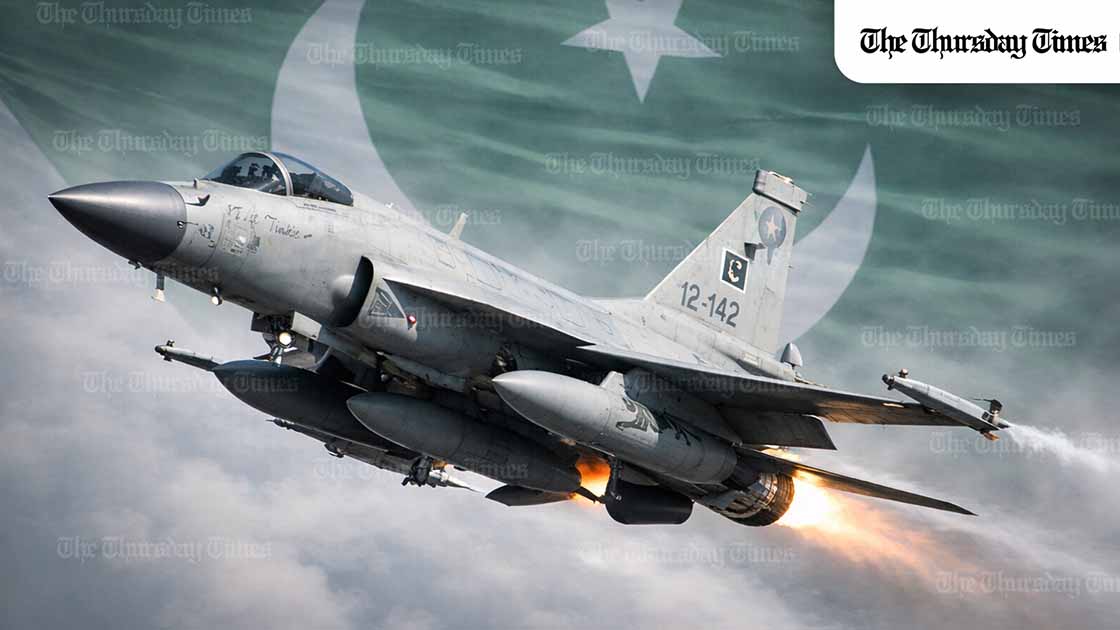
ISLAMABAD / MOGADISHU (The Thursday Times) — The JF-17 Thunder, once viewed primarily as a budget-conscious alternative to Western combat aircraft, has moved into a different category. Following Pakistan’s recent military confrontation with India, the aircraft has been presented by officials and defence commentators as combat-tested and operationally validated, a distinction that carries weight in global arms markets.
During the heightened tensions, the JF-17 was integrated into Pakistan’s layered air defence posture and maintained at high readiness. The analysts argue that the episode strengthened the jet’s reputation as a credible frontline multirole fighter rather than merely a cost-effective option.
That shift in perception now appears to be influencing procurement decisions far beyond South Asia.
The Federal Government of Somalia is reportedly engaged in advanced negotiations with Pakistan to acquire up to 24 JF-17 Thunder Block III fighter jets, according to defence observers and regional security officials familiar with the discussions. If finalised, the deal, estimated at roughly 900 million dollars, would represent Somalia’s most consequential defence acquisition since the collapse of its central government in 1991.
The aircraft is jointly produced by the Pakistan Aeronautical Complex and China’s AVIC Chengdu Aircraft Corporation, and serves as a backbone platform for the Pakistan Air Force. The latest Block III variant incorporates an active electronically scanned array radar, upgraded avionics, enhanced electronic warfare systems and compatibility with advanced beyond-visual-range missile systems, features designed to narrow the technological gap with more expensive Western fighters.
For Somalia, the potential acquisition is transformative. The Somali Air Force has lacked a fixed-wing combat fleet for more than three decades. Since the early 1990s, Mogadishu has relied heavily on external partners for airspace monitoring and limited aerial support. Restoring an indigenous fighter capability would mark a decisive step towards sovereign control of its vast airspace, maritime corridors and critical trade routes.
A recent visit to Islamabad by a Somali Air Force delegation led by Commander Mohamud Sheikh Ali underscored the operational urgency behind rebuilding that capability. Officials familiar with the talks say Pakistan’s offer extends beyond aircraft delivery to include pilot training, weapons integration, maintenance infrastructure and long-term logistical support.
Pakistan is not marketing an unproven platform. The JF-17 already flies with foreign operators. Myanmar and Nigeria field the aircraft within their air forces, while Azerbaijan has joined the programme more recently, expanding its order and publicly unveiling new deliveries. These exports have provided Islamabad with practical experience in sustaining overseas fleets and managing long-term defence partnerships.
Beyond confirmed operators, the sales pipeline appears to be widening. Bangladesh has engaged in discussions that include the potential acquisition of JF-17s, and defence reporting in recent months has cited interest or exploratory talks involving Iraq, Indonesia, Saudi Arabia and Libya. The breadth of engagement reflects Pakistan’s effort to position the aircraft as a competitive option for emerging and mid-tier air forces seeking multirole capability without the financial and political constraints often attached to Western systems.
For Somalia, the regional implications are considerable. The Horn of Africa continues to grapple with piracy, insurgency and illicit trafficking networks. A fleet of modern fighters would significantly expand Mogadishu’s capacity to monitor and defend its airspace and maritime approaches, potentially reshaping the local airpower balance.
For Pakistan, each negotiation reinforces a broader strategic ambition. Islamabad has increasingly framed defence exports as a pillar of economic and diplomatic policy, targeting partnerships across Africa, the Middle East and Asia. By emphasising affordability, operational validation and flexible cooperation terms, Pakistan seeks to differentiate its aerospace industry in a competitive global marketplace.
The agreement would not only restore Somalia’s aerial deterrence for the first time in a generation. It would also underscore Pakistan’s emergence as a credible exporter of modern fighter aircraft, signalling that the JF-17 Thunder has evolved from a regional programme into a platform with growing global reach.


