
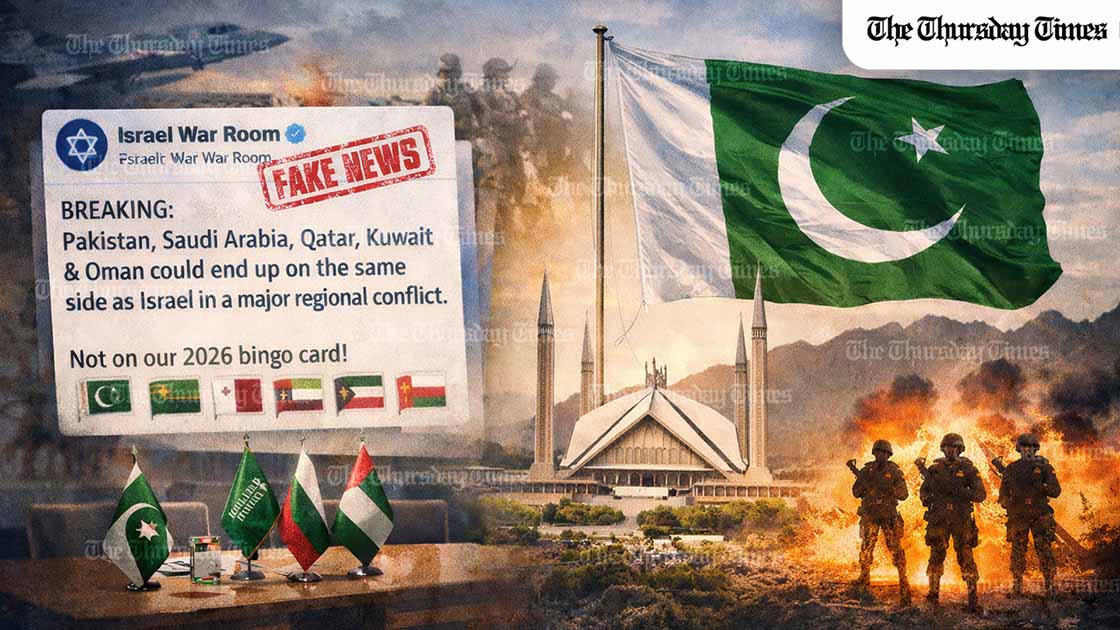
ISLAMABAD (The Thursday Times) — A single X post from an account calling itself “Israel War Room” has been elevated into “official sources” across social media horizon, including parts of the Afghan media ecosystem, and then used to sell a sensational line: that Pakistan, Saudi Arabia, Qatar, Kuwait and Oman could end up fighting “on the same side as Israel”. It is a familiar pattern in modern conflict coverage: a viral screenshot becomes a geopolitical thesis, and context becomes collateral damage.
Let’s be blunt. The post reads like social media commentary, not state policy. “Not on our 2026 bingo card” is not the language of governments or militaries setting doctrine in the middle of a war. Yet it is being treated as if it carries institutional weight, simply because it is shareable, performs well in outrage cycles, and arrives with the aesthetics of credibility.
Pakistan’s position is being deliberately blurred in the process. Islamabad’s recent messaging has been consistent with crisis management, not camp selection: contain escalation, prevent spillover into the Gulf, and protect Pakistan’s interests and citizens across the region. When Pakistani officials referenced the Pakistan–Saudi defence framework in communications with Tehran, it was deterrence signalling aimed at preventing strikes on Saudi territory, not a statement of Israeli alignment or a commitment to fight Iran.
This distinction matters because it is the difference between warning a party not to widen a war and volunteering to join it. Pakistan can support the principle of shielding Saudi Arabia and other Gulf states from attack while also maintaining diplomatic engagement with Iran and calling for de-escalation. In fact, that is exactly what a balancing state does when the region starts to slide.
And then there is the basic credibility issue that social media conveniently ignores. If this account truly represents an “Israeli war room”, why does it so often sound like it is operating in an American political register? Put simply: what kind of “war room” is it if it appears to be run for a US timeline rather than an Israeli national conversation? That does not prove anything on its own, but it should make editors think twice before treating it as a governmental mouthpiece.
None of this is to pretend the region is calm. The Gulf is anxious, air defence calculations are shifting, and deterrence messaging is intensifying. But it is precisely in these moments that lazy conclusions become dangerous. Presenting Pakistan–Saudi security ties as proof that “Pakistan is fighting alongside Israel” is not just sloppy, it is a deliberate attempt to manufacture a false narrative, dress opinion up as fact, and push a made-for-social-media storyline that inflames sectarian sentiment and sabotages diplomacy.
Pakistan is not “joining Israel” because an X account made a quip. Pakistan is signalling deterrence to prevent the war expanding into Saudi territory while keeping diplomatic lines open and pushing to reduce escalation. If commentators want to argue Islamabad’s approach is flawed, they should argue it on policy and evidence, not on the basis of a viral post being mislabelled as an “official source”.
In a crisis, everyone is hungry for certainty. But screenshots do not make alliances — decisions do.


