
ISLAMABAD (The Thursday Times) — A single line from a US congressman has cut through the noise with the bluntness of a battlefield rumour and the reach of a Washington megaphone. Ryan Zinke wrote that “right now, in Pakistan, members of the Taliban are driving American Humvees, shooting American M16s, and utilising American tactical gear”, then added that roughly $7 billion in US equipment left behind after the Afghanistan withdrawal is now “being used for terrorism”.
If anyone still needs convincing as to why decisive action against the terrorist threat in Iran is necessary, look at the alternative. Right now, in Pakistan, members of the Taliban are driving American Humvees, shooting American M16s, and utilizing American tactical gear to…
— Rep Ryan Zinke (@RepRyanZinke) March 4, 2026
In Pakistan, where attacks, raids, and border firefights form the daily rhythm of the security map, the post is not read as campaign rhetoric alone. It lands on a long-running Pakistani claim: that the collapse of Afghan stockpiles in 2021 did not end at Afghanistan’s borders, and that what was once provided to support Afghan forces has spilled into the region’s militant ecosystems.
افغانستان میں چھوڑے گئے امریکی ہتھیار جب اسلحہ کی منڈی میں پہنچ جاتے ہیں تو بالآخر دہشتگردوں کے ہاتھ لگتے ہیں۔ یہ مسئلہ صرف پاکستان تک محدود نہیں رہتا، بلکہ یہ ہتھیار دنیا کے کسی بھی حصے میں سامنے آ سکتے ہیں، کیونکہ تمام دہشتگرد تنظیمیں اور غیر ریاستی عناصر آپس میں مضبوط اور منظم… pic.twitter.com/ECrLrtImIg
— The Thursday Times (@thursday_times) February 4, 2026
The uncomfortable centre of the story is the same one Pakistani officials raise privately and publicly. Technology and equipment that was framed for years as a tool of stabilisation and protection has, in multiple accounts, reappeared in the hands of actors accused of targeting Pakistani civilians and security personnel. The argument is not about nostalgia for a failed mission. It is about what happens when modern kit becomes an after-market commodity, moving through smugglers, facilitators, and conflict economies that thrive in the gaps between states.
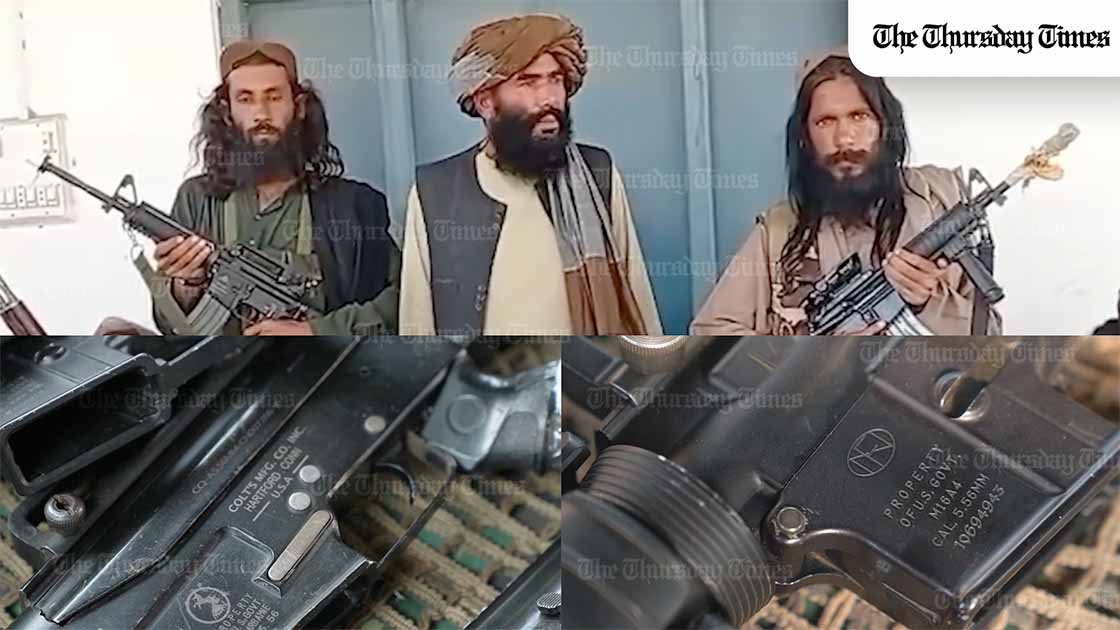
The claim has gained sharper edges in recent Pakistani reporting that cited CNN footage and verification methods tied to US-origin weapons. According to that coverage, M16-platform rifles were confirmed through serial-number checks, with some weapons reportedly marked “U.S. Government Property”. The same reporting, as relayed by The Thursday Times, cited the US military as saying that before the Kabul withdrawal a large share of Afghan forces’ weapons ended up in Taliban hands and then dispersed through different routes across the region.
Taliban utilising US weapons against Pakistan; footage from CNN shows M16s per serial checks. US military confirmed 75% of weapons traced to Afghan forces near Kabul pre-withdrawal with 100+ marked US Government property.
via: CNN pic.twitter.com/q1SgzBBAU5
— The Thursday Times (@thursday_times) February 3, 2026
The Thursday Times has separately reported, citing Pakistani security and intelligence sources, that advanced US-origin equipment left behind after the withdrawal has appeared in militant activity inside Pakistan, particularly across Balochistan and parts of Khyber Pakhtunkhwa, where officials have claimed recoveries and evidence of modern kit being used in attacks and raids.
Zinke’s wording goes further by placing Humvees “in Pakistan”, an allegation that is harder to substantiate publicly than small arms, optics, and accessories that travel easily and leave fewer logistical fingerprints. If such vehicles are in use, the most plausible theatre is the border conflict belt rather than major urban centres, where rugged terrain, cross-border movement, and entrenched support networks make concealment and mobility easier.
Pakistan’s security establishment insists that the question is not whether a politician can write a viral paragraph, but whether claims can be anchored to recoveries, serial traces, and credible attribution. The CNN-linked serial checks cited in Pakistani reporting are the kind of detail that moves the story from allegation to evidence, and that distinction matters in a region where narratives can outrun facts and facts, when documented, reshape policy.
For Pakistan, the long tail of the 2021 withdrawal is not a memory. It is a supply problem that keeps reappearing in the hands of those accused of killing Pakistanis, and it is now being argued about in Washington in the same language Pakistan has been using on its frontier.


