
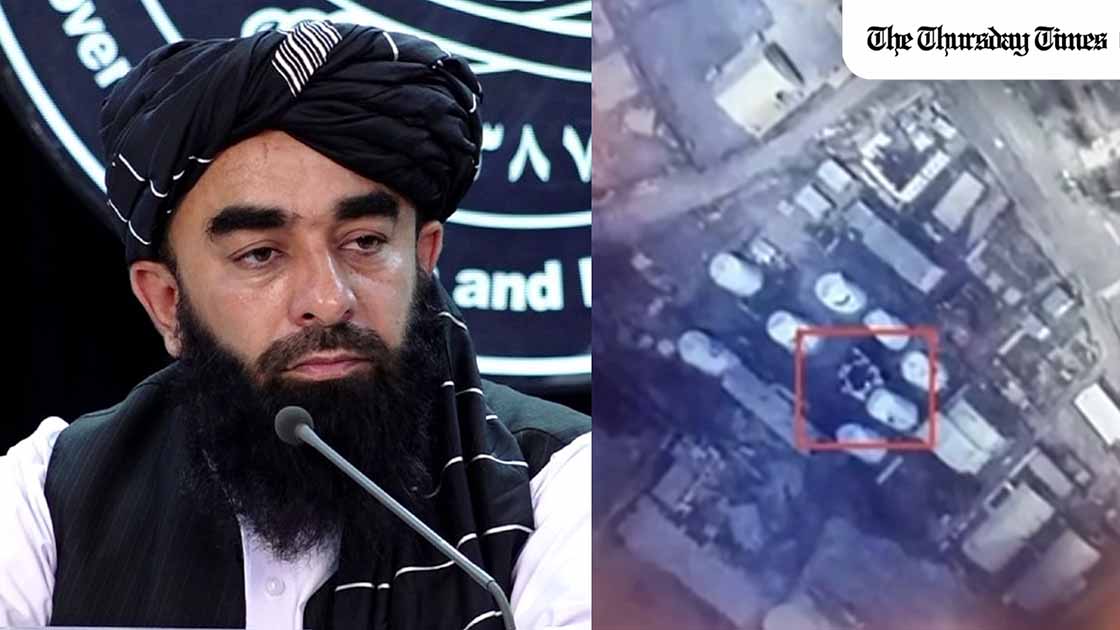
LONDON (The Thursday Times) — BBC’s handling of Zabihullah Mujahid’s remarks deserves serious scrutiny, not because it reported his claims, but because of how it framed them. The problem is not that the Taliban spokesman was quoted. The problem is that his version of events was elevated too easily, too prominently, and with too little visible scepticism for a report dealing with a live cross-border security incident in one of the most contested information environments in the region.
At the centre of the issue is verification. Mujahid claimed that Pakistan struck a rehabilitation centre for drug addicts and an empty container in a former military compound, causing no casualties. That is a claim from one side of an active conflict. It should have been treated as exactly that: a claim requiring careful testing, corroboration, and balance. Instead, the report gave his account the weight of an established fact while doing far less to foreground the competing evidence presented by Pakistan.
That imbalance is what makes the piece so difficult to defend. Pakistan did not merely issue a denial or a vague counter-accusation. It put forward what it says were near real-time visuals of the strikes, alongside geolocation-based material and analysis intended to support its position that the target was not a medical facility, but infrastructure linked to hostile activity. Even where such material still requires independent verification, it plainly deserved mention in any report claiming to present the dispute fairly. Leaving it out weakens the credibility of the whole framing.
Journalism in a conflict zone cannot become a matter of repeating the most dramatic allegation simply because it is quotable. The word “hospital” or “rehabilitation centre” carries immediate emotional force. It shapes public reaction at once. That is precisely why such claims demand the highest evidential threshold before being allowed to dominate a headline or narrative structure. If one side makes an inflammatory allegation and the other provides visual material to contest it, responsible reporting requires the audience to see both, not just the more sensational version.
The other missing element is context. The strikes did not occur in a vacuum. They came amid a long period of rising tension, repeated Pakistani claims of cross-border militant threats, and an increasingly strained security environment along the frontier. Whether one agrees with Pakistan’s military response or not, that background is essential to understanding why such an operation was carried out. To strip the event of that context is to flatten it into a simple story of unprovoked aggression, which is a distortion of the wider security picture.
This is where the BBC’s editorial judgment becomes most questionable. A global broadcaster with the BBC’s reach has a duty not merely to transmit statements, but to interrogate them. When it appears to give one party’s language pride of place while downplaying or omitting the evidentiary and security case advanced by the other, it risks moving from reporting into narrative selection. That matters, because in information warfare, selection is not neutral. What gets emphasised, what gets buried, and what gets omitted altogether can shape international perception as much as any explicit editorial line.
There is also a broader credibility issue at stake. Audiences today are not passive. They compare footage, statements, satellite imagery, and open-source analysis in real time. When a major outlet appears slower to acknowledge publicly circulating evidence than ordinary observers online, it creates the impression that the newsroom is less interested in pursuing the fullest available account than in preserving a familiar framing. That is damaging, especially in South Asian coverage, where perceptions of selective emphasis and inherited bias already run deep.
No serious observer is asking the BBC to become a platform for Pakistan’s official position. That is not the standard. The standard is fairness, rigour, and visible scepticism toward all sides. If the Taliban spokesman’s allegation was worth reporting, then Pakistan’s supporting material, its security rationale, and the retaliatory context were worth reporting too. To do otherwise is not balance. It is asymmetry dressed up as neutrality.
The core question, then, is simple. Why was the Taliban narrative allowed to lead so decisively, while Pakistan’s evidence and stated basis for the strike were pushed to the margins or left out? Why was a verbal claim given centre stage, while material presented in support of the opposing version did not receive comparable treatment? These are not minor editorial choices. They go to the heart of whether the audience was shown the full dispute or only the most headline-friendly half of it.
If the BBC wants to preserve trust on stories like this, it has to do more than quote both sides unevenly and call that impartiality. It must show that it has tested competing claims, weighed available evidence, and resisted the temptation to privilege drama over discipline. In a conflict as charged as this one, anything less does not merely fall short of good journalism. It risks becoming part of the problem.


