
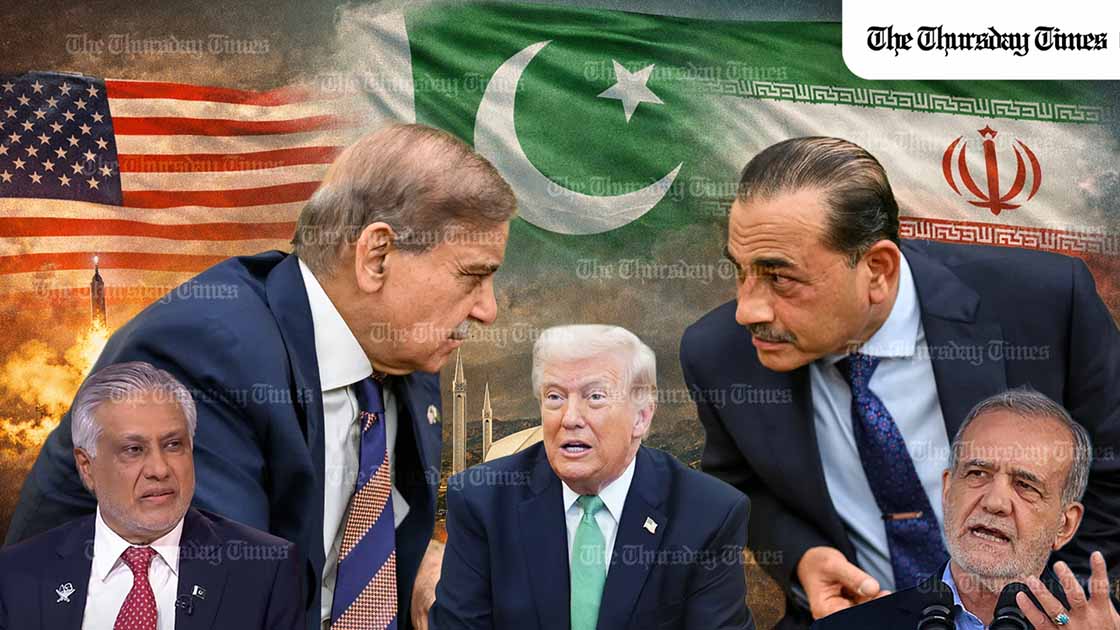
NEW YORK (The Thursday Times) — Pakistan is quietly but deliberately trying to pull one of the region’s most dangerous crises back from the brink. As the war centred on Iran threatens to widen into a broader regional confrontation, Islamabad is emerging not as a spectator but as a state attempting to keep the door to diplomacy open when others are preparing for escalation.
According to Bloomberg, Pakistan’s military and political leadership are in contact at the same time with Washington, Tehran and key Gulf capitals in an effort to prevent the conflict from hardening into a wider regional disaster. What is taking shape is not loud, theatrical diplomacy. It is a more calculated attempt to position Pakistan as a credible channel between powers that no longer trust one another, but may still need somewhere to talk.
At the centre of that effort, Bloomberg reported, was Field Marshal Syed Asim Munir’s contact with US President Donald Trump on Monday. People familiar with the matter said the discussion focused on finding a possible path towards ending the fighting. The report added that Pakistan is seeking to present Islamabad as a possible venue for talks, while Trump’s special envoy, Steve Witkoff, is said to be playing a central role in the diplomatic track.
That matters because, in conflicts of this kind, venue is never just venue. The location of possible talks often signals who is trusted, who is acceptable to both sides, and who has managed to preserve enough credibility to sit between rivals without immediately being dismissed by either of them. Islamabad’s emergence in that conversation suggests Pakistan believes it now has precisely that kind of leverage.
Trump said on Monday that he had postponed possible strikes on Iran’s energy infrastructure after what he described as productive conversations. Iranian officials, for their part, have not publicly acknowledged any formal negotiation process. Yet CBS News reported, citing a senior Iranian official, that messages sent by the United States through mediators were under review in Tehran. Even where official denials remain in place, the diplomatic traffic itself points to movement beneath the surface.
Taken together, these signals reinforce the impression that Pakistan is trying to cast itself as a state working to preserve contact rather than inflame confrontation. That distinction is critical. In moments of regional crisis, there is always a premium on countries willing to amplify rhetoric. There are far fewer willing, or able, to absorb political risk in order to keep channels open.
Bloomberg’s account suggests Pakistan is now drawing on a rare combination of relationships. On one side are its recent lines of communication with Trump and wider American circles. On the other are its longstanding ties with Iran, Saudi Arabia and other regional players. This is not neutrality in the abstract. It is strategic balance, built on the fact that Pakistan has enough access across competing camps to make itself useful.
Prime Minister Shehbaz Sharif’s conversation on Monday with Iranian President Masoud Pezeshkian fits squarely within that approach. Sharif expressed solidarity with Iran while also calling for de-escalation, later saying that Pakistan’s diplomatic outreach had been shared with the Iranian leadership and that Islamabad would continue to play a constructive role in facilitating peace in the region. That language was careful by design: firm enough to register political support, restrained enough to keep diplomatic space alive.
The same pattern runs through other reporting. The Financial Times also said Munir had spoken with Trump on Sunday, while Axios reported that mediating countries were trying to convene a possible meeting in Islamabad involving Steve Witkoff, Jared Kushner and potentially US Vice President JD Vance. Those reports remain unconfirmed in formal terms, but their cumulative effect is unmistakable. Islamabad has entered the diplomatic map of this crisis in a serious way.
Pakistan’s urgency is not driven by principle alone. It is also grounded in hard national interest. As the conflict expands, the pressure on the Gulf and on global energy routes has intensified. The Strait of Hormuz, through which roughly a fifth of the world’s oil and liquefied natural gas moves, has come under severe strain since the fighting began. For Pakistan, which depends heavily on Gulf imports of crude oil, refined petroleum and LNG, any prolonged disruption is not a distant geopolitical concern. It is an immediate economic threat.
That helps explain why Islamabad has accelerated its regional diplomacy. Foreign Minister Ishaq Dar attended a joint meeting in Riyadh last week with his counterparts from Arab and Muslim states to discuss the conflict. Bloomberg reported that Pakistan pushed to keep the language of the joint statement from worsening tensions between Iran and its Gulf neighbours. That is a small but revealing detail. States seeking to calm a crisis do not only work through grand summits and headline meetings. They also fight over adjectives, tone and phrasing, knowing that one reckless line can narrow the room for de-escalation.
Asim Munir’s own engagement with Saudi Arabia underlines how seriously Pakistan is treating the moment. He and Shehbaz Sharif travelled to Jeddah on March 12 to meet Crown Prince Mohammed bin Salman, just a day after Sharif had spoken with Iran’s president. Earlier in March, Munir also met the Saudi defence minister. These were not isolated calls. They form part of a broader effort to ensure that Pakistan remains in direct conversation with the capitals most likely to shape the next phase of the crisis.
The wider strategic backdrop also matters. Pakistan and Saudi Arabia signed a defence pact last September stating that aggression against one would be considered aggression against both. That agreement does not make Pakistan a passive observer of Gulf instability. It gives Islamabad a direct stake in preventing confrontation from spilling across the region in ways that could force choices later.
What Bloomberg’s reporting ultimately captures is not merely a sequence of calls and meetings, but a larger shift in perception. Pakistan is no longer appearing simply as a state watching events develop from the edge. It is trying, quietly, to place itself inside the room where outcomes may be shaped.
In a region tilting dangerously towards wider war, Pakistan is making a calculated bet – that influence now belongs not only to those who can threaten escalation, but also to those still capable of organising a way back from it.


