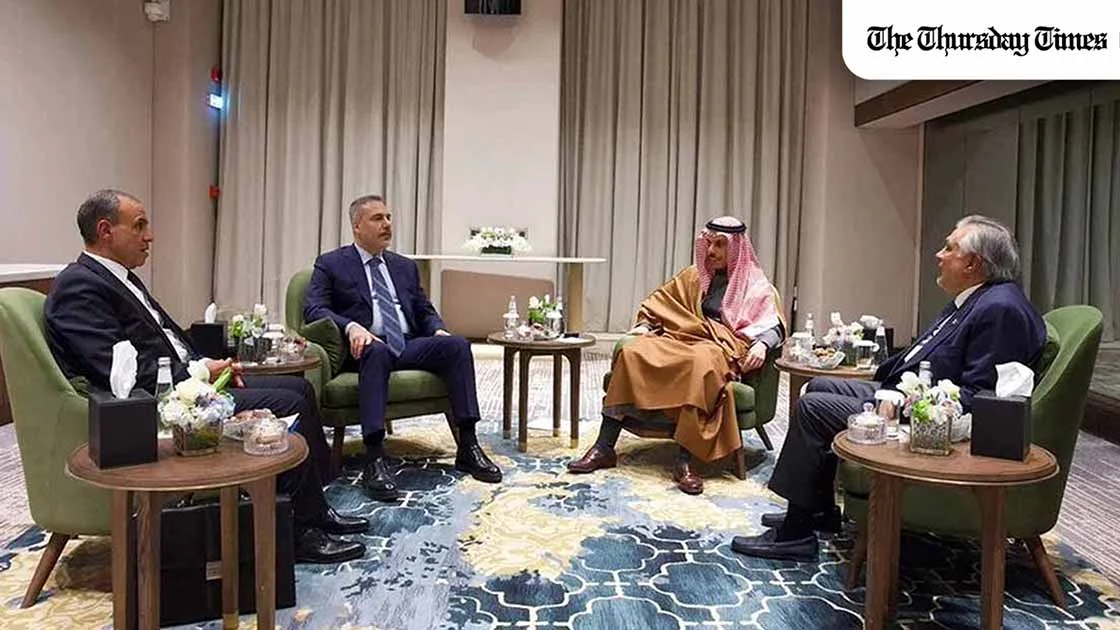
ISLAMABAD (The Thursday Times) — Pakistan is about to host a significant diplomatic event at a moment when the region faces not just general tension but also the war between Iran and the United States, the risks of its spread, and the question of how it will end diplomatically. On 29 and 30 March 2026, the foreign ministers of Saudi Arabia, Türkiye and Egypt will arrive in Islamabad. The visit is at the invitation of Deputy Prime Minister and Foreign Minister Senator Muhammad Ishaq Dar and, according to an official statement, will involve detailed consultations on a range of important matters, including efforts to reduce tension in the region.
According to an official statement shared by Ishaq Dar, Saudi Foreign Minister Prince Faisal bin Farhan Al Saud, Turkish Foreign Minister Hakan Fidan and Egyptian Foreign Minister Dr Badr Abdelatty will make a joint visit to Islamabad. The statement says the three foreign ministers will hold detailed exchanges of views with the Pakistani leadership and will also meet the Prime Minister of Pakistan.
Looking forward to welcoming my brother Foreign Ministers of Saudi Arabia, Türkiye, and Egypt to Islamabad.@FaisalbinFarhan @HakanFidan @mfaEgypt pic.twitter.com/3LLsJyUobv
— Ishaq Dar (@MIshaqDar50) March 28, 2026
The visit comes at a time when Pakistan itself has emerged as an intermediary in efforts to pass messages between Iran and the United States and to find a possible diplomatic way forward. According to Reuters, US envoy Steve Witkoff confirmed this week that the United States has presented Iran with a 15-point plan and that Pakistan is playing a mediating role at the initial stage. Reuters later also reported that Iran's response was expected and that the proposed framework had been conveyed to Tehran through Pakistan.
Against this background, the presence of the foreign ministers of Saudi Arabia, Türkiye and Egypt in Islamabad does not look like a routine diplomatic gathering. These three countries carry weight not only in the wider Muslim world and in the politics of the Middle East, but also play an important part in the shifting balance between Iran, the Gulf, the Arab world and the Western powers. For that reason the meeting is being seen as a platform where an effort could be made to build a common outlook on the war, diplomacy, regional stability and possible paths to negotiation. This is also supported by recent diplomatic contacts in which the Egyptian, Turkish and Pakistani foreign ministers discussed efforts to pave the way for direct US-Iran talks.
The meeting matters to Pakistan in two ways. On one hand, Islamabad is presenting itself as a capital where serious consultation can take place in tense regional conditions. On the other, if a diplomatic route between Iran and the United States does indeed open through Pakistan, the gathering of the foreign ministers of Saudi Arabia, Türkiye and Egypt in Islamabad at this very moment becomes a clear sign of Pakistan's growing diplomatic weight. In this context the visit appears to be not merely an expression of relations but part of a larger regional arrangement in which various powers are trying to stop the war from spreading and to find a politically acceptable way forward.
It is also worth noting that, although Pakistan's statement uses cautious language and confines itself to matters of mutual interest, cooperation and coordination, external reporting views the meeting more directly in the context of the Iran-US war. According to an AFP report, the talks in Islamabad are linked to the Middle East war and to efforts to reduce tension in the region. Some other regional reports have also described it as an important consultative step in the context of the US-Iran conflict, although some of the analytical claims in them are best treated with caution for now.
In this whole picture, the real question is not whether the meeting is important but how important it is. If the war between Iran and the United States takes a diplomatic turn, the consultations in Islamabad could be counted among the early and more meaningful stages of that process. And if the war spreads further, the same meeting could still become the basis of a structure of coordination among these states that is capable of using shared political weight during the crisis.
For now, this much is clear: the visit of the foreign ministers of Saudi Arabia, Türkiye and Egypt to Pakistan at this delicate stage is not mere coincidence but part of a larger diplomatic calculation, and in that calculation Pakistan's role appears more important than ever before.∎