
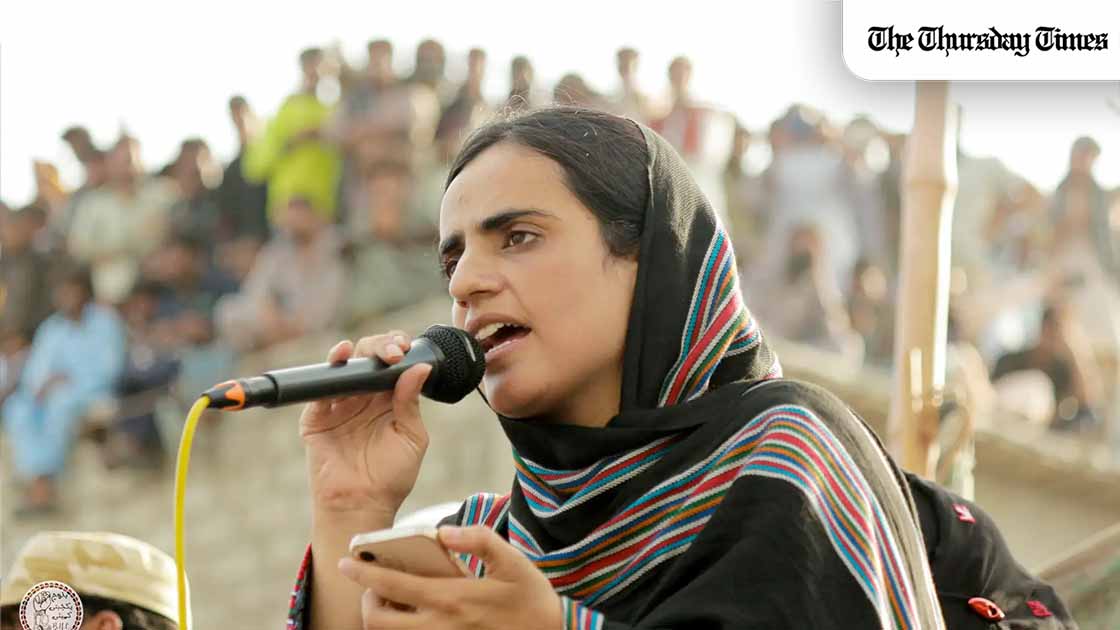
LONDON (The Thursday Times) — The Guardian’s 1 April piece by Mahrang Baloch is powerful, emotive and politically effective. It is also plainly an opinion article, published under the paper’s comment rubric, and it asks readers to accept a contested political narrative while leaving out substantial parts of the public record. That matters, because the issue is no longer simply whether Baloch grievances exist, but whether western outlets are flattening a violent and legally complicated landscape into a morality play with one heroine and one villain.
The first thing readers should understand is what The Guardian actually published. This was not a reported investigation or a balanced reconstruction of events. It was a first-person advocacy essay, headlined around “solitary confinement” and “peaceful fight”, with Mahrang Baloch presenting her own case directly to an international audience. The paper itself labels it as Opinion. That distinction is not cosmetic. It is the difference between a testimony and a tested account.
That difference becomes even more important because The Guardian has already had to correct parts of its earlier coverage of Mahrang. In its August 2024 profile, the paper later amended the article to say that an earlier version had wrongly stated that 50,000 people had been abducted, and removed a reference to 25,000 being killed. That correction does not invalidate every subsequent line the paper has published on Balochistan. It does, however, reinforce the need for caution when highly charged numbers and political claims are repeated without adequate scrutiny.
The most emotionally loaded claim in the new essay is the phrase “my year in solitary confinement”. Yet even the article itself complicates that image. Mahrang writes that two other BYC members are in cells next to hers and that hearings are taking place while she remains in custody. Outside the essay, the record is fuller still. Dawn reported on 25 March 2025 that the Balochistan High Court allowed Mahrang to meet relatives in jail. Dawn also reported a chain of remand hearings and court productions in July, August and September 2025, while Amnesty said authorities brought the activists before an anti-terrorism court on 8 July 2025 and later conducted “jail trials”, including proceedings on 7 February 2026 inside prison. In other words, the public record shows restricted and controversial detention, yes, but not a clean, uninterrupted picture of total disappearance from legal process or total isolation from all human contact.
That does not mean the prison conditions alleged by Mahrang are invented. Amnesty has raised concerns over her medical condition, the denial of adequate care, and the opacity of proceedings. But that is precisely why accuracy matters. If the argument is that she is being held under restrictive, politicised and unfair conditions, that case can be made on the basis of the record. Stretching that record into an absolute image of uninterrupted solitary confinement turns a serious rights argument into a rhetorical one.
The second major omission in western coverage is the insurgent context. The Guardian’s own essay says that the presence of armed groups in Balochistan is “an undeniable reality”, but the weight of that reality is immense. Reuters reported in August 2025 that the United States designated the Baloch Liberation Army as a foreign terrorist organisation. Reuters further noted that the group had claimed responsibility for the March 2025 Jaffar Express hijacking, which killed civilians and security personnel and saw hundreds of passengers held hostage. Any profile, op-ed or advocacy essay that asks readers to view Baloch politics primarily through the lens of nonviolent resistance while minimising that wider insurgent environment is not giving readers the whole picture.
That is where the BYC question becomes more serious. Pakistan’s Foreign Office said on 28 March 2025 that elements behind the agitation were “operating in collusion with terrorists”, while Dawn reported in January 2026 that a senior CTD official alleged militants were using the BYC platform to recruit and indoctrinate youth. These are not marginal allegations. They come from the centre of the Pakistani state’s case, and they form part of the context any serious international reader deserves to see.
The same applies to the March 2025 protests after the Jaffar Express attack. Dawn reported that protesters took bodies from the Quetta hospital morgue, while authorities said those bodies had been brought there after the train attack and were the unidentified bodies of militants killed in the operation. In a separate report, carried by Dawn, Pakistan’s Foreign Office said the latest proof of what it called a “nexus” was the storming of the hospital and the forcible seizure of bodies of militants killed during the Jaffar Express rescue operation. Mahrang and her supporters dispute the state’s framing of those events, but to erase that dispute and recast the entire episode solely as a peaceful rights mobilisation is to strip away the very issue under argument.
At the same time, honesty requires saying what the record does not prove. Dawn reported in July and August 2025 that while BYC was not listed among banned organisations by NACTA, Mahrang herself was on the list of proscribed persons. That distinction is important. So is the fact that a Karachi anti-terrorism court acquitted Mahrang in December 2025 in a terrorism and sedition case, saying there was no probability of conviction. The state has levelled grave accusations against her and her circle. But at least one major case fell apart in court. A responsible rebuttal should therefore challenge the western framing without pretending that every allegation against her has already been judicially established.
This is where The Guardian’s article is weakest. It asks readers to accept Mahrang’s self-description as the central truth of the matter, while relegating the hardest questions to a few defensive lines. It says she has “always condemned all violence”. It insists BYC remains within Pakistan’s constitution. Yet the same public record shows repeated terror allegations, anti-terror prosecutions, Supreme Court litigation over detention, and official claims of overlap between activist mobilisation and militant ecosystems. None of that automatically proves the state’s entire case. But omitting most of it leaves readers with an article that is politically useful rather than journalistically complete.
The broader issue, then, is not whether Balochistan has genuine grievances. The issue is whether western media can hold those truths while also confronting the province’s militant violence, the state’s security case, and the grey zone in which activism, insurgency, propaganda and repression now collide. Too often, the answer is no. Too often, the western frame rewards clarity over complexity, symbolism over documentation, and a compelling dissident voice over a messy, contradictory record.
The Guardian was entitled to publish Mahrang Baloch’s testimony. But readers should read it for what it is: a partisan account, sharply written and emotionally potent, not a settled version of events.


