
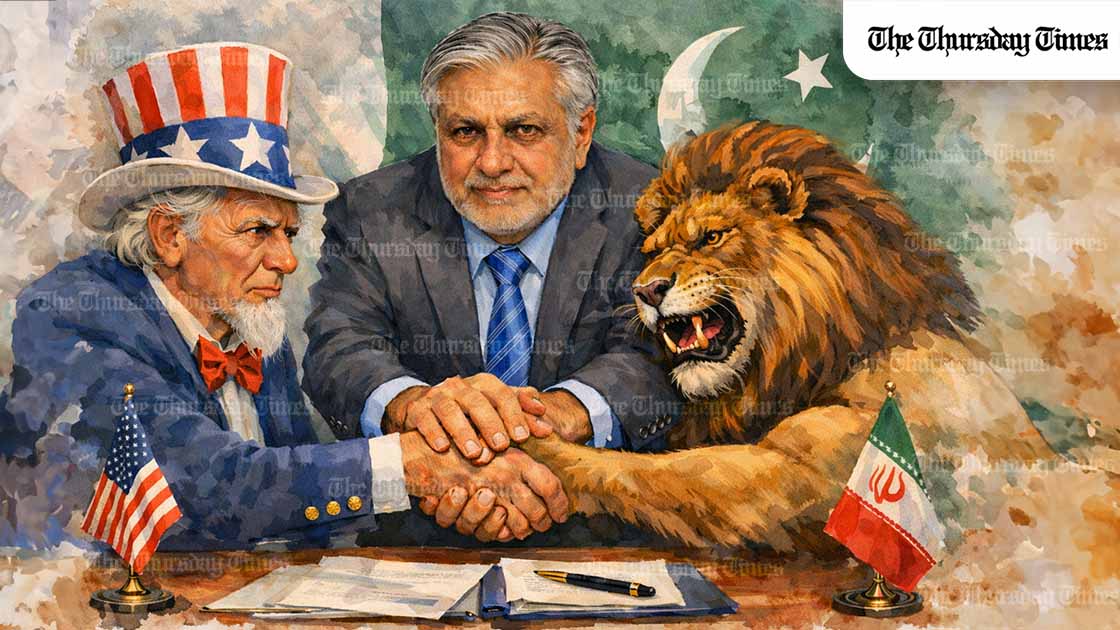
THERE IS A PARTICULAR KIND of diplomacy that does not arrive with fanfare. It does not thunder. It does not pose for history in the manner of great-power theatre. It moves quietly, deliberately, and with just enough confidence to make itself indispensable. Over the past month, Ishaq Dar has begun to embody that kind of diplomacy for Pakistan. At a moment when the region has been pulled towards confrontation, escalation and uncertainty, he has helped place Islamabad not on the margins of events, but near their centre.
That, in itself, is no small achievement. In international affairs, relevance cannot be declared into existence. It has to be earned. States become important when others begin to see them as useful, credible and steady under pressure. Over recent weeks, Pakistan has increasingly been treated as exactly that, and Dar has been one of the principal faces of that transformation. His diplomacy has not been ornamental. It has been functional. It has been about access, trust, coordination and movement.
The first and perhaps most important measure of his success is simple: the door was open. Tehran was engaged. Washington was listening. Regional capitals were responding. In a crisis defined by suspicion, that is the first victory any diplomat can hope to secure. Dar helped ensure that Pakistan was not speaking into a void. It was being heard. Messages were being carried. Channels were being preserved. And where others saw only hardened positions, Pakistan saw an opening for communication.
What makes this more impressive is that Dar did not confine Pakistan’s role to polite statements about peace. He helped move it into the realm of practical utility. Islamabad was not merely urging calm from a safe distance. It was actively positioning itself as a venue, a facilitator and a trusted intermediary at a time when direct confidence between the United States and Iran remained fragile. That shift matters. It takes a country from the language of commentary to the language of consequence.
There is also something deeply telling in the way Dar approached the task. He did not treat diplomacy as a solo performance. He understood that credible mediation requires architecture. It requires allies, supporting voices and a wider circle of states willing to lend weight to the cause of de-escalation. That is why the consultations in Islamabad with Saudi Arabia, Türkiye and Egypt carried such significance. Pakistan was not improvising. It was convening. Dar was helping to build not just a channel, but a framework.
And there is real power in that. The ability to bring others into the same room, or at least the same diplomatic frame, is one of the clearest signs that a state still matters. For too long, many countries are judged only by the hard currency of military strength or financial clout. Yet diplomacy has its own currency: trust, timing, discretion and the capacity to gather actors around a shared necessity. Over the past month, Dar demonstrated that Pakistan still possesses that power, and can still exercise it with seriousness.
What also distinguished his diplomacy was its connection to reality. It was not abstract peace-making detached from material stakes. It was tied to the urgent question of the Strait of Hormuz, to maritime passage, to trade, to stability in energy flows, and to the prevention of wider economic panic. This is where Dar’s work showed particular maturity. He did not speak of peace only as a noble aspiration. He engaged with it as a practical need, bound up with ships, supply lines, markets and the daily consequences of regional disorder.
That grounding gave Pakistan’s position added credibility. In moments of crisis, the most persuasive diplomacy is often the kind that recognises both the human and the strategic cost of further escalation. Dar’s month was marked by that blend. He was part of an effort that understood that preventing war is not only about avoiding bloodshed, though that is reason enough. It is also about stopping the collapse of commercial confidence, preventing regional paralysis, and ensuring that the wider world is not dragged into the economic aftershocks of a conflict it cannot control.
Then came the move to widen the field even further. The Beijing engagement showed that Dar’s diplomacy was not meant to end in Islamabad. It was meant to travel, to gather endorsement and to connect Pakistan’s role to a larger international effort. By helping produce a joint peace-oriented understanding with China, Dar gave Pakistan’s mediation a broader horizon. He turned bilateral access into multilateral momentum. That is not routine foreign ministry work. That is a sign of ambition married to discipline.
What has perhaps been most striking, though, is the tone. At no point did Dar’s diplomacy descend into chest-thumping. There was no need for needless spectacle, no rush to turn every opening into self-congratulation. The posture remained measured. The message stayed consistent. Dialogue mattered. De-escalation mattered. Contact mattered. That restraint strengthened Pakistan’s credibility. In diplomacy, reliability often speaks louder than excitement. A calm state is often a more trusted state.
None of this means the crisis has been solved. It has not. No responsible reading of the moment would pretend otherwise. But diplomacy should never be judged only by whether it instantly delivers a grand settlement. It should also be judged by whether it creates space where there was none, whether it keeps the line open before silence turns fatal, and whether it makes peaceful outcomes more imaginable than they were before. By that standard, Dar’s recent record deserves genuine credit.
Ishaq Dar’s contribution over the past month has been to show that Pakistan still has the capacity to matter in the moments that matter most. He has helped turn access into influence, caution into credibility, and diplomacy into something active rather than ceremonial. In an age where so much power is expressed through destruction, there is something quietly significant about a foreign minister proving that power can still mean the ability to connect, to calm and to carry a crisis back from the edge. ∎


