

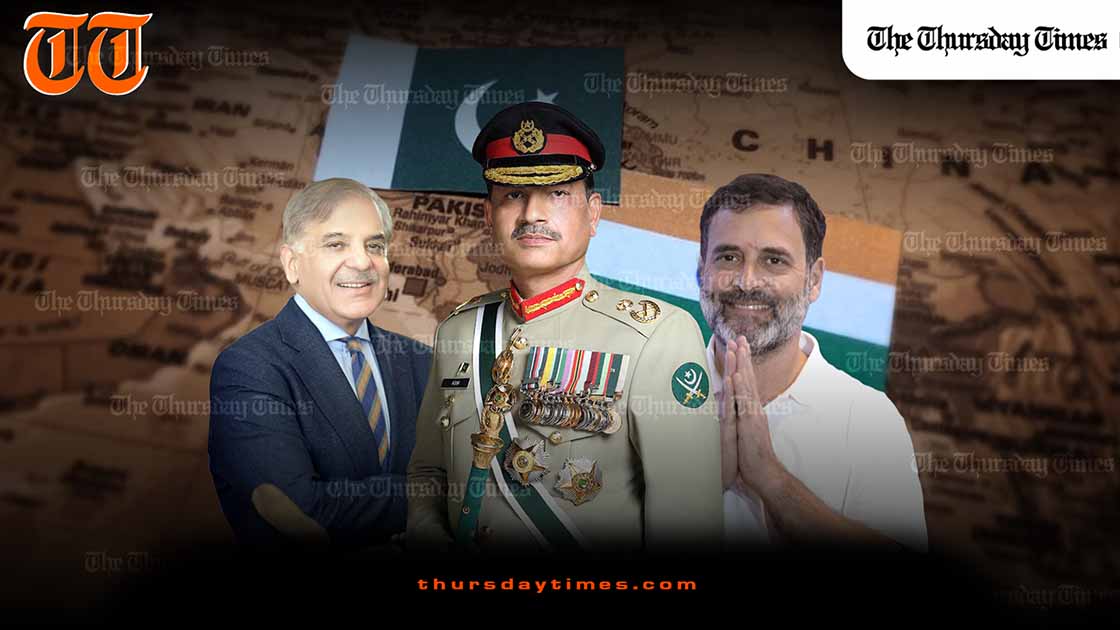
New Delhi (The Thursday Times) — India’s main opposition party, the Indian National Congress, has issued a strongly worded statement welcoming the temporary cessation of hostilities in West Asia, while using the moment to launch a sweeping attack on Prime Minister Narendra Modi’s government over what it described as strategic, diplomatic and political failures.
In its statement, the Congress said the ceasefire should be seen as an important opening for de-escalation, renewed diplomacy and constructive dialogue aimed at securing a lasting peace in West Asia. It argued that any meaningful settlement must remain rooted in the principles of the United Nations Charter, particularly the prohibition on the use of force against territorial integrity and intervention in the domestic affairs of states.
But the statement did not stop at welcoming the pause in fighting. It quickly turned into a wider indictment of the BJP government’s handling of regional diplomacy, energy security and foreign policy, claiming that New Delhi’s mistakes have carried serious costs both at home and abroad.
Congress argued that the conflict exposed India’s vulnerabilities in stark terms. It said the BJP government’s “missteps, partisan alignment and cowardly silence” had weakened India’s standing across its wider neighbourhood, undermined its role in the Indian Ocean region, and reduced its moral credibility within the Global South. The party further claimed that these failures had left ordinary Indians facing shortages of cooking gas, fertilisers and other essential commodities while also unsettling the Indian diaspora in West Asia.
The most politically explosive part of the statement, however, was its direct reference to Pakistan. Congress said the BJP government’s mistakes had effectively allowed Pakistan to play a mediating role between the warring parties, despite India, in its own view, being better placed to act as a credible interlocutor. That line is particularly significant because it amounts to an open acknowledgment from India’s largest opposition party that Islamabad has managed to occupy diplomatic space that New Delhi believes should have belonged to it.
Congress went even further, alleging that the BJP government had effectively handed Pakistan a “platform” in Islamabad to rehabilitate itself on the world stage. It also repeated familiar Indian accusations about Pakistan’s regional conduct, claiming that Islamabad was using the moment to reposition itself as a middle power in an increasingly competitive Asian landscape, potentially giving it leverage over India in key bilateral matters through third-party engagement.
The statement framed these developments not as unavoidable consequences of war, but as the direct result of what it called Modi’s “partisan support” for a far-right government on the eve of both war and national elections, as well as a broader pattern of ideological internationalism. Congress said this amounted to a dangerous break from India’s traditional foreign policy consensus and from the counsel of the country’s diplomatic establishment since independence.
In unusually blunt language, the party said the BJP government had repeatedly subordinated India’s national interest to electoral and ideological considerations. It urged the Indian government to abandon that approach immediately, restore confidence, and return to a more principled, proactive and credible foreign policy posture.
Taken together, the statement is revealing on two fronts. First, it shows that even within India’s own political establishment there is now open recognition that the regional balance has shifted in uncomfortable ways for New Delhi. Second, it suggests that Pakistan’s diplomatic activism in the present crisis has become difficult to dismiss, even for its critics, because it is now being discussed not only abroad but in the language of India’s own opposition.


