

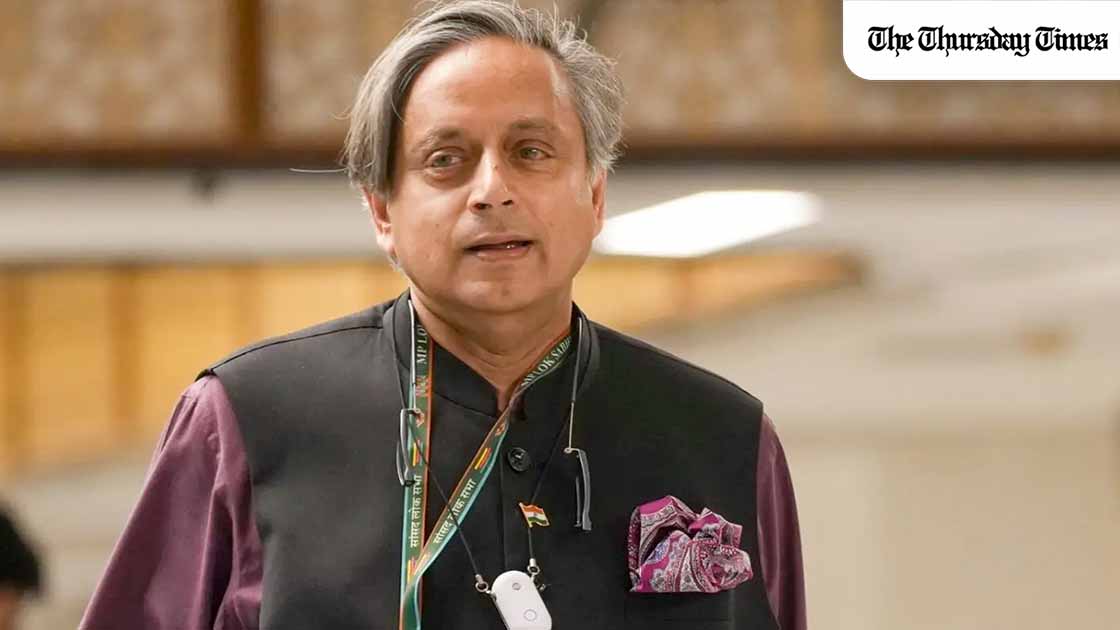
NEW DELHI (The Thursday Times) — Senior Indian opposition leader Shashi Tharoor has said India should “celebrate” Pakistan’s mediation in the recent United States–Iran ceasefire, arguing that peace in the region benefits New Delhi as much as Islamabad and should not be viewed through a zero-sum lens.
In an interview with a local Indian channel, the Congress MP described India’s official response to the ceasefire as “mature” and “sensible,” emphasising that regional stability and energy security outweigh geopolitical rivalry. He suggested that diplomatic initiatives leading to de-escalation should be welcomed, regardless of which country facilitates them.
“Not everything is zero-sum,” Tharoor said, adding that if Pakistan’s actions contributed to peace rather than conflict, “we should actually be celebrating.” He pointed to India’s own government statement welcoming the ceasefire as evidence of strategic restraint and regional responsibility.
Tharoor framed the development within a broader recalibration of global diplomacy, arguing that India must balance caution with engagement. He said New Delhi should “watch as an interested neighbour, not as a critic,” noting that de-escalation in a potential Middle Eastern conflict would stabilise global energy markets and protect Indian interests.
At the same time, Tharoor offered a more cautious interpretation of Pakistan’s role. He suggested the possibility that Islamabad may have served as a diplomatic intermediary rather than the principal architect of the peace effort. Referencing a social media post by Pakistan’s Prime Minister Shehbaz Sharif, Tharoor said the United States might have used Pakistan as a “neutral third-party face” to allow both Washington and Tehran to step back without appearing to concede.
“In other words, Pakistan might be a diplomatic fig leaf for the Americans rather than the real initiator of the peace,” he said. “But still, the fact that Pakistan is there doing this in Islamabad has to be respected.”
Tharoor also pointed to geopolitical realities shaping Pakistan’s involvement, including its shared border with Iran and the risk of refugee flows or regional instability. “Pakistan has what you might call skin in the game,” he noted, arguing that this provided Islamabad with a clear incentive to pursue de-escalation.
The Congress leader further highlighted shifting global dynamics, warning that the erosion of the traditional “rules-based international order” has created a vacuum in which regional powers must assume greater diplomatic responsibility. He urged India to position itself as a credible voice of the Global South in shaping a new international framework.
“We can’t afford the world to crumble,” Tharoor said, cautioning against a “law of the jungle” in which smaller nations become vulnerable to superpower competition. He argued that India should emerge from the crisis with renewed diplomatic initiative, contributing to regional stability and broader global governance.
His remarks come amid growing attention to Pakistan’s diplomatic engagement with Washington and Tehran, including contacts involving U.S. President Donald Trump and Pakistan’s army chief Asim Munir. While Tharoor acknowledged the optics of such interactions, he reiterated that India’s interests lie in supporting any process that reduces the risk of conflict.
For New Delhi, he said, the outcome should not be viewed as a strategic setback but rather as an opportunity to reinforce regional stability. “Why should we disparage it?” Tharoor asked, adding that peace in the region serves the interests of all neighbouring countries.


