

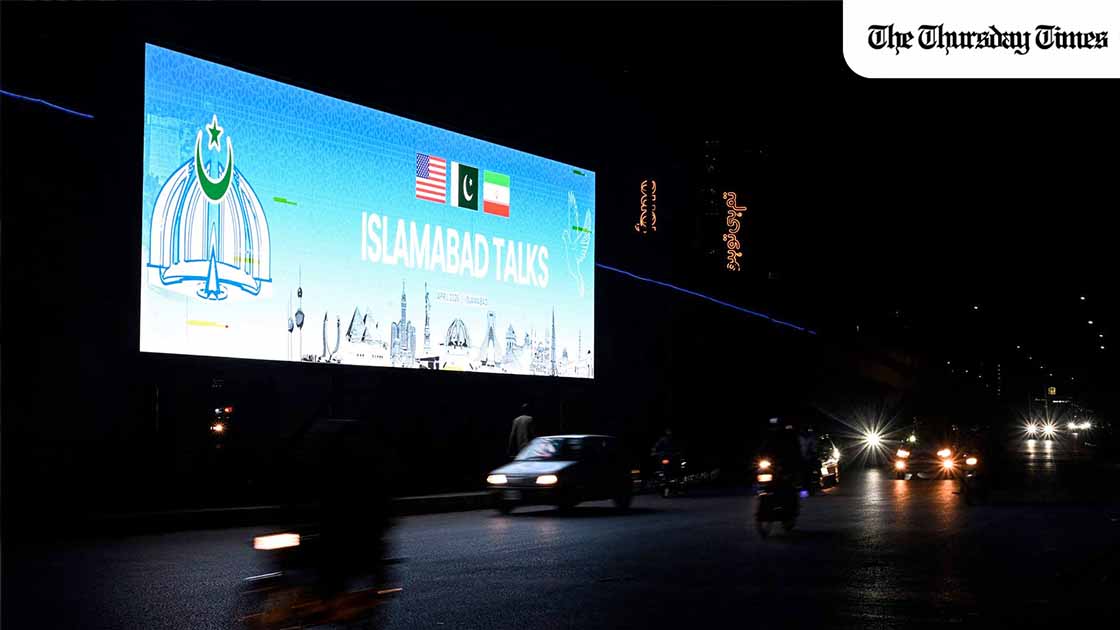
ISLAMABAD (The Thursday Times) — The most persistent misunderstanding about the recent Islamabad Talks between the United States and Iran is also the simplest: they were never meant to deliver a final agreement. They were designed to start a process.
To call the Islamabad Talks a failure is to misunderstand the nature of diplomacy itself. High-stakes negotiations, especially between adversaries who have not engaged at this level in decades, do not culminate in instant breakthroughs. They unfold in stages. Islamabad was not the conclusion of a diplomatic effort; it was its formal beginning.
That distinction matters. The talks were part of a broader process shaped by weeks of back-channel engagement, signalling and trust-building. They were a means to an end, not the end itself. In that sense, their true value lies not in what they immediately produced, but in what they made possible.
One of the clearest outcomes was the acknowledgement, from both Washington and Tehran, of Pakistan’s role. Both sides publicly and privately expressed appreciation for the efforts of Shehbaz Sharif and Asim Munir, whose leadership made the talks possible. In a diplomatic environment often marked by suspicion, that level of mutual recognition is itself notable.
Equally important is what was not said. None of the three parties involved — the United States, Iran or Pakistan — described the talks as having failed. The absence of an agreement was acknowledged, but that is not the same as failure. It reflects the reality that one central issue remains unresolved, not that the process has collapsed.
In fact, the very occurrence of the talks marks a significant moment. This was the first face-to-face engagement between the United States and Iran at such a level in nearly half a century. That alone represents a shift in diplomatic posture, suggesting that both sides are willing, at least conditionally, to explore a negotiated path.
President Donald Trump himself acknowledged that progress had been made. He indicated that agreement had been reached on several points, describing some of them as preferable to continued military operations. That language signals movement, even if it falls short of a comprehensive deal.
The remaining obstacle is clear. The nuclear issue continues to define the limits of the negotiation. For Washington, it is the central demand. For Tehran, it is a matter of sovereignty and strategic posture. The gap is substantial, but it is now explicitly defined, which in diplomatic terms is a step forward.
At the same time, the shift in tone following the talks should be understood within its proper context. The language around naval blockades and mine-clearing operations appears to reflect a post-talks pressure strategy rather than a breakdown of diplomacy. Such signalling is not unusual in negotiations where leverage is continuously recalibrated.
There are also signs that the talks achieved something less tangible but equally significant: a degree of humanisation between the delegations. Trump noted that the American and Iranian representatives developed a level of familiarity and respect over the course of the discussions. That does not resolve disputes, but it alters the atmosphere in which they are addressed.
Perhaps the most important indicator of continuity is the ceasefire. None of the parties has suggested that it has been terminated. In a region where escalation can occur rapidly, the preservation of a ceasefire is not a minor detail. It provides the stability necessary for diplomacy to continue.
The talks also took place despite considerable external pressure. Attempts to derail the process through competing narratives, political resistance and strategic scepticism were evident throughout. Yet the fact that both sides still arrived in Islamabad underscores the determination, however cautious, to keep the diplomatic track alive.
Iranian officials have described the outcome as a foundational framework for future negotiations, while American officials have signalled that the next move rests with Tehran. Neither side has closed the door. Instead, both appear to be navigating the delicate balance between domestic political positioning and international engagement.
In that context, Pakistan’s role becomes clearer. It acted as a mediator and facilitator, not a decision-maker. The responsibility for any final agreement lies with the United States and Iran. What Islamabad achieved was to create the conditions in which such an agreement could, in time, be negotiated.
The broader implication is that Pakistan’s diplomatic standing has been strengthened. By bringing both sides to the table and sustaining the process through a volatile period, it has positioned itself as a credible intermediary in a complex geopolitical environment.
What happens next remains uncertain, but the trajectory is not without direction. There is sufficient evidence to suggest that both Washington and Tehran are prepared to continue engaging, even if cautiously and on their own terms. The absence of a deal has not closed the process; it has clarified it.
The question now is not whether the Islamabad Talks succeeded or failed, but whether they will be followed by a second phase. If the first round established contact and defined the core dispute, a potential “Islamabad Talks 2.0” would test whether that foundation can support a more substantive agreement.
For now, the signal is one of guarded continuity. The ceasefire holds. The channels remain open. The positions are clear. And the process, which began quietly before the world took notice, appears set to continue.


