

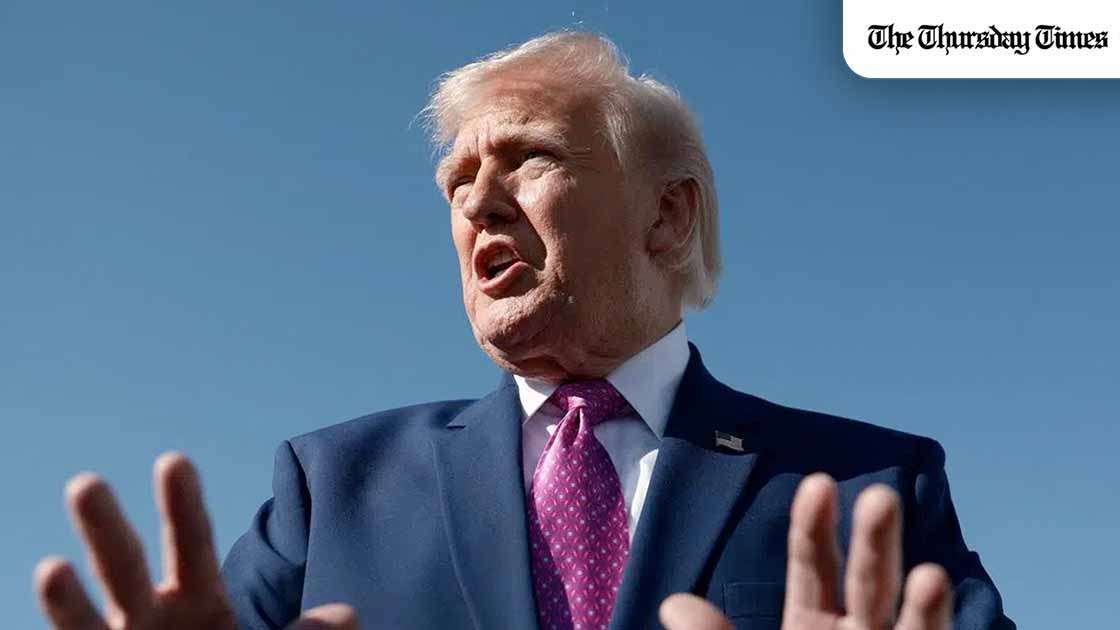
WASHINGTON, D.C. (The Thursday Times) — U.S. President Donald Trump said in a Fox News interview on Sunday that he believed Iran would return to negotiations and “give us everything we want,” adopting a defiant tone hours after high-level talks in Islamabad ended without an agreement.
Donald Trump:
Iran has not left the table. I predict they will come back and give us everything we want.via: Fox News pic.twitter.com/ycBED8eKNJ
— The Thursday Times (@thursday_times) April 12, 2026
Trump’s comments came as the administration moved to tighten pressure on Tehran following more than 20 hours of talks in Pakistan that had not resolved the central dispute over Iran’s nuclear programme. U.S. officials had sought a firm Iranian commitment not to pursue nuclear weapons, while Iranian officials resisted the American terms.
“I predict they come back and they give us everything we want,” Trump said in the interview, according to reports of his remarks. He also said he had instructed his team not to settle for less than a complete outcome, underscoring the administration’s insistence on broad Iranian concessions rather than a limited deal.
The remarks provided one of Trump’s clearest public statements yet on how he sees the next phase of the standoff. While the administration has not declared diplomacy over, the president’s language suggested that Washington expects any renewed talks to proceed from a position of intensified U.S. leverage, not mutual compromise.
Donald Trump: We had a meeting lasting more than 21 hours in Islamabad, but we did not get there on the key issue. Iran wants nuclear weapons. They are not going to have nuclear weapons.
via: Fox News pic.twitter.com/eoOVwzfDDF
— The Thursday Times (@thursday_times) April 12, 2026
The talks in Islamabad had been closely watched because they represented a rare direct engagement between senior American and Iranian officials after weeks of war and ceasefire diplomacy. Vice President JD Vance led the U.S. delegation, and the discussions were widely seen as an attempt to test whether a broader diplomatic opening was still possible. No breakthrough emerged, however, and the U.S. side left Pakistan without a deal.
Trump’s interview was accompanied by a broader hardening of the administration’s posture. On Sunday he also said a U.S.-led naval blockade of the Strait of Hormuz would soon become effective, part of a wider campaign to increase economic and military pressure on Iran after the talks stalled.
That combination of diplomacy and pressure has left the immediate direction of U.S. policy in sharper focus. The White House is still presenting negotiations as possible, but Trump’s comments indicated that it sees pressure as the mechanism by which Iran will eventually be brought back to the table on American terms.
Iran has not publicly indicated that it is prepared to accept the kind of full concession Trump described. Reports on the Islamabad talks said the negotiations foundered on the nuclear question, with major differences still separating the two sides by the time the delegations parted.
For now, Trump’s remarks appear to have clarified one point more than any other: the talks may continue, but the president is presenting them not as a search for middle ground, but as a test of whether Iran will yield under mounting pressure. Whether that approach produces another round of diplomacy or further escalation remained uncertain on Sunday.


