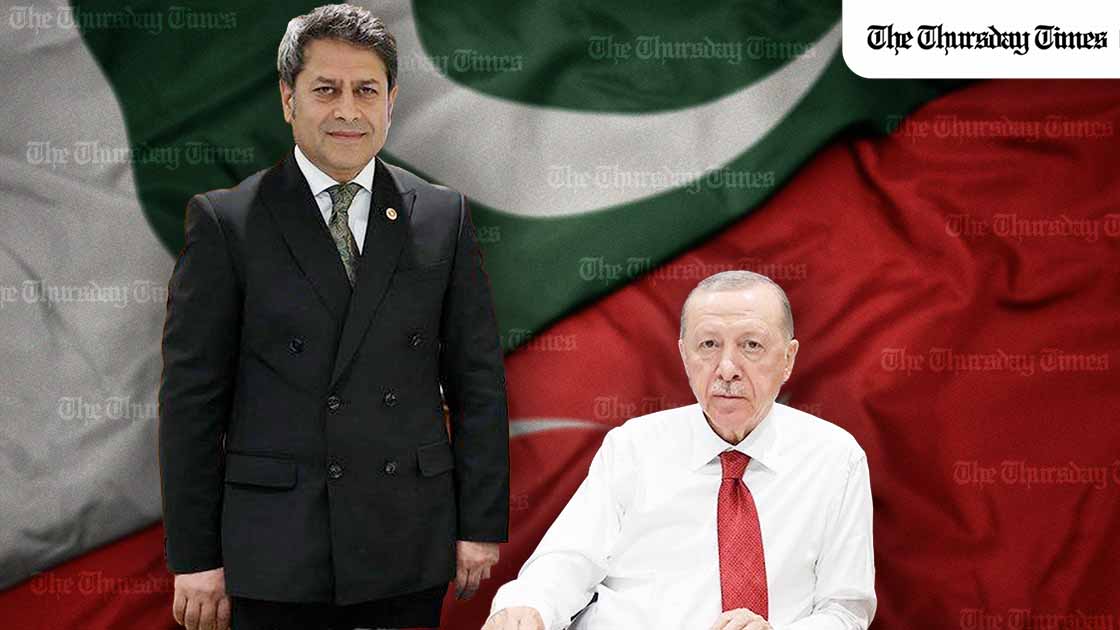
ANKARA (The Thursday Times) — A prominent Turkish parliamentarian has called for Pakistan to be admitted as a full member of the Organization of Turkic States, describing the relationship between Pakistan and Turkey as “multidimensional and special,” unlike any other partnership between states.
PAKİSTAN TÜRK DEVLETLERİ TEŞKİLATI ÜYESİ OLMALIDIR…
Pakistan ile Türkiye ilişkisi dünyada eşi ve bezeri bir başka iki devlet arasında görülmemiş, rastlanmamış türden çok boyutlu ve özel bir ilişkidir.
Benim açımdan Pakistan ve Türkiye ilişkisi; kod ve şifreleri Allah… pic.twitter.com/zo7OYAHKZK
— Ali ŞAHİN (@AliSahin501) April 18, 2026
The remarks came from Ali Şahin, a member of Turkey’s governing Justice and Development Party and a lawmaker from Gaziantep, who used a public statement to set out an unusually sweeping argument for Pakistan’s inclusion in the Turkic bloc.
“The relationship between Pakistan and Turkey is a multidimensional and special kind of bond unlike anything seen or encountered between any other two states in the world,” he wrote.
From there, the language became even more personal. “From my perspective,” he said, “the relationship between Pakistan and Turkey is a genetic one, with its codes and ciphers written by God Himself.”
He added that every child born in Pakistan comes into the world with love for Turkey, and every child born in Turkey with love for Pakistan.
Such language would once have been dismissed as rhetorical flourish. Yet it reflects something real in both countries: a political culture in which mutual affection is regularly described in familial rather than diplomatic terms. Turkish leaders often refer to Pakistan as a brotherly nation, while in Pakistan, Turkey occupies a place of emotional prestige that goes well beyond standard foreign policy alignment.
Şahin’s first case for Pakistani membership centred on language.
Although Urdu belongs to the Indo-Aryan family, he argued that its development was directly shaped by Turkic-Islamic states that ruled parts of South Asia for centuries.
He noted that the word Urdu is widely traced to the Turkish word “Ordu,” meaning army camp or military encampment, and described Urdu as, in effect, a language born from imperial contact zones where soldiers, administrators and merchants interacted.
He also listed everyday words he said travelled through Turkish usage into Urdu vocabulary, arguing that these layers created what he called a “cultural kinship” and a shared mental world between the two peoples.
Linguists may debate the scale and pathways of that influence, but politically the point was clear: he was making the case that kinship need not be defined only by bloodlines or modern borders.
Şahin’s second argument was historical. He pointed to Turkic-origin dynasties that ruled the region, including the Ghaznavid Empire, the Delhi Sultanate and the Mughal Empire.
According to his telling, those centuries did not simply leave monuments and chronicles. They created deep social fusion between Central Asian arrivals and local populations, traces of which he said survive in family names, elite traditions and military culture across present-day Pakistan.
He argued that elements of bureaucratic order and martial discipline in Pakistan still carry echoes of those older state traditions.
This is not the first time Turkish conservatives and nationalists have framed South Asia as part of a broader Turkic civilisational space. But it is rare to hear the argument made so directly in relation to formal institutional membership.
If his historical claims were broad, his cultural ones were more intimate.
Şahin wrote that communities can be linked not only by blood, but by “spiritual bonds.” To illustrate that idea, he invoked Muhammad Iqbal, who revered Jalal ad-Din Rumi as a guiding intellectual force.
Iqbal’s poetry and philosophy drew deeply from Rumi, and for generations of readers in South Asia, Anatolia has represented not just a foreign land but a place embedded in Islamic memory and literary imagination.
Şahin suggested that for many Pakistanis, Turkey carries the meaning of a “spiritual homeland.”
He also cited parallels in religious tradition, noting the Sunni Hanafi and Maturidi currents historically present in both societies. In his formulation, these shared references create social familiarity even where geography does not.
Perhaps his strongest emotional argument concerned the early twentieth century.
Şahin pointed to support from Muslims of the Indian subcontinent during the Turkish War of Independence and the era surrounding the Khilafat movement, saying sacrifices made at that time transformed the two peoples into “kin from hard times.”
That memory still holds power in Turkey and Pakistan alike. Funds were raised, campaigns organised and public sympathy mobilised in South Asia during a formative period for the modern Turkish republic. In both national narratives, that solidarity has endured as proof that the relationship was tested before either modern state fully emerged.
He argued that the sense of brotherhood felt toward Turkey among Pakistanis had become part of collective identity itself, not merely a matter of foreign policy preference.
Şahin’s final argument was geopolitical.
He said Turkey’s strategic worldview should not be limited to Central Asia and the Balkans, and described Pakistan as Ankara’s most natural ally in South Asia.
He called Pakistan a gateway to the region and said growing cooperation in defence production, education and diplomacy was already turning the two countries into “strategic kin” in the modern era.
That assessment aligns with visible trends. Turkey and Pakistan have expanded defence ties, increased official exchanges and regularly support each other on diplomatic platforms. Turkish industry has sought opportunities in Pakistan, while Pakistani audiences remain among the most receptive to Turkish cultural exports.
Can it happen?
For now, the proposal remains aspirational.
The Organization of Turkic States was established as a framework for Turkic-speaking nations and states with direct historical and linguistic ties to that identity. Any move to include Pakistan as a full member would require consensus and likely a broader redefinition of what the organisation represents.
Yet even if membership never materialises, the significance of Şahin’s remarks lies elsewhere.
They show how some influential figures in Ankara increasingly view Pakistan not simply as a friendly Muslim country, but as part of a wider strategic and civilisational map stretching from Anatolia through Central Asia to the Indian Ocean.
And they show how, in a fractured world, nations still search for older languages of belonging: memory, affinity, shared struggle and imagined family.
In that sense, Şahin was making more than a procedural argument about membership. He was making a claim about identity itself — and insisting that, in Turkey’s eyes, Pakistan already belongs.