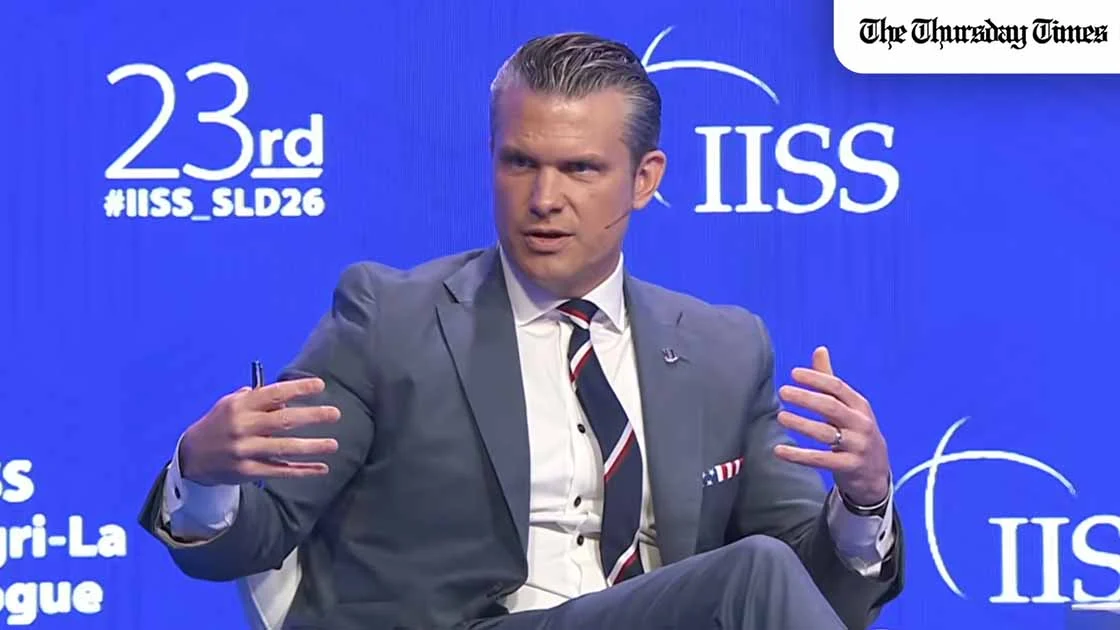
WASHINGTON (The Thursday Times) — United States Defence Secretary Pete Hegseth said a “true friendship” is growing between Washington and Pakistan as Islamabad helps negotiate an end to the war with Iran, describing Pakistan’s mediation role as “an unexpected development” and praising the roles of Field Marshal Asim Munir and Prime Minister Shehbaz Sharif directly. The remarks, made at a press conference, represent the first time America’s top military official has personally and publicly praised Pakistan’s role in the US-Iran negotiations.
US Defence Secretary Pete Hegseth on Pakistan:
— The Thursday Times (@thursday_times) May 30, 2026
Pakistan’s Field Marshal and Prime Minister are playing an important role in peace negotiations.
An “unexpected development” and “a true friendship developing there.” pic.twitter.com/GiSZX3cVM5
The Thursday Times has covered Pakistan’s central mediation role throughout. Read our report on Trump saying he gave Iran a chance because Pakistan asked here. Read our report on Trump posting deal terms from the Situation Room as Ishaq Dar met Rubio here.
“The role that the Field Marshal and the Prime Minister are playing in peace negotiations, an unexpected development and a true friendship developing there, which I think is important.”
US Defence Secretary Pete Hegseth · Press conference · May 2026
Why Hegseth’s words matter
Pete Hegseth is not a diplomat. He is America’s Secretary of Defense, the head of the Pentagon, responsible for the military operations that have been ongoing against Iran. His praise of Pakistan’s Field Marshal and Prime Minister is not diplomatic boilerplate, it is a personal characterisation from the official who oversees the military dimension of the very conflict Pakistan has been working to end. When Hegseth says “unexpected development,” he is speaking from the perspective of the US military establishment, which had not historically viewed Pakistan as a trusted mediator in Middle Eastern affairs. The fact that he is now using the language of friendship and calling the development unexpected signals a genuine shift in how Washington’s security establishment views Islamabad.
The 15-point framework through Pakistan
The depth of Pakistan’s role goes beyond shuttle diplomacy. The Trump administration’s 15-point action list forming the framework for a peace deal with Iran was circulated through the Pakistani government. Pakistan was not merely a messenger carrying goodwill between two hostile capitals. It was the channel through which the substantive framework of a potential agreement was delivered and refined. That level of trust, extended by the US to Pakistan on the most sensitive security negotiation of Trump’s second term, is what Hegseth’s “true friendship” language reflects.
Three senior US officials, one week
Hegseth’s remarks are the third major public acknowledgement of Pakistan’s role from a senior US official within the space of one week. On 27 May, President Trump said he gave Iran a chance because Pakistan asked him to, calling Field Marshal Munir and PM Shehbaz Sharif “great” and saying they asked him to pause the war. On 29 May, Secretary of State Marco Rubio expressed appreciation for Pakistan’s “continued willingness to play a constructive role in mediating conversations with Iran” after meeting Deputy PM Ishaq Dar at the State Department. And now Hegseth has added the Pentagon’s voice to that chorus, using language that goes beyond appreciation into genuine personal warmth.
Trump. Rubio. Hegseth. The President. The Secretary of State. The Secretary of Defense. Three of the most powerful officials in the United States government have publicly praised Pakistan’s mediation role within days of each other. That convergence is not accidental. It reflects a deliberate and consistent message from the highest levels of the US government about where Pakistan stands in Washington’s assessment.
India-Pakistan peace also referenced
Hegseth also referenced Trump’s role in brokering peace between India and Pakistan, describing it as part of the same broader diplomatic effort. “You saw that in the ability of the President to come together on brokering a peace between India and Pakistan, two nuclear-capable countries,” he said. The reference to both the Iran mediation and the India-Pakistan ceasefire in the same breath signals that Washington now views Pakistan as a central stabilising force across two of the most volatile conflicts in the region simultaneously.
Frequently asked questions
What did Pete Hegseth say about Pakistan?
US Defence Secretary Pete Hegseth said a “true friendship” is growing between Washington and Pakistan as Islamabad helps negotiate an end to the war with Iran, describing Pakistan’s mediation role as “an unexpected development” and praising Field Marshal Asim Munir and Prime Minister Shehbaz Sharif directly.
What is Pakistan’s role in the US-Iran negotiations?
Pakistan has served as the primary mediator between the United States and Iran since brokering the original ceasefire on 8 April 2026. Field Marshal Asim Munir flew to Tehran for overnight negotiations on 22 and 23 May 2026. Deputy Prime Minister Ishaq Dar met Secretary of State Marco Rubio in Washington on 29 May 2026. The Trump administration’s 15-point Iran peace framework was circulated through the Pakistani government.
Where did Pete Hegseth make these remarks?
Pete Hegseth made these remarks at the IISS Shangri-La Dialogue in May 2026, an annual international security summit held in Singapore attended by defence ministers and senior security officials from across the world.∎