
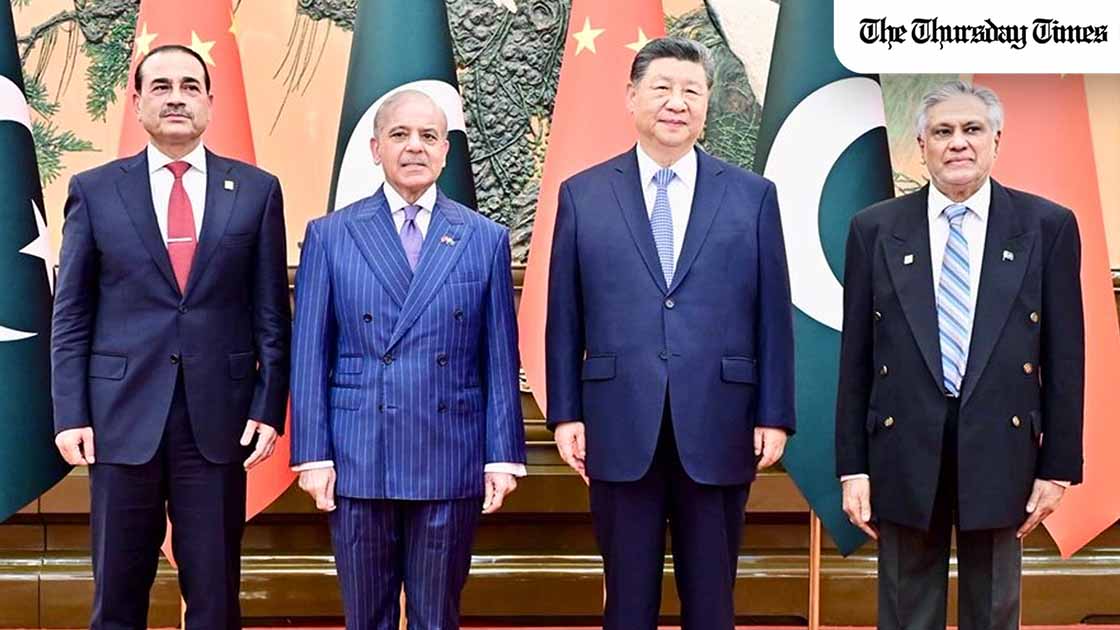
BEIJING (The Thursday Times) — China and Pakistan issued a comprehensive joint statement on 26 May 2026 at the conclusion of Prime Minister Shehbaz Sharif’s four-day official visit to Beijing, formally acknowledging Pakistan’s role in brokering the US-Iran ceasefire and Islamabad Talks, reaffirming China’s support for Pakistan’s position on Kashmir, naming the Tehreek-e-Taliban Pakistan by name as a group that must not be allowed to use Afghan territory, and announcing a Pakistan astronaut could become the first foreigner to enter China’s Space Station. The statement, numbered 129/2026 and issued by Pakistan’s Ministry of Foreign Affairs, covers security, diplomacy, CPEC Phase II, artificial intelligence, space, agriculture and regional peace.
The Thursday Times has reported on Pakistan’s mediation role throughout this week. Read our report on Iran publicly thanking Pakistan here. Read our report on Xi Jinping praising Pakistan’s mediation role here.
Iran ceasefire formally acknowledged
In a significant diplomatic milestone, the joint statement formally acknowledged Pakistan’s efforts “in facilitating the temporary ceasefire between the US and Iran and holding the Islamabad Talks.” This is the first time China has put its acknowledgement of Pakistan’s Iran mediation role into a formal bilateral document. Both sides reiterated early implementation of China’s five-point initiative for restoring peace and stability in the Gulf and Middle East region, and expressed readiness to jointly make positive contributions for the early restoration of peace and stability.
Kashmir: China reiterates UN resolutions position
The Chinese side reiterated that the Jammu and Kashmir dispute “is left over from history, and should be properly and peacefully resolved in accordance with the UN Charter, relevant UN Security Council resolutions and bilateral agreements.” The Pakistani side briefed the Chinese side on the latest developments in Kashmir. Both sides reiterated opposition to any unilateral actions and reaffirmed the significance of maintaining peace and stability in South Asia through dialogue and diplomacy.
TTP named in joint statement
In a notable inclusion, the joint statement specifically named the Tehreek-e-Taliban Pakistan, saying both sides stressed the need of “not allowing any individual, group or party, including the Tehreek-e-Taliban Pakistan, the Eastern Turkistan Islamic Movement, etc., to use the territories to harm and threaten regional security and interests, or conduct terrorist actions and activities.” This is a direct reference to Pakistan’s longstanding concern that Afghan territory is being used by TTP to launch attacks inside Pakistan. China naming TTP explicitly in a joint statement signals Beijing’s alignment with Islamabad’s position on this issue.
On Afghanistan, Pakistan welcomed China providing a dialogue platform for communication between Pakistan and Afghanistan, and spoke positively of the informal trilateral talks held among China, Afghanistan and Pakistan in Urumqi, Xinjiang in April 2026. Both sides agreed to stay in close communication and coordination on Afghanistan. Separately, China said it was ready to establish a formal China-Pakistan Security Partnership and strengthen military-to-military cooperation to further promote regional peace and stability.
Anti-double standards on terrorism
The statement said both sides “reaffirmed their firm opposition to applying double standards on counter-terrorism or to politicizing and instrumentalizing counter-terrorism.” Without naming any country, this language is understood as a direct reference to India’s practice of raising terrorism concerns against Pakistan while itself being accused of supporting separatist and extremist elements in Pakistani territory. China’s endorsement of this language in a formal document carries diplomatic weight.
CPEC Phase II and economic cooperation
Both sides agreed to promote the high-quality development of CPEC 2.0, advance the Karakoram Highway realignment project in a phased and orderly manner, leverage the potential of Gwadar Port as a regional connectivity hub, and make use of the Khunjerab Pass to strengthen land connectivity. Industrial parks, textiles, home appliances, mining, oil and gas, agriculture and digital economy cooperation were all included. China agreed to facilitate market access for more high-quality Pakistani agricultural products and will deliver 3,000 training opportunities to Pakistan for 2025 to 2029. China also trained 1,000 young Pakistani agricultural technicians.
Pakistan astronaut in China Space Station
One of the most striking announcements in the statement was that China “welcomes two Pakistani astronauts to come to China for training and looks forward to a Pakistani astronaut becoming the first foreign astronaut for the early entrance into the China Space Station.” This would make Pakistan the first country to have a national aboard China’s Space Station, a milestone in the two countries’ space cooperation programme.
International order and opposing fascism
Both sides agreed that it is essential to firmly uphold the outcomes of World War II and oppose any attempt to revive fascism and militarism. The two sides expressed support for the postwar international order underpinned by the Cairo Declaration and the Potsdam Proclamation. Both sides also agreed to jointly promote an equal and orderly multipolar world and a universally beneficial and inclusive global economic order. This language, standard in Chinese bilateral agreements, reflects Beijing’s ongoing concern about Japanese historical revisionism and its broader push for a multipolar world order that challenges US-led unipolarity.
Taiwan, one-China and mutual core interests
Pakistan reaffirmed its strong commitment to the one-China principle, stating that Taiwan is “an inalienable part of the territory of the People’s Republic of China.” Pakistan said it “firmly supports all efforts by China to achieve national reunification and resolutely opposes any form of Taiwan independence.” Pakistan also expressed support for China’s positions on Xinjiang, Xizang, Hong Kong and the South China Sea. In return, China reiterated its “unwavering support for Pakistan in defending its national sovereignty, independence, and territorial integrity.”
Artificial intelligence and SCO
Pakistan expressed support for China’s initiative to establish a World Artificial Intelligence Cooperation Organisation, saying it would work with China to advance global governance on artificial intelligence. China reaffirmed its commitment to supporting Pakistan as the next rotating President of the Shanghai Cooperation Organisation and acknowledged Pakistan’s UN Security Council non-permanent membership from 2025 to 2026.
The joint statement was signed in Beijing on 26 May 2026 and is referenced as document 129/2026 of Pakistan’s Ministry of Foreign Affairs.
Source: Joint Statement between the People’s Republic of China and the Islamic Republic of Pakistan, 26 May 2026, document 129/2026, Pakistan Ministry of Foreign Affairs. All content sourced directly from the official joint statement.