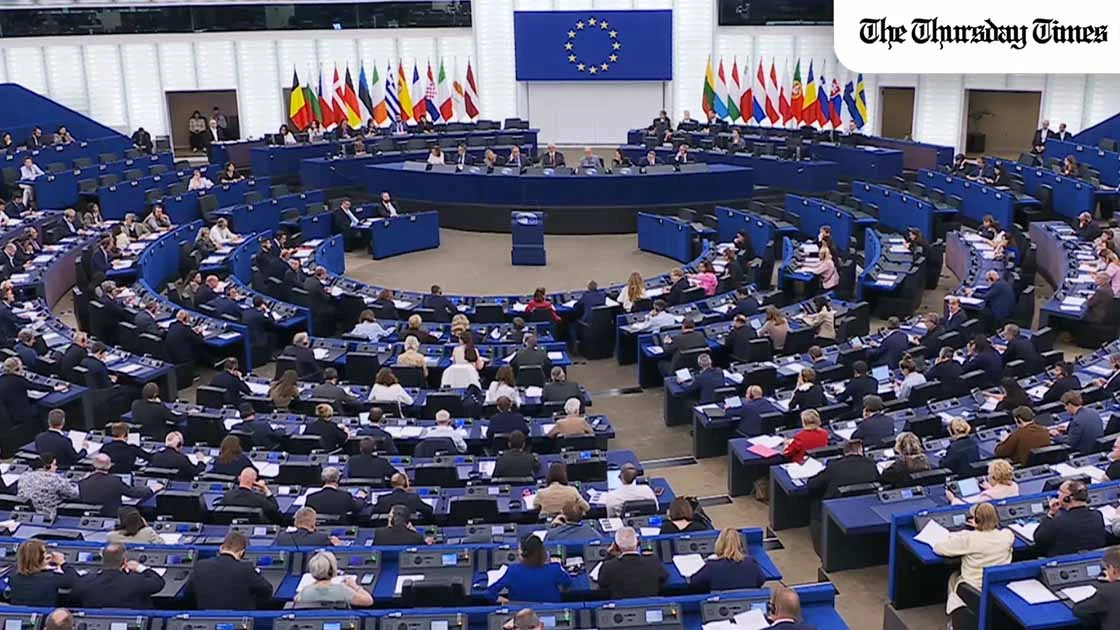
BRUSSELS (The Thursday Times) — The European Parliament adopted a resolution on 21 May 2026 calling for expanded sanctions against Taliban leaders, condemning the group’s Criminal Procedure Code for Courts as an instrument of gender apartheid, slavery and corporal punishment, and expressing regret over the European Union’s own decision to invite the Taliban to Brussels for talks. The resolution passed with 480 votes in favour, five against and 83 abstentions. It is referenced as TA-10-2026-0186 (2026/2737(RSP)) in the official EU Parliament record.
What the resolution says
The resolution condemns the Taliban’s Criminal Procedure Code for Courts, which EU lawmakers said advances the systematic persecution of women and girls and institutionalises violations of fundamental rights including gender apartheid, slavery and corporal punishment. The Parliament called on Taliban authorities to immediately repeal the code and end public floggings, executions and all restrictions imposed on women and girls, religious minorities and other vulnerable groups.
The resolution urges the European Commission and EU member states to extend human rights sanctions against Taliban leaders deemed responsible for persecution, including travel bans and asset freezes. It calls for the enforcement of International Criminal Court arrest warrants against Taliban leaders and for the formal recognition of slavery, gender apartheid and forced child marriages as crimes against humanity under a proposed international treaty.
EU lawmakers reaffirmed the policy of non-recognition and non-normalisation of the Taliban and urged all European institutions and member states to maintain that position. The resolution also expressed direct regret over the EU’s decision to invite Taliban representatives to Brussels for talks, a rare instance of the Parliament publicly criticising an EU institutional decision.
The European Parliament has approved sanctions against Taliban leaders over systematic human rights abuses in Afghanistan, including the growing repression of women and girls.
— The Thursday Times (@thursday_times) May 28, 2026
The debate also highlighted concerns that the Taliban’s new laws effectively legitimise child marriage,… pic.twitter.com/RoHpOkSSu8
The Taliban’s record
Since seizing power in August 2021, the Taliban have issued more than 150 edicts systematically excluding women and girls from public life. Girls have been banned from education beyond sixth grade. Women have been barred from most employment, from appearing in public without a male guardian, and from accessing healthcare independently. The Criminal Procedure Code that prompted Thursday’s resolution grants husbands discretionary authority to punish wives and institutionalises practices the EU Parliament has now formally described as gender apartheid and slavery.
The Taliban have not recognised any international legal authority over their governance. They have responded to international criticism by issuing further restrictive edicts rather than modifying their position. A subsequent code sanctioning child marriage was issued after the Criminal Procedure Code drew international condemnation.
The international response
The EU Parliament resolution is part of a broader pattern of international action against the Taliban that has accelerated in 2025 and 2026. Australia created what it described as a world-first autonomous sanctions framework in December 2025, imposing financial sanctions and travel bans on four Taliban officials including ICC-wanted Chief Justice Abdul Hakim Haqqani. Canada, Germany and the Netherlands have filed proceedings at the International Court of Justice for Taliban violations of the UN women’s rights convention. The United States has designated individual Taliban leaders under Treasury sanctions and is reviewing whether to impose the heavier Foreign Terrorist Organization designation.
Blocking stronger action at the UN level, Russia formally recognised the Taliban government in July 2025, the first UN Security Council permanent member to do so, while China accredited a Taliban ambassador in 2023. Both countries veto any UN Security Council escalation on Afghanistan.
Why this matters for Pakistan
The international isolation of the Taliban has direct implications for Pakistan. The Taliban’s refusal to act against the Tehreek-e-Taliban Pakistan, which operates from Afghan territory and has killed thousands of Pakistanis, remains Pakistan’s most pressing security concern. The China-Pakistan joint statement issued in Beijing on 26 May 2026, referenced as document 129/2026, explicitly named the TTP as a group that must not be allowed to use Afghan territory to threaten regional security. The EU Parliament’s resolution, which similarly demands that Afghanistan not be used as a base for terrorism, aligns with Pakistan’s stated position on the TTP even as it focuses primarily on human rights rather than security.
Pakistan has maintained diplomatic engagement with the Taliban since 2021 while simultaneously pressing Kabul to act against TTP sanctuaries. That balancing act has grown harder as the Taliban’s international isolation deepens and the TTP’s cross-border attacks continue. The EU Parliament’s overwhelming vote, 480 to 5, signals that the international community’s patience with the Taliban is not recovering.∎