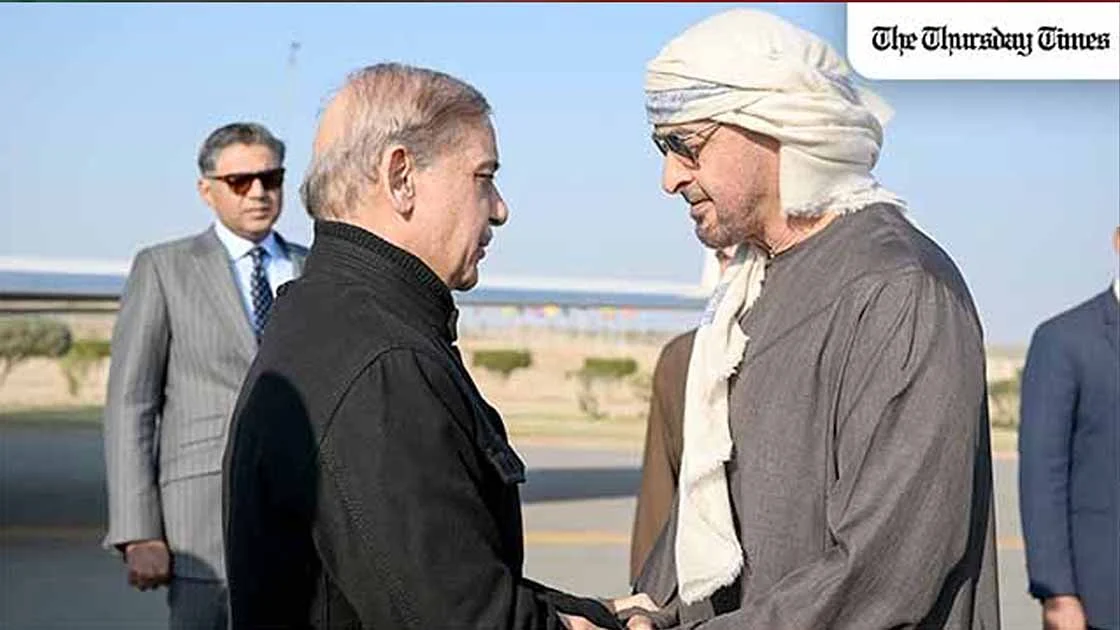
ISLAMABAD (The Thursday Times) — Prime Minister Shehbaz Sharif has strongly condemned the missile and drone attacks on civilian infrastructure in the United Arab Emirates, expressing Pakistan’s full solidarity with UAE President Sheikh Mohamed bin Zayed Al Nahyan and the Emirati people at what he described as a difficult moment for the Gulf state.
In a statement, Shehbaz said Pakistan “strongly condemns” the attacks, which he said targeted civilian infrastructure in the UAE last night. He added that Islamabad stands firmly with its “Emirati brothers and sisters” and with the Government of the United Arab Emirates.
The language was direct, but also carefully calibrated. Pakistan’s message was not only one of condemnation. It was also a call to preserve the fragile diplomatic space that remains in a region already strained by missile fire, drone warfare and the risk of a wider confrontation.
Shehbaz said it was “absolutely essential” that the ceasefire be upheld and respected, arguing that this would allow the necessary room for dialogue leading to enduring peace and stability in the region. The statement places Pakistan’s position firmly on the side of de-escalation while also making clear that attacks on civilian infrastructure are unacceptable.
Pakistan strongly condemns the missile and drone attacks on civilian infrastructure in the United Arab Emirates last night. I express full solidarity with His Highness @MohamedBinZayed. Pakistan stands firmly with our Emirati brothers and sisters as well as with the Government of…
— Shehbaz Sharif (@CMShehbaz) May 5, 2026
For Islamabad, the moment carries a particular diplomatic weight. Pakistan has been seeking to position itself as a serious regional actor capable of maintaining close ties with Gulf capitals while also supporting negotiations and restraint in wider Middle Eastern crises. Its condemnation of attacks on the UAE is therefore both an expression of solidarity and a signal of where Pakistan stands as regional tensions test old alliances and new diplomatic channels.
The UAE is one of Pakistan’s closest partners in the Gulf, home to a large Pakistani expatriate community and a key source of trade, investment and remittances. Any threat to Emirati stability is therefore not distant from Pakistan’s own economic and strategic interests.
The prime minister’s statement also reflects a broader concern shared across the region: that attacks on civilian infrastructure can quickly turn a limited confrontation into something more dangerous. In a region where shipping lanes, energy markets and expatriate communities are closely connected, escalation rarely remains contained.∎