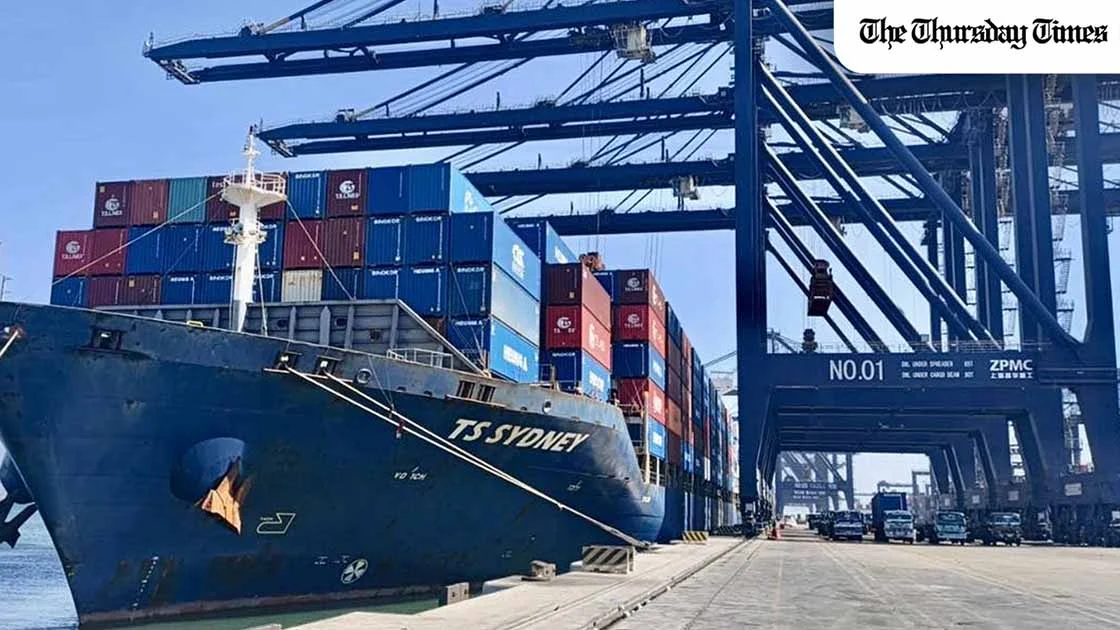
KARACHI (The Thursday Times) — Pakistan’s major ports are seeing a sharp rise in container and transshipment activity as shipping lines redirect cargo away from disrupted Gulf routes and towards Karachi, Port Qasim and Gwadar.
The surge follows months of maritime uncertainty linked to tensions involving Iran, Israel and the United States, which have raised freight and insurance risks across parts of the Gulf region. The disruption has pushed some shipping operators to reassess traditional routes through regional hubs and test Pakistan’s ports as alternative transshipment points.
The clearest increase has been recorded in Karachi, where private terminals have handled thousands of additional transshipment containers since March. Hutchison Ports Pakistan said this week that new vessel calls would add 4,000 TEUs of transshipment cargo, taking its total handled volume since March to more than 14,300 TEUs.
Transshipment cargo refers to goods unloaded from one vessel and transferred to another before reaching their final destination. The business has traditionally been dominated by major Gulf and regional logistics hubs, including Dubai’s Jebel Ali, Salalah and other established ports. Recent disruption, however, has created a temporary opening for alternative routes closer to the Arabian Sea.
Official and industry figures point to a wider rise across Pakistan’s port network. Karachi Port recorded a sharp acceleration in transshipment activity in March, with reported volumes exceeding the total handled during the whole of 2025. Port Qasim has also seen increased vessel and cargo movement, while Gwadar has received diverted transshipment cargo originally scheduled for Gulf destinations.
Gwadar’s role remains smaller than Karachi’s, but symbolically important. Port authorities said the vessel MV Sho-Long arrived in May carrying more than 16,000 metric tonnes of transshipment cargo, including Chinese-origin industrial equipment and pipes that had originally been bound for Kuwait. Officials also reported several transshipment vessel calls at Gwadar in April, indicating that the port is being tested during regional shipping disruption.
The government has moved quickly to support the shift. Authorities have reduced port charges, revised transshipment procedures, offered storage concessions and introduced incentives to attract foreign-flagged vessels. At Karachi Port, the revised tariff structure includes concessions linked to transshipment volume and vessel activity, while Gwadar has also received tariff reductions aimed at increasing transit and transshipment traffic.
The measures form part of a wider effort to position Karachi, Port Qasim and Gwadar as more competitive regional maritime hubs. Pakistan’s geography gives it access to shipping routes outside some of the Gulf’s most vulnerable chokepoints, but officials and industry figures say geography alone will not be enough to turn a crisis-driven spike into a permanent trade advantage.
The increase has also brought operational pressure. Industry sources have warned that diverted cargo can create congestion if storage, scanning, customs clearance and inland transport systems do not keep pace. Some analysts have also cautioned that the economic benefit remains modest unless Pakistan converts the current opening into a lasting commercial proposition for global shipping lines.
That will require lower costs, predictable procedures, faster clearance, stronger digital systems, better inland connectivity and consistent service standards across ports and terminals. Without those reforms, the current rise in cargo activity may remain a temporary result of Middle East instability rather than a structural shift in regional maritime trade.
For now, the trend is still significant. Pakistan’s ports are handling unusual levels of transshipment and container activity at a moment when regional shipping routes are under pressure. The country has been given an opening to present itself as a safer, cheaper and more flexible logistics option.∎