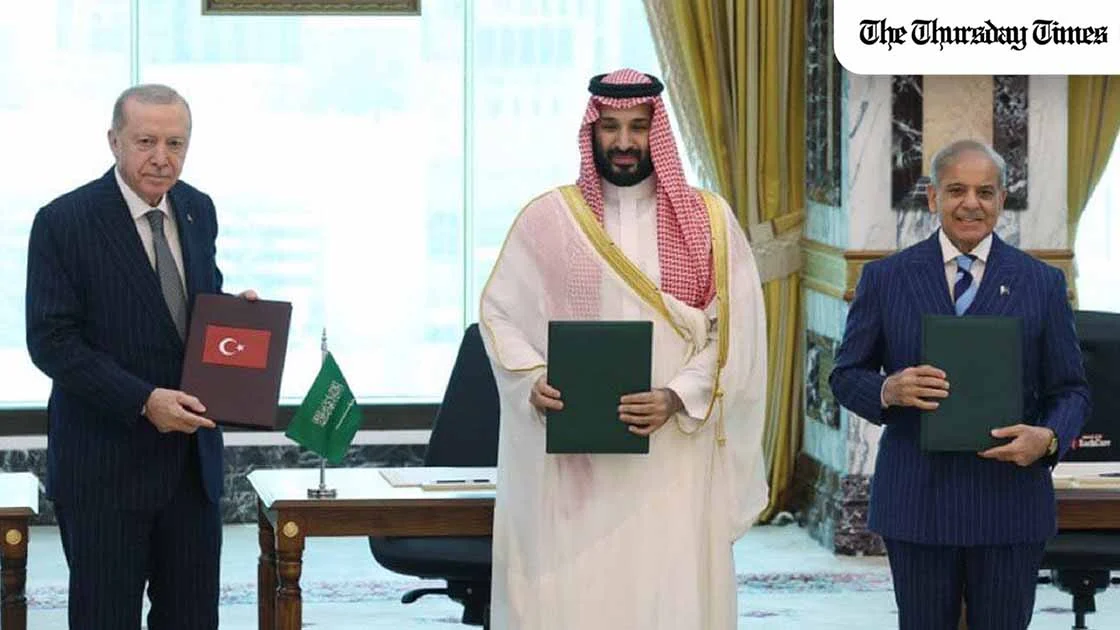
MAKKAH (The Thursday Times) — Saudi Arabia, Turkey and Pakistan have signed the Makkah Joint Defence Agreement, a trilateral pact under which an armed attack against any one of the three states will be regarded as an attack against them all. The agreement was signed at Al-Safa Palace in Makkah on Friday by Crown Prince and Prime Minister Mohammed bin Salman, Turkish President Recep Tayyip Erdogan and Prime Minister Shehbaz Sharif, at the conclusion of the Makkah Al-Mukarramah Summit for Joint Defence.
Erdogan and Sharif travelled to the Kingdom at the invitation of the Custodian of the Two Holy Mosques, King Salman bin Abdulaziz Al Saud, and were received by the Crown Prince at Al-Safa Palace, where the summit reviewed relations between the three states along with a number of issues of mutual interest. The joint statement issued after the signing described the agreement as reflecting a shared commitment to strengthening collective security and to promoting peace, security and stability in the region and beyond.
The core provision is a collective defence clause. The agreement is intended to strengthen collective deterrence against any act of aggression, and stipulates that any armed attack against any one of the three states shall be regarded as an attack against them all. It further provides for the enhancement of all aspects of defence cooperation between the three countries. Pakistan’s Foreign Office has described the framework as defensive in character, built on collective security and collective deterrence, and not directed against any state.
The pact formalises relationships that have been running for decades without a signature underneath them. Pakistan’s relationship with Turkey predates Pakistan itself, with roots in the Khilafat Movement of 1919 to 1924, when Muslims of the subcontinent organised in support of the Ottoman caliphate. The Saudi relationship is younger but no less dense, built over nearly eight decades of strategic, political and economic ties and carried in large part by the millions of Pakistanis who have lived and worked in the Kingdom. The joint statement grounded the agreement in what it called the enduring bonds of brotherhood and Islamic solidarity uniting the three states, alongside their shared strategic interests and longstanding defence cooperation.
The timing sits against a region in the middle of a strategic reordering. The war between the United States and Iran has disrupted shipping through the Strait of Hormuz and the Red Sea and drawn in Gulf states that had hoped to stay out of it, leaving governments across the region recalculating how far they can rely on external security guarantees. Saudi Arabia has been seeking to diversify its security partnerships, Turkey has been expanding its role in the Middle East, and Pakistan has been widening its presence in the region beyond the Gulf.
Each of the three brings something the others do not. Pakistan contributes a large and combat-experienced military, and is the Muslim world’s only nuclear-armed state. Saudi Arabia brings economic weight as the Arab world’s only G20 economy, custodianship of Islam’s two holiest cities, and the diplomatic reach that comes with both. Turkey brings a defence-industrial base that has expanded rapidly over the past decade, particularly in drones and electronic systems, along with NATO’s second-largest army.
For Pakistan, the agreement follows a year in which its diplomatic standing has risen. Its mediation between Washington and Tehran produced the Islamabad Memorandum of Understanding, and Islamabad maintains working relationships with Saudi Arabia, Turkey and Iran simultaneously, as well as with both Washington and Beijing. The Makkah agreement builds on the Strategic Mutual Defence Agreement signed by Pakistan and Saudi Arabia at Al-Yamamah Palace in Riyadh in September 2025, under which any aggression against either country is treated as aggression against both. Kuwait separately ratified its own 2023 defence cooperation agreement with Pakistan by decree last month.∎