ISLAMABAD (The Thursday Times) — Bangladesh’s reported interest in acquiring China’s advanced J-10CE fighter jets has opened a fresh debate over South Asia’s shifting airpower balance, raising the prospect that India could face Chinese-built aircraft of the same family across its western, northern and eastern theatres.
Regional media reports suggest Dhaka is considering the J-10CE as part of a broader effort to modernise the Bangladesh Air Force. No formal announcement has been made by Bangladesh or China, but the possibility is already being closely watched in defence circles across the region.
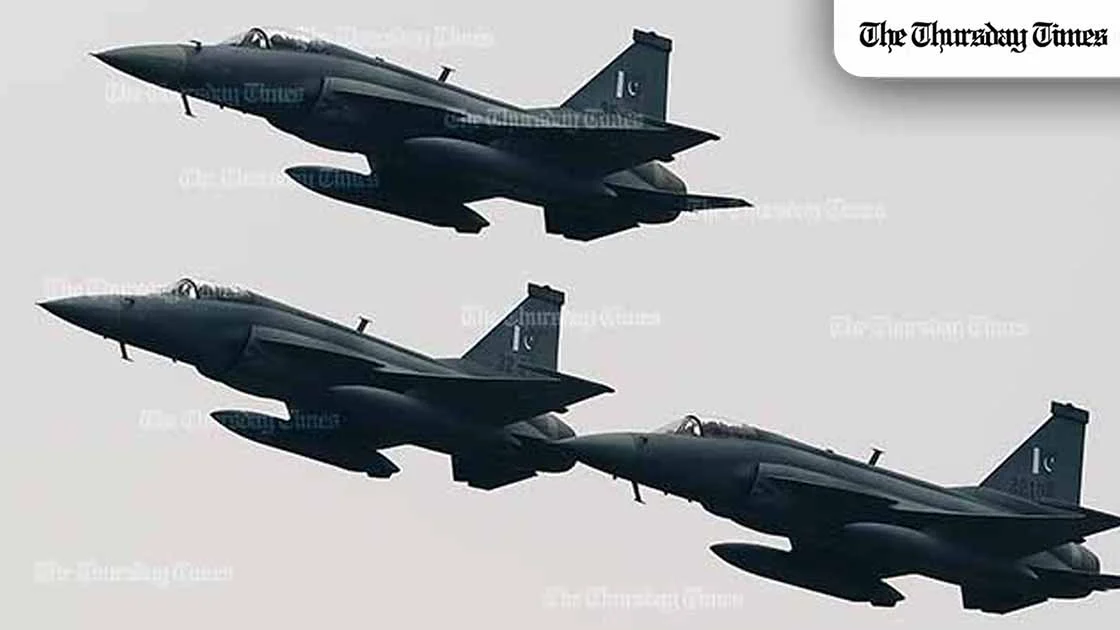
Pakistan currently operates the J-10CE, while China fields different variants of the J-10 family within its own air force. If Bangladesh adopts the same platform, India could find itself in an unusual strategic position, with Pakistan to the west, China to the north and Bangladesh to the east all linked to the same Chinese-origin fighter ecosystem.
Analysts say such a development would not amount to a formal military alignment against India. Still, it would point to China’s growing defence influence in South Asia and to a gradual reshaping of the region’s aerial balance.
The J-10CE is the export version of China’s J-10C, designed as a multirole fighter capable of air-to-air and air-to-ground operations. It is equipped with modern radar, long-range weapons capability and systems that make it attractive to countries seeking advanced combat aircraft at a lower cost than many Western alternatives.
The aircraft gained wider international attention after the Pakistan-India aerial clashes of May 2025, when Pakistan used J-10CE fighters in combat operations. Pakistani officials said modern Indian aircraft, including French-built Rafale jets, were shot down during the engagement, a claim that became central to wider international debate about the performance of Chinese fighter technology and long-range air combat systems.
For Bangladesh, the potential purchase would fit into years of efforts to modernise an ageing air fleet and strengthen national air defence. For China, another regional buyer would reinforce the export profile of its defence industry and deepen its strategic footprint around India.
New Delhi is unlikely to view the matter as a routine procurement decision. India already tracks Pakistan’s air force modernisation, China’s military posture along the Himalayan frontier and Beijing’s growing presence in the Bay of Bengal. A Bangladesh J-10CE acquisition would add a new layer to those calculations.
At the same time, defence experts caution that the purchase of modern fighter jets does not automatically signal hostile intent. Bangladesh’s priority may be capability renewal, cost-effective procurement and long-term defence planning rather than confrontation with India.
Even so, the symbolism is difficult to ignore. A Chinese fighter already used by Pakistan and fielded by China could soon appear in Bangladesh’s inventory, placing India in a more complex airpower environment than before.
If the deal moves forward, South Asia’s aerial balance may enter a new phase, one shaped not only by numbers of aircraft, but also by defence suppliers, battlefield experience and the strategic networks forming around Chinese military technology.∎