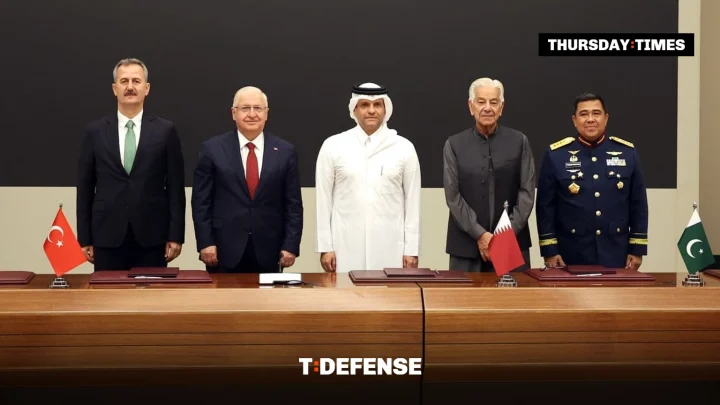
The memorandum that Türkiye, Qatar, Pakistan and Indonesia signed in Doha on Wednesday is easy to mistake for one more line in the long ledger of Muslim-world defence communiqués. It is better read as industrial policy. The Badr Memorandum of Understanding is not a promise to fight together but a plan to build together, and between them its four signatories bring the four things an arms industry needs: factories, money, manpower and a market.
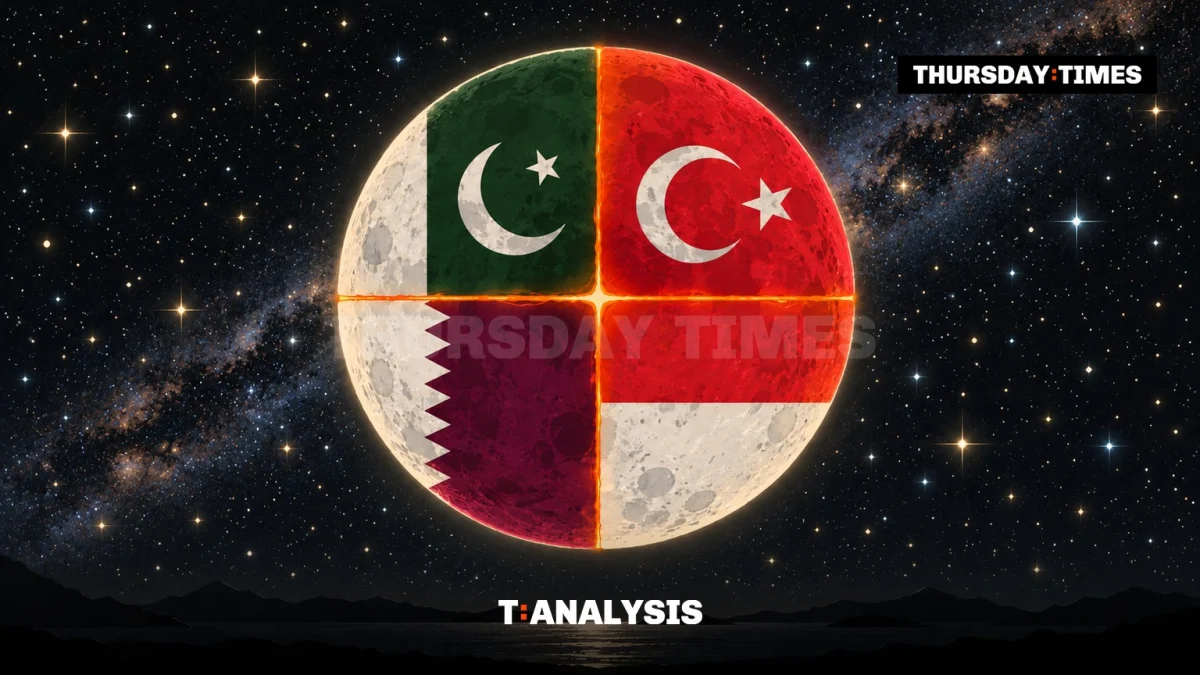
Why a full moon
Türkiye’s Ministry of National Defence, which announced the signing, chose the name with care. Badr recalls the Battle of Badr in 624, the first decisive victory of the early Muslim community. The ministry offered a plainer reading too: badr means “full moon”, an image it used for four nations that complete one another.
The stated aims are broad. The memorandum commits the four to cooperate in military production, raise their armed forces’ capabilities and work together on technical military training, research and development. The ministry said it would pool the signatories’ production capacity to meet “the needs of allied and friendly nations”, a phrase that looks beyond the four towards export, and called the accord one of “substantial economic importance”.
“Badr means ‘full moon’.”
Türkiye’s Ministry of National Defence, on four nations that complete one another
Four parts of one machine
Each signatory already has its own thread running to Ankara. What Badr does is weave them onto one loom, and each partner brings something the others lack.
Türkiye
The factory
$10.05bn in defence and aerospace exports in 2025, a record.
Builds Bayraktar drones, ASELSAN electronics and the KAAN fighter; 22% of its military budget goes into a fund for its arms industry.
Qatar
The capital
4th largest arms importer in the world in 2021–25.
Barzan Holdings, its defence ministry’s investment arm, already runs joint ventures with ASELSAN, STM and Beretta.
Pakistan
The nuclear power
The Muslim world’s only nuclear power, with ~660,000 active troops, the largest force of the four.
Builds JF-17 fighters at Kamra and sold up to 40 to Azerbaijan; Karachi Shipyard built two of its four Turkish-designed MILGEM corvettes.
Indonesia
The market
+28% rise in military spending in 2025, to $15.0bn.
Ordered 48 KAAN jets in a deal reported at about $10bn, with components to be made in Indonesia.
Türkiye is the obvious anchor. Its defence and aerospace exports passed $10 billion for the first time in 2025, according to Haluk Görgün, head of the Presidency of Defence Industries, who attended the signing in Doha. The sector closed the year with a record $17.8 billion in new contracts. SIPRI noted in April that the biggest driver of Turkish military spending is no longer operations in Iraq, Syria and Somalia but investment in the country’s own arms industry.
Türkiye’s defence and aerospace exports, $bn
New export contracts signed in 2025 reached a record $17.8bn. Source: Presidency of Defence Industries; Turkish Exporters Assembly.
Qatar brings what factories need most: patient capital and a first customer. Barzan Holdings, chaired by Sheikh Saoud bin Abdulrahman Al Thani, who signed for Doha on Wednesday, has spent the past year turning purchases into partnerships. At the DIMDEX exhibition in January it widened its BARQ joint venture with ASELSAN to add local production, signed a joint production memorandum with the drone maker STM and a letter of intent with KNDS on ammunition. More than 70 agreements, reportedly worth over $5.1 billion, were announced at that show alone. On Monday, Sheikh Saoud told the Global Security Forum that Qatar would soon announce a local defence production hub.
Pakistan, the Muslim world’s only nuclear power, offers scale and experience. It fields the largest standing force of the four and runs working production lines: fighters at the Pakistan Aeronautical Complex in Kamra, warships in Karachi. The sale of up to 40 JF-17s to Azerbaijan, valued at up to $4.6 billion, was its largest export deal, and the four-day conflict with India in May 2025, which SIPRI notes involved combat aircraft, drones and missiles, gave its forces the kind of operational data defence industries prize. The Babur-class corvettes show how Pakistan already works with Türkiye: the 2018 MILGEM deal included design rights and construction know-how, and two of the four ships were built at Karachi Shipyard.
Indonesia, finally, is the market, and an assertive one. A country of more than 280 million people raised military spending by 28 per cent last year, the steepest rise of the four, and insists on building what it buys. The KAAN contract signed in Istanbul in July 2025 includes manufacturing and maintenance facilities in Indonesia, and a separate agreement brought in PT Dirgantara Indonesia and PT Republik Aero Dirgantara.
Military spending, 2025, $bn
The three published budgets alone come to $56.9bn. Source: SIPRI Military Expenditure Database, April 2026.
From buyers to builders
The deeper logic lies in who these countries have been buying from. In SIPRI’s arms-transfer data for 2021–25, Qatar and Pakistan were the world’s fourth and fifth largest importers, together taking more than a tenth of all the major weapons traded across borders. Pakistan bought 80 per cent of its arms from China; Qatar alone accounted for 7.4 per cent of all American arms exports.
Share of global arms imports, 2021–25
Source: SIPRI Arms Transfers Database, March 2026.
Buying at that scale means waiting in other countries’ queues. An industry source told Middle East Eye in May that US Patriot and THAAD air-defence systems, and their ammunition, faced multi-year delivery backlogs, while Turkish systems could be supplied “within a similar timeframe”, with “a potential option for localisation and joint development if the conditions are right”.
“Gulf states increasingly recognise that it is a better offer.”
An industry source, to Middle East Eye
The Iran war drove the point home in Doha. Qatar shut much of its liquefied natural gas complex at Ras Laffan soon after the fighting began, and restrictions on shipping through the Strait of Hormuz disrupted its trade. Qatari sources told Middle East Eye that Badr reflects those lessons, and Doha’s need for air defence it can afford and obtain quickly.
How it is meant to work
The memorandum’s text has not been published, but people familiar with the arrangement have described a three-tier structure to Middle East Eye.
Each country sets its needs
Requirements are defined within each member’s own national security framework.
An executive board plans
Technical teams from the four draft joint production plans.
A strategic board decides
Ministers, deputy ministers and industry chiefs settle budgets and where production goes.
Türkiye, with the region’s deepest industrial base, is expected to host the joint production facilities, while Qatar has committed funding and technology, the same sources said. Türkiye’s defence industry agency has said the memorandum will help carry forward defence projects already under way among the four, which suggests Badr’s first job is to bind existing bilateral work, from KAAN to MILGEM to BARQ, into a single pipeline rather than to start from scratch.
Makkah and Badr
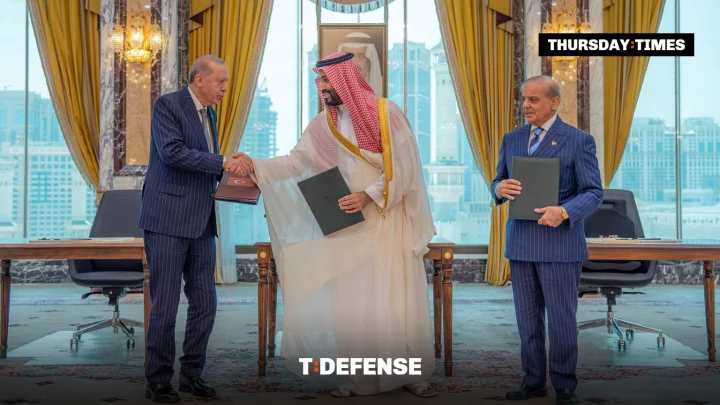
Badr comes ten weeks after the Makkah Joint Defence Agreement, signed on August 7 by Crown Prince Mohammed bin Salman, President Recep Tayyip Erdoğan and Prime Minister Shehbaz Sharif, under which “any armed attack against any one of the three states shall be regarded as an attack against them all”.
The two are different instruments. Makkah is a guarantee: it settles who comes to whose aid. Badr is a supply chain: it settles who builds what. Pakistan and Türkiye sit in both, which makes them the hinge of an emerging arrangement in which a security pact and an industrial bloc overlap without merging. Both are written with room to grow. Deputy Prime Minister Ishaq Dar has said the Makkah accord is open to others who share its principles, and Badr’s founding statement already speaks of serving “allied and friendly nations”.
“Makkah settles who comes to whose aid. Badr settles who builds what.”
Half a century on
This has been tried before, and Qatar was in the room. In April 1975 Egypt, Saudi Arabia, the United Arab Emirates and Qatar founded the Arab Organization for Industrialization in Cairo. The three Gulf states put in $260 million each and Egypt contributed four military factories. The venture foundered within four years, when the Arab states broke with Egypt over its peace with Israel.
The difference now is the partner holding the tools. In 1975 the factories belonged to a state that depended on its backers’ orders. In 2026 the anchor is an exporter in its own right: by Görgün’s account, more than half of Türkiye’s $10 billion in defence exports last year went to EU and NATO countries and the United States. Pakistan sells fighters abroad, and Indonesia builds parts of what it buys. Badr is not a rich patron funding a workshop. It is four producers and buyers agreeing to share a production line.
What to watch
- The first programme carrying the Badr name. Air defence is the likeliest candidate, given Doha’s stated priority.
- Qatar’s promised defence production hub, and which Turkish and Pakistani firms anchor it.
- KAAN work arriving at Indonesian plants, the first test of production shared across the bloc.
- Whether Saudi Arabia, already bound to Pakistan and Türkiye through Makkah, joins the production side as well.
The ceremony in Doha was brief and the photographs formal. But a memorandum that puts a factory, a treasury, an army and a market at the same table is more than a communiqué. If Badr yields even one weapon designed, financed, built and bought among its four members, the full moon will have earned its name.∎