

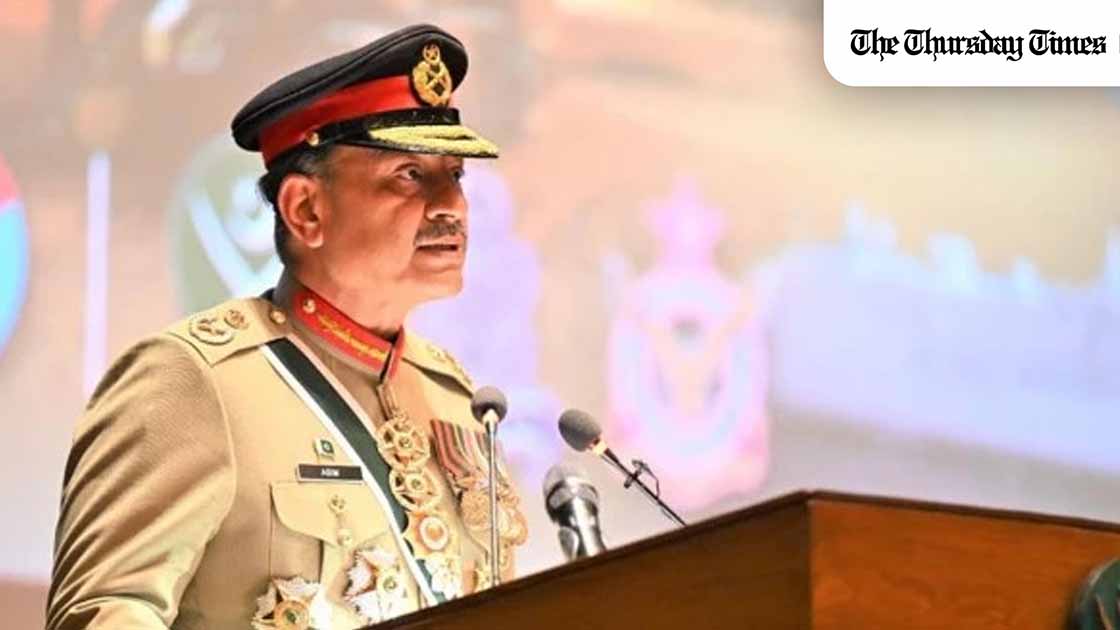
RAWALPINDI (THE THURSDAY TIMES) — Pakistan’s newly elevated Chief of Defence Forces (CDF), Field Marshal Syed Asim Munir, has delivered his clearest warning yet to Afghanistan’s Taliban administration, telling Kabul that it must choose between a working relationship with Pakistan or continued patronage of the Tehreek-e-Taliban Pakistan (TTP). The TTP, which Pakistani authorities now pointedly label “Fitna al-Khawarij,” is blamed for a surge in deadly attacks inside Pakistan in recent years.
The message was conveyed from General Headquarters in Rawalpindi, where Munir presided over the inauguration of Pakistan’s new Defence Forces Headquarters (DFHQ). At the ceremony, he received a tri-services guard of honour from the army, navy and air force, formally marking the operational launch of a unified command intended to coordinate Pakistan’s military posture across land, air, maritime, cyber and information domains. Munir’s appointment as CDF, confirmed last week, sits alongside his existing role as Chief of Army Staff and is framed by officials as a structural reform meant to sharpen joint planning and response in the face of shifting regional security dynamics.
In his address to senior officers, Munir described the DFHQ as a “historic step” in Pakistan’s defence architecture, arguing that it would allow more coherent planning and “multi-domain” operations while preserving the internal identity and autonomy of each service. But it was his remarks on Afghanistan that signalled the sharpest policy line. According to the military’s statement, Munir told officers that a “clear message” had been delivered to the Taliban government in Kabul: it must decide between Pakistan and “Fitna al-Khawarij,” the term now used officially for the outlawed TTP.
The phrase is carefully chosen. By invoking Khawarij, the Pakistani state is seeking not just to delegitimise the TTP politically, but to strip it of religious credibility. Over the past year, civil and military officials have increasingly framed the TTP as a deviant, quasi-heretical movement, aligning the security campaign against it with an ideological and theological argument.
At the heart of this confrontation lies Pakistan’s allegation that the TTP enjoys safe haven and facilitation on Afghan soil. Since the Taliban’s return to power in Kabul in 2021, Islamabad says TTP networks have regrouped across the border and intensified attacks on Pakistani forces and installations, especially in Khyber Pakhtunkhwa and Balochistan. Pakistani security agencies link a string of roadside bombs, suicide operations and targeted killings to TTP cells that, they claim, slip back and forth across the porous frontier.
The Afghan Taliban reject this narrative. They insist that Afghan territory is not being used as a springboard for cross-border militancy and argue that the TTP is, at its core, a Pakistani problem born of Islamabad’s own political and security missteps over the past two decades. Taliban officials have also hinted that they lack the capacity to fully control every armed group operating within Afghanistan’s borders at a time when their own state institutions remain fragile.
Munir’s “choose Pakistan or TTP” formulation is designed to upend that ambiguity. It reframes the TTP not as a residual by-product of Pakistan’s internal struggles but as a litmus test for the Taliban government’s intent and reliability as a neighbour. For Islamabad, Kabul’s willingness or reluctance to act decisively against TTP leadership, infrastructure and funding networks will now be taken as a measure of the entire relationship.
The warning also comes amid a steadily worsening climate along the Durand Line. Border clashes have repeatedly flared over the past two years, from Chaman–Spin Boldak in the south to Kurram in the northwest, with exchanges of artillery and heavy weapons causing civilian casualties on both sides. Previous attempts at de-escalation, including talks facilitated in Qatar and later in Turkey and Saudi Arabia, have produced only fragile, short-lived understandings.
At the same time, Pakistan has been expelling large numbers of Afghans in staggered phases, focusing first on undocumented migrants and then on groups that Islamabad claims pose security concerns. The deportations have strained Afghan communities, fuelled resentment towards Pakistan within Afghanistan, and added a humanitarian dimension to an already tense relationship. For Afghan officials, these measures, combined with Pakistani airstrikes and drone operations against suspected TTP positions inside Afghanistan, are evidence of a coercive approach that undercuts public trust and makes cooperation politically costly.
Kabul’s dilemma is not just diplomatic but internal. Many TTP fighters once fought shoulder to shoulder with the Afghan Taliban against NATO forces. Networks of kinship, tribe and ideology cross the frontier. A forceful campaign against the TTP risks angering powerful constituencies and may push some militants into the arms of the Islamic State Khorasan Province (ISIS-K), which the Taliban view as a direct existential threat. From the Afghan side, taking on the TTP too aggressively could therefore fragment their own support base and strengthen a rival jihadist group simultaneously.
For Pakistan’s military, however, the calculus is increasingly stark. In public messaging, the TTP is now bracketed with other perceived strategic threats in a kind of triad: the “Fitna al-Khawarij” of the TTP, the challenge posed by India on the eastern front, and what officials describe as Afghan equivocation in between. In the same speech in Rawalpindi, Munir reiterated that Pakistan’s response to any future Indian aggression would be “swifter and more severe” than past confrontations, casting Pakistan as a “peace-loving” but “invincible” state whose sovereignty cannot be compromised.
The launch of the DFHQ and the expansion of Munir’s role must also be read through a domestic lens. With a five-year term as CDF, legal immunity, and the rank of field marshal, Munir is now at the apex of Pakistan’s security establishment in a more formalised, legally entrenched way than his predecessors. Supporters argue that this offers continuity and strategic coherence in a turbulent regional environment marked by terrorism, great-power rivalry and economic instability. Critics, particularly those sympathetic to jailed former prime minister Imran Khan, see the new command structure and legal framework as consolidating military dominance over civilian institutions and personalising power around one man.
The Rawalpindi warning to Kabul sits squarely within that wider narrative. It projects a Pakistan in which the armed forces, under a unified command, are repositioning themselves as the central manager of the country’s security, ideological and regional posture. By casting the TTP as a theological aberration and demanding an explicit Afghan choice, Munir links Pakistan’s internal counter-terrorism campaign, its border management, and its regional diplomacy into a single, sharper line.
What happens next will depend heavily on Kabul’s response. A genuine crackdown on TTP infrastructure in Afghanistan, curbing movement across the border, disrupting logistical support, constraining leadership, and signalling clear political disapproval could open space for a more stable modus vivendi with Pakistan. It might ease pressure on Afghan refugees, reduce the frequency of border skirmishes, and create conditions for greater economic engagement at a time when Afghanistan’s economy remains in dire need of trade and transit revenue. But it would also force the Taliban to confront parts of their own social and ideological ecosystem and risk pushing some fighters into more radical alternatives.
If, on the other hand, Kabul offers only rhetorical reassurances while TTP operations in Pakistan continue, Islamabad is likely to interpret that as defiance. With the DFHQ now in place, Pakistan has signalled that it is prepared to respond with a mix of targeted strikes, border closures, diplomatic pressure and information campaigns designed to isolate the TTP and impose costs on those seen as facilitating it. Such a path, however, carries the risk of a grinding, low-level confrontation along the Durand Line, with ordinary Afghans and Pakistanis paying the highest price.
For now, the Taliban government has not issued a detailed public reply to Munir’s specific “choose Pakistan or TTP” ultimatum. Both sides continue to insist in general terms that they favour dialogue over escalation. Yet by placing the TTP question at the centre of his first major speech as Chief of Defence Forces, Pakistan’s top general has made clear that, from Islamabad’s perspective, the era of ambiguity is over. In the Pakistani military’s eyes, Afghanistan can no longer act nor even be perceived to act, as both a neighbour and a sanctuary for the Pakistani Taliban.


