

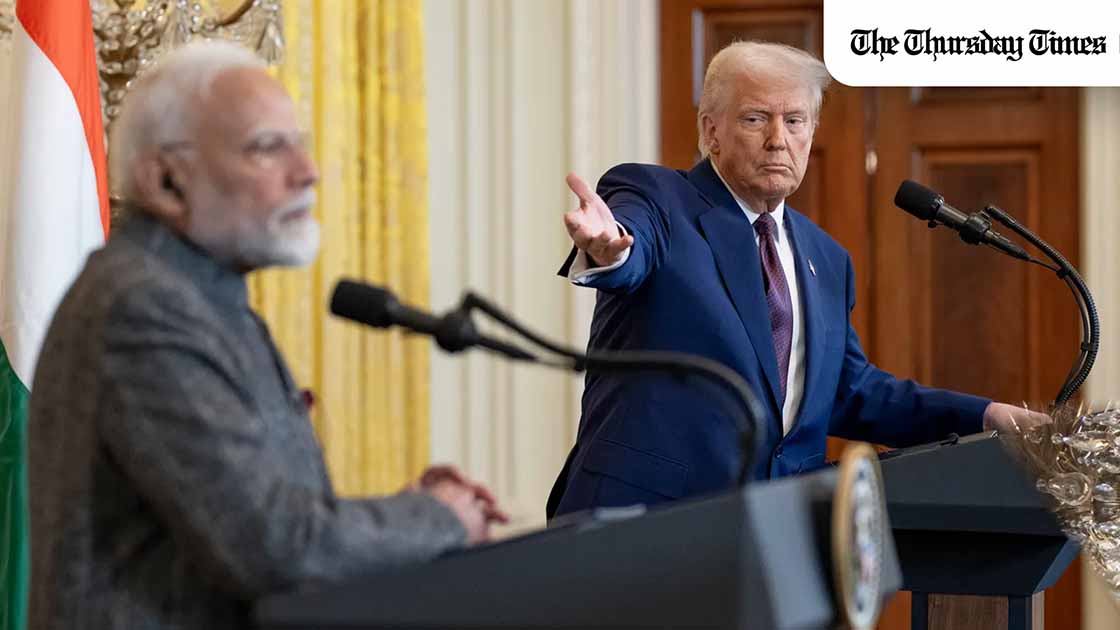
WASHINGTON (THE THURSDAY TIMES) — U.S. President Donald Trump has opened a fresh line of attack in United States–India trade relations, publicly accusing New Delhi of “dumping” rice into American markets and questioning why India is “allowed” to do so, in remarks that have unsettled exporters and energised some US farm groups.
U.S. President Trump asks Treasury Secretary Scott Bessent over India “dumping rice” into the US:
“Why is India allowed to do that? They have to pay tariffs.. Do they have an exemption on rice?”
Bessent: “No, sir. We’re still working on their trade deal.”
Trump: “They should… pic.twitter.com/tYHdxYqvJs— The Thursday Times (@thursday_times) December 8, 2025
The comments came during a White House agriculture meeting, when Trump turned to Treasury Secretary Scott Bessent and demanded to know why Indian rice was entering the United States without heavier tariff protection. “Why is India allowed to do that?” he asked. “They have to pay tariffs. Do they have an exemption on rice?” Bessent replied that India had no special carve-out and that Washington was still working on a broader trade deal, prompting Trump to cut in: “They should not be dumping. They cannot do that.”
India, the world’s largest rice exporter, dominates in parboiled and basmati varieties, while US producers in states such as Arkansas and Louisiana have struggled to hold market share in regions where Indian and Thai rice undercut their prices. American growers accuse subsidised Asian exporters of selling at unfairly low prices, although under World Trade Organisation rules “dumping” requires detailed proof that exports are priced below cost or below home-market levels.
Trump’s language fits a familiar pattern in which he presents the United States as a victim of foreign “cheating” and uses specific grievances to justify tariffs and threats of tariffs. For many rice farmers, a televised complaint that India “cannot” keep sending rice on current terms sounds like an implicit promise of tougher measures. For New Delhi, any new US duties would threaten a key source of foreign exchange and could invite retaliation, pulling more agricultural products into a wider dispute.
The episode lands at a delicate moment. Security and technology ties between Washington and New Delhi have deepened, but economic relations remain prickly, with quarrels over digital taxes, market access and data rules now joined by agricultural tensions. Officials in Trump’s team are trying to fold the rice issue into broader trade negotiations, yet public targeting risks hardening positions on both sides.


