

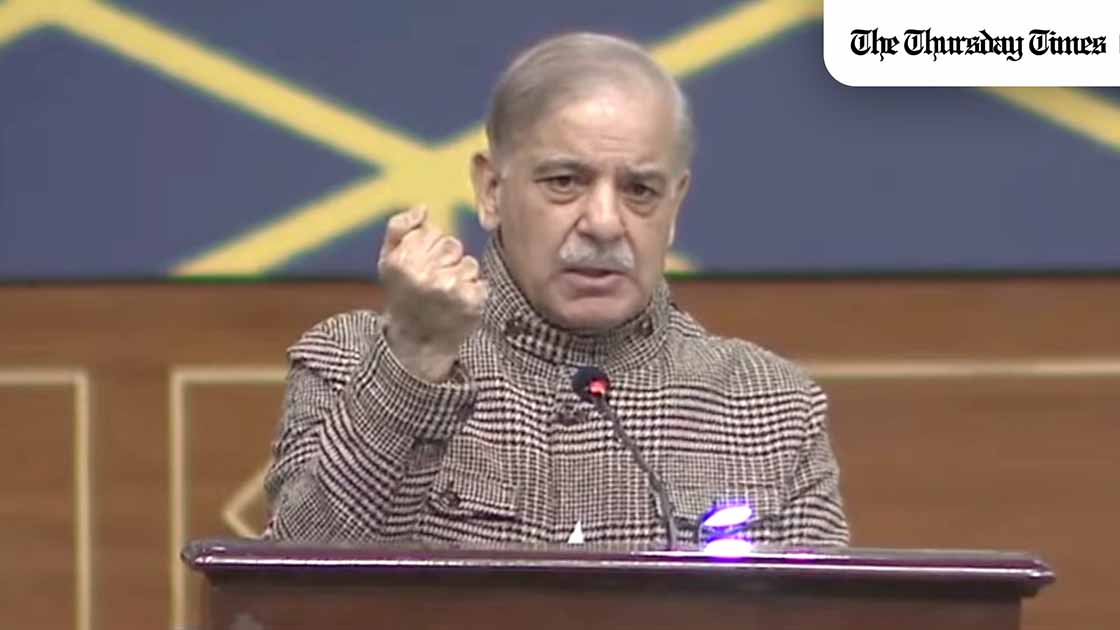
ISLAMABAD (THE THURSDAY TIMES) — Prime Minister Shehbaz Sharif has said that Pakistan will not move forward through “magic, superstitions” or shortcuts, but only through hard work, national unity and respect for the sacrifices of its armed forces, casting the country’s future as a test of cohesion rather than charisma.
Addressing a national ulema convention in Islamabad, Mr Sharif said Pakistan could not reach its “true potential” as long as society remained divided by sectarianism, political polarisation and casual attacks on the military. “If we mock the sacrifices of our soldiers, why would the world respect Pakistan,” he asked, linking the country’s international standing directly to its treatment of the army at home.
The prime minister praised the armed forces for what he described as a recent “Ma’raka-e-Haq,” or battle of truth, against India, saying that under the leadership of Field Marshal Syed Asim Munir the military had fought with “courage and professional skill” and inflicted a “humiliating defeat” on the enemy. According to Mr Sharif, that outcome had not only lifted Pakistani morale but had been celebrated by “friendly and brotherly countries” who, he said, saw the victory as partly their own.
Mr Sharif cast the episode as a moment of national prayer answered and insisted that “every soldier, every officer and every martyr” had a share in the result. In that context, he argued, organised campaigns against the armed forces on social media or in political rhetoric played directly into the hands of hostile powers. When enemies see “discord in our ranks,” he warned, they look for weaknesses to exploit, and turning state institutions into permanent targets of controversy only amplifies their narrative.
The prime minister reserved some of his sharpest language for sectarian division. He said it was “tragic” that some followers of particular schools of thought still refused to pray behind imams from other traditions and described such attitudes as both contrary to the spirit of Islam and a major obstacle to national unity. He called on clerics to reject hate speech, extremism and sectarian labelling, and to use their pulpits instead to spread messages of tolerance, solidarity and fraternity.
Turning to the economy, Mr Sharif claimed that Pakistan was now moving “rapidly” towards stabilisation and growth, after what he portrayed as a narrow escape from default. He credited both political and military leadership with taking “difficult but necessary decisions” to keep the state solvent and argued that if earlier policies of “irresponsible rhetoric and international isolation” had continued, Pakistan would today be facing deep financial collapse and disorder.
Reiterating his central theme, the prime minister said that Pakistan would not be saved by slogans, superstition or theatrical politics. “This country will not advance through spells or chants,” he said. “It will advance through work, discipline and unity.” He urged Pakistanis to move beyond personality-driven politics and instead rally around stronger institutions, the rule of law and an economic agenda focused on internal strength, peace and self-reliance, insisting that both honour and victory lay in making the state robust from within.


