
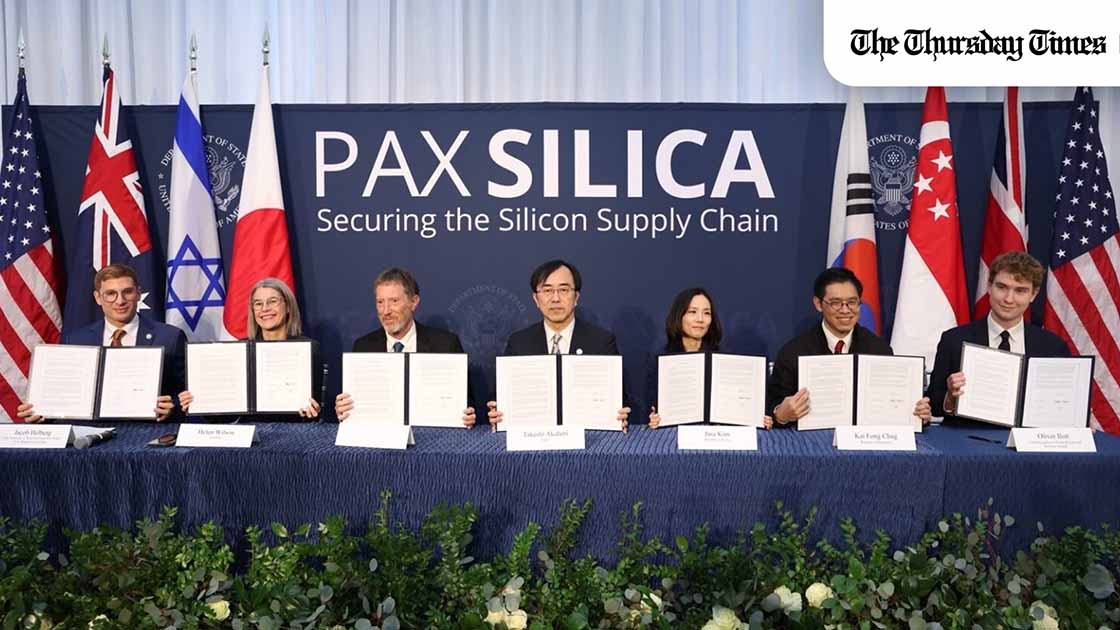
ISLAMABAD (THE THURSDAY TIMES) — India has been excluded from the initial grouping of the United States-led “Pax Silica” initiative, a new coalition Washington says is designed to secure critical minerals and advanced technology supply chains that underpin semiconductors and artificial intelligence.
The US State Department describes Pax Silica as a push to build a “secure” and “innovation-driven” silicon supply chain spanning critical minerals and energy inputs through advanced manufacturing, semiconductors, AI infrastructure and logistics, with an explicit emphasis on reducing “coercive dependencies” and protecting capabilities foundational to AI.
.@potus, @SecRubio, @davidsacks47, and @mkratsios47 laid out a roadmap in the AI Action Plan for America to lead International AI Diplomacy and build a vast partner ecosystem.
Pax Silica operationalizes that vision. 🇺🇸 🚀 https://t.co/bY13RjkKqX pic.twitter.com/h2CpsRmPqS
— Under Secretary of State Jacob S. Helberg (@UnderSecE) December 13, 2025
The inaugural summit brought together the United States with counterparts from Japan, South Korea, Singapore, the Netherlands, the United Kingdom, Israel, the United Arab Emirates and Australia, a line-up that Indian coverage noted pointedly did not include New Delhi.
In India, the omission has rapidly turned political. The Times of India and The Indian Express reported that Congress seized on India’s absence to attack Prime Minister Narendra Modi’s government, casting it as a “missed opportunity” and noting that other Quad partners, including Japan and Australia, are in the initial grouping. Congress leader Jairam Ramesh went further in a public post, saying that “according to some news reports” the US has excluded India from the nine-nation initiative, and argued that the “sharp downturn” in Trump–Modi ties since May 10, 2025, helps explain why New Delhi was not included, adding that it would have been “to our advantage” to be part of the group.
According to some news reports, the US has excluded India from a nine-nation initiative it has launched to reduce Chinese control on high tech supply chains. The agreement is called Pax Silica clearly as a counter to Pax Sinica. The nations included (for the moment at least) are…
— Jairam Ramesh (@Jairam_Ramesh) December 13, 2025
From Pakistan’s perspective, the development is notable less for the immediate membership list and more for what it signals about the next phase of geopolitical competition: Washington is formalising a “trusted network” model for the AI economy, where supply chain access, industrial capacity and alignment with US economic security priorities increasingly determine who gets a seat at the table.
For India, which has spent years selling itself as a central pillar of “China plus one” supply chain diversification, being omitted from a flagship US framework on silicon and AI-era inputs lands as an uncomfortable contrast, especially amid ongoing India–US trade and technology negotiations referenced in Indian reporting.


