

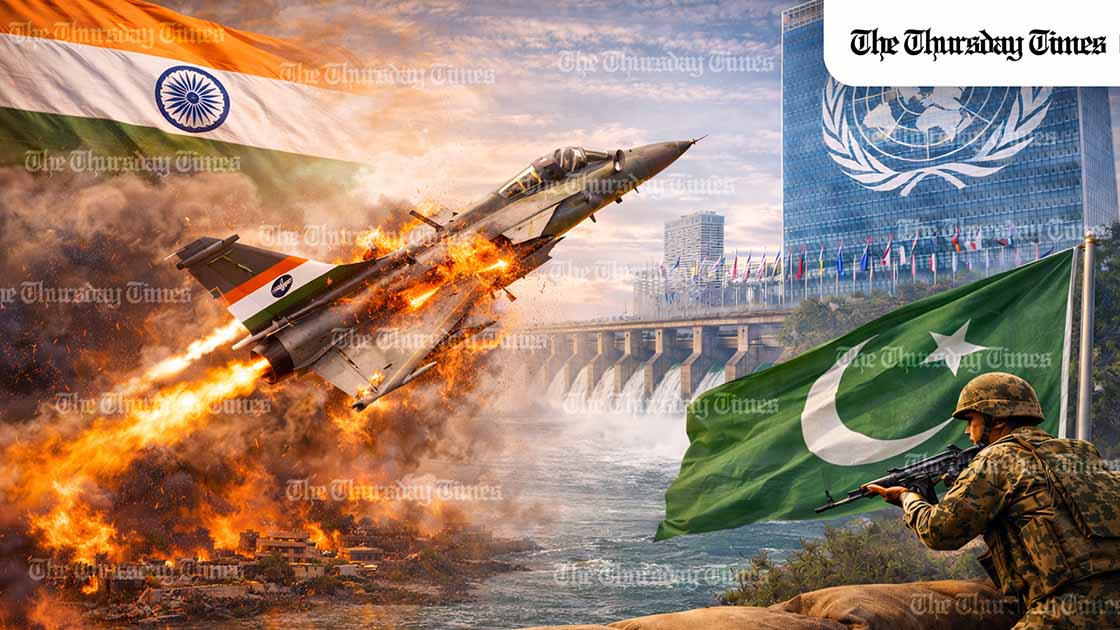
ISLAMABAD (The Thursday Times) — United Nations special rapporteurs have sharply criticised India’s conduct during the May conflict with Pakistan, concluding that Indian military strikes inside Pakistani territory may have breached international law and significantly raised the risk of wider regional confrontation.
In a report released on Friday, UN experts focused on events beginning May 7, when Indian forces allegedly carried out cross border strikes. The experts said the unilateral use of force appeared inconsistent with the United Nations Charter, noting that India had not formally notified the UN Security Council, a procedural requirement under international law when a state claims self defence.
The report documents civilian harm, stating that strikes hit populated areas and resulted in casualties, injuries, and damage to religious sites including mosques. While condemning the Pahalgam attack that preceded the escalation, the experts said there was insufficient evidence to substantiate India’s claims of Pakistani state involvement.
The legal assessment is unambiguous. International law, the report states, recognises no independent right to use unilateral military force for counter terrorism purposes. The experts warned that such action may violate the right to life and could entitle Pakistan to exercise its own right of self defence if the strikes amount to an armed attack, characterising the operation as a serious violation of Pakistan’s sovereignty.
Particular concern was directed at India’s declaration that the Indus Waters Treaty would be held in abeyance. The experts said any obstruction or threat to river flows could undermine the fundamental rights of millions of Pakistanis, including access to water, food security, livelihoods, public health, environmental protection, and development.
The report stressed that international watercourses must not be weaponised for political or economic leverage. It concluded that the treaty remains legally binding unless both states agree to terminate it through a new arrangement, and that unilateral suspension is unlawful under treaty law.
The experts described India’s language on holding the treaty in abeyance as legally vague, noting that New Delhi had not invoked any recognised suspension mechanism. Claims of material breach and allegations of cross border terrorism were dismissed as legally weak, with the report stating that Pakistan has not been shown to have violated any provision of the treaty.
Countermeasures, the experts added, do not suspend human rights obligations and must be temporary, proportionate, and preceded by notice and negotiation. Permanent disruption of water flows would therefore be unlawful and disproportionately harmful to civilians.
Responsibility for the deterioration of treaty engagement was largely attributed to India, with the report noting that annual meetings of the Indus Commission have not taken place since 2022 and highlighting persistent obstacles to data sharing and dispute settlement.
Pakistan’s leadership welcomed the findings. In a statement issued by the President’s Secretariat, President Asif Ali Zardari said the report reinforced Pakistan’s long held position that unilateral cross border force violates the UN Charter and constitutes a grave breach of sovereignty. He warned that bypassing dispute resolution mechanisms under the Indus Waters Treaty risks severe human rights consequences.
Deputy Prime Minister and Foreign Minister Ishaq Dar told foreign diplomats that India had unilaterally suspended the treaty in April 2025 and withheld critical data to which Pakistan is legally entitled. He said the UN experts had affirmed the treaty’s central role in maintaining peace and stability in South Asia, cautioning that weakening it could destabilise the entire region.
Dar also cited unusual fluctuations in the Chenab River earlier this year, alleging that unannounced water releases exposed Pakistan to flooding and drought risks, and said projects such as Kishanganga and Ratle remain inconsistent with the treaty’s technical framework.
The report situates these concerns within a broader escalation that followed the April attack in Pahalgam, which killed civilian tourists and triggered a rapid breakdown in diplomatic relations. What followed was a cycle of military operations, ceasefire violations, drone interceptions, missile strikes, and retaliatory actions before a ceasefire was announced on May 10 through external mediation.
For Pakistan, the UN findings mark a rare and detailed international legal assessment that challenges India’s narrative of the conflict and places renewed scrutiny on New Delhi’s adherence to international law at a moment of heightened regional fragility.


